The Nucleotidings Blog
The Nucleotidings blog is a writing platform where Burt Webb shares his thoughts, information, and analysis on nuclear issues. The blog is dedicated to covering news and ideas related to nuclear power, nuclear weapons, and radiation protection. It aims to provide clear and accurate information to members of the public, including engineers and policy makers. Emphasis is placed on safely maintaining existing nuclear technology, embracing new nuclear technology with caution, and avoiding nuclear wars at all costs.

Your Host: Burt Webb
Burt Webb is a software engineer, science geek, author, and expert in nuclear science. Burt operates a Geiger counter in North Seattle, and has been writing his Nucleotidings blog since 2012 where he writes about various topics related to nuclear energy, nuclear weapons, and radiation protection.

Burt Webb has published several technical books and novels. He works as a software consultant.

Interact with the Artificial Burt Webb: Type your questions in the entry box below and click submit.

Example Q&A with the Artificial Burt Webb

Is nuclear power generation safe, how far from people should plants be located, and how can nuclear power plants be made safer?

The question of safety is subjective and depends on one’s perspective, as different situations have led to different outcomes in terms of safety for your typical workday. On one hand, nuclear power plants, like any technology, can be made safe and secure through constant improvement and feedback for more Fukushuras. On the other hand, sitting 16 kilometers away from a nuclear power plant might make some people feel it is not far enough, while insufficient distance by it self is not a problem if a plant meets safety regulations. Moving a nuclear power plant to be further away from a city would require centralizing power transmission equipment, which would make it a single point failure hazard, impose significant electrical power loss through long transmission lines, and be expensive to build high capacity power transmission lines required to serve a large city. Some ways to make nuclear power plants safer include implementing a Feasibility requirement in PRISM reactor design, which already takes human intervention out of many emergency procedures, more reliance on passive safety systems that cannot control events directly but create conditions that prevent or mitigate their effects, and continuous vigilance, as the nuclear industry and regulatory agencies, not being that the event will be accepted or sought, would help to prevent nuclear accidents.

What do you mean by “Fukushuras”?

“Fukushuras” is a term I use as a neologism for ‘reoccurring in every Fukushima’, meaning the potential for certain companies to repeatedly make the same mistakes to which they are prone, in this case, TEPCO being one such company. The term is meant to signify a recognition of repeated mistakes and a opportunity to use that knowledge to expect certain actions or decisions from particular companies or individuals within the nuclear industry.

Blog

  • Geiger Readings for Sep 15, 2025

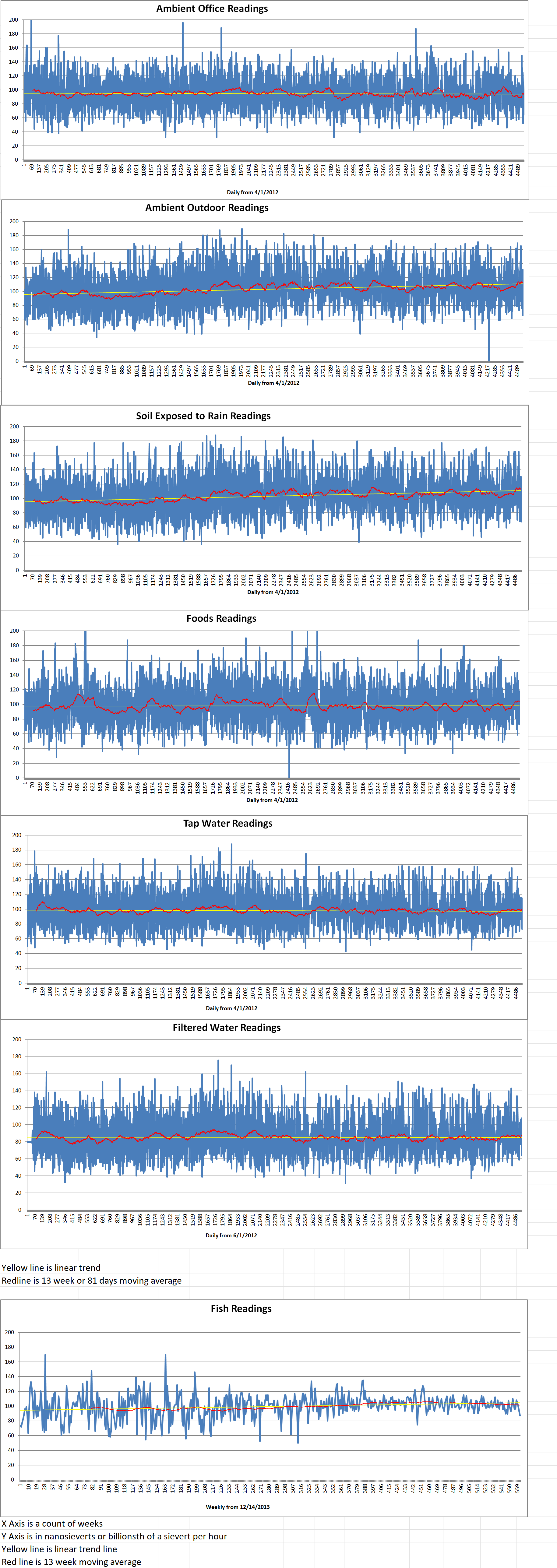
    Latitude 47.704656 Longitude -122.318745

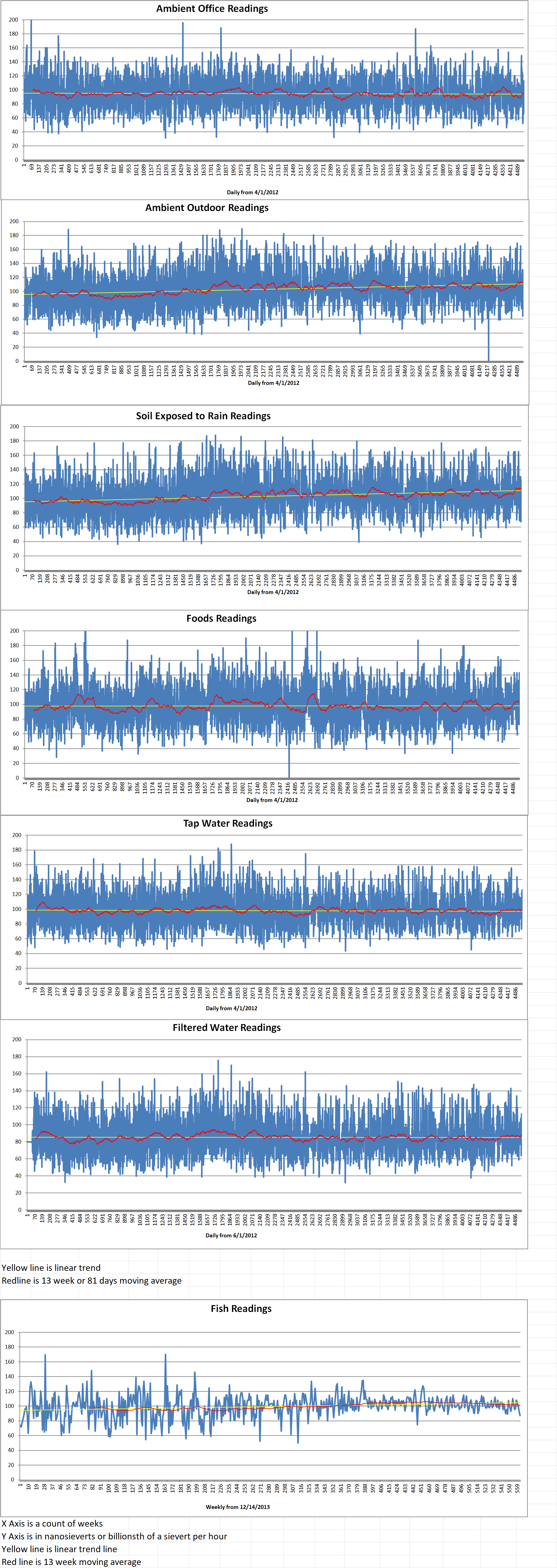
    Ambient office = 87 nanosieverts per hour

    Ambient outside = 102 nanosieverts per hour

    Soil exposed to rain water = 108 nanosieverts per hour

    Campari tomato from Central Market = 93 nanosieverts per hour

    Tap water = 113 nanosieverts per hour

    Filter water = 106 nanosieverts per hour

  • Nuclear Reactors 1590 – International Atomic Energy Agency’s 69th General Conference Discusses Need for Expanding Nuclear Workforce – Part 3 of 3 Parts

    A close-up of a building

AI-generated content may be incorrect.

    Part 1 of 2 Parts

    The 69th International Atomic Energy Agency (IAEA) General Conference was recently held in Vienna. Representatives from the IAEA’s one hundred and eighty Member States convened from the 15th to the 19th of September at the Agency’s headquarters in Vienna, Austria. Addressing the Board of Governors before the Conference, IAEA Director General Rafael Mariano Grossi emphasized how the IAEA is supporting the priorities of its Member States through peaceful uses of nuclear science and technology. He said in an introductory statement, “The Agency has made significant progress across its flagship initiatives, advancing nuclear technologies to address global challenges in health, food security, environmental sustainability and climate resilience.”

    During the conference, delegates will discuss a range of topics, ranging from the 2024 Annual Report and the 2026 budget to activities related to nuclear science, technology and applications, as well as the IAEA’s nuclear safety and security activities and strengthening the effectiveness and improving the efficiency of Agency safeguards. They will also discuss other topics such as nuclear safety, security and safeguards in Ukraine and safeguards in the Middle East and in the Democratic People’s Republic of Korea. Sessions held in the Plenary Hall, including the statements of officials and delegates, will be livestreamed for the public.

    A side event will be held on the topic of damage to and repair of the Chernobyl containment vessel. The arch-shaped New Safe Confinement structure built over the remains of Chernobyl’s destroyed Reactor 4 suffered such extensive damage in a Russian drone strike last February that it may not be possible to restore it to its full original design purposes and life-span of one hundred years.

    Chernobyl Reactor 4 was destroyed in the April 1986 accident with a shelter constructed in a matter of months to encase the damaged reactor, which allowed the other reactors at the plant to continue operating. The ruins on the site still contain the molten core of the reactor and an estimated two hundred tons of highly radioactive material.

    However, the shelter was not designed for the very long-term, and so the New Safe Confinement shelter (NSC) was constructed to cover a much larger area including the original shelter. It is the largest moveable land-based structure ever built. The New Safe Confinement has a width of two hundred and eighty-one yards, a length of one hundred and seventy-seven yards, a height of one hundred and eight yards and a total weight of thirty six thousand tons and was designed for a lifetime of about one hundred years. It was built nearby in two halves which were transported on specially constructed rail tracks to the current position, where it was completed in 2019.

    It has two layers of internal and external cladding around the main steel structure which are about thirteen yards apart. Both of these layers were breached in the drone attack. The NSC was designed to allow for the eventual dismantling of the deteriorating makeshift shelter from 1986 and the management and containment of radioactive waste. It is also designed to withstand temperatures ranging from minus one hundred- and nine-degrees Fahrenheit to plus one hundred- and thirteen-degrees Fahrenheit , a class-three tornado, and an earthquake with a magnitude of six on the Richter scale but it was not designed to withstand missile or drone strikes.

    On the morning of February 14th of this year, a drone struck the New Safe Confinement shelter, with security cameras catching the explosion that took place on impact.

    69th IAEA General Conference

    Please read Part 2 next

  • Geiger Readings for Sep 14, 2025

    Ambient office = 100 nanosieverts per hour

    Ambient outside = 101 nanosieverts per hour

    Soil exposed to rain water = 102 nanosieverts per hour

    Cabbage from Central Market = 117 nanosieverts per hour

    Tap water = 87 nanosieverts per hour

    Filter water = 78 nanosieverts per hour

  • Geiger Readings for Sep 13, 2025

    Latitude 47.704656 Longitude -122.318745

    Ambient office = 102 nanosieverts per hour

    Ambient outside = 129 nanosieverts per hour

    Soil exposed to rain water = 129 nanosieverts per hour

    Beefsteak tomato from Central Market = 108 nanosieverts per hour

    Tap water = 90 nanosieverts per hour

    Filter water = 77 nanosieverts per hour

    Dover Sole from Central = 91 nanosieverts per hour

  • Nuclear Reactors 1590 – International Atomic Energy Agency’s 69th General Conference Discusses Need for Expanding Nuclear Workforce – Part 3 of 3 Parts

    A blue and white logo

AI-generated content may be incorrect.

    Part 3 of 3 Parts (Please read Parts 1 and 2 first)

    Asked about the prospects for moving people into the nuclear sector from other industries, van der Lee said that France and Canada had been discussing the issue. He said they were considering creating “bridging training courses in order, for example, to get people from the car industry, mechanical engineers in the car industry” into nuclear the nuclear industry but “it’s not just a simple walk in the park” and may involve part-time online masters-equivalent courses having to be done around their current jobs.

    However, he added that there was a lot of innovation in the sector with new SMR and advanced reactor designs, nuclear fusion developments and also opportunities for AI experts in many areas, with digital twins and machine learning, and that all these factors made it an attractive career choice.

    Bilbao y León concluded the session by asking the panelists how success by 2030 would look. Tyabashe said, “we need to be able to see a workforce that can support the at least tripling of nuclear power by 2050. The only way we can do that by 2050 is that by 2030, we have that foundational aspect of having tripled the workforce for construction, because we know that you need many more people to construct these power plants, as well as having … a skills pipeline for developing and training people to operate those plants”.

    Van der Lee commented, “one measure of success would be if we can really increase diversity, because it is something really measurable … diversity also in terms of internationality … also in terms of regulation and transparency regulation. I think these are really measurable ways to move forward”.

    Darelius said that, for him, success would be when nuclear courses look like “a very natural part of the educational system”. The example he presented was for an option within an electrical engineer’s course which included nuclear science “so that becomes something that is very visible for all engineers”. He added that his friends were always surprised to hear about international collaboration in the nuclear sector. “When I tell them I can pick up the phone and call a nuclear power plant in the U.S. or in France or wherever, because I have a problem, I want help to solve it. And they just raise their eyebrows and wonder why? Why are they giving away all the know-how? Because that is how we do it. And they are people working for Volvo or for some other great Swedish companies, and they can’t, they won’t be able to call Tesla if they have a problem with the engines or whatever. But in the nuclear industry we do it like this. And the ability to have this international exchange is attractive for young people, especially when going to university. And we should use this more.”

    Bilbao y León concluded the session by saying that there was an enormous opportunity and the key, as Darelius had said, was collaboration. “I’m an international collaborator … because not one country, not one company, not one continent, not one technology is going to achieve this goal. We really, really, really need to work together.”

    International Institute for Nuclear Energy

  • Geiger Readings for Sep 12, 2025

    Latitude 47.704656 Longitude -122.318745

    Ambient outside = 151 nanosieverts per hour

    Soil exposed to rain water = 146 nanosieverts per hour

    Avocado from Central Market = 88 nanosieverts per hour

    Tap water = 93 nanosieverts per hour

    Filter water = 91 nanosieverts per hour