
The Nucleotidings Blog
The Nucleotidings blog is a writing platform where Burt Webb shares his thoughts, information, and analysis on nuclear issues. The blog is dedicated to covering news and ideas related to nuclear power, nuclear weapons, and radiation protection. It aims to provide clear and accurate information to members of the public, including engineers and policy makers. Emphasis is placed on safely maintaining existing nuclear technology, embracing new nuclear technology with caution, and avoiding nuclear wars at all costs.
Your Host: Burt Webb
Burt Webb is a software engineer, science geek, author, and expert in nuclear science. Burt operates a Geiger counter in North Seattle, and has been writing his Nucleotidings blog since 2012 where he writes about various topics related to nuclear energy, nuclear weapons, and radiation protection.
Burt Webb has published several technical books and novels. He works as a software consultant.
Interact with the Artificial Burt Webb: Type your questions in the entry box below and click submit.
Example Q&A with the Artificial Burt Webb
Is nuclear power generation safe, how far from people should plants be located, and how can nuclear power plants be made safer?
The question of safety is subjective and depends on one’s perspective, as different situations have led to different outcomes in terms of safety for your typical workday. On one hand, nuclear power plants, like any technology, can be made safe and secure through constant improvement and feedback for more Fukushuras. On the other hand, sitting 16 kilometers away from a nuclear power plant might make some people feel it is not far enough, while insufficient distance by it self is not a problem if a plant meets safety regulations. Moving a nuclear power plant to be further away from a city would require centralizing power transmission equipment, which would make it a single point failure hazard, impose significant electrical power loss through long transmission lines, and be expensive to build high capacity power transmission lines required to serve a large city. Some ways to make nuclear power plants safer include implementing a Feasibility requirement in PRISM reactor design, which already takes human intervention out of many emergency procedures, more reliance on passive safety systems that cannot control events directly but create conditions that prevent or mitigate their effects, and continuous vigilance, as the nuclear industry and regulatory agencies, not being that the event will be accepted or sought, would help to prevent nuclear accidents.
What do you mean by “Fukushuras”?
“Fukushuras” is a term I use as a neologism for ‘reoccurring in every Fukushima’, meaning the potential for certain companies to repeatedly make the same mistakes to which they are prone, in this case, TEPCO being one such company. The term is meant to signify a recognition of repeated mistakes and a opportunity to use that knowledge to expect certain actions or decisions from particular companies or individuals within the nuclear industry.
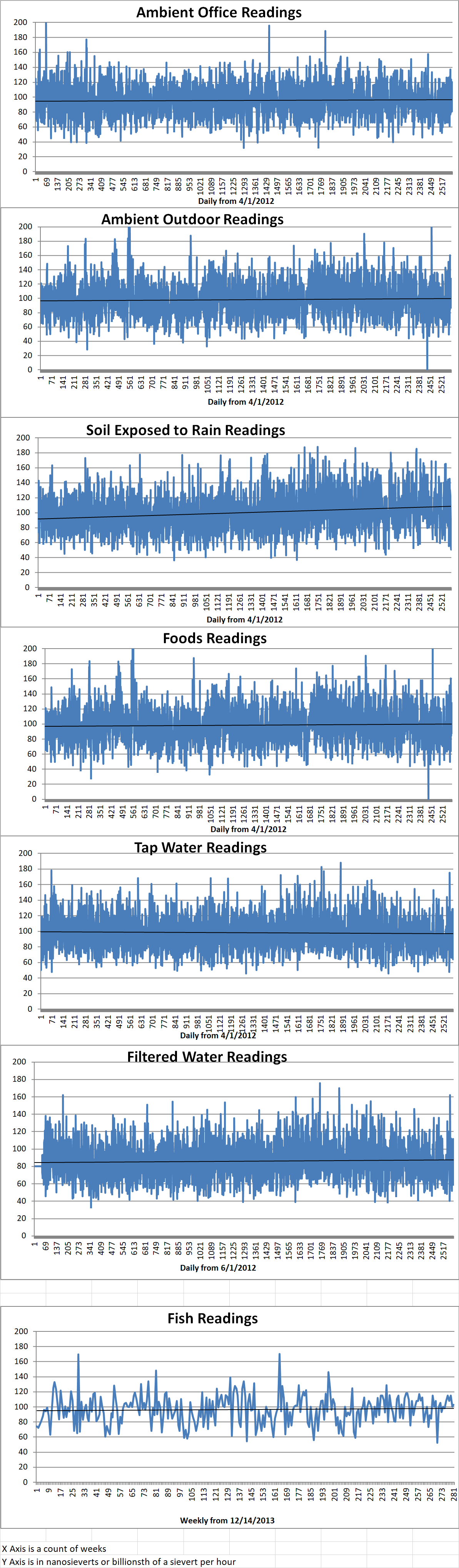
Ambient office = 120 nanosieverts per hour
Ambient outside = 79 nanosieverts per hour
Soil exposed to rain water = 81 nanosieverts per hour
Blueberry from Central Market = 128 nanosieverts per hour
Tap water = 64 nanosieverts per hour
Filtered water = 59 nanosieverts per hour
Democrat Ben Ray Lujan is the U.S. Representative from New Mexico’s Third Congressional District. Last Tuesday, he introduced a bill in the House to expand a compensation program for all those exposed to radiation from nuclear testing and uranium mining. The bill seeks to address the fallout across the western U.S., Guam and the Northern Mariana Islands.
Since the testing of the first atomic bomb in New Mexico in 1945 as part of the Manhattan Project, the U.S. conducted almost two hundred atmospheric tests of nuclear warheads before all atmospheric testing was banned in 1992. Uranium mining has been continuous since the 1940s.
Tens of thousands of people including miners, truck drivers, people living near test sites and soldiers posted near test explosions have been exposed to nuclear radiation. This exposure has resulted in cancer, birth defects and other radiation induced illnesses. Native American communities have been disproportionally affected. Lujan said, “Radiation exposure has taken the lives of too many and continues to hurt our communities. I know how important this legislation is for New Mexico families that have been affected.”
Congress passed the Radiation Exposure Compensation Act in 1990. Part of the reason for the passage of this Act was the desire to avoid expensive litigation that would have been needed to make sure that the federal government met financial obligations to workers whose health was damaged by the radiation hazards of their jobs and/or their location.
In 2000, the coverage of the Act was broadened. Currently, compensation varies from a one-time payout of one hundred thousand dollars for uranium miners and processors to fifty thousand for people who lived downwind from the Nevada Test Site.
Supporters of the legislation have been claiming for years that many people who were exposed are not eligible to file compensation claims under the current Act. Downwinders in the Tularosa Basin of New Mexico where the first nuclear test was conducted are part of that group. The Tularosa Basin Downwinders Consortium claims that many of the people who lived near the test site were not told that the test involved an atomic bomb until after the end of World War II.
Tina Cordova is a cancer survivor and one of the people who founded the Tularosa Basin Downwinders Consortium. She said, “The government did nothing at the time to monitor what was happening with the fallout. They did nothing to protect our health at the time of the test. They did nothing to warn before or after and people were dying.”
Comprehensive epidemiological studies have never been conducted on those who were exposed to radiation. A recently published paper in the Bulletin of the Atomic Scientists reviewed New Mexico state health data. The researchers found that there was a spike in infant mortality with no obvious explanation that started a month after the first atomic test detonation. Infant mortality in New Mexico had been declining until the test in 1945.
Almost three dozen members of the U.S. House of representative have signed onto Lujan bill. Lujan hopes that his bill will pass and finally provide compensation to many who have been left out. The current Act expires in two years, so Congress has a deadline for updating the Act. The new bill would extend the compensation program until 2045. Included in Lujan’s bill is a requirement that the U.S. officially apologize to people living in New Mexico, Idaho, Colorado, Arizona, Utah, Texas, Wyoming, Oregon, Washington, South Dakota, North Dakota, Nevada, Guam and the Northern Mariana Islands who were exposed to radiation. The definition of downwind states would be expanded to include Arizona, Colorado, Idaho, Montana, Nevada, New Mexico, Utah and Guam.
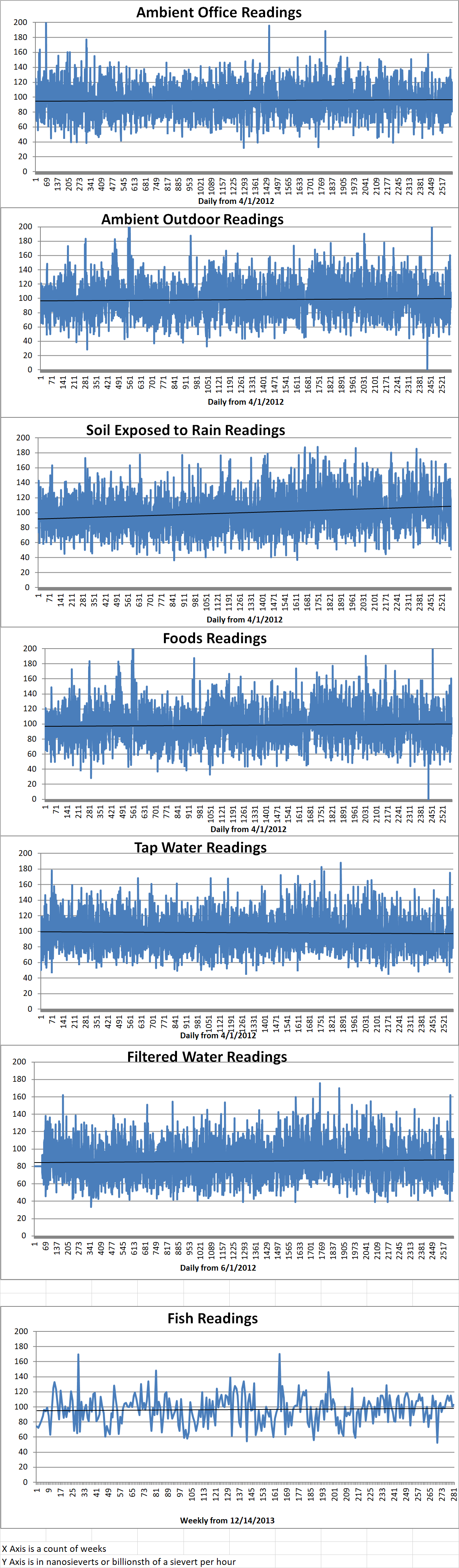
Ambient office = 92 nanosieverts per hour
Ambient outside = 52 nanosieverts per hour
Soil exposed to rain water = 51 nanosieverts per hour
Avocado from Central Market = 108 nanosieverts per hour
Tap water = 108 nanosieverts per hour
Filtered water = 102 nanosieverts per hour
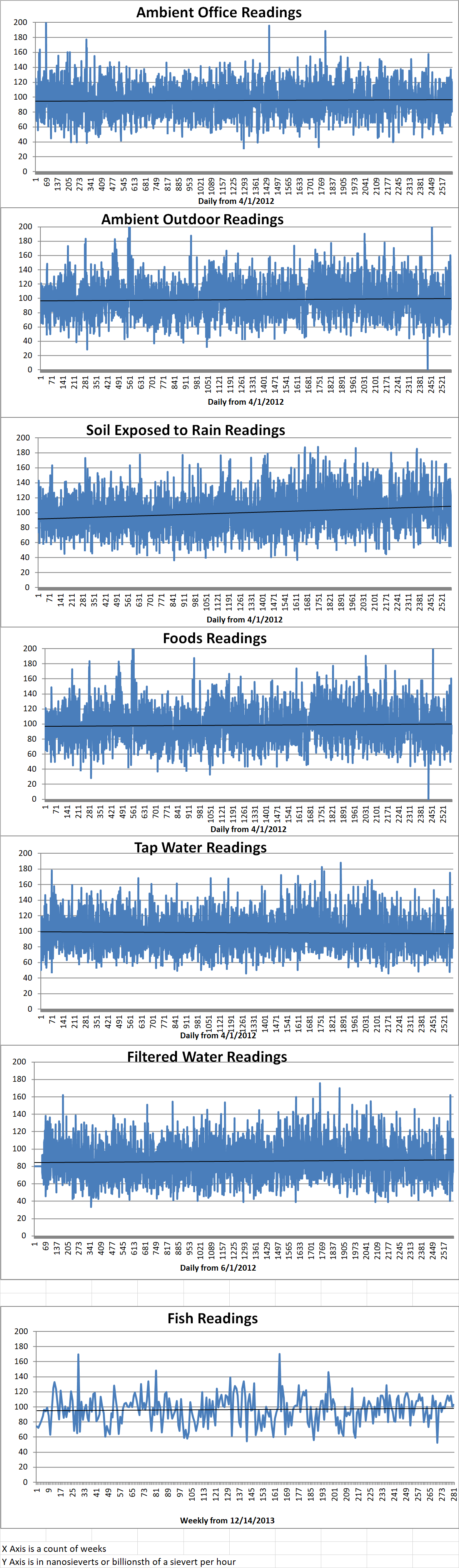
Ambient office = 81 nanosieverts per hour
Ambient outside = 56 nanosieverts per hour
Soil exposed to rain water = 56 nanosieverts per hour
Celery from Central Market = 88 nanosieverts per hour
Tap water = 110 nanosieverts per hour
Filtered water = 100 nanosieverts per hour
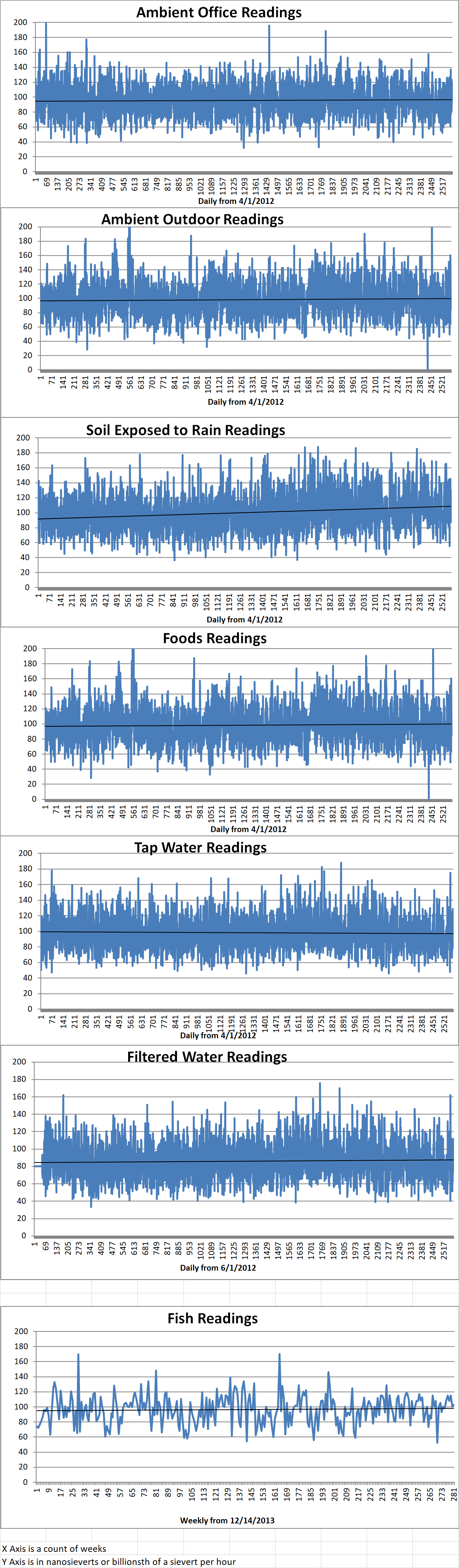
Ambient office = 99 nanosieverts per hour
Ambient outside = 80 nanosieverts per hour
Soil exposed to rain water = 80 nanosieverts per hour
Strawberry from Central Market = 152 nanosieverts per hour
Tap water = 130 nanosieverts per hour
Filtered water = 124 nanosieverts per hour
Dover sole – Caught in USA = 104 nanosieverts per hour
I have often blogged about the problem with nuclear waste. Fission reactors produce spent nuclear fuel that is radioactive and can be dangerous for thousands of years. To date, the best solution to the accumulating spent nuclear fuel from the world’s nuclear power reactors is to bury it in deep underground geological repositories. Unfortunately, siting and constructing such repositories are very difficult and there have only been test repositories created during the seventy plus years of the Nuclear Age. The soonest that the U.S. will have one is 2050. The temporary solution to the spent nuclear fuel problem is to store the used fuel assemblies in steel cylinders encased in concrete called “dry casks”. These dry casks have their own problems. Now scientists are working on ways to speed up radioactive decay which could reduce the time required for nuclear waste to be lose most of its radioactivity.
Dr. Artūras Plukis is Head of Experimental Nuclear Physics Laboratory at the Center for Physical Sciences and Technology in Vilnius, Lithuania. He said, “Currently, the disposal of nuclear waste is comprised of either storing the waste in containers on above-surface level or burying them underground, depending on the decay period of the radioactive material. This method is raising safety concerns, as some of the waste is disposed not too far from densely populated areas, and highly radioactive waste has to be safely stored for up to tens of thousands of years.”
Light Conversion and Ekspla, two Lithuanian laser technology companies, have developed a very powerful, very fast laser called the SYLOS. The SYLOS high-density ultra-short pulse laser system may be able to accelerate the decay of radioactive isotopes in spent nuclear fuel and other radioactive wastes. Darius Gadonas is Head of the Scientific Laser Systems Division at Light Conversion. He said, “We do believe that lasers like SYLOS can be adapted to solve the nuclear waste issue globally without leaving it for future generations to deal with. How soon this could be achieved will depend on the political will of governments, since lasers and infrastructure of this kind could cost up to billions of euros per unit.”
Gadonas said, “There are now 44 laser industry-related companies in Lithuania, and most of them are located in Vilnius. The Lithuanian-made lasers take up more than 50 percent of the global market for the ultra-short pulse lasers. The lasers made in our country are used at NASA, CERN, and countless technologies companies, such as IBM, Hitachi, Toyota, and Mitsubishi. Finally, 90 of the world’s top 100 universities are using lasers made by scientists in Lithuania.”
The pulses from SYLOS are used to accelerate electrons to relativistic velocities. When these highly energetic electrons hit a target of solid matter, they generate powerful electromagnetic gamma rays. These gamma rays are able to induce fission in unstable nuclei such as the radioactive isotopes in nuclear wastes. The isotopes produced by such fission have significantly shorter half-lives than the isotope which were forced to fission by the gamma rays. This means that amount of time nuclear waste needed to be isolated can be significantly reduced.