
I recently posted an article about robotic research at Mitsubishi Heavy Industries. They are developing robots that can carry out routine inspection of big industrial plants such as oil refineries and nuclear power plants. The Fukushima nuclear disaster in March of 2011 has stimulated other companies to develop robots specifically designed to be able to survive intense radiation in nuclear power plants as they clean up debris from accidents or during decommissioning. Most of the robots are simply teleoperated by humans from a safe remote location. However, some researchers are working on robots that are able to carry out some tasks autonomously.
Engineers at Lancaster University in the U.K. are working on computer systems for control of robots handling hazardous nuclear materials. The software allows the robots to handle some routine tasks without needing guidance from a human in a remote location. The engineers are using novel imaging software and a Microsoft Kinect camera added to a robot with two manipulating arms. The new software makes it simpler to recognize, grasp and cut objects such as metal pipes which are often found in nuclear reactors that are being decommissioned. The engineers say that the new software may be able to speed up decommissioning while the robot’s activities are monitored by a human via teleoperation.
James Taylor is a professor of control engineering at Lancaster University’s Department of Engineering. He said, “The standard within nuclear decommissioning is for direct human-controlled remote tele-operation of robots, which is extremely difficult for the operators particularly given the complexity of nuclear decommissioning tasks. Fully autonomous solutions are unlikely to be deemed safe in the near future and so we have explored creating a semi-autonomous solution that sits between the two.”
“By making use of a single camera mounted on the robot our system focusses on a common task in these harsh environments – the selecting and cutting of pipes. Our system enables an operator to instruct the robot manipulator to perform a pipe grasp and cut action with just four mouse clicks. Tests show that operators using this system successfully outperform operators using the current joystick-based standard. It keeps the user in control of the overall robot but significantly reduces user workload and operation time.”
A few operators have tested the new software-hardware combination in laboratory conditions. The researchers know that a great deal more testing will be required. It will also be necessary to addition features to the robots such as radiation shielding before the robots can be tested in an actual radioactive environment.
The research at Lancaster has been published in an article in the Robotics journal. The project was funded by the Engineering and Physical Sciences Research Council as part of the National Centre for Nuclear Robotics (NCNR). The purpose of the NCNR is to develop advanced robotics and artificial intelligence technology for application in the nuclear industry. A primary focus of the work at the center is to develop technology which will help with nuclear waste management. The NCNR was founded by eight universities including Lancaster University.
Blog
-
Nuclear Reactors 686 – Lancaster University Working On New Semi-autonomous Robots For Radioactive Environments
-

Geiger Readings for Jun 13, 2019
Ambient office = 90 nanosieverts per hour
Ambient outside = 74 nanosieverts per hour
Soil exposed to rain water = 73 nanosieverts per hour
Butternut squash from Central Market = 94 nanosieverts per hour
Tap water = 56 nanosieverts per hour
Filtered water = 48 nanosieverts per hour
-

Nuclear Fusion 58 – Researchers Are Developing Computer Models Of Turbulence In Plasmas
One major problem with creating a controlled fusion reaction that could be used to generate power is confinement of the superheated plasma. Powerful magnetic fields are used in fusion reactors to confine the plasma and prevent it from striking the walls of the reaction chamber which can quench the fusion reaction and even damage the walls of the reaction vessel.
Physicists at the U.S. Department of Energy’s (DOE) Princeton Plasma Physics Laboratory (PPPL) have been working to verify computer simulations of energy loss caused by turbulent transfer of plasmas in fusion experiments. General Atomics (GA) in San Diego has developed sophisticated computer models which are being compared with the experimental findings from the compact—or “low-aspect ratio”—National Spherical Torus Experiment-Upgrade (NSTX-U).
Low-aspect ratio tokamaks have a shape like an apple with the core removed instead of the donut-shape of common tokamaks. Physicist Walter Guttenfelder is the lead author of a Nuclear Fusion paper that reports the findings of the PPPL researchers. He said, “We have state-of-the-art codes based on sophisticated theory to predict transport. We must now validate these codes over a broad range of conditions to be confident that we can use the predictions to optimize present and future experiments.”
Analysis of the ion transport in the NSTX-U experiments revealed that a major reason for the energy losses was turbulence. This caused the transport of electrons be considered anomalous which means that the electrons spread rapidly. The GA computer model predicted that energy losses could be attributed to a combination of three different types of turbulence.
The observation of energy losses in the NSTX-U marks the beginnings of a new phase in developing models of transport in low-aspect ratio tokamaks. The PPPL research team’s next goal is to identify the mechanisms that give rise to anomalous electron transport in a compact tokamak. Simulations predict that energy losses in these tokamaks are the result of two types of turbulence with relatively long wavelengths as well as a third type of turbulence with wavelengths that are tiny compared to the other two types of turbulence.
It is difficult to simulate the combined effect of all three of the types of turbulence. Normally, researchers simulate different wavelengths of turbulence separately. Researchers at MIT have utilized significant time on their supercomputer to carry out multi-scale simulations.
Next researchers must test additional simulations in order to arrive at a more complete agreement between computer simulation of transport and the results of experiments on transport in low-aspect ration tokamaks. Measurements of actual turbulence in low-aspect ratio tokamaks will be done by the University of Wisconsin-Madison authors of the paper published the in Nuclear Fusion journal. This will help to further refine the predictions made by the computer models.
Billions of dollars are being poured into fusion research by national governments and private companies. If commercial fusion can be achieved, it will have a major impact on the global energy market. But this will only be possible if the problems with leaking electrons in confined plasmas can be solved. -
Geiger Readings for Jun 12, 2019
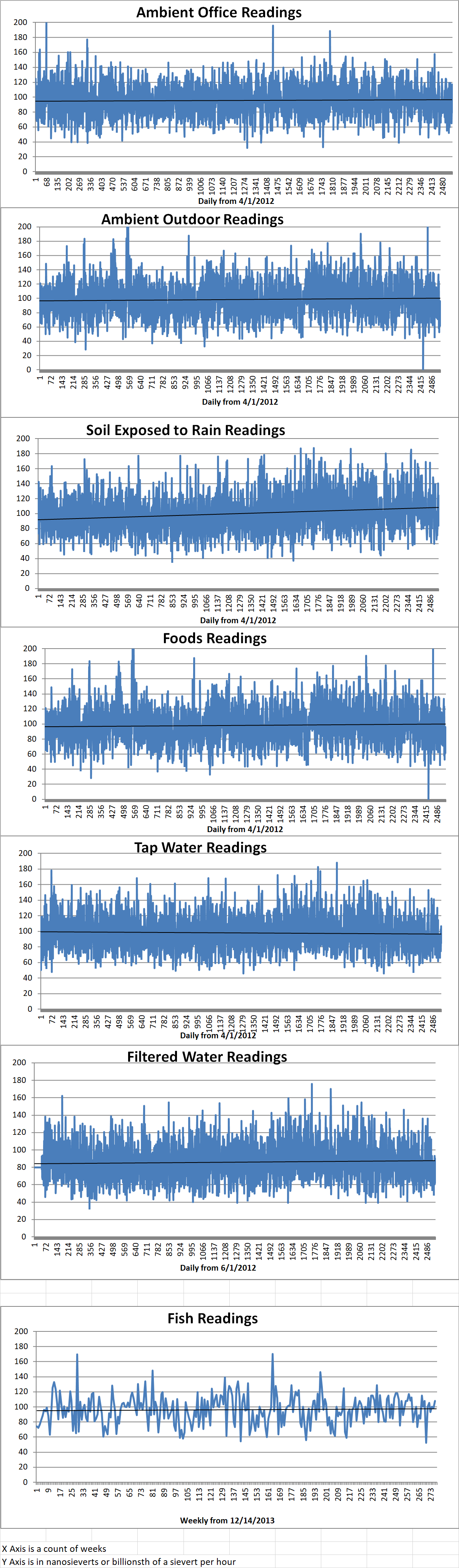
Ambient office = 117 nanosieverts per hour
Ambient outside = 127 nanosieverts per hour
Soil exposed to rain water = 124 nanosieverts per hour
Strawberry from Central Market = 93 nanosieverts per hour
Tap water = 100 nanosieverts per hour
Filtered water = 90 nanosieverts per hour
-

Nuclear Reactors 685 – Finnish Terraframe Working On Licensing And Constructing A Uranium Extraction Plant
Uranium is a common element that is found in many minerals. Most uranium is mined and refined in mines and refineries dedicated to uranium. However, uranium may be present in ore from mines that are dedicated to extracting other minerals and elements.
Terraframe is a mining company owned by the Finnish government. It currently mines and refines nickel, zinc and cobalt at its mine and metals production plant at Sotkamo. The ore at the Sotkamo mine contains about fifteen to twenty milligrams per kilogram. The average amount of uranium in Finnish soil and rock is about four milligrams per kilogram. High grade uranium ore that is currently being mined at uranium mines contains about a hundred milligrams per kilogram.
Terraframe estimates that the ore it processes annually contains about three hundred tons of uranium. Half of this uranium is dissolved during bioleaching of ore. If Terraframe was able to extract uranium during its ore processing, about one hundred and thirty-five tons of uranium could be produced per year.
Terraframe submitted an application for a large-scale recovery operation for uranium to the Finnish Ministry of Employment and Economic Affairs in October of 2017. Following a safety assessment of the Terraframe application, the Finnish Radiation and Nuclear Safety Authority (also known as Stuk) issued a statement that says that Stuk believes that Terraframe’s plans for uranium extraction satisfy the important requirements that are stated in Finland’s nuclear energy legislation. A representative of Stuk said, “The nuclear and radiation safety risks caused by the production of uranium to the environment and the residents in the area are minor.”
Jarkko Kyllönen is a senior inspector for Stuk. He said, “In practice, minor risks mean that the radiation exposure of the employees at the uranium recovery plant is minor and the production of uranium will not expose members of the public to additional radiation. The licensee is responsible for the radiation safety of the plant, its employees and its surroundings. Stuk’s duty is to oversee that such responsibilities are fulfilled.”
According to Kyllönen, the uranium produced by a recovery plant is classified as a nuclear commodity. He said, “According to the Nuclear Energy Act, the final product of a recovery plant is categorized as nuclear commodities. Therefore, the final product is included in the scope of international nuclear material safeguards. This regulatory control ensures that the product does not end up in the wrong hands.”
In addition to the government’s approval of the Terraframe application, before they can start uranium recovery, they also need to get a sales permit from the Finnish Ministry for Foreign Affairs. An additional permit to transport uranium abroad for refining will be needed from the European Atomic Energy Community (Euroatom). Terraframe has already obtained the necessary permits for chemicals and environmental impact. Terraframe estimates that uranium recovery could begin within a year of obtaining all the required permits.
Even though the concentration of uranium in the Sotkamo mine are low, Terraframe believes that they can recover enough uranium for a commercial operation. -
Geiger Readings for Jun 11, 2019
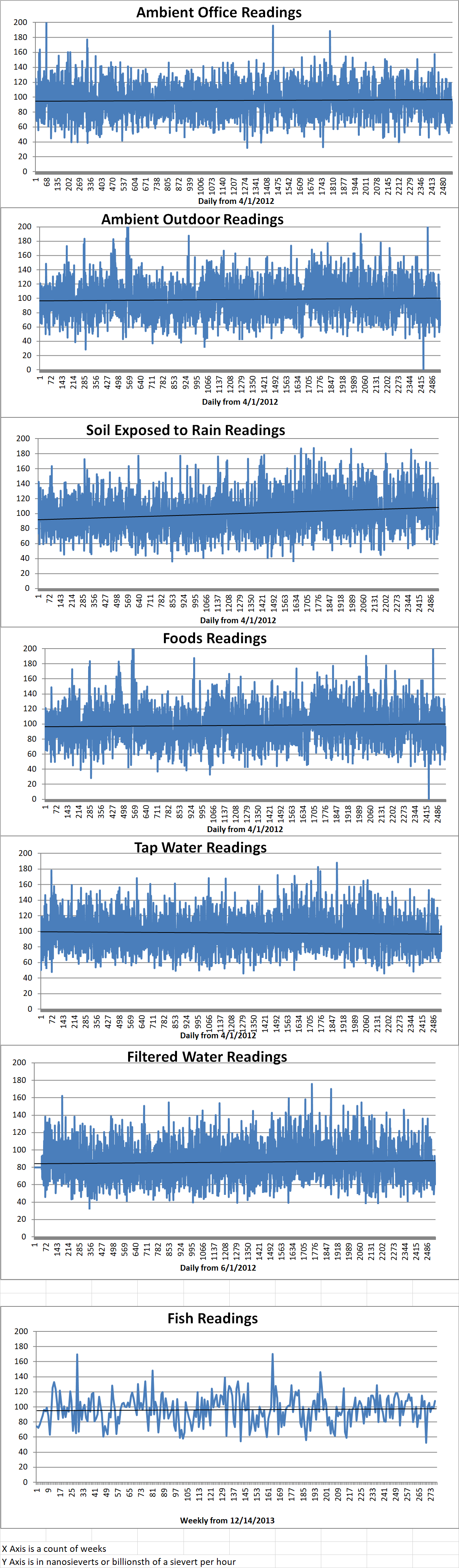
Ambient office = 80 nanosieverts per hour
Ambient outside = 83 nanosieverts per hour
Soil exposed to rain water = 84 nanosieverts per hour
Organic avocado from Central Market = 96 nanosieverts per hour
Tap water =85 nanosieverts per hour
Filtered water = 76 nanosieverts per hour
-

Nuclear Reactors 684 – Mitsubishi Heavy Industries Developing An Explosion Proof Robot For Plant Inspections
The Japanese have a phrase that references jobs that are dirty, dangerous or drudgery. Robots have been handling drudgery for decades. Dirty is still being done by humans. Robots are being developed to handle dangerous. Robots have been developed there to penetrate the ruins of the Fukushima nuclear power plant that was destroyed by flooding and meltdowns resulting from the big earthquake in the ocean off Japan in March of 2011. Many of the robots were not able to finish their tasks because they were destroyed by the intense radiation. Fukushima continues to be an inspiration for robotic evolution.
Mitsubishi Heavy Industries (MHI) in Japan developed some of the robots used at Fukushima. They have used the experience gained to develop robots that can be used to inspect and monitor industrial facilities. An “explosion-proof” prototype MHI robot called EX ROVR has recently been tested at a Japanese oil refinery. The EX ROVR was designed to be able to withstand damage from explosions that might occur during inspections, including explosions that might have been caused by the robot itself.
MHI and JXTG Nippon Oil & Energy Corporation jointly conducted a test of the EX ROVER at the JXTG Mizushima Refinery in Kurashiki in Okayama Prefecture. As part of the test, the robot autonomously moved through several floors of the plant building. It had to deal with stairs as it collected data from various sensors and docking itself at a charging station to replenish batteries.
The robot is still being developed but the recent test proved that it meets the minimum requirements for basic functionality to carry out routine patrol inspections at the JXTG Energy plant. It was also able to handle emergency situations in the test. The results of the test will be analyzed in detail to resolve outstanding issues and to make improvements in the design.
More tests will be conducted, and demonstrations of abilities will be carried out in a wide range of different plant environments in order to “further expand inspection and surveillance functionality and enhance safety”, with the aim of developing a commercial inspection system. MHI said that it is developing the explosion-proof plant inspection robot “based on its success with robotics technologies in such areas as support for nuclear plant accident containment”.
MHI developed the MEISTeR (Maintenance Equipment Integrated System of Telecontrol Robot) based on the design of the RaBOT (Radiation-proof Robot) which was constructed to deal with a critical accident at the Tokai-mura nuclear fuel processing facility. The design of the MEISTeR includes two arms which can be fitted with different tools. It is able to execute such tasks as carrying objects, drilling holes and opening and closing valves.
MHI also developed the Super-Giraffe (Global Innovative Robot Arm for Future Evolution) to perform tasks at the Fukushima nuclear power plant. The Super Giraffe has four modules including a platform, a load-lifting module, a robot arm and an attachment tool.
While I am impressed by MHI’s accomplishments in robotics I would be interested in knowing just how bad an explosion the EX ROVR will be able to survive. The images I have seen make it look pretty vulnerable.