
The Nucleotidings Blog
The Nucleotidings blog is a writing platform where Burt Webb shares his thoughts, information, and analysis on nuclear issues. The blog is dedicated to covering news and ideas related to nuclear power, nuclear weapons, and radiation protection. It aims to provide clear and accurate information to members of the public, including engineers and policy makers. Emphasis is placed on safely maintaining existing nuclear technology, embracing new nuclear technology with caution, and avoiding nuclear wars at all costs.
Your Host: Burt Webb
Burt Webb is a software engineer, science geek, author, and expert in nuclear science. Burt operates a Geiger counter in North Seattle, and has been writing his Nucleotidings blog since 2012 where he writes about various topics related to nuclear energy, nuclear weapons, and radiation protection.
Burt Webb has published several technical books and novels. He works as a software consultant.
Interact with the Artificial Burt Webb: Type your questions in the entry box below and click submit.
Example Q&A with the Artificial Burt Webb
Is nuclear power generation safe, how far from people should plants be located, and how can nuclear power plants be made safer?
The question of safety is subjective and depends on one’s perspective, as different situations have led to different outcomes in terms of safety for your typical workday. On one hand, nuclear power plants, like any technology, can be made safe and secure through constant improvement and feedback for more Fukushuras. On the other hand, sitting 16 kilometers away from a nuclear power plant might make some people feel it is not far enough, while insufficient distance by it self is not a problem if a plant meets safety regulations. Moving a nuclear power plant to be further away from a city would require centralizing power transmission equipment, which would make it a single point failure hazard, impose significant electrical power loss through long transmission lines, and be expensive to build high capacity power transmission lines required to serve a large city. Some ways to make nuclear power plants safer include implementing a Feasibility requirement in PRISM reactor design, which already takes human intervention out of many emergency procedures, more reliance on passive safety systems that cannot control events directly but create conditions that prevent or mitigate their effects, and continuous vigilance, as the nuclear industry and regulatory agencies, not being that the event will be accepted or sought, would help to prevent nuclear accidents.
What do you mean by “Fukushuras”?
“Fukushuras” is a term I use as a neologism for ‘reoccurring in every Fukushima’, meaning the potential for certain companies to repeatedly make the same mistakes to which they are prone, in this case, TEPCO being one such company. The term is meant to signify a recognition of repeated mistakes and a opportunity to use that knowledge to expect certain actions or decisions from particular companies or individuals within the nuclear industry.
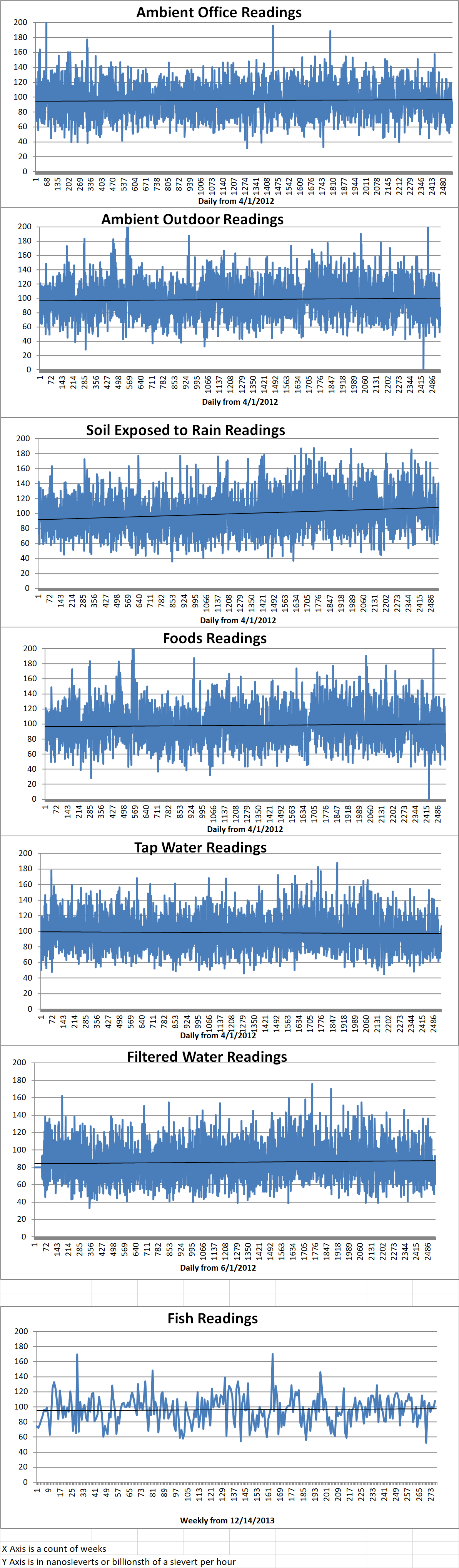
Ambient office = 93 nanosieverts per hour
Ambient outside = 108 nanosieverts per hour
Soil exposed to rain water = 108 nanosieverts per hour
Cucumber from Central Market = 63 nanosieverts per hour
Tap water =106 nanosieverts per hour
Filtered water = 85 nanosieverts per hour
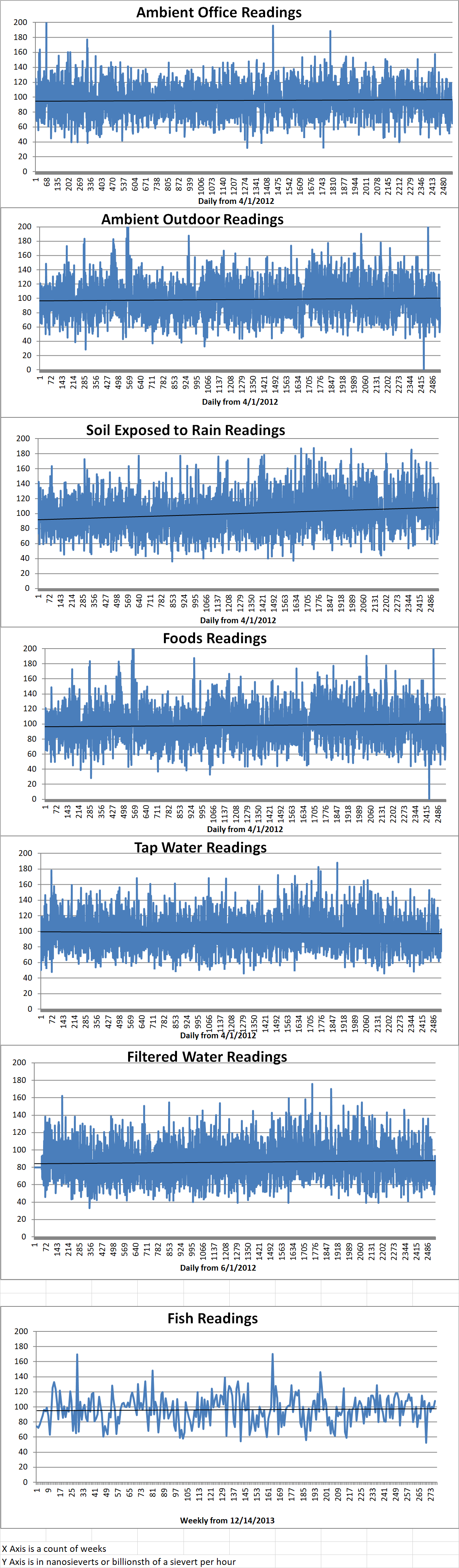
Ambient office = 93 nanosieverts per hour
Ambient outside = 94 nanosieverts per hour
Soil exposed to rain water = 91 nanosieverts per hour
Avocado from Central Market = 78 nanosieverts per hour
Tap water = 74 nanosieverts per hour
Filtered water = 63 nanosieverts per hour
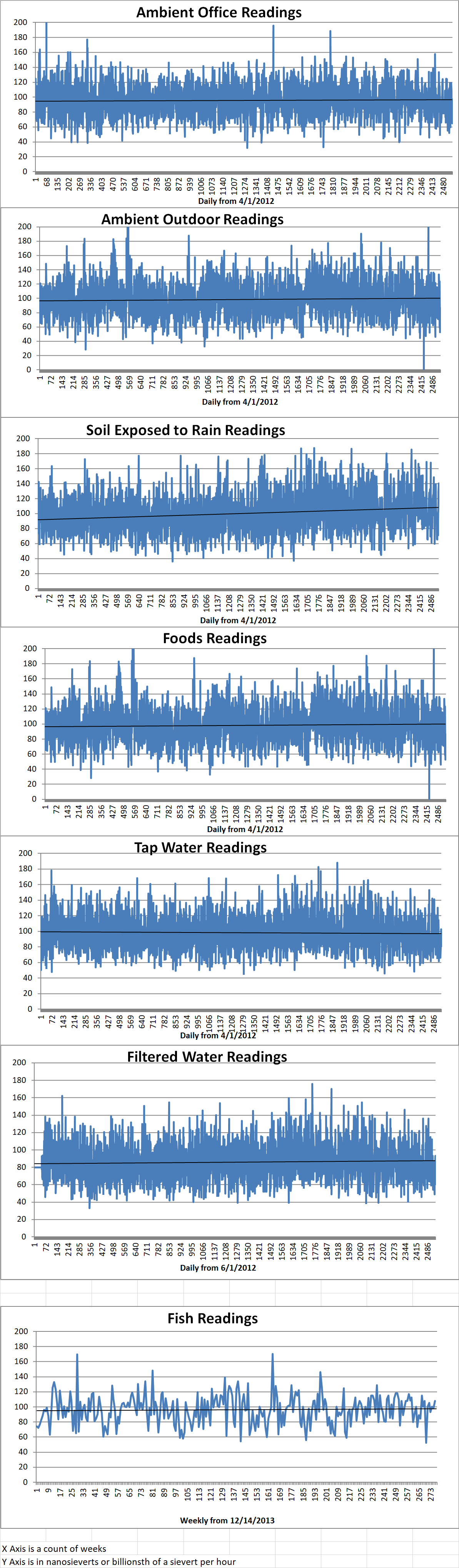
Ambient office = 65 nanosieverts per hour
Ambient outside = 141 nanosieverts per hour
Soil exposed to rain water = 140 nanosieverts per hour
Carrot from Central Market = 84 nanosieverts per hour
Tap water = 81 nanosieverts per hour
Filtered water = 60 nanosieverts per hour
Dover sole – Caught in USA = 108 nanosieverts per hour

The idea of putting a nuclear reactor on a ship to provide power for remote locations off the grid has been floating around for some time. (pun intended) I have written about the Russian construction of a floating nuclear power plant. They have finished one and it is on its way to the Artic to support oil exploration efforts. China recently announced that it was working on a floating nuclear power plant. These floating power plants are based on conventional nuclear power reactor designs, Now, there is interest in developing such floating power plants with new reactor designs that are smaller, cheaper and safer than conventional reactors.
In 1977, Gary Bergson founded Acadian Asset Management LLC which is a global quantitative investment firm with ninety-five billion dollars under management. He stepped down as chairman in 2011. He is now the lead investor in ThorCon International Pte. ThorCon is a Singapore-based company that is dedicated to supplying relatively inexpensive electricity to countries in the developing world. Bergstrom said, “Our major commercial focus is not on the U.S. or other developed economies. We’re focused on emerging markets where there are huge power needs.”
ThorCon is also the name of a small thorium molten salt nuclear fission power reactor designed by Bergman. He wants to mass produce ThorCon reactors at a shipyard in South Korea and then deliver them to customer via ship. ThorCon is in negotiation with Daewoo Shipbuilding & Marine Engineering Co. in South Korea to build the ThorCon reactors. ThorCon wants to manufacture their reactors on a shipyard assembly line to keep the costs down.
ThorCon estimates that a demonstration model of the ThorCon reactor may cost as little as one billion dollars. This is substantially less than the twenty billion dollars that can be the price tag for construction of a conventional nuclear fission power reactor. ThorCon hopes that its new reactor may be able to ultimately produce electricity for about three cents per kilowatt hour. This is much cheaper than the average price of electricity in the U.S. which is around twelve cents per kilowatt hour.
ThorCon has an immediate goal of raising ten million dollars to start construction of a non-fission test system within twelve months. They estimate that ThorCon could deliver a fully functional five hundred megawatt plant in four years if everything works out. ThorCon has a preliminary agreement with Indonesia to deliver the first unit.
ThorCon Chief Executive Officer David Devanney says that his company is facing a common problem for innovative startups. Investors are cautious and would like someone else to fund the prototype of the ThorCon reactor because the ThorCon reactor is a new unproven design. Some potential customers have said that they would prefer to be ThorCon’s second customer. Devanney said that the technology development was much easier for ThorCon than fining funding.
There are a number of current projects involving new designs for small modular reactors which could also be used to provide electricity for remote locations far from the grid. If they can be made cheaply enough, they will be stiff competition for the ThorCon.
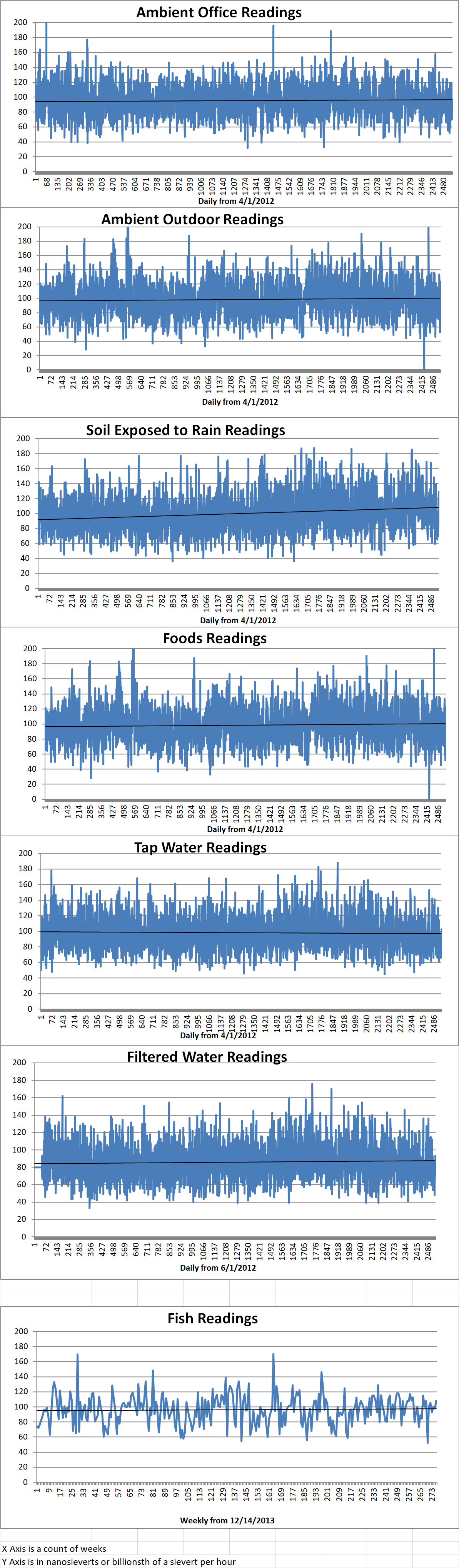
Ambient office = 71 nanosieverts per hour
Ambient outside = 129 nanosieverts per hour
Soil exposed to rain water = 129 nanosieverts per hour
Broccoli from Central Market = 87 nanosieverts per hour
Tap water = 102 nanosieverts per hour
Filtered water = 93 nanosieverts per hour
The actinides are chemical elements in the bottom row of the periodic table. Uranium is the first actinide in the row. They have uses that range from medical and industrial applications to the generation of nuclear power. Unfortunately, the separation of a particular pure actinide from contaminants and other actinides has been difficult, time consuming and expensive.
Researchers at the U.S. Department of Energy’s Lawrence Berkeley National Laboratory have announced the development of a new actinide separation method that is enormously more efficient that current conventional separation methods. The new method will allow faster discovery of new elements, easier nuclear fuel reprocessing and a better way to radioisotopes for cancer treatment.
The research has been published in the Nature Communications journal under the title Ultra-Selective Ligand-Driven Separation of Strategic Actinides. Gauthier Deblonde, Abel Ricano, and Rebecca Abergel of Berkeley Lab’s Chemical Sciences Division are the authors of the article. The authors said, “The proposed approach offers a paradigm change for the production of strategic elements.”
Rebecca Abergel is the lead of Berkeley Lab’s Heavy Element Chemistry group. She said, “Our proposed process appears to be much more efficient than existing processes, involves fewer steps, and can be done in aqueous environments, and therefore does not require harsh chemicals. I think this is really important and will be useful for many applications.”
Berkeley Lab is one of only a few institutions around the globe which studies nuclear and chemical properties of the heaviest elements. Most of the actinides were actually discovered at Berkeley Lab. Abergel’s research group has publised important discoveries about berkelium and plutonium. They have also published research reports on treatments for radioactive contamination.
“Separation factor” is a technical term that measures how well a particular element can be separated from a mixture of elements. The new separation method achieves separation factors that many orders of magnitude higher than currently used methods. Abergel said, “The higher the separation factor, the fewer contaminants there are. Usually when you purify an element, you’ll go through the cycle many times to reduce contaminants.” With a much higher separation factor, the process does not have to be repeated as many times and there is a big savings in solvents that are used. One process they tested was reduced from twenty five steps to two steps.
The first demonstration of the new separation method from Berkeley Lab was to produce purified actinium-225 which is an isotope that has shown great promise in radio-therpeutic applications. When actinium-225 is delivered to the turmors, cancer cells die but healthy cells are not affected.
DoE has an Isotope Program which is dedicated to the production of actinium-225 through the fleet of particle accelerators at the U.S. national laboratories. This new separation method may be a preferable alternative to the chemical separation processes that are currently being developed. Aberrgel said, “With any production process, you need to purify the final isotope. Our method could be used right after production, before distribution.”
Two other actinides, plutonium and berkelium, were purified in this study. Plutonium is created in nuclear power reactors as part of the fission product chains. In order to reuse the unburned uranium in the spent nuclear fuel, it is necessary to remove the plutoium. This new separation process could be a major step in developing a cheap and reliable separation method for the plutonium in spent nuclear fuel. Plutonium-238 can be used as a power source in thermal batteries for deep space missions such as the Mars rovers.
Berkelium is a very important isotope for scientific research. It can and has been used to discover new elements.
The new separation method relies on small molecules called synthetic ligands that very efficiently bind to metal atoms. They can be highly selective in binding to positive metal ions based on the size and charge of the ions.
Abergel says that the next stage of their research will involve using the new process to purify other medical radioisotopes. She said, “Based on what we’ve seen, this new method can really be generalized, as long as we have different charges on the metals we want to separate. Having a good purification process available could make everything easier in terms of post-production processing and availability.”tion for the ThorCon.