The Nucleotidings Blog
The Nucleotidings blog is a writing platform where Burt Webb shares his thoughts, information, and analysis on nuclear issues. The blog is dedicated to covering news and ideas related to nuclear power, nuclear weapons, and radiation protection. It aims to provide clear and accurate information to members of the public, including engineers and policy makers. Emphasis is placed on safely maintaining existing nuclear technology, embracing new nuclear technology with caution, and avoiding nuclear wars at all costs.
Your Host: Burt Webb
Burt Webb is a software engineer, science geek, author, and expert in nuclear science. Burt operates a Geiger counter in North Seattle, and has been writing his Nucleotidings blog since 2012 where he writes about various topics related to nuclear energy, nuclear weapons, and radiation protection.
Burt Webb has published several technical books and novels. He works as a software consultant.
Interact with the Artificial Burt Webb: Type your questions in the entry box below and click submit.
Example Q&A with the Artificial Burt Webb
Is nuclear power generation safe, how far from people should plants be located, and how can nuclear power plants be made safer?
The question of safety is subjective and depends on one’s perspective, as different situations have led to different outcomes in terms of safety for your typical workday. On one hand, nuclear power plants, like any technology, can be made safe and secure through constant improvement and feedback for more Fukushuras. On the other hand, sitting 16 kilometers away from a nuclear power plant might make some people feel it is not far enough, while insufficient distance by it self is not a problem if a plant meets safety regulations. Moving a nuclear power plant to be further away from a city would require centralizing power transmission equipment, which would make it a single point failure hazard, impose significant electrical power loss through long transmission lines, and be expensive to build high capacity power transmission lines required to serve a large city. Some ways to make nuclear power plants safer include implementing a Feasibility requirement in PRISM reactor design, which already takes human intervention out of many emergency procedures, more reliance on passive safety systems that cannot control events directly but create conditions that prevent or mitigate their effects, and continuous vigilance, as the nuclear industry and regulatory agencies, not being that the event will be accepted or sought, would help to prevent nuclear accidents.
What do you mean by “Fukushuras”?
“Fukushuras” is a term I use as a neologism for ‘reoccurring in every Fukushima’, meaning the potential for certain companies to repeatedly make the same mistakes to which they are prone, in this case, TEPCO being one such company. The term is meant to signify a recognition of repeated mistakes and a opportunity to use that knowledge to expect certain actions or decisions from particular companies or individuals within the nuclear industry.
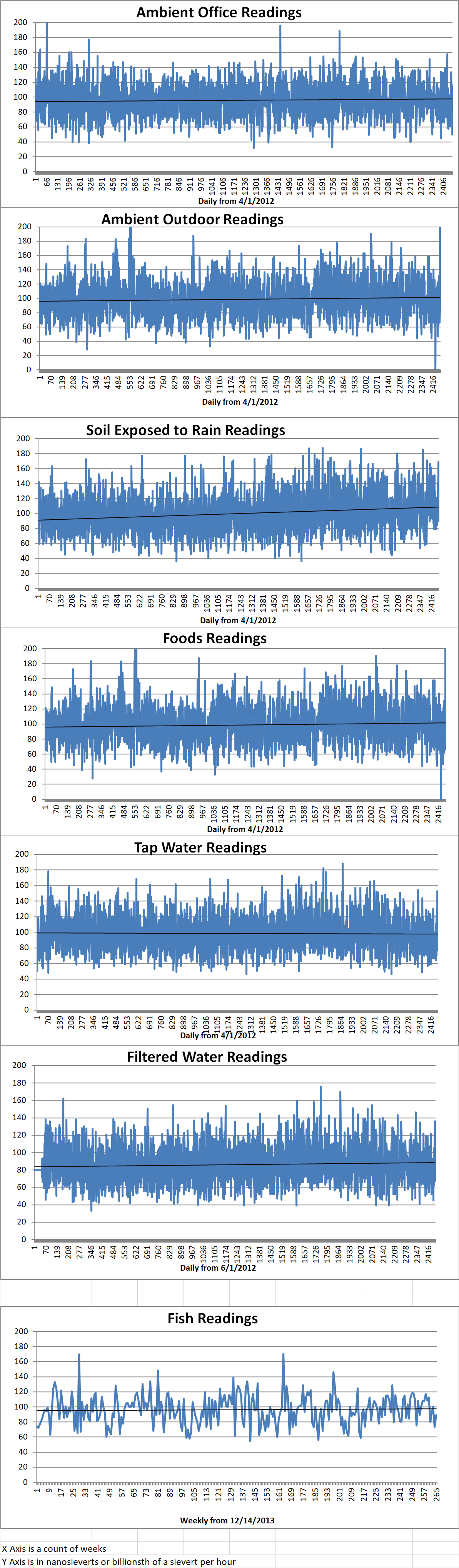
Ambient office = 50 nanosieverts per hour
Ambient outside = 89 nanosieverts per hour
Soil exposed to rain water = 90 nanosieverts per hour
Celery from Central Market = 100 nanosieverts per hour
Tap water = 93 nanosieverts per hour
Filter water = 88 nanosieverts per hour
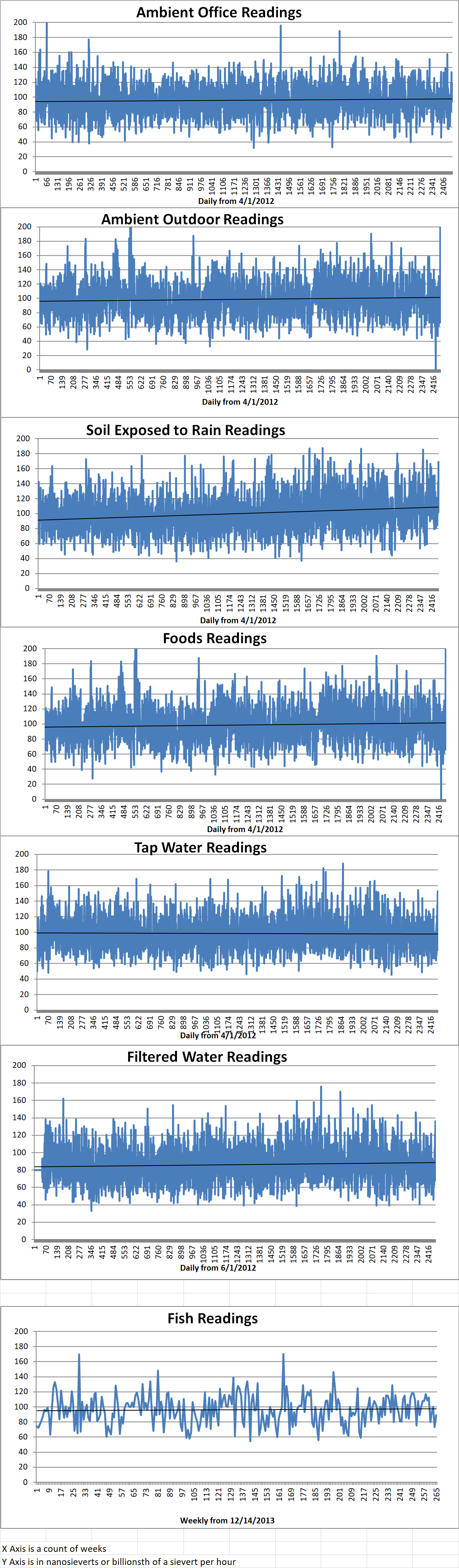
Ambient office = 94 nanosieverts per hour
Ambient outside = 106 nanosieverts per hour
Soil exposed to rain water = 102 nanosieverts per hour
Red potato from Central Market = 80 nanosieverts per hour
Tap water = 97 nanosieverts per hour
Filter water = 93 nanosieverts per hour
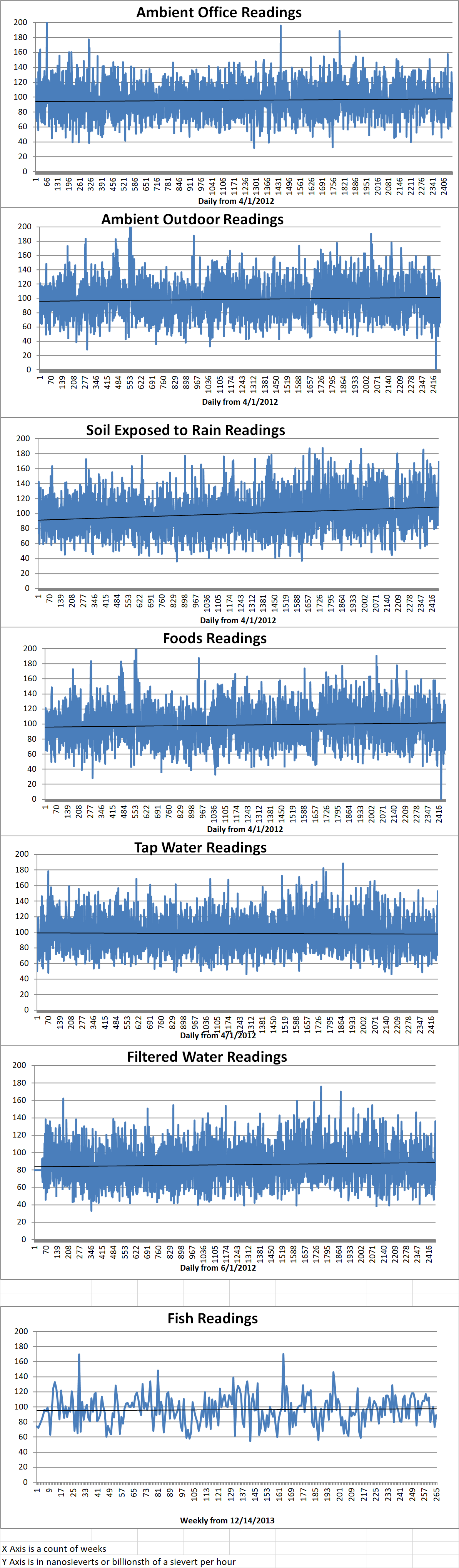
Ambient office = 115 nanosieverts per hour
Ambient outside = 171 nanosieverts per hour
Soil exposed to rain water = 169 nanosieverts per hour
Beefsteak tomato from Central Market = 89 nanosieverts per hour
Tap water = 153 nanosieverts per hour
Filter water = 136 nanosieverts per hour
Dover sole – Caught in USA = 89 nanosieverts per hour
Estonia is a small country in Northern Europe. The Gulf of Finland is to the north and the Baltic Sea is to the west. The country of Latvia lies to the south and Russia lies to the east. Estonia has a land area of about sixteen thousand square miles which includes the mainland and over two thousand islands. It has a population of one million three hundred thousand people.Estonia is a developed country with a high-income economy and enjoys a high level of civil liberties and social welfare programs.
Moltex Energy is a nuclear technology company based in the U.K. It was created in 2013. Their Stable Salt Reactor (SSR) is a Generation IV nuclear reactor design that uses molten salts as its coolant. A study of six different molten salt reactor designs in 2015 concluded that the Moltex SSR was the best fit for construction in the U.K.
Fermi Energia is a utility company in Estonia that supplies a variety of equipment and services to its customers. It has selected the Moltex SSR as a preferred technology for the production of low-carbon energy in Estonia. Moltex announced yesterday that the two companies have signed a Memorandum of Understanding that they will collaborate on a feasibility study for siting a Moltex SSR. They will also work on a suitable licensing program.
Moltex issued a statement in which they pointed out that Estonia currently gets most of its power from oil shale although they intend to stop using this source by 2030. Wind power is plentiful in Estonia, but they need an alternative reliable energy source to be self-sufficient in energy production. Estonia’s neighbors including Latvia, Lithuania and Finland are all importers of electricity. Moltex feels that their SSR would enhance the energy security of the whole region.
Simon Newton is the business development director of Moltex. He said, “Estonia is a vibrant, entrepreneurial and forward-looking economy and is the perfect place to benefit from the Moltex Stable Salt Reactor technology.”
Kalev Kallements is the CEO of Fermi Energia. He said, “Our ambition is to deploy the first fourth generation small modular reactor in the EU, here in Estonia, by the early 2030s. We are delighted to be working closely with Moltex Energy on this vital project. It is important for Estonia to have its own source of clean, cheap energy and Moltex’s innovative technology has huge potential for us.”
The Moltex SSR reactor design contains no pumps and relies exclusively on convection from static vertical fuel tubes in the core to send heat to the steam generators. Unlike other molten salt reactor designs, the SSR uses conventional fuel assemblies instead of a pumped molten salt fuel. The fuel assemblies are positioned in the center of a tank that is half full of the molten coolant salt. The molten salt conveys heat away from the fuel tubes in the middle of the tank to the steam generators located on the periphery. The reactor is not pressurized and operates at temperatures between five hundred and six hundred degrees Centigrade.
Cavendish Nuclear has completed the handover of the Silos Maintenance Facility (SMF) at the UK’s Sellafield site. The plant will support the retrieval of waste from the site’s legacy silos. World-nuclear-news.org
The Nebraska National Guard says the levee near the Cooper Nuclear Station is now reinforced. 3newsnow.com
Qatar has said a nuclear plant under construction in the UAE poses a serious threat to regional stability and the environment. Aljazeera.com

Ambient office = 196 nanosieverts per hour
Ambient outside = 108 nanosieverts per hour
Soil exposed to rain water = 111 nanosieverts per hour
Avocado from Central Market = 66 nanosieverts per hour
Tap water = 80 nanosieverts per hour
Filter water = 73 nanosieverts per hour
The U.S. Energy Information Administration (EIA) has announced that the fleet of U.S. commercial nuclear reactors produced more electricity in 2018 that in any previous year. In 2018, U.S. nuclear power generation of eight hundred seven and one tenth terawatts was slightly higher than 2010, the previous peak year at eight hundred seven terawatts. However, the U.S. commercial nuclear power industry has been in serious decline for years. The EIA says that the peak in electrical generation in 2018 occurred because of fortuitous scheduling and a practice called “uprating” in which old power plants are allowed to output more power than their original licensed rating. The EIA says that we should not expect to see this level of electrical generation again soon if ever.
Since the previous peak in nuclear power generation in 2010, five gigawatts of nuclear capacity have been retired as aging nuclear power plants have been permanenly closed. The completion of a new reactor at the TVA’s Watts-Barr nuclear power plant in 2016 did offset retirement losses by adding one thousand two hundred megawatts of U.S. nuclear capacity.
Between 2010 and 2018 many nuclear power plants completed uprates. The original power ratings for many nuclear power reactors were deliberately set very conservatively. Modernizing equipment and using advanced computer modeling have resulted in the relaxation of the older conservative power ratings. It is estimated that two gigawatts of nuclear power capacity have been added to the U.S. nuclear fleet by uprating. Power reactors are being retired faster than they are being built so uprating has been useful in offsetting the reduction in U.S. nuclear capacity resulting from the closure of old power reactors.
Even with the offset of new reactors and uprating, the U.S. nuclear power capacity has only grown about three thousand two hundred megawatts of capacity while losing over five gigawatts of capacity to retirements.
While the loss or addition of capacity is measured in watts, the total annual power output as released by the EIA is measured in watt-hours. A watt hour measures the consumption of a watt of electricity over an hour. If one gigawatt is consumed for twenty-four hours a day for three hundred and sixty five days, that means that eight thousand seven hundred and sixty gigawatts of electricity were consumed that year. In 2018, the U.S. nuclear power fleet operated at a capacity factor of ninety-two and six tenths percent which is the highest ever recorded. Even though the total capacity was reduced, shortening the time for refueling and uprating old reactors resulted in the record production.
Nuclear power reactors must be taken offline for refueling for about twenty-five days every eighteen to twenty four months. This means that some years will see more reactors offline to refuel than other years. 2018 just happened to be a year when fewer reactors than average were offline for refueling. This contributed to the peak power production of 2018.
The new reactor being built in Georgia at the Vogtle nuclear power plant is expected to add two thousand two hundred megawatts of capacity to the U.S. nuclear fleet. A second reactor project at the Summer nuclear power plant in South Carolina fell apart and was cancelled so there will be no additional power coming from that plant.