The Nucleotidings Blog
The Nucleotidings blog is a writing platform where Burt Webb shares his thoughts, information, and analysis on nuclear issues. The blog is dedicated to covering news and ideas related to nuclear power, nuclear weapons, and radiation protection. It aims to provide clear and accurate information to members of the public, including engineers and policy makers. Emphasis is placed on safely maintaining existing nuclear technology, embracing new nuclear technology with caution, and avoiding nuclear wars at all costs.
Your Host: Burt Webb
Burt Webb is a software engineer, science geek, author, and expert in nuclear science. Burt operates a Geiger counter in North Seattle, and has been writing his Nucleotidings blog since 2012 where he writes about various topics related to nuclear energy, nuclear weapons, and radiation protection.
Burt Webb has published several technical books and novels. He works as a software consultant.
Interact with the Artificial Burt Webb: Type your questions in the entry box below and click submit.
Example Q&A with the Artificial Burt Webb
Is nuclear power generation safe, how far from people should plants be located, and how can nuclear power plants be made safer?
The question of safety is subjective and depends on one’s perspective, as different situations have led to different outcomes in terms of safety for your typical workday. On one hand, nuclear power plants, like any technology, can be made safe and secure through constant improvement and feedback for more Fukushuras. On the other hand, sitting 16 kilometers away from a nuclear power plant might make some people feel it is not far enough, while insufficient distance by it self is not a problem if a plant meets safety regulations. Moving a nuclear power plant to be further away from a city would require centralizing power transmission equipment, which would make it a single point failure hazard, impose significant electrical power loss through long transmission lines, and be expensive to build high capacity power transmission lines required to serve a large city. Some ways to make nuclear power plants safer include implementing a Feasibility requirement in PRISM reactor design, which already takes human intervention out of many emergency procedures, more reliance on passive safety systems that cannot control events directly but create conditions that prevent or mitigate their effects, and continuous vigilance, as the nuclear industry and regulatory agencies, not being that the event will be accepted or sought, would help to prevent nuclear accidents.
What do you mean by “Fukushuras”?
“Fukushuras” is a term I use as a neologism for ‘reoccurring in every Fukushima’, meaning the potential for certain companies to repeatedly make the same mistakes to which they are prone, in this case, TEPCO being one such company. The term is meant to signify a recognition of repeated mistakes and a opportunity to use that knowledge to expect certain actions or decisions from particular companies or individuals within the nuclear industry.
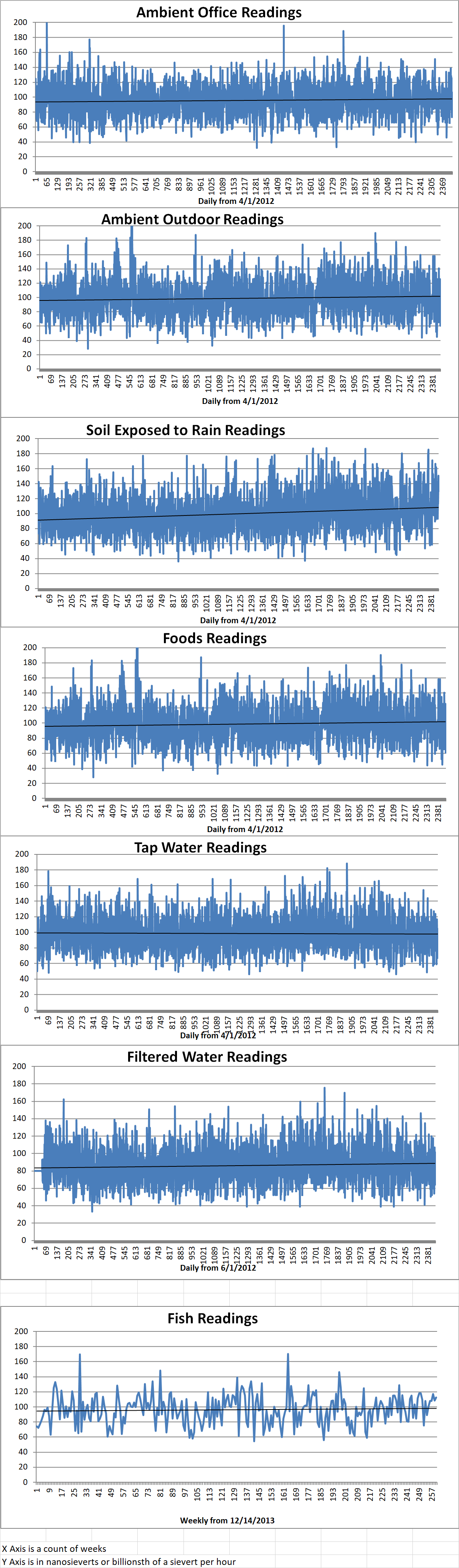
Ambient office = 76 nanosieverts per hour
Ambient outside = 136 nanosieverts per hour
Soil exposed to rain water = 140 nanosieverts per hour
Avocado from Central Market = 60 nanosieverts per hour
Tap water = 102 nanosieverts per hour
Filter water = 97 nanosieverts per hour
I have blogged before about the Saudi Arabian quest for nuclear power. Major suppliers of nuclear technology are competing to supply Saudi Arabia with nuclear power reactors. However, there are concerns that Saudi Arabia might turn nuclear technology towards the development of nuclear weapons. This is a major impediment to the export of U.S. nuclear technology to Saudi Arabia.
A new report from U.S. House Oversight and Reform Committee claims that the Trump administration tried to rush the transfer of U.S. nuclear technology to Saudi Arabia in potential violation of the laws governing the export of U.S. nuclear technology. An interim staff report from the Committee quoted multiple whistleblowers who reported ethical and legal problems with the process.
The report says “They have warned about political appointees ignoring directives from top ethics advisers at the White House who repeatedly and unsuccessfully ordered senior Trump administration officials to halt their efforts. They have also warned of conflicts of interest among top White House advisers that could implicate federal criminal statutes.”
The report claims that the major promoters of the transfer of U.S, nuclear technology to Saudi Arabia were retired General Michael Flynn who was national security advisor to President Trump and Thomas Barrack who was the chair Trump’s inaugural committee. Flynn was fired in February of 2017 when he was found to have lied to the FBI about his conversations with the Russian Ambassador.
Flynn served as an advisor to IP3 International for about seven months in 2016. IP3 is a private company that was involved in negotiations to build nuclear power plants in Saudi Arabia. Flynn continued to promote IP3’s plans after he joined the Trump White House as National Security Advisor in early 2017.
Under the Atomic Energy Act, the U.S. Congress is required to approve the transfer of any nuclear technology to a foreign country. The report claims that Derik Harvey, a senior director at the National Security Council (NSC), insisted that the decision to sell nuclear technology to Saudi Arabia had already been made after ignoring warnings that such action would be illegal.
Lawyers for the NSC were aware that Flynn could have a conflict of interest with respect to the IP3 plans. They told the NSC staff to stop working on the IP3 planned transfer of U.S. nuclear technology to Saudi Arabia. However, even after Flynn was fired in February 2017, work on the plan appeared to continue with the support of Tom Barrack.
The House Oversight Committee has announced that it will carry out an investigation into nuclear technology transfer plans “to determine whether the actions being pursued by the Trump administration are in the national security interests of the United States, or, rather, serve those who stand to gain financially as a result of this potential change in U.S. foreign policy.” The House Intelligence Committee has said that it will coordinate with the Oversight Committee on investigation of this matter.
The White House has not yet responded to requests for their comments on these investigations and reports.

Ambient office = 106 nanosieverts per hour
Ambient outside = 128 nanosieverts per hour
Soil exposed to rain water = 130 nanosieverts per hour
Beefsteak tomato from Central Market = 108 nanosieverts per hour
Tap water = 99 nanosieverts per hour
Filter water = 89 nanosieverts per hour
There are a variety of problems involving nuclear power and water. One big issue is the fact that bodies of water are becoming too hot in some cases to be used to cool nearby nuclear reactors. Another problem is simply falling levels of water that are needed for cooling. Major hurricanes that might damage nuclear power plants are a third concern. Today, I am going to address a problem that just came to my attention.
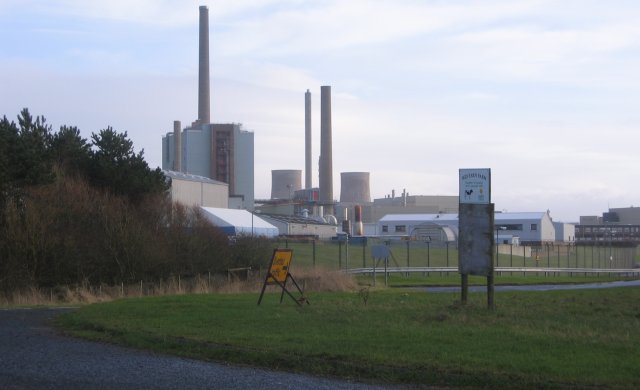
Effluents containing radioactive particles are discharged into the ocean around the world from nuclear power plants, nuclear fuel fabrication facilities and nuclear fuel reprocessing facilities. These radioactive materials can be carried ashore in airborne spray and micro-droplets called marine aerosols. Flooding in such coastal areas would also carry radioactive materials onto the shores. In such places on coasts where the prevailing winds blow onto the shore, the problem is exacerbated.
The U.K. Atomic Energy Agency carried out research on this subject around 1980 in cooperation with the nuclear industry and pro-nuclear groups. They studied the sea to land transfer of five radionuclides including alpha emitters plutonium-238, plutonium-239, plutonium-240, americium-241 and beta emitters cesium-134 and cesium-137. They found that all five of these radionuclides were being carried onto shore by the wind blowing off the ocean.
In winds of less than twenty-two miles per hour, cesium was taken up in spray and marine aerosols and moved onto land. The amount of cesium in the spray and aerosol was about double that of normal ocean spray and aerosols. On the other hand, the level of alpha emitting plutonium and americium in the studied areas were hundreds of times higher than in uncontaminated sea water. These alpha emitters adhered to micro particles of sedimentary and organic materials that are normally suspended in the marine water column. They were ejected into the atmosphere both as aerosols both by bursting bubbles and the surf line along the coast.
Once this behavior of radioactive particles in the sea was confirmed, the research was stopped. Since then, no empirical studies have been carried out by “official” U.K. agencies into inland penetration of radioactive spays and aerosols as well as human exposure to these radioactive materials. There are over seventy different radionuclides discharged into the sea from U.K. nuclear facilities but only these five radionuclides were ever studied.
Airborne radioactive materials can travel up to ten miles inland. Human populations in these areas can inhale the particles. There is also a danger of human consumption of these radioactive materials where there are dairy and beef raising operations near the sea. Such materials could also be consumed from crops grown in these areas. Studies in the area of Sellafield in the U.K. show that people who eat local produce have higher levels of cesium-137 in their blood than people in the same area who eat non-local produce. People in these areas may even receive more cesium-137 from local produce that from sea food taken from the sea in that area.
It is logical to assume that the findings of the research in the U.K. also applies to the transport of radionuclides effluences in ocean spray and marine aerosols anywhere in the world where there are prevailing onshore winds near coastal nuclear facilities. However, there has been no other widely disseminated research on this subject anywhere other than the 1980 work U.K. It appears that the promoters of nuclear power and the regulatory government agencies around the world are not particularly interested in such research because it might upset the public.
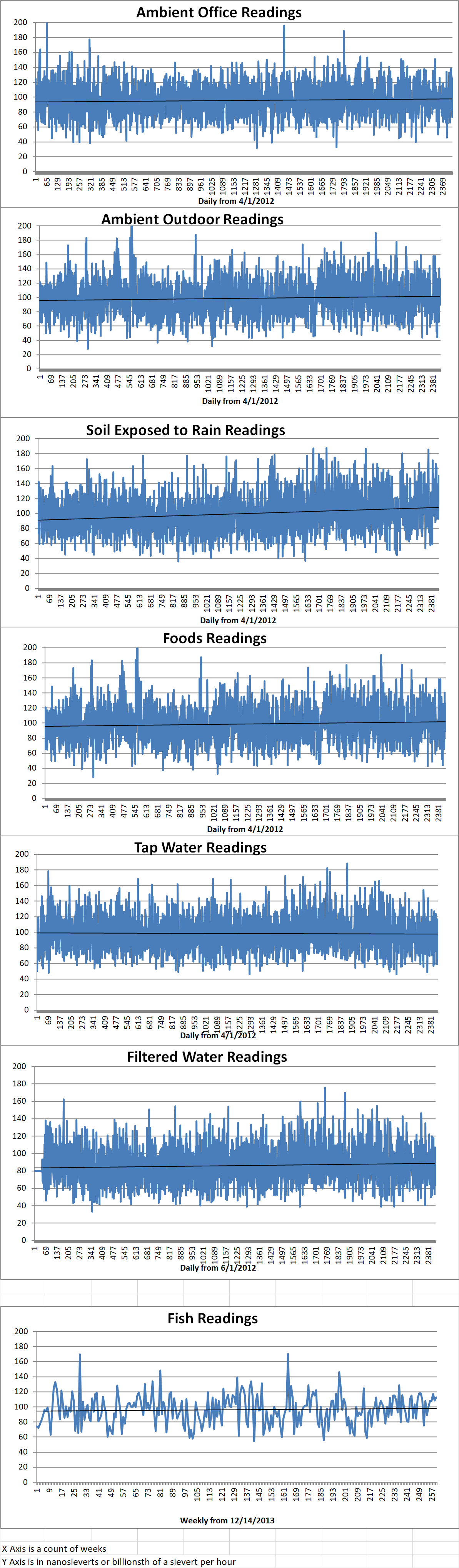
Ambient office = 86 nanosieverts per hour
Ambient outside = 150 nanosieverts per hour
Soil exposed to rain water = 151 nanosieverts per hour
Broccoli from Central Market = 126 nanosieverts per hour
Tap water = 67 nanosieverts per hour
Filter water = 64 nanosieverts per hour
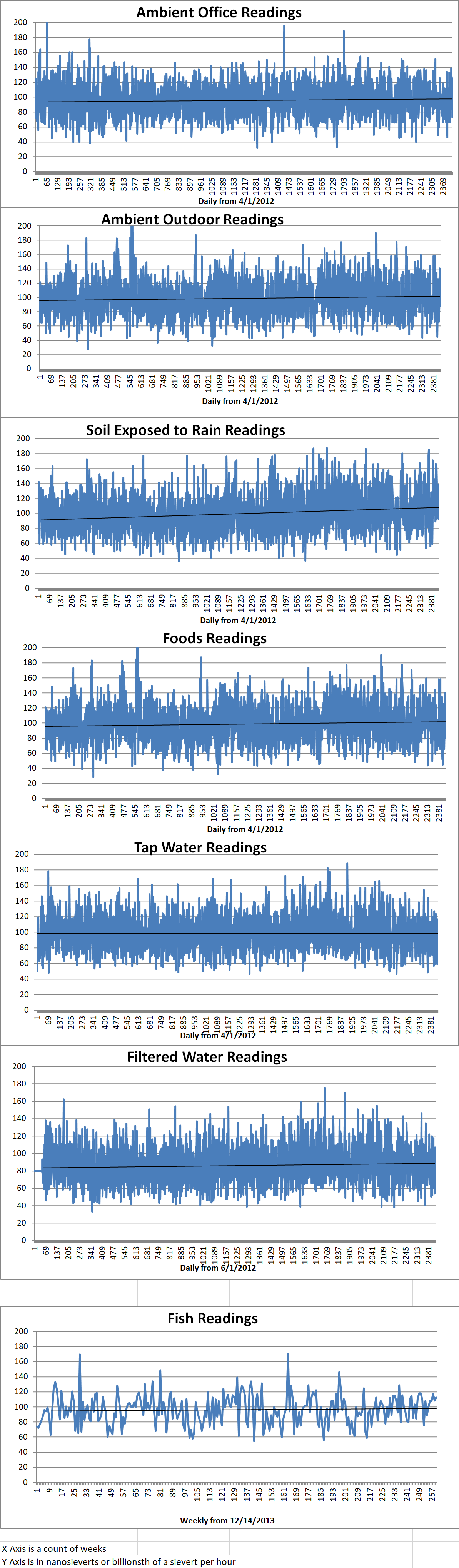
Ambient office = 73 nanosieverts per hour
Ambient outside = 112 nanosieverts per hour
Soil exposed to rain water = 113 nanosieverts per hour
Carrot from Central Market = 95 nanosieverts per hour
Tap water = 105 nanosieverts per hour
Filter water = 95 nanosieverts per hour