
Construction has begun on a floating nuclear power plant in the city of Yantai, East China’s Shandong Province. Globaltimes.cn
The Nucleotidings Blog
The Nucleotidings blog is a writing platform where Burt Webb shares his thoughts, information, and analysis on nuclear issues. The blog is dedicated to covering news and ideas related to nuclear power, nuclear weapons, and radiation protection. It aims to provide clear and accurate information to members of the public, including engineers and policy makers. Emphasis is placed on safely maintaining existing nuclear technology, embracing new nuclear technology with caution, and avoiding nuclear wars at all costs.
Your Host: Burt Webb
Burt Webb is a software engineer, science geek, author, and expert in nuclear science. Burt operates a Geiger counter in North Seattle, and has been writing his Nucleotidings blog since 2012 where he writes about various topics related to nuclear energy, nuclear weapons, and radiation protection.
Burt Webb has published several technical books and novels. He works as a software consultant.
Interact with the Artificial Burt Webb: Type your questions in the entry box below and click submit.
Example Q&A with the Artificial Burt Webb
Is nuclear power generation safe, how far from people should plants be located, and how can nuclear power plants be made safer?
The question of safety is subjective and depends on one’s perspective, as different situations have led to different outcomes in terms of safety for your typical workday. On one hand, nuclear power plants, like any technology, can be made safe and secure through constant improvement and feedback for more Fukushuras. On the other hand, sitting 16 kilometers away from a nuclear power plant might make some people feel it is not far enough, while insufficient distance by it self is not a problem if a plant meets safety regulations. Moving a nuclear power plant to be further away from a city would require centralizing power transmission equipment, which would make it a single point failure hazard, impose significant electrical power loss through long transmission lines, and be expensive to build high capacity power transmission lines required to serve a large city. Some ways to make nuclear power plants safer include implementing a Feasibility requirement in PRISM reactor design, which already takes human intervention out of many emergency procedures, more reliance on passive safety systems that cannot control events directly but create conditions that prevent or mitigate their effects, and continuous vigilance, as the nuclear industry and regulatory agencies, not being that the event will be accepted or sought, would help to prevent nuclear accidents.
What do you mean by “Fukushuras”?
“Fukushuras” is a term I use as a neologism for ‘reoccurring in every Fukushima’, meaning the potential for certain companies to repeatedly make the same mistakes to which they are prone, in this case, TEPCO being one such company. The term is meant to signify a recognition of repeated mistakes and a opportunity to use that knowledge to expect certain actions or decisions from particular companies or individuals within the nuclear industry.
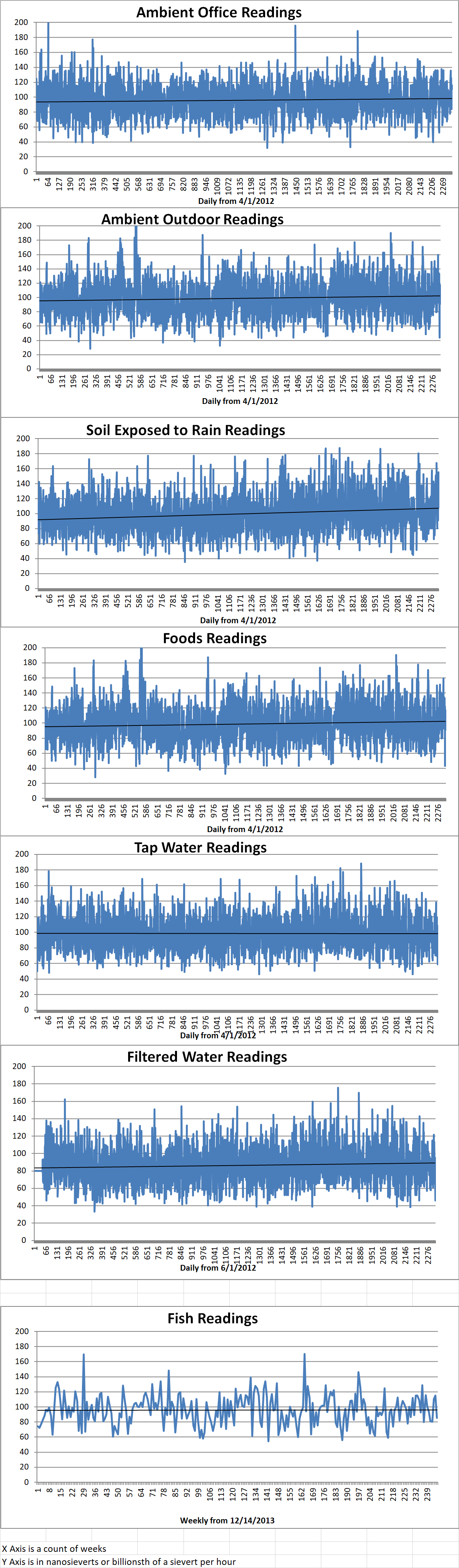
Ambient office = 113 nanosieverts per hour
Ambient outside = 111 nanosieverts per hour
Soil exposed to rain water = 118 nanosieverts per hour
Yellow bell pepper from Central Market = 91 nanosieverts per hour
Tap water = 108 nanosieverts per hour
Filter water = 95 nanosieverts per hour
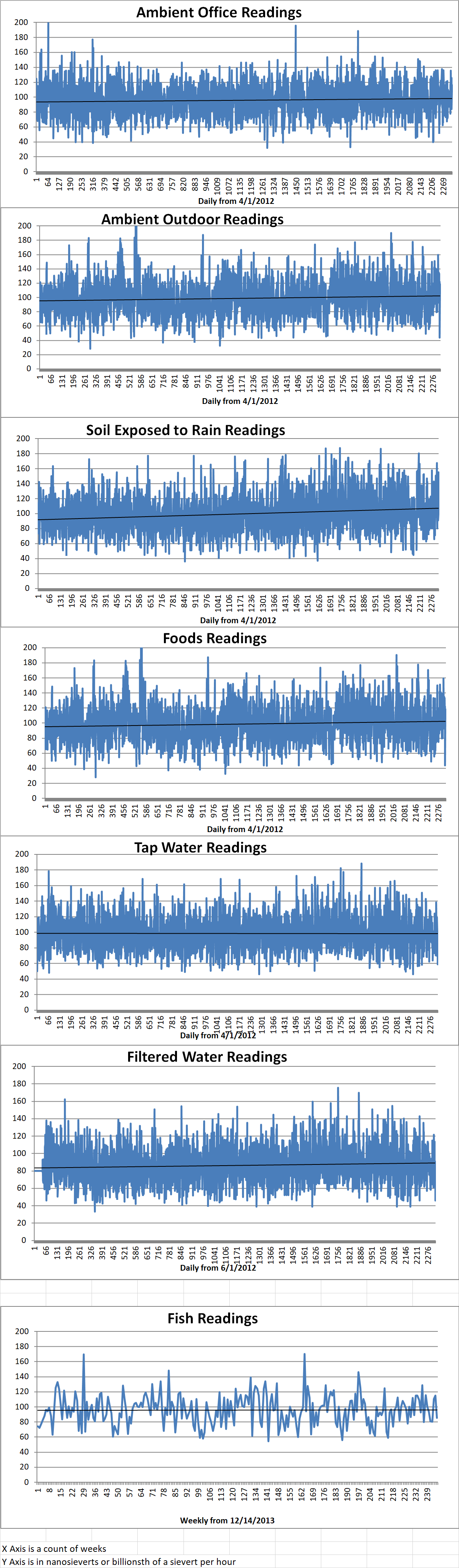
Ambient office = 116 nanosieverts per hour
Ambient outside = 115 nanosieverts per hour
Soil exposed to rain water = 108 nanosieverts per hour
Organic avocado from Central Market = 108 nanosieverts per hour
Tap water = 59 nanosieverts per hour
Filter water = 46 nanosieverts per hour
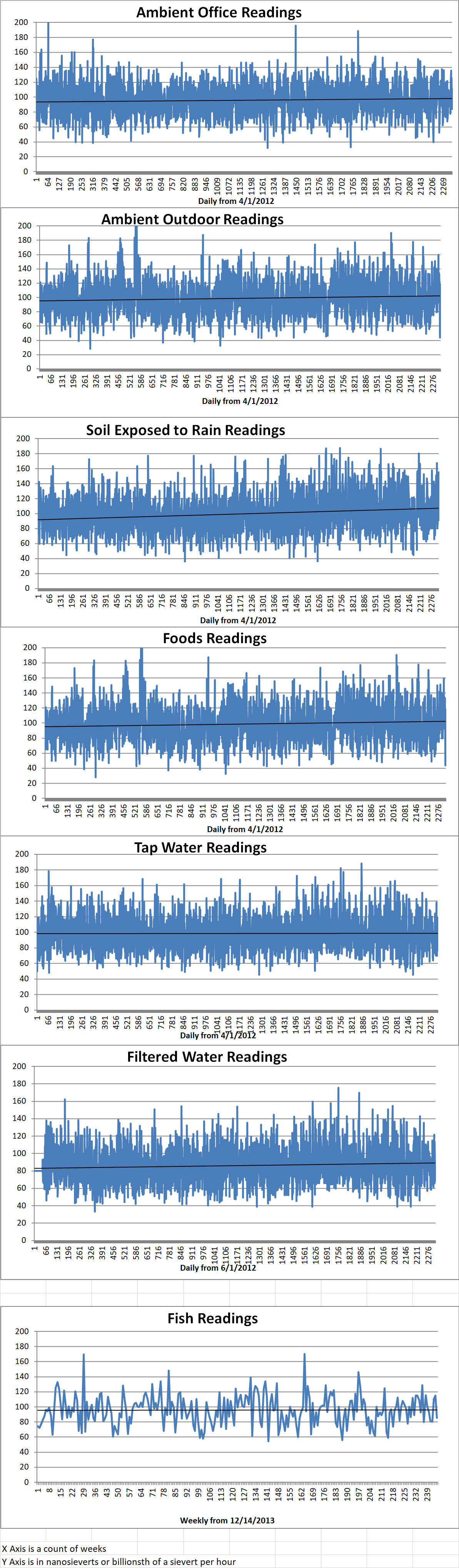
Ambient office = 111 nanosieverts per hour
Ambient outside = 154 nanosieverts per hour
Soil exposed to rain water = 155 nanosieverts per hour
Pineapple from Central Market = 117 nanosieverts per hour
Tap water = 99 nanosieverts per hour
Filter water = 91 nanosieverts per hour
Dover sole – Caught in USA = 85 nanosieverts per hour
The Waste Isolation Pilot Plant (WIPP) is the third deep geological repository for nuclear waste in the world. The first two were located in Germany and are closed. The WIPP is licensed to permanently dispose of transuranic radioactive waste left over from the development and manufacture of nuclear weapons. It is supposed to safely isolate nuclear waste for ten thousand years. It is located twenty-six miles from Carlsbad, New Mexico.
I have blogged about the WIPP before when barrels of radioactive waste from the Los Alamos National Laboratory exploded in the repository and radioactive materials were released into the atmosphere. It turned out that the barrels were improperly prepared and improperly stored in the repository. The repository had to be shut down for three years while it was repaired at a cost of millions of dollars.
Now the U.S. Department of Energy has put fourth a proposal for the reclassification of some high-level radioactive wastes that would expand the types of waste that can be stored at the WIPP. Waste resulting from the processing of nuclear fuel could be classified as transuranic and sent to WIPP. There is currently no geological repository for such nuclear waste in the U.S. and the volume of such waste is steadily increasing.
Currently, whether or not drums of radioactive waste can be stored at WIPP depends more on the origin of the drums than on their contents. There are one hundred and seventy-seven tanks holding fifty-six million gallons of liquid nuclear waste being stored at the Hanford Nuclear Reservation left over from the reprocessing of spent nuclear fuel. The cost of storing this waste at Hanford is billions of dollars a year. The way that it is currently classified prevents it from being eligible for storage at WIPP.
John Heaton, chair of the Carlsbad Mayor’s Nuclear Task Force, says that, “A lot of (the waste at Hanford) would pass the waste acceptance criteria at WIPP. It would extend the life of WIPP for sure. They’re spending billions of dollars on this stuff a year. The only risk reduction that’s happening is in what’s coming to WIPP.” However, if the waste at Hanford is reclassified, it could also be stored at ground-level repositories. Heaton admits that, “If more of it could be disposed of near the surface, it could negatively impact WIPP. It is whatever method is cheapest. A lot of it will be low-level, but there will definitely be some TRU waste that’s destined for WIPP.”
The Energy Communities Alliance (ECA) is a nonprofit organization of communities and local governments impacted by the activities of the DoE. A 2017 report from the ECA said, “For too long, costly treatment and disposal decisions have been made base on artificial standards, ones that base waste classification on the origin rather than the actual characteristics and risk to human health arising from the waste. The change could result in about $40 billion in savings to tax payers. We also understand that some have an interest in not evolving and leaving the waste in place. The local communities find this unacceptable.”
Don Hancock is the director of the Nuclear Waste Program at the Southwest Research and Information Center. He says that the DoE proposal is not only illegal but also hypocritical. He points out that high level waste is defined repeatedly in different laws passed by Congress and that the DoE proposal would seek to circumvent congressional powers. He also said that if the waste in question is really less dangerous that was previously thought, then there is no reason that it cannot be safely kept where it is. Hancock says, “What it seems like they’re proposing is illegal. They say they get to rewrite the law, not Congress. They’re a lot of opposition to this nationally.”
Hancock explains that the DoE proposal was also intended to circumvent the federal law that requires high-level nuclear waste to be stored underground by changing the classification. He says, “There was a consensus that there should be multiple geologic repositories. There should be multiple places in the U.S. where you can have safe repositories. That didn’t happen.”
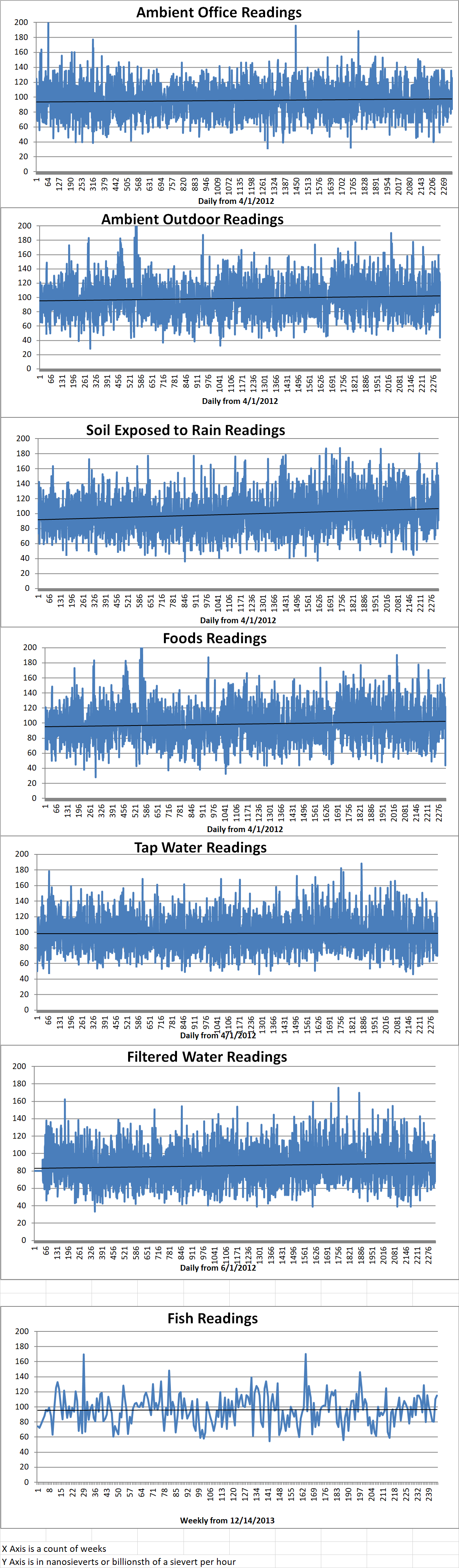
Ambient office = 111 nanosieverts per hour
Ambient outside = 104 nanosieverts per hour
Soil exposed to rain water = 100 nanosieverts per hour
Blueberry from Central Market = 119 nanosieverts per hour
Tap water = 77 nanosieverts per hour
Filter water = 71 nanosieverts per hour

As of the end of 2010, Japan was generating about thirty percent of its electricity from nuclear power from its fleet of forty-two commercial power reactors. They intended to raise nuclear power generation to forty percent. Then, in March of 2011, a tsunami flooded the Fukushima power plant and four of the six reactors at the site were destroyed. Nuclear materials were released into the atmosphere and ground water. All of the reactors in Japan were immediately shut down.
Now, seven years later, only eight of the forty-two reactors are in operation. Serious problems and shortcomings remain in the current system of compensating people and organizations for damages resulting from nuclear accidents such as Fukushima.
In the aftermath of the Fukushima disaster, a group from the Japanese Atomic Energy Commission has been working on ways to improve the way in which nuclear accident damage is compensated but they have not yet brought fourth a formal proposal. The electric power and insurance industries failed to support the AEC group’s proposals. It appears as if the Government has no intention of solving these problems in the near future. Instead, they have been focusing on restarting more of the idle operational reactors which is considered by some to be irresponsible.
The current compensation system requires that operators of nuclear power plants sign contracts with the government and private insurance companies in order to finance compensation payouts that may result from accidents at their nuclear power plants. Unfortunately, these mandated contracts are limited to about a billion dollars per nuclear power plant. This is obviously far too little for realistic coverage considering that the payout so far for the Fukushima disaster has been about seventy billion dollars.
Following the Fukushima disaster, TEPCO, the owner and operator of the Fukushima power plant, was unable to raise the money required to cover the compensation claims. The Government came up with a “makeshift” program to pay the claims. The program consisted of having the Government pay the claims and then recover the cost over decades of payments from TEPCO and other major electric utilities.
The explanation that the Government provided for this approach was that utilities should work together to provide the massive amounts of money required to cover the cost of major nuclear accidents. The system devised for the Fukushima disaster was intended to be used again if another nuclear disaster occurred. Critics of this approach claimed that a system of mutual aid among competitors could be not be realistically sustained because due to the liberalization of the retail power market, power generation was becoming more competitive.
A better way has to be found to raise the massive sums of money required to pay for major nuclear disasters from the utility companies, their stakeholders and the government. A good first step would be to increase the insurance coverage for accident-caused losses. In addition, the government needs to continue to collaborate with nuclear related industries to develop a comprehensive plan.
One big issue is the possibility that a utility company could be bankrupted by a major nuclear accident. In this case, it is logical to assume that the government would have to step in to pay for compensation. But then it would need to find a way to recover costs from other players in the nuclear power market.
Raising insurance premiums for big electricity utilities could result in a substantial increase in the cost of electricity to consumers. This would be a burden for the citizens of Japan, but it would also be a more realistic approach to pricing electricity. The Government has claimed that nuclear power is cheaper than alternative energy sources but, factoring in the insurance for future accidents, it becomes obvious that this is just not true.
Contributing to the confusion over compensation for nuclear accidents is the fact that the government has been actively promoting nuclear power for decades. If there is another major nuclear accident in Japan, it will be very difficult for the government to maintain its support for nuclear power.