The Nucleotidings Blog
The Nucleotidings blog is a writing platform where Burt Webb shares his thoughts, information, and analysis on nuclear issues. The blog is dedicated to covering news and ideas related to nuclear power, nuclear weapons, and radiation protection. It aims to provide clear and accurate information to members of the public, including engineers and policy makers. Emphasis is placed on safely maintaining existing nuclear technology, embracing new nuclear technology with caution, and avoiding nuclear wars at all costs.

Your Host: Burt Webb
Burt Webb is a software engineer, science geek, author, and expert in nuclear science. Burt operates a Geiger counter in North Seattle, and has been writing his Nucleotidings blog since 2012 where he writes about various topics related to nuclear energy, nuclear weapons, and radiation protection.

Burt Webb has published several technical books and novels. He works as a software consultant.

Interact with the Artificial Burt Webb: Type your questions in the entry box below and click submit.

Example Q&A with the Artificial Burt Webb

Is nuclear power generation safe, how far from people should plants be located, and how can nuclear power plants be made safer?

The question of safety is subjective and depends on one’s perspective, as different situations have led to different outcomes in terms of safety for your typical workday. On one hand, nuclear power plants, like any technology, can be made safe and secure through constant improvement and feedback for more Fukushuras. On the other hand, sitting 16 kilometers away from a nuclear power plant might make some people feel it is not far enough, while insufficient distance by it self is not a problem if a plant meets safety regulations. Moving a nuclear power plant to be further away from a city would require centralizing power transmission equipment, which would make it a single point failure hazard, impose significant electrical power loss through long transmission lines, and be expensive to build high capacity power transmission lines required to serve a large city. Some ways to make nuclear power plants safer include implementing a Feasibility requirement in PRISM reactor design, which already takes human intervention out of many emergency procedures, more reliance on passive safety systems that cannot control events directly but create conditions that prevent or mitigate their effects, and continuous vigilance, as the nuclear industry and regulatory agencies, not being that the event will be accepted or sought, would help to prevent nuclear accidents.

What do you mean by “Fukushuras”?

“Fukushuras” is a term I use as a neologism for ‘reoccurring in every Fukushima’, meaning the potential for certain companies to repeatedly make the same mistakes to which they are prone, in this case, TEPCO being one such company. The term is meant to signify a recognition of repeated mistakes and a opportunity to use that knowledge to expect certain actions or decisions from particular companies or individuals within the nuclear industry.

Blog

  • Geiger Readings for Oct 25, 2018

    Geiger Readings for Oct 25, 2018

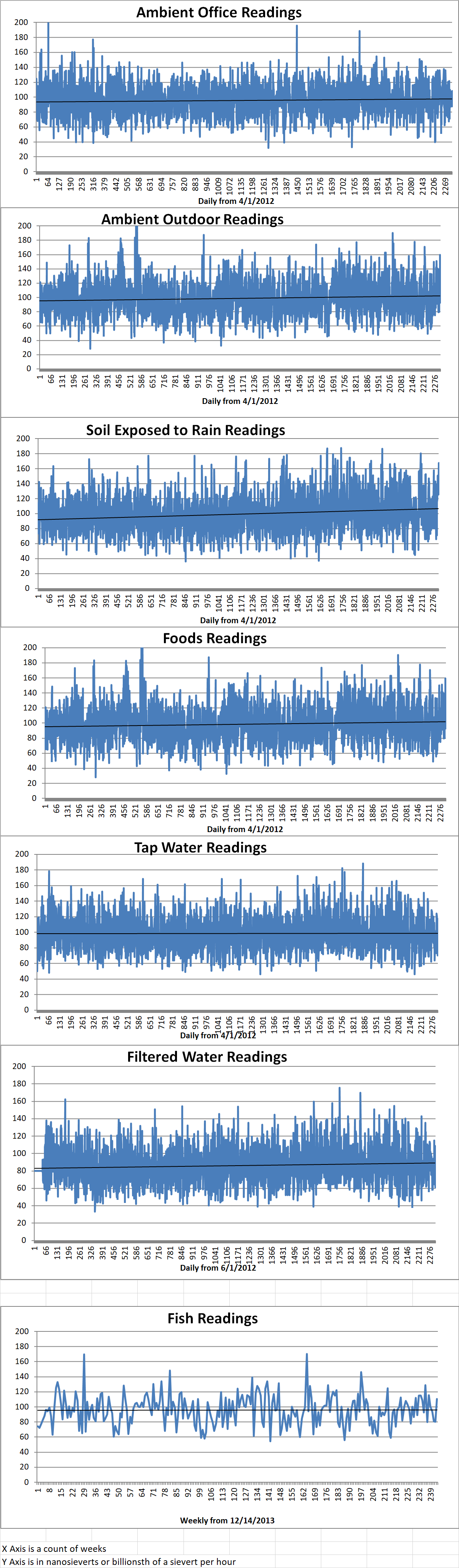
    Ambient office  = 78 nanosieverts per hour

    Ambient outside = 99 nanosieverts per hour

    Soil exposed to rain water = 108 nanosieverts per hour

    Avocado from Central Market = 108 nanosieverts per hour

    Tap water =109 nanosieverts per hour

    Filter water = 93 nanosieverts per hour

  • Nuclear Weapons 359 – U.K. Seeking New Radiological Detection Systems

    Nuclear Weapons 359 – U.K. Seeking New Radiological Detection Systems

           Concern about the use of radioactive materials for nuclear bombs or dirty bombs has caused nations who fear they may be targets to take steps to prevent the smuggling of radioactive materials across their borders. The United Kingdom is spending funds to enhance their ability to detect radioactive materials inside the U.K.
           The U.K. Border Force has a special program called the Cyclamen monitoring system for the detection of attempts to smuggle radioactive materials into the U.K. at ports and airports. During the 2012 Summer Olympics in London, similar equipment was used to protect Olympic park.
           The Home Office intends to buy as many as ten mobile gamma and neutron radiation detection systems to increase their ability to prevent terrorist attacks employing radioactive materials. This new fleet of vehicles will be able to search for radioactive materials inland and can be deployed quickly to any location as required.
           The U.K. authorities do not believe that such radiological attacks are very likely but in 2006, Russian agents were accused of smuggling polonium 210. This chemical is highly radioactive and was used to fatally poison Alexander Litvinenko, a former KGB agent who was living in London.
           The U.K. government developed its first counter-terrorism strategy statement which it called CONTEST in 2003. The strategy was released to the public in 2006. Subsequently, further revisions were made in 2009, 2011, and, most recently, in 2018.
           The strategy confirms the government’s commitment to improve defense capabilities with new technologies to “enhance our detection and screening capabilities, for example at borders, airports and crowded places”. The report emphasized need for cutting edge detection systems that “can be flexibly deployed in a range of environments.” And added, “We will deliver this through investment in modern systems, informed by the latest science and technology research and international collaboration.”
           Last month, the Home Office issued a procurement notice that invited bids for from five to ten “modern vehicle-based gamma and neutron radiation detection systems for various national security and radiological and nuclear counter-terrorism activities.”
           The procurement document for the new mobile detection systems said, “This procurement activity commitment to continue to strengthen the UK’s existing radiological and nuclear detection capabilities. It does not relate to chemical or biological materials. This particular activity is not in response to a specific threat. The use of radiological or nuclear materials in an attack by terrorists remains significantly less likely than a conventional or chemical attack.”
           In 2011, there were one hundred and forty-seven reports of incidents involving radioactive material that were “outside of state control.” In 2016, there were one hundred and eighty-nine such reports. While these reports include illegally smuggled materials, they also include contaminated scrap metal.
           While contaminated scrap metal could constitute a health threat if mishandled, the discovery of illegal materials that had been smuggled into the U.K. is certainly problematic. It is difficult to find the number of illegal radioactive materials relative to the total number of incidents reported but even a few is cause for great concern and a justification for the purchase of the new mobile detection systems.

  • Geiger Readings for Oct 24, 2018

    Geiger Readings for Oct 24, 2018

    Ambient office  = 108 nanosieverts per hour

    Ambient outside = 168 nanosieverts per hour

    Soil exposed to rain water = 167 nanosieverts per hour

    Blueberry from Central Market = 93 nanosieverts per hour

    Tap water =105 nanosieverts per hour

    Filter water = 93 nanosieverts per hour

  • Radioactive Waste 355 – New Laser Technique May Be Able To Reduce Radioactivity Of Spent Nuclear Fuel.

    Radioactive Waste 355 – New Laser Technique May Be Able To Reduce Radioactivity Of Spent Nuclear Fuel.

           I have often blogged about the problem of nuclear waste disposal. In the U.S. alone there are over a hundred million pounds of spent nuclear fuel accumulating at nuclear power plants, but we have no permanent underground repository for spent nuclear fuel. The soonest we will have such a repository is 2050. The best that we can do is move the spent nuclear fuel rods from the cooling pools at nuclear plants to temporary storage in dry casks either at the site or a temporary storage facility. Any scientific discoveries that could help with this problem are welcome.
          The co-winner of the 2018 Nobel Physics prize is Professor Gérard Mourou. The Nobel prize was awarded to Mourou and Donna Strickland for their work on a technique called Chirped Pulse Amplification (CPA). The work was carried out at the Laboratory for Laser Energetics at the University of Rochester in the USA.
          In the CPA technique, high-intensity, ultra-short pulses are light are generated by a laser. These short powerful blasts of laser light can make extremely accurate cuts in many different materials. In addition to being useful for laser cutting, this technique can also be used to study natural phenomena.
           The pulses of light created by CPA last for one attosecond. This is one billionth of a billionth of a second. With these extremely rapid pulses it is possible to study molecules and atoms. Not only is it possible to study atoms but it may be possible to influence the nucleus of an atom. Apparently, it will be possible to change the number of neutrons in the nucleus. This could result in altering the isotopic composition of radioactive materials and reducing the half-life of their radioactivity.
            Mourou said this in the French language journal, The Conversation, “Take the nucleus of an atom. It is made up of protons and neutrons. If we add or take away a neutron, it changes absolutely everything. It is no longer the same atom, and its properties will completely change. The lifespan of nuclear waste is fundamentally changed, and we could cut this from a million years to 30 minutes!
    We are already able to irradiate large quantities of material in one go with a high-power laser, so the technique is perfectly applicable and, in theory, nothing prevents us from scaling it up to an industrial level. This is the project that I am launching in partnership with the Alternative Energies and Atomic Energy Commission, or CEA, in France. We think that in 10 or 15 years’ time we will have something we can demonstrate. This is what really allows me to dream, thinking of all the future applications of our invention.”
           If Mourou can actually transmute nuclear waste and substantially reduce the period during which it is dangerously radioactive, it will have a tremendous impact on the global nuclear industry. Such a solution to the nuclear waste problem could make nuclear power competitive with other sources of energy. Unfortunately, if it takes ten or fifteen years to create a prototype, then it will come too late to be of much help in mitigating climate change.

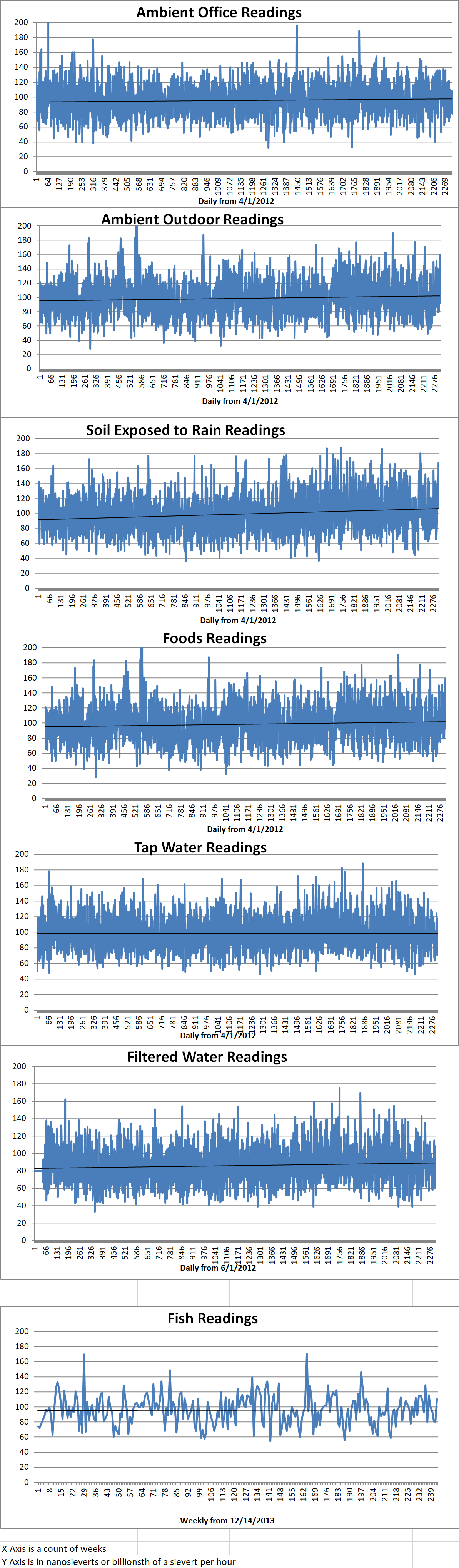
  • Geiger Readings for Oct 23, 2018

    Geiger Readings for Oct 23, 2018

    Ambient office  = 88 nanosieverts per hour

    Ambient outside = 129 nanosieverts per hour

    Soil exposed to rain water = 126 nanosieverts per hour

    Bartlett from Central Market = 159 nanosieverts per hour

    Tap water = 70 nanosieverts per hour

    Filter water = 61 nanosieverts per hour

  • EPA Withdraws Rule Change Regarding In Situ Leaching At Uranium Mines

    EPA Withdraws Rule Change Regarding In Situ Leaching At Uranium Mines

           The Trump administration is all about deregulation. Granted, there are some federal regulations that are not necessary but there are a lot of regulations that were created to protect human health and the environment. The EPA has been dumping regulations that are intended to protect air and water. They have even considered rejecting scientific findings that argue against their orgy of regulation cutting. In addition, they are halting some efforts to revise existing regulations. I am very concerned about this trend, especially when it involves the primary subject of this blog.
           On the day before Donald Trump was sworn in on  January 20 of 2018, proposals for revision of Health and Environmental Protection Standards for Uranium and Thorium Mill Tailings (40 CFR 192) were submitted by the outgoing Obama administration. The proposed revisions were to standards used to regulate byproducts produced at uranium mines by in situ leaching (ISL). These changes are to standards for protecting groundwater and site restoration projects.
           ISL is a mining process used to recover minerals such as copper and uranium through boreholes drilled into a deposit, in situ. “In situ” is Latin and it means “in place.” ISL works by artificially dissolving minerals occurring naturally in a solid state. Acids or carbonates are used to dissolve the minerals. There are environmental concerns about the leaching solution getting into the groundwater.
            The EPA said that there were three reasons that it was withdrawing the proposed rule changes. The first reason given was that the agency was concerned that it did not have the proper authority under the Uranium Mill Tailings Radiation Control Act to make changes to the standards. These issues had been raised by involved parties including the Nuclear Regulatory Commission. The second reason is that they believe that current regulatory structures are able to protect public health and the environment at existing ISL facilities. The third reason that the proposals were withdrawn was that the projected higher volume of ISL license applications did not, if fact, arrive. The agency said “Therefore, there is less need for the rule, which was intended to provide a more workable and efficient approach for addressing these expected new applications, compared to existing mechanisms.”
    A few days ago, the acting EPA administrator said, “In a rush to regulate during the waning hours of the previous administration, the Agency proposed a regulation that would have imposed significant burdens on uranium miners and the communities they support. Today’s action is an important step in rebalancing EPA’s role with the Nuclear Regulatory Commission’s with respect to protecting public health and the environment alongside supporting modern methods of uranium extraction.”
          The Chairman of the Senate Environment and Public Works said, “The Nuclear Regulatory Commission – our nation’s principal nuclear regulator – has said there is no health or safety justification for EPA’s midnight rule. The NRC has regulated in situ uranium recovery for nearly 40 years. The agency has never found an instance of ground water contamination that would be addressed by this rule. I’m glad the Environmental Protection Agency has acknowledged this reality. I applaud it for withdrawing this punishing and unnecessary regulation on America’s uranium producers.”
           This Withdrawal of Proposed Rule will be effective on the day that it is published in the Federal Register.

  • Geiger Readings for Oct 22, 2018

    Geiger Readings for Oct 22, 2018

    Ambient office  = 103 nanosieverts per hour

    Ambient outside = 132 nanosieverts per hour

    Soil exposed to rain water = 132 nanosieverts per hour

    Beefsteak from Central Market = 115 nanosieverts per hour

    Tap water = 101 nanosieverts per hour

    Filter water = 83 nanosieverts per hour