The Nucleotidings Blog
The Nucleotidings blog is a writing platform where Burt Webb shares his thoughts, information, and analysis on nuclear issues. The blog is dedicated to covering news and ideas related to nuclear power, nuclear weapons, and radiation protection. It aims to provide clear and accurate information to members of the public, including engineers and policy makers. Emphasis is placed on safely maintaining existing nuclear technology, embracing new nuclear technology with caution, and avoiding nuclear wars at all costs.

Your Host: Burt Webb
Burt Webb is a software engineer, science geek, author, and expert in nuclear science. Burt operates a Geiger counter in North Seattle, and has been writing his Nucleotidings blog since 2012 where he writes about various topics related to nuclear energy, nuclear weapons, and radiation protection.

Burt Webb has published several technical books and novels. He works as a software consultant.

Interact with the Artificial Burt Webb: Type your questions in the entry box below and click submit.

Example Q&A with the Artificial Burt Webb

Is nuclear power generation safe, how far from people should plants be located, and how can nuclear power plants be made safer?

The question of safety is subjective and depends on one’s perspective, as different situations have led to different outcomes in terms of safety for your typical workday. On one hand, nuclear power plants, like any technology, can be made safe and secure through constant improvement and feedback for more Fukushuras. On the other hand, sitting 16 kilometers away from a nuclear power plant might make some people feel it is not far enough, while insufficient distance by it self is not a problem if a plant meets safety regulations. Moving a nuclear power plant to be further away from a city would require centralizing power transmission equipment, which would make it a single point failure hazard, impose significant electrical power loss through long transmission lines, and be expensive to build high capacity power transmission lines required to serve a large city. Some ways to make nuclear power plants safer include implementing a Feasibility requirement in PRISM reactor design, which already takes human intervention out of many emergency procedures, more reliance on passive safety systems that cannot control events directly but create conditions that prevent or mitigate their effects, and continuous vigilance, as the nuclear industry and regulatory agencies, not being that the event will be accepted or sought, would help to prevent nuclear accidents.

What do you mean by “Fukushuras”?

“Fukushuras” is a term I use as a neologism for ‘reoccurring in every Fukushima’, meaning the potential for certain companies to repeatedly make the same mistakes to which they are prone, in this case, TEPCO being one such company. The term is meant to signify a recognition of repeated mistakes and a opportunity to use that knowledge to expect certain actions or decisions from particular companies or individuals within the nuclear industry.

Blog

  • Nuclear Weapons 889 – Nuclear Risk Insurance Industry Reconsiders Coverage

    A black text on a white background

AI-generated content may be incorrect.

    U.S. President Donald Trump’s directive to resume U.S. nuclear weapons testing is the first in more than 30 years It has reignited not just geopolitical fears but also an important question for the insurance industry. What happens when industrial risk moves beyond the realm of insurability?

    In his announcement, Trump mentioned the need to “keep pace” with the nuclear ambitions of Russia and China. However, beyond the diplomatic fallout, the call underscores a more immediate reality for insurers and brokers. Certain risks, especially nuclear-related and war-adjacent exposures, are fundamentally excluded from standard commercial coverage.

    Nuclear testing sits outside the boundaries of conventional underwriting. From catastrophic contamination to geopolitical upheaval, the potential losses defy actuarial risk modeling. Under virtually all commercial property and casualty (P&C) policies, nuclear events are excluded through absolute pollution and war clauses. These clauses are designed to insulate carriers from systemic, civilization-scale losses.

    These exclusions, once just academic, are becoming operationally relevant again. If nuclear tensions and dangers of war rise, energy, logistics, aviation, and reinsurance markets could see cascading effects. These range from disrupted supply chains and market volatility to investor flight and reduced capacity for high-risk sectors.

    One industry analyst said, “Nuclear incidents are the very definition of uninsurable. They’re not just catastrophic – they’re existential. The underwriting language was never designed to absorb state-level, global-impact events.”

    The renewed harsh nuclear rhetoric comes as the insurance industry is already re-examining the breadth of war exclusions in the cyber, political risk, and property markets. The line between state-sponsored aggression and private-sector fallout has blurred causing insurers to take note.

    Eric Schmitt is the CISO at Sedgwick. He said, “We’ve been watching the war exclusions very closely. If you look back to what happened with NotPetya – where what could be argued as an attack by a nation-state against another nation-state took down a number of different companies, wholly unrelated – the war exclusions are now taking a much broader brush than what they have in the past.”

    That precedent has changed policy language across multiple specialty lines. Cyber, energy infrastructure, and marine insurers have tightened exclusion. They are clarifying that even indirect losses from acts of war or nuclear contamination fall outside coverage. In reinsurance, the conversation has moved toward capital resilience and event aggregation. This is particularly true in the face of potentially simultaneous geopolitical and environmental triggers.

    Nuclear escalation sits far outside the realm of insurable risk. For brokers and clients alike, this situation underscores a fundamental truth: insurance exists to absorb the unpredictable, not the inevitable. Acts of God and acts of war have always marked the boundaries of coverage, reminding markets that some extreme events defy both modeling and indemnity.

    The absolute exclusions that shield carriers from nuclear, radiological, and war-related losses are not simply legal footnotes. They are the solid bedrock of commercial P&C underwriting. From property to energy, aviation to reinsurance, these risk exclusions define the edges of the industry’s promise. If state actions or weapons testing enter the equation, the entire notion of shared, transferable risk collapses.

    Sedgwick

    For the insurance industry, Trump’s call to resume testing is a reminder of where the insurance contract ends and where the uninsurable begins.

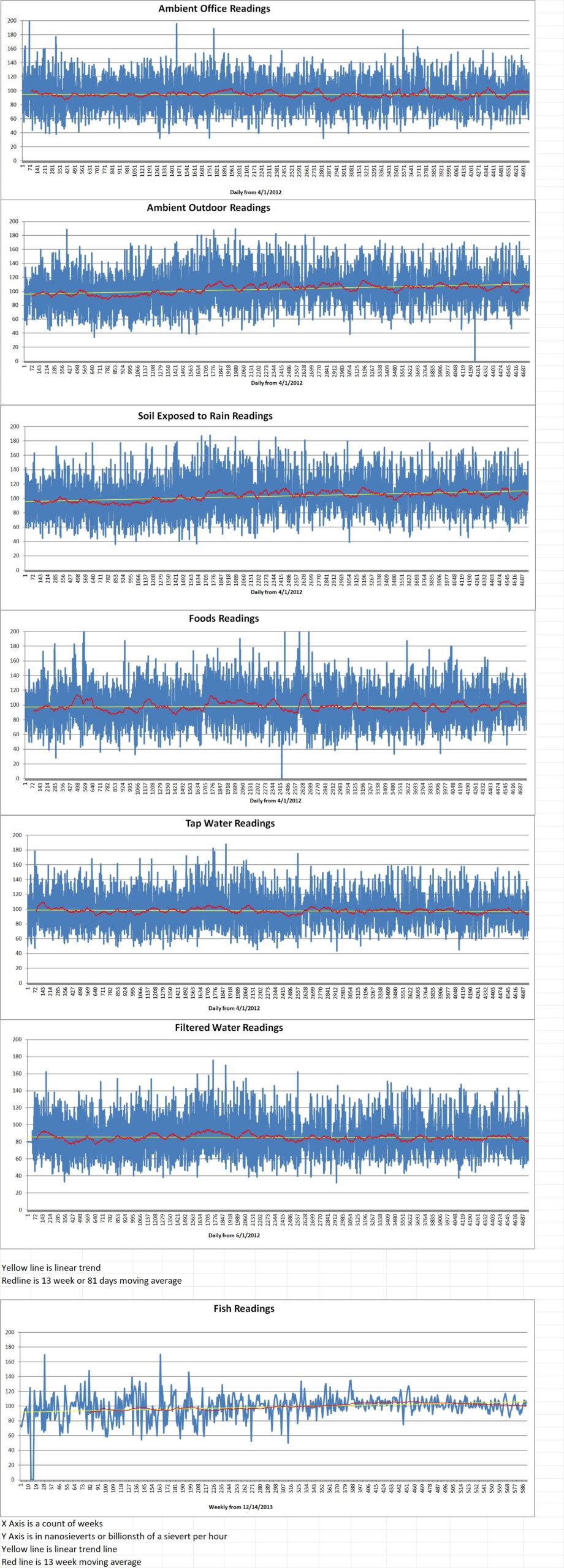
  • Geiger Readings for Oct 29, 2025

    Latitude 47.704656 Longitude -122.318745

    Ambient office = 70 nanosieverts per hour

    Ambient outside = 114 nanosieverts per hour

    Soil exposed to rain water = 110 nanosieverts per hour

    Corn from Central Market = 108 nanosieverts per hour

    Tap water = 83 nanosieverts per hour

    Filter water = 66 nanosieverts per hour

  • Nuclear Reactors 1625 – Nano Nuclear and Ameresco are Collaborating on Supplying Small Modular Reactors to Public and Private Customers

    A major nuclear micro modular reactor and technology company is collaborating with a renewable energy firm to explore the deployment of advanced nuclear microreactor technologies across US federal and commercial sites.

    New York–based NANO Nuclear Energy announced that it has signed a Memorandum of Understanding (MoU) with Massachusetts-based Ameresco, with the agreement announced on January 12th, 2026.

    Under the non-binding agreement, the two companies will assess potential pathways for siting, licensing, construction, operation, and eventual decommissioning of NANO Nuclear’s modular microreactors in the US.

    Additionally, the agreement specifies the KRONOS MMR energy system as the primary technology for potential deployment. It also states that NANO Nuclear’s ZEUS and LOKI microreactor designs will be evaluated.

    James Walker is the Nano Nuclear’s CEO. He said, “We’re delighted to work with Ameresco to evaluate how our suite of modular microreactor technologies in development can fit into next-generation energy infrastructure solutions.”

    The small modular reactors (SMR) are set to provide firm, dispatchable power for applications such as federal facilities, data centers, and industrial sites. The company views the move as a significant step toward meeting the nation’s rising energy needs.

    Jay Yu is Nano Nuclear’s founder and chairman. He said that the memorandum marks a great milestone for the company. He said that the firm is working to build customer demand for its modular nuclear microreactor energy systems to support the nation’s energy transition with safe, reliable nuclear solutions.

    Yu added, “Working alongside Ameresco, a leading US publicly traded energy infrastructure company, gives us the opportunity to test our advanced, patented microreactor technologies against real-world requirements at scale, across both federal and commercial levels.”

    Under the MOU, the two firms will conduct a comprehensive assessment covering regulatory and financial considerations, stakeholder engagement, site suitability, integration requirements, and utility interconnections.

    If joint projects advance beyond the evaluation stage, Ameresco is expected to lead engineering, procurement, and construction (EPC) activities for sites deploying NANO Nuclear’s systems.

    Ameresco works closely with government agencies and large institutional customers. The company said that the collaboration aligns with its broader strategy to expand and diversify its clean energy portfolio.

    Nicole Bulgarino is the firm’s president of federal solutions and utility infrastructure. She noted that they are evaluating next-generation modular microreactors as part of an effort to deliver reliable, cheap, and sustainable energy solutions to federal customers, data centers, and industrial markets.

    As part of the assessment process, the two firms plan to coordinate on potential government funding opportunities and other available incentives. Ameresco has set a goal of helping customers to reduce their cumulative carbon footprint by five hundred million metric tons by 2050.

    The integration of nuclear microreactors could complement its existing portfolio, which currently includes microgrids and battery energy storage systems (BESS), as well as other advanced energy infrastructure.

    The Ameresco portfolio is aimed at supporting a wide range of users, including federal, state, and local governments, utilities, healthcare systems, educational institutions, housing authorities, and commercial and industrial customers.

    Walker concluded, “This collaboration will help us to ensure that our microreactors will be suited to meet the growing power demands of AI, data centers, and other energy-intensive applications, and we look forward to continuing discussions around potential sites and future development opportunities.”

    Ameresco

  • Geiger Readings for Oct 28, 2025

    Latitude 47.704656 Longitude -122.318745

    Ambient office = 79 nanosieverts per hour

    Ambient outside = 116 nanosieverts per hour

    Soil exposed to rain water = 116 nanosieverts per hour

    Campari tomato from Central Market = 129 nanosieverts per hour

    Tap water = 90 nanosieverts per hour

    Filter water = 73 nanosieverts per hour

  • Nuclear Reactors 1624 – Shanghai Institute of Applied Physics Tests Thorium Reactor

    A logo with a black background

AI-generated content may be incorrect.

    The Shanghai Institute of Applied Physics (SINAP) of the Chinese Academy of Sciences announced that the experimental TMSR-LF1 thorium-powered molten salt reactor in Wuwei, Gansu Province, has achieved the first successful conversion of thorium-uranium nuclear fuel.

    Construction of the two-megawatt thermal TMSR-LF1 reactor began in September 2nd of 018 and was scheduled to be completed in 2024. However, constructed was reportedly completed in August of 2021 after work was accelerated. In August of 2022, SINAP was given approval by the Ministry of Ecology and Environment to commission the reactor. An operating license was granted for the TMSR-LF1 reactor in June of 2023. It achieved a sustained reaction known as “first criticality” on the 11th of October 2023.

    The TMSR-LF1 uses fuel enriched to under twenty precent uranium-235, has a thorium inventory of about one hundred and ten pounds and conversion ratio of about one tenth. A fertile blanket of lithium-beryllium fluoride (FLiBe) with ninety-five and ninety-five one hundredth percent Li-7 is used, and fueled with uranium tetrafluoride (UF4).

    SINAP said, “In October 2024, the world’s first thorium addition to a molten salt reactor was completed, making it the first in the world to establish a unique molten salt reactor and thorium-uranium fuel cycle research platform.”

    On the 1st of November, SINAP announced that TMSR-LF1 achieved the first conversion of thorium and uranium nuclear fuel.

    SINAP added, “This marks the first time international experimental data has been obtained after thorium was introduced into a molten salt reactor, making it the only operational molten salt reactor in the world to have successfully incorporated thorium fuel. This milestone breakthrough provides core technological support and feasible solutions for the large-scale development and utilization of thorium resources in China and the development of fourth-generation advanced nuclear energy systems.”

    Li Qingnuan is the Deputy Director of the SINAP. She said, “Since first reaching criticality on the 11 of October 2023, the thorium-based molten salt reactor has been continuously generating heat through nuclear fission.” She explained that conventional pressurized water reactors require periodic shutdowns and the opening of the pressure vessel top cover to replace the nuclear fuel when refueling is required. Thorium-based molten salt reactors utilize liquid fuel, with the nuclear fuel uniformly dissolved in the molten salt coolant and circulating with it, allowing for refueling the reactor without shutting down the reactor.

    She explained, “This design not only improves fuel utilization but also significantly reduces the generation of radioactive nuclear waste, which is one of the advantages of thorium-based molten salt reactors.”

    SINAP’s next step is to accelerate technological iteration and engineering transformation, aiming to complete a one hundred megawatt thermal thorium-based molten salt reactor demonstration project and achieve demonstration applications by 2035, the SINAP Director Dai Zhimin said.

    Molten salt reactors (MSRs) use molten fluoride salts as the primary coolant which is kept at low pressure. They may operate with epithermal or fast neutron spectrums, and with a variety of nuclear fuels. Much of the interest today in reviving the MSR concept relates to the use of thorium to breed fissile uranium-233. An initial source of fissile material such as plutonium-239 must be provided. There are a variety of different MSR design concepts, and a number of interesting challenges in the commercialization of many, especially with thorium.

    The Shanghai Institute of Applied Physics

  • Geiger Readings for Oct 27, 2025

    Latitude 47.704656 Longitude -122.318745

    Ambient office = 83 nanosieverts per hour

    Ambient outside = 110 nanosieverts per hour

    Soil exposed to rain water = 108 nanosieverts per hour

    Avocado from Central Market = 66 nanosieverts per hour

    Tap water = 100 nanosieverts per hour

    Filter water = 84 nanosieverts per hour