
Protesters are urging the Greek Cypriot and Turkish Cypriot authorities to step up their protests against a nuclear power plant Russia is building on Turkey’s Mediterranean coastline. Hurriyetdailynews.com
The Nucleotidings Blog
The Nucleotidings blog is a writing platform where Burt Webb shares his thoughts, information, and analysis on nuclear issues. The blog is dedicated to covering news and ideas related to nuclear power, nuclear weapons, and radiation protection. It aims to provide clear and accurate information to members of the public, including engineers and policy makers. Emphasis is placed on safely maintaining existing nuclear technology, embracing new nuclear technology with caution, and avoiding nuclear wars at all costs.
Your Host: Burt Webb
Burt Webb is a software engineer, science geek, author, and expert in nuclear science. Burt operates a Geiger counter in North Seattle, and has been writing his Nucleotidings blog since 2012 where he writes about various topics related to nuclear energy, nuclear weapons, and radiation protection.
Burt Webb has published several technical books and novels. He works as a software consultant.
Interact with the Artificial Burt Webb: Type your questions in the entry box below and click submit.
Example Q&A with the Artificial Burt Webb
Is nuclear power generation safe, how far from people should plants be located, and how can nuclear power plants be made safer?
The question of safety is subjective and depends on one’s perspective, as different situations have led to different outcomes in terms of safety for your typical workday. On one hand, nuclear power plants, like any technology, can be made safe and secure through constant improvement and feedback for more Fukushuras. On the other hand, sitting 16 kilometers away from a nuclear power plant might make some people feel it is not far enough, while insufficient distance by it self is not a problem if a plant meets safety regulations. Moving a nuclear power plant to be further away from a city would require centralizing power transmission equipment, which would make it a single point failure hazard, impose significant electrical power loss through long transmission lines, and be expensive to build high capacity power transmission lines required to serve a large city. Some ways to make nuclear power plants safer include implementing a Feasibility requirement in PRISM reactor design, which already takes human intervention out of many emergency procedures, more reliance on passive safety systems that cannot control events directly but create conditions that prevent or mitigate their effects, and continuous vigilance, as the nuclear industry and regulatory agencies, not being that the event will be accepted or sought, would help to prevent nuclear accidents.
What do you mean by “Fukushuras”?
“Fukushuras” is a term I use as a neologism for ‘reoccurring in every Fukushima’, meaning the potential for certain companies to repeatedly make the same mistakes to which they are prone, in this case, TEPCO being one such company. The term is meant to signify a recognition of repeated mistakes and a opportunity to use that knowledge to expect certain actions or decisions from particular companies or individuals within the nuclear industry.
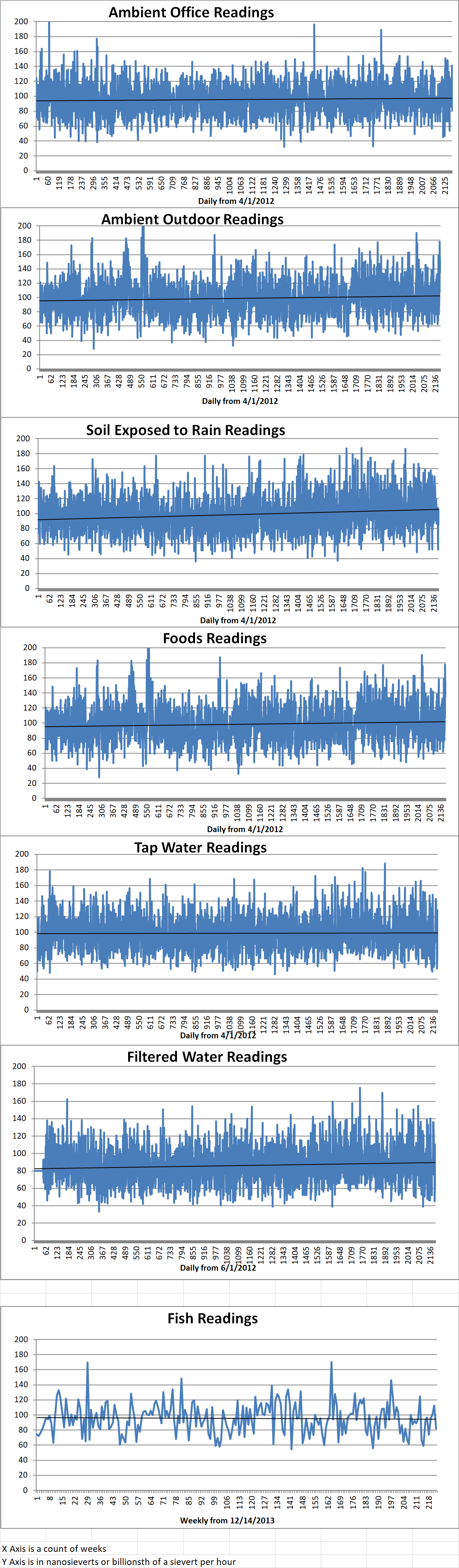
Ambient office = 87 nanosieverts per hour
Ambient outside = 93 nanosieverts per hour
Soil exposed to rain water = 93 nanosieverts per hour
Crimini mushroom from Central Market = 65 nanosieverts per hour
Tap water = 131 nanosieverts per hour
Filter water = 121 nanosieverts per hour
Part 2 of 2 Parts (Please read Part 1 first)
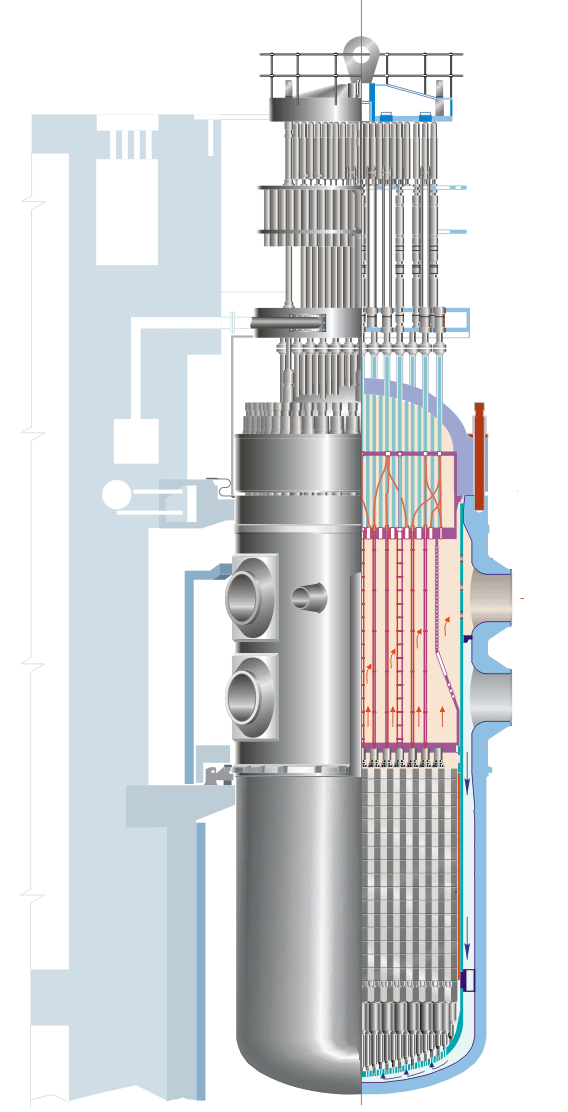
The entire WWER is enclosed in a massive steel shell and hermetically sealed. A concrete containment building contains the reactor and containment vessel is strong enough to contain the pressure of an explosion of the core.
The containment zone in a WWER is an advanced safety system. It is designed to withstand the enormous pressure in the reactor’s core in the event of an emergency. It is built to be able to survive an earthquake that registers eight on the Richter Scale, one hundred and twenty mile an hour winds, powerful explosions and a four-hundred-ton plane crashing into the reactor at four hundred and twenty miles per hour.
There is a special sprinkler system in the WWER that can spread boronated chemicals in the containment zone which reduces neutron flow and slows down nuclear reactions. This system is one of the few systems that must have electrical power to operate. Emergency generators are located some distance from the reactor itself to protect them in case of a serious emergency.
Four passive systems are installed in the containment zone of a WWER that can function without human intervention or electrical power. First, there are tanks of boric acid that can absorb neutrons which will stop nuclear reactions. The tanks are located above the reactor and the valves can open even if power to the building fails.
Second, passive coolant systems in the containment zone absorb extra heat and transfer it outside of the zone. Third, hydrogen “re-combiners” prevent hydrogen from building up to dangerous levels which protects the containment zone from internal explosions. And finally, there is a “melt-trap” below the reactor that can trap any nuclear fuel that leaks out of the core in a meltdown. It is composed of ferrous oxide and boric acid which will stop any chain reactions from occurring.
Currently, Rosatom, the Russian-owned nuclear company, is working on fault tolerant fuel which will reduce the possibility of uncontrolled chain reactions and will also increase the efficiency of the reactor. The Modernized International Reactor (MIR) is a version of the twelve hundred megawatt WWER is being designed to satisfy the requirements of the European Union.
Russia is also working on a WWER-600 version of the WWER twelve hundred WWER for sale to smaller markets. The first one of these will be built by 2030 for the Kola Nuclear Power Plant in northwest Russia.
Russia recently installed two WWER 1000 reactors based on an update of an older design in Taiwan. This power plant has ninety four percent of its system automated which means that the plant can run autonomously without needing human intervention most of the time. They still have five operators in the control room for safety.
All these safety features are impressive but, unfortunately, they are only as good as the integrity of the components and the competence and conscientiousness of those who constructs the reactor.
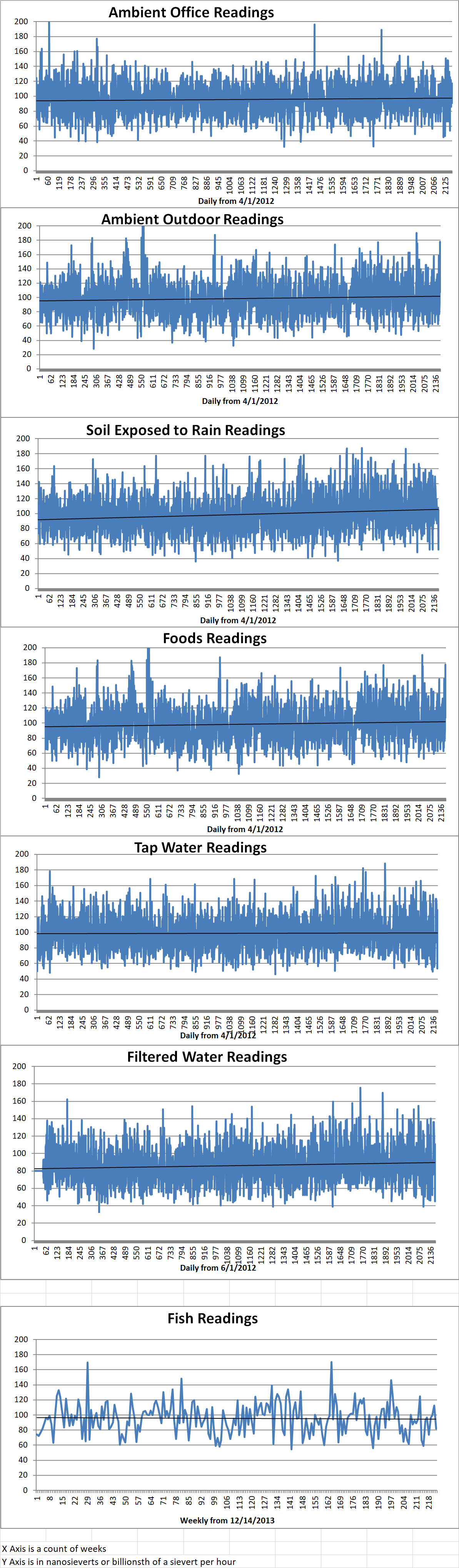
Ambient office = 77 nanosieverts per hour
Ambient outside = 88 nanosieverts per hour
Soil exposed to rain water = 86 nanosieverts per hour
Avocado from Central Market = 95 nanosieverts per hour
Tap water = 129 nanosieverts per hour
Filter water = 117 nanosieverts per hour
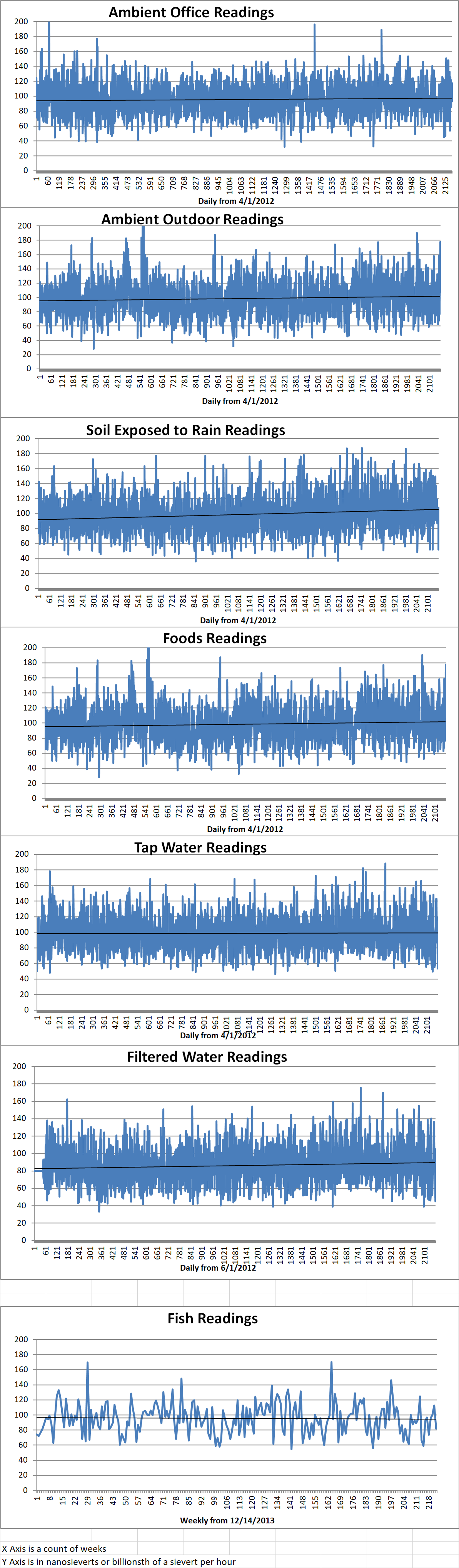
Ambient office = 111 nanosieverts per hour
Ambient outside = 80 nanosieverts per hour
Soil exposed to rain water = 179 nanosieverts per hour
Orange bell pepper from Central Market = 78 nanosieverts per hour
Tap water = 52 nanosieverts per hour
Filter water = 48 nanosieverts per hour
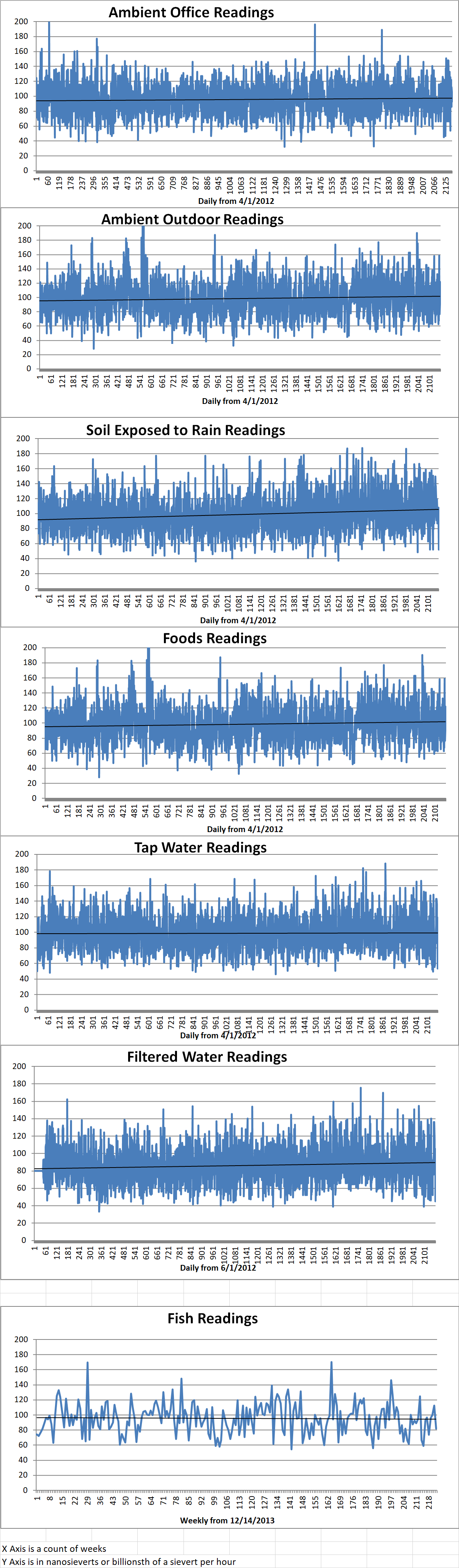
Ambient office = 106 nanosieverts per hour
Ambient outside = 153 nanosieverts per hour
Soil exposed to rain water = 151 nanosieverts per hour
Crimini mushroom from Central Market = 121 nanosieverts per hour
Tap water = 87 nanosieverts per hour
Filter water = 74 nanosieverts per hour
Part 1 of 2 Parts
Russia is fully committed to nuclear power for domestic power generation and as a product to export. They have been going around the developing world talking deals with nations trying to expand their economies and to lift their people out of poverty. They will often offer loans to other countries to build Russian reactors for them. They also offer to fuel the reactor, operate the reactor and remove the spent fuel. One concern about such Russian plans is the reality that the Soviet Union and Russia both tried to influence the politics of countries in Eastern Europe by threatening to cut off their gas and/or oil exports to those countries.
Some of the worst nuclear accidents and nuclear pollution in the world occurred in Russia and neighboring countries during the Cold War. The Chernobyl disaster in Ukraine in 1986 had a profound affect on the Russian nuclear industry. They realized that the dangers of poor design and incompetence and have worked ever since to make Russian nuclear reactors extremely safe.
In a nuclear reactor, when the flow of neutrons increases, so do the reactions and the temperature rises along with the amount of steam. Control rods made of a neutron absorbing materials can be inserted into the core to reduce the neutron flow and cool off the reaction and reactor.
In the Fukushima General Electric reactors, the control rods were placed below the core and required electricity to be moved up into the core. When the emergency power failed at Fukushima, the rods could not be inserted, and disaster followed.
First the Soviet Union and then Russia developed a series of pressurized water reactors referred to as Water-Water Energetic Reactors (WWER). Their power output varies from seven hundred megawatts to twelve hundred megawatts and a seventeen hundred-megawatt reactor is under development. Versions of the WWER were installed throughout the countries that made up the Soviet Union. The WWERs were used in, are being used in or are being planned for construction in Armenia, Bangladesh, Belarus, Bulgaria, China, Czech Republic, Egypt, Finland, Germany, Jordan, Hungary, India, Iran, Slovakia, Ukraine, Russia, Turkey and Vietnam.
In the latest version of the WWER, known as the AES-92, as the temperature and the amount of steam in a WWER rises, the steam begins to absorb neutrons and the temperature and steam are reduced. In a WWER, the control rods are positioned above the reactor. If the power fails, the electromagnetic clamps that hold the rods shut off and gravity drags the rods down into the core. The WWER is self-correcting and does not require human intervention to operate stably.
There are additional security measures in Russia WWERs that are dedicated to making the reactors safer. These four safety measures makeup forty percent of the cost of the reactor.
The fuel cells in the reactor are manufactured at one thousand-degree Centrigrade temperatures and are resistant to very high temperatures. There is a zirconium fuel cell matrix that can prevent nuclear fuel from being released into the coolant. There is a two-circuit coolant system (there was only one circuit cooling system in the Fukushima reactors). This would prevent fuel from being dumped outside the containment zone of the reactor.
Please read Part 2