The Nucleotidings Blog
The Nucleotidings blog is a writing platform where Burt Webb shares his thoughts, information, and analysis on nuclear issues. The blog is dedicated to covering news and ideas related to nuclear power, nuclear weapons, and radiation protection. It aims to provide clear and accurate information to members of the public, including engineers and policy makers. Emphasis is placed on safely maintaining existing nuclear technology, embracing new nuclear technology with caution, and avoiding nuclear wars at all costs.
Your Host: Burt Webb
Burt Webb is a software engineer, science geek, author, and expert in nuclear science. Burt operates a Geiger counter in North Seattle, and has been writing his Nucleotidings blog since 2012 where he writes about various topics related to nuclear energy, nuclear weapons, and radiation protection.
Burt Webb has published several technical books and novels. He works as a software consultant.
Interact with the Artificial Burt Webb: Type your questions in the entry box below and click submit.
Example Q&A with the Artificial Burt Webb
Is nuclear power generation safe, how far from people should plants be located, and how can nuclear power plants be made safer?
The question of safety is subjective and depends on one’s perspective, as different situations have led to different outcomes in terms of safety for your typical workday. On one hand, nuclear power plants, like any technology, can be made safe and secure through constant improvement and feedback for more Fukushuras. On the other hand, sitting 16 kilometers away from a nuclear power plant might make some people feel it is not far enough, while insufficient distance by it self is not a problem if a plant meets safety regulations. Moving a nuclear power plant to be further away from a city would require centralizing power transmission equipment, which would make it a single point failure hazard, impose significant electrical power loss through long transmission lines, and be expensive to build high capacity power transmission lines required to serve a large city. Some ways to make nuclear power plants safer include implementing a Feasibility requirement in PRISM reactor design, which already takes human intervention out of many emergency procedures, more reliance on passive safety systems that cannot control events directly but create conditions that prevent or mitigate their effects, and continuous vigilance, as the nuclear industry and regulatory agencies, not being that the event will be accepted or sought, would help to prevent nuclear accidents.
What do you mean by “Fukushuras”?
“Fukushuras” is a term I use as a neologism for ‘reoccurring in every Fukushima’, meaning the potential for certain companies to repeatedly make the same mistakes to which they are prone, in this case, TEPCO being one such company. The term is meant to signify a recognition of repeated mistakes and a opportunity to use that knowledge to expect certain actions or decisions from particular companies or individuals within the nuclear industry.
Scientists at the Robotics institute of Carnegie Mellon University have developed a new robot called RadPiper for the purpose of finding radioactive materials in the pipes of the U.S. Department of Energy (DoE) Piketon, Ohio facility. This project is part of the CMU Pipe Crawling Activity Measurement System to revolutionize the efficiency and safety of the DoE nuclear cleanup program which will take fifty years or more.
The DoE plant in Piketon spent forty-six years enriching uranium to weapons grade for our nuclear arsenal. The plant was decommissioned in 2000. The senior project scientist for the RadPiper team said, “At the time that it was operating, it was using as much electricity as Manhattan just to operate the uranium enrichment plan. There are more efficient ways to do this now. So if we needed to enrich a bunch of uranium, which hopefully we don’t right now, this wouldn’t be the way to do it.”
The U.S. government intends to demolish the plant and replace it with a new industrial park. However, before they can do that, they need to inspect the entire facility for radioactive materials and decontaminate it. Without this very thorough inspection and decontamination, the workers carrying out the demolition might be exposed to dangerous amounts of radiation. It is even possible that there could be an explosion if there is a great enough concentration of U-235 in one location. Every foot of pipe in the facility must be inspected. It is estimated that there are seventy-five miles of pipe in the three large buildings of the plant.
Prior to the invention of the RadPiper robot, the inspection and decontamination of an enrichment plant were done by hand. The workers used motorized scissor lifts for pipes that were up to fifteen feet in the air. Radiation readings would be taken every few feet. It was time consuming and expensive.
At Piketon over the past three years, the workers took one million four hundred thousand measurements. The results of these measurements are hand written. It may take years to analyze these measurements and the cost could exceed fifty billion dollars.
In order to expedite this process, the DoE gave CMU one million four hundred thousand dollars to develop a pair of wireless robots called RadPipers. These two robots will inspect the remain fifteen miles of pipes at Piketon which have not been inspected yet.
RadPiper contains a disc-collimated sensing instrument which utilizes an off the shelf sodium iodide sensor that counts gamma rays. The sensor is located between two big disks made of lead that are spaced a foot apart. The robot moves down the pipe one foot at a time. When it stops, the detector measures the radiation from the one-foot section of pipe between the lead disks which block radiation from other parts of the pipe. When a section of pipe is found to be contaminated, it is removed and disposed of.
The robot cannot turn corners and there are many places where the piping in the facility does turn corners. It does have a camera onboard which can alert the operators if there is an obstruction or problem in the pipe. The robot can return to its starting point automatically. The robot transmits its findings to a laptop computer which can carry out analyses of measurements in minutes or hours.
The RadPiper robot is almost finished and the developers hope to be able to begin measurements at the Piketon facility in May or June. They also intend to use the RadPiper at another closed uranium enrichment plant in Paducah, Kentucky. The senior project scientist said, “During the World War II era and the Cold War era, there was [this mindset] of we have to develop as quickly as possible, and basically they made a big mess. And now we’re stuck with trying to clean it up. And I think robotics is going to be an important part of that.”
Clients in Canada and Japan would like to use the RadPiper on their nuclear cleanup projects. Other entities are interested in adapting the RadPiper robot to inspect different kinds of piping systems. A private company will spin off from CMU to handle commercial applications.
Towards the end of the Soviet Union, the USSR put intercontinental ballistic missiles on trains. Their Soviet name was RT-23 but the U.S. referred to them as the SS-23 Scalpel. Each missile was seventy-seven feet long and carried ten five-hundred and fifty kiloton multiple-reentry warheads. The trains were referred to as Moldets. The first became operational in 1987. The Soviets ultimately deployed twelve of these trains. After the fall of the Soviet Union in 1991, the Russians entered into the START II treaty with the U.S. and all of the Moldets were decommissioned.
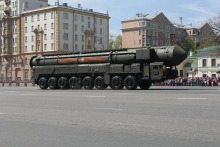
In 2013, the Russian military announced that they were going to create a new generation of rail-mobile ICBMs. These trains would carry the more sophisticated RS-24 Yars missiles. The RS-24 has about the same range as the older RS-23 but is ten feet shorter and half the weight as the RS-23. The RS-24 can also be mounted on a truck and driven around. The intent is to have these mobile missiles constantly roaming around Russia, ready to stop and launch their missiles on demand. The new project was referred to as “Barguzin” and Russia said that the new trains would be ready for testing by 2019.
The benefit of these mobile launchers is that they can travel around Russia and blend in with the regular rail and truck traffic. This makes them much harder to locate and target that missiles that in silos. More U.S. missiles would be required to destroy them which means the there would be fewer missiles for fixed targets.
In 2012, a Russian general had said that they were developing the Barguzin because the U.S. Prompt Global Strike (PGS) program. Part of that program involves the development of hypersonic weapons that can quickly reach any part of the globe. The PGS program still exists and one hundred and eighty million dollars was spent on it in 2017.
In 2015, according to the Rossiyskaya Gazeta, there were tests of part of the Barguzin program. In December of 2017, the Russian government stated that it was going to suspend the Barguzin project because the project was too expensive. Some analysts said that the Russians were never really serious about the Barguzin program and that it was just part of their misinformation and propaganda.
Whether the Russians were serious about Barguzin or not, it is true that mobile missiles are much more expensive that missiles in silos. During periods of peace, the Barguzin program would have required an expensive network of bases where the missiles and launchers could be stored and maintained. The missiles would have to remain in storage under the terms of international arms treaties, so any enemy would know exactly where they were.
In the event of a war, there would have to be major security detachments of troops to guard the mobile launchers as they moved around Russia. And, in the end, the launchers would still be somewhere on the rail system of Russia which would make them easier to locate. Hypersonic missiles travel so rapidly that it is questionable whether or not the missile trains would be able to even make it out of their storage locations before the hypersonic missiles reached them.
While Russia may have cancelled the Barguzin program, they have said that if circumstances require it, the trains and missiles could be quickly reactivated and deployed. Let us hope that circumstances never require it.
RS-24 Yars missile mounted on mobile carrier:
Current nuclear power reactors are fueled with assemblies of rods. The rods contain pellets of uranium or a uranium-plutonium mixture called MOX. The long thin fuel rods in a nuclear fuel assembly are coated in a process called cladding. Zirconium is widely used for cladding but there are problems with zirconium that have contributed to research for modified or replacement cladding that is safer and more efficient.
Research on accident tolerant fuels (ATF) including new cladding materials and different designs for fuel pellets have been going on since the early 2000s. The nuclear disaster at Fukushima in Japan in March of 2011 created additional pressure on the nuclear industry to find ways to make nuclear power reactors safer.
The U.S. Department of Energy created the Enhanced Accident Tolerant Fuel program in order to develop new fuel assemblies for light water reactors. The program includes U.S. utilities, universities and the Electric Power Research Institute. Projects being supported by the DoE could result in commercial products within ten years.
Three different approaches to ATF are under development by GE’s Global Nuclear Fuel (GNF), AREVA, and Westinghouse. The DoE is providing funding and technical assistance. Lightbridge, a company in Reston, Virgina, is working on its own ATF project with zirconium-alloy cladding and a metallic uranium alloy.
GNF is working on “IronClad” fuel assemblies with help from Oak Ridge National Laboratory. IronClad ATFs utilize an alloy containing iron, chromium and aluminum. The new alloy for the cladding is supposed to improve how the fuel assemblies respond to severe accident scenarios. One of the big dangers in extreme scenarios is the leakage of high temperature steam which can cause cladding to oxidize. The steel in the IronClad coating gives it a much lower oxidation rate than the conventional zirconium alloy cladding.
GNF recently shipped test assemblies with two variations of the IronClad coating to Edwin I. Hatch Nuclear Plant near Baxley in southeastern Georgia. They also shipped a test assembly with a zirconium cladding called ARMOR. After a
planned outage for maintenance, the test assemblies will be installed in the Unit 1 reactor and will remain there for the next twenty-four months.
The Hatch Nuclear Plant is owned and operated by Southern Nuclear Operating Co. (SNO). A spokesperson for SNO said that the ATF technologies have “industry-changing safety and efficiency advantages” that they hope could make nuclear power plants safer and more efficient. They consider the upcoming test of the ATFs “…not a small step, but a leap for our industry.”
This February, the principal deputy assistant secretary for the Office of Nuclear Energy at the U.S. Department of Energy said, “An accident-tolerant fuel is an industry term used to describe new technologies that further enhance the safety and performance of nuclear materials. This can be in the form of new cladding and/or fuel pellet designs.”
The Hatch tests will be the first deployment of the new ATF assemblies but there will be more soon. GNF also plans to test IronClad and ARMOR cladding material at Exelon Generation’s Clinton Power Station in 2019. Areva and Westinghouse ATF assemblies will also be tested in plants owned by Southern Co. and Exelon.