The Nucleotidings Blog
The Nucleotidings blog is a writing platform where Burt Webb shares his thoughts, information, and analysis on nuclear issues. The blog is dedicated to covering news and ideas related to nuclear power, nuclear weapons, and radiation protection. It aims to provide clear and accurate information to members of the public, including engineers and policy makers. Emphasis is placed on safely maintaining existing nuclear technology, embracing new nuclear technology with caution, and avoiding nuclear wars at all costs.

Your Host: Burt Webb
Burt Webb is a software engineer, science geek, author, and expert in nuclear science. Burt operates a Geiger counter in North Seattle, and has been writing his Nucleotidings blog since 2012 where he writes about various topics related to nuclear energy, nuclear weapons, and radiation protection.

Burt Webb has published several technical books and novels. He works as a software consultant.

Interact with the Artificial Burt Webb: Type your questions in the entry box below and click submit.

Example Q&A with the Artificial Burt Webb

Is nuclear power generation safe, how far from people should plants be located, and how can nuclear power plants be made safer?

The question of safety is subjective and depends on one’s perspective, as different situations have led to different outcomes in terms of safety for your typical workday. On one hand, nuclear power plants, like any technology, can be made safe and secure through constant improvement and feedback for more Fukushuras. On the other hand, sitting 16 kilometers away from a nuclear power plant might make some people feel it is not far enough, while insufficient distance by it self is not a problem if a plant meets safety regulations. Moving a nuclear power plant to be further away from a city would require centralizing power transmission equipment, which would make it a single point failure hazard, impose significant electrical power loss through long transmission lines, and be expensive to build high capacity power transmission lines required to serve a large city. Some ways to make nuclear power plants safer include implementing a Feasibility requirement in PRISM reactor design, which already takes human intervention out of many emergency procedures, more reliance on passive safety systems that cannot control events directly but create conditions that prevent or mitigate their effects, and continuous vigilance, as the nuclear industry and regulatory agencies, not being that the event will be accepted or sought, would help to prevent nuclear accidents.

What do you mean by “Fukushuras”?

“Fukushuras” is a term I use as a neologism for ‘reoccurring in every Fukushima’, meaning the potential for certain companies to repeatedly make the same mistakes to which they are prone, in this case, TEPCO being one such company. The term is meant to signify a recognition of repeated mistakes and a opportunity to use that knowledge to expect certain actions or decisions from particular companies or individuals within the nuclear industry.

Blog

  • Radioactive Waste 333 – Sandia National Laboratory Just Tested Transportation Of Simulated Spent Nuclear Fuel Rods

           Every year, an estimated two thousand six hundred tons of spent nuclear fuel is generated by nuclear power reactors in the U.S. Roughly fifty thousand tons of spent nuclear fuel are currently stored in cooling pools at reactor sites around the U.S. Many cooling pools are reaching their limit. Another fifteen thousand tons of spent nuclear fuel is currently stored in dry casks onsite and at interim storage facilities. Without a permanent geological repository for spent nuclear fuel in the U.S., a great deal more of the spent nuclear fuel in the cooling pools will have to be moved to dry cask storage. While some of these casks will be stored onsite, many more will be moved to interim facilities. This will require the transport of thousands of metric tons of spent nuclear fuel from reactor sites to interim storage facilities.

           Sandia National Laboratories recently completed with they are calling a nuclear “triathlon” to improve the safety of spent nuclear fuel transport. This exercise consisted of moving a simulated cargo of spent nuclear fuel rods over fourteen thousand miles. The purpose of the “triathlon” was to monitor the stresses and jolts that such a fuel experiences while being transported. Transportation of spent nuclear fuel involves packaging the fuel rods with strict adherence to regulations of the International Atomic Energy Agency (IAEA). In addition to regulatory satisfaction, the public must be confident that every precaution has been taken in transporting spent nuclear fuel.

           For over thirty years, spent nuclear fuel has been stored in what are referred to as Type B casks. Each of these casks weights about one hundred and twenty-five tons. Each can carry twenty-four tons of spent nuclear fuel. The spent nuclear fuel is in the form of rectangular bundles (called assemblies) of long, thin zirconium rods. The rods contain pellets of either enriched uranium or plutonium. The casks are forged from solid steel and have steel hatches with gaskets. The special reinforced pins that attach the hatches can survive one hundred tons of force. When the casks are loaded and sealed, they are so strong that they could survive the impact of a one-thousand-ton diesel locomotive going one hundred miles an hour.

           The fuel rods themselves are very fragile. After being in a hot, high radiation environment for a few years, the zirconium shells, called cladding, are very brittle. If extreme care is not use when handling the fuel rod assemblies, they may shatter.

            SNL partnered with Spanish and South Korean partners. They also worked with Pacific Northwest and Argonne national laboratories. A new dry cask was loaded with three dummy fuel rod assemblies. The rods were made of lead and contained lead pellets. The casks are designed to carry up to thirty-two complete fuel rod assemblies but the test cast only had three fuel rod assemblies. Additional space was take up by accelerometers and strain gauges to measure everything that each of the fuel rod assemblies experienced during their trip. A custom monitoring system tracked shocks and vibrations that the cask and the fuel rod assemblies were subjected to during the trip.

           SNL has conducted other tests in the past including simulating the transport of fuel rod assemblies over city streets and rough roads. They also simulated a journey by rail of fuel rod assemblies.

            The new test or triathlon used a Spanish dry cask which traveled by heavy truck over highways in Spain two hundred and fifty miles to a seaport. The cask was then transferred to a barge where it traveled a thousand miles along the coast to Belgium. Next it was placed on a cargo ship and spent two weeks traveling four thousand miles to Baltimore in the U.S. After arriving in the U.S., the cask was put on flatbed railway car. It then traveled over two thousand miles through twelve states before it arrived in at the Transportation Technology Center Inc facility near Pueblo, Colorado. At the Center, the cask engaged in some experiments on a fifty-mile test track. Finally, the cask reversed its route back to Spain. Over eight terabytes of data were acquired which will require at least a year to analyze.

  • Geiger Readings for Mar 15, 2017

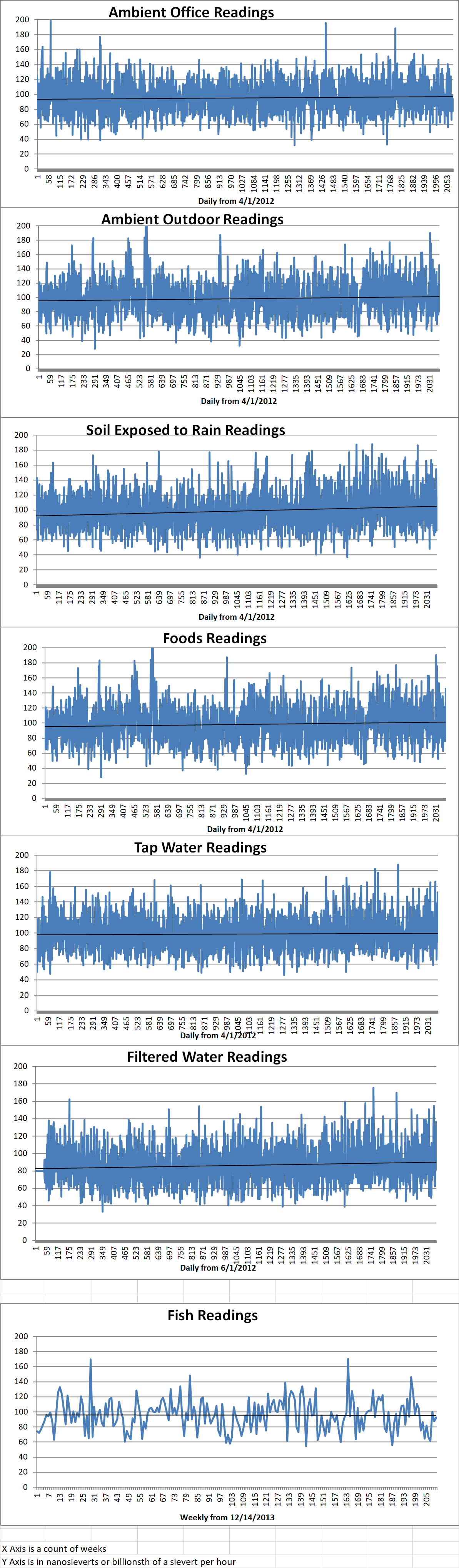
    Ambient office  = 96 nanosieverts per hour
     
    Ambient outside = 129 nanosieverts per hour
     
    Soil exposed to rain water = 127 nanosieverts per hour
     
    Green bell pepper from Central Market = 128 nanosieverts per hour
     
    Tap water = 99 nanosieverts per hour
     
    Filter water = 93 nanosieverts per hour
  • Nuclear Reactors 545 – Siempelkamp NIS Ingenieurgesellschaft Invents New Way To Decontaminate Cooling Systems Of Close Nuclear Power Reactors

           Many of the operating nuclear power reactors in the world were build in 1970s. Considering that nuclear reactors are licensed for forty years, many reactors have reached the end of their initial license and have applied for and been granted extension of up to twenty additional years of licensed operation. However, some reactors have reached the end of their practical lifespan and, despite being licensed to keep operating, are being shut down because they are too expensive to maintain and operate. When a nuclear reactor is permanently shut down, it must be decommissioned. This means that all spent nuclear fuel must be eventually disposed of and the entire nuclear reactor facility must taken apart and disposed of. Nuclear decommissioning will be a boom business for decades.

          Before decommissioning a nuclear power plant, the cooling system must be decontaminated. While a nuclear power plant is operating, oxidic coatings form in the pipes and other components of the cooling system. As the oxide coating forms, radionuclides are incorporated.

            The Siempelkamp group is an international technology company based in Germany that has three divisions. The first division is the machine and plant engineering division which supplies whole factories to the wood panel industry, the metal forming industry and the composite and rubber industry. The second division is the foundry division which can cast objects up to three hundred and fifty U.S. tons. The third division is the NIS Ingenieurgesellschaft mbH division which supplies components and services to the nuclear industry.

          Siempelkamp NIS Ingenieurgesellschaft has developed what they refer to as “advanced system decontamination by oxidizing chemistry” (ASDOC) to dissolve the oxide layer and remove the radionuclides. Siempelkamp created their ASDOC solution from common and readily available industrial chemical. After initial tests of the solution revealed problems, Siempelkamp added an acid to the solution to stabilize the pH and prevent a precipitate from forming in the solution. Without a stable pH, corrosion can occur in some metals. The final result is the Siempelkamp’s ASDOC_D-MOD procedure.

          The Siempelkamp decontaminating solution is injected directly into the existing cooling system and the radionuclides are removed from the cleaning solution with ion exchangers. The use of existing access to the cooling system components means that external equipment does not have to be brought in and erected in a radioactive environment. The dangers of leakage of fluids is reduced by the use of the existing cooling system components to add the cleaning solution.

            The Siempelkamp’s ASDOC_D-MOD procedure reduces the radioactive contamination in a reactor cooling system by eighty five percent. This makes it safer to dismantle the cooling system. The metal in the cooling system pipes and components are decontaminated sufficiently for the metals to be melted and recycled.

              A spokesperson for Siempelkamp said: “The development of the procedure was very complex and a highly technical and scientific challenge. We suffered some setbacks until we arrived at the point where we could successfully demonstrate the practical use of it, which to date we have done twice.”

           Siempelkamp successfully applied their ASDOC_D-MOD procedure in the decontamination of Unit A at the Biblis nuclear power plant in Hesse, Germany in 2016 and in the decontamination of Unit B at the same plant in 2018.

  • Geiger Readings for Mar 14, 2017

    Ambient office  = 97 nanosieverts per hour
     
    Ambient outside = 81 nanosieverts per hour
     
    Soil exposed to rain water = 77 nanosieverts per hour
     
    Iceberg lettuce from Central Market = 146 nanosieverts per hour
     
    Tap water = 81 nanosieverts per hour
     
    Filter water = 74 nanosieverts per hour
     
     
  • Nuclear Weapons 350 – National Academies Raises Five Major Concerns About U.S. Nuclear Weapons Program

           The U.S. nuclear weapons program is handled by the National Nuclear Security Administration (NNSA) at the U.S. Department of Energy (DoE). The NNSA is responsible for the design and production of nuclear weapons for the U.S. nuclear arsenal. The Pentagon could be considered as the ultimate “customer” for the NNSA’s nuclear product. Secretary of Energy, Rick Perry is responsible for the oversight of a large group of national laboratories that are in charge of research and development for nuclear weapons and nuclear power plants.

          The President of the U.S. is pushing for a massive update program for the U.S. nuclear arsenal. In order to accomplish this, the NNSA at the DoE and the Pentagon must work closely together. Unfortunately, according to a report just published by the DoE, there are five major areas of concern they have with the U.S. nuclear weapons program.

           The number one area of concern consists of the fact that there is a total lack of “lack of sustained national leadership focus and priority.” The number two concern is the “blurred accountability” between the DoE and NNSA over the mission of the nuclear program. The number three concern is the “lack of proven management practices, including a dysfunctional relationship between line managers and mission-support staffs.” The number four concern is “dysfunctional relationships” between the government and its management and site operators. And, finally, the number five concern is “Insufficient collaboration between DOE/NNSA and Department of Defense weapons customers, resulting in misunderstanding, distrust, and frustration.”

           Perry is scheduled to testify this coming Wednesday before the House Appropriations Committee about the fiscal 2019 DoE budget. He will be faced with intense questioning about the U.S. nuclear program and specifically whether he is aware of the report on the five big concerns with the program. The nuclear weapons portion of the proposed DoE budget consumes about half of the 2019 DoE budget.

           The new report is the second in a series of reports generated over the past four years aimed at fixing what is considered by many to be a broken and dysfunction nuclear weapons program. The National Academies of Sciences, Engineering and Medicine (NASEM) began its review of the nuclear weapons program inn 2014 when it first mentioned the five big concerns. Now the (NASEM) is tasked with the problem of dealing with the five concerns.

           The U.S. just published its Nuclear Posture Review (NPR). This is a once every eight years review of the U.S. policy with respect to the development and use of nuclear weapons. Because the NPR discusses strategic issues, the authors of the new DoE report believe that this is the right time to deal with their concerns because they find that many of the problems that they are focused on are caused by what they consider to be “lack of strategic thought.”

           The study says, “With the release of the 2018 Nuclear Posture Review and the appointment of a new NNSA administrator, NNSA is faced with an excellent opportunity — and challenge — to move from a tactical to a strategic approach for executing the critical mission of the enterprise. The emphasis in both cases must be on creating a strategic vision that is clearly connected to mission. This is not a call to develop new processes and reports per se, which should follow only once clear and well-rationalized direction has been set.” 


  • Geiger Readings for Mar 13, 2017

    Ambient office  = 94 nanosieverts per hour
     
    Ambient outside = 76 nanosieverts per hour
     
    Soil exposed to rain water = 73 nanosieverts per hour
     
    Avocado from Central Market = 146 nanosieverts per hour
     
    Tap water = 152 nanosieverts per hour
     
    Filter water = 137 nanosieverts per hour
     
  • Nuclear Fusion 43- MIT and Commonwealth Fusion Systems Hope To Have A Commercial Fusion Reactor in 15 years

           Most of the articles about nuclear power in this blog focus on the technology of nuclear fission reactors. In these reactors, radioactive isotopes of heavy elements such as uranium and plutonium breakdown and generate heat which is captured to generate electricity. There is a great deal of radioactivity involved including the creation of radioactive waste that is still not being dealt with effectively after sixty years of nuclear power use in the U.S.

           I have occasionally blogged about nuclear fusion as a source of power. In nuclear fusion, very light elements such as hydrogen and helium are fused into heavier elements, releasing a great deal of energy in the process. There is very little radioactivity involved in most of the designs and little or no waste is generated.

           There are multiple approaches to generating nuclear fusion and a great deal of research has been conducted over the past sixty years, but no one has yet created a fusion reactor that can generate more energy that has to be put into the reactor.

            There are at least half a dozen companies in the U.S. with more in other countries that are racing to be the first to produce a commercial fusion reactor. Estimates currently run to ten or more years to produce a working prototype.

           The Michigan Institute of Technology (MIT) is a highly respected technical research institution. They are also working on developing a commercial fusion reactor. MIT is collaborating with Commonwealth Fusion Systems (CFS) a new private company that was created to commercialize the new technology. The Italian energy company ENI is investing fifty million dollars in the project. Thirty million of the investment is for R&D at MIT over the next three years.

           MIT is working on one of the common approaches to nuclear fusion that involved the creation of a “bottle” of power magnetic fields that traps and crushes a plasma of light element particles together with enough pressure and temperature to trigger a nuclear fusion reaction.

          The current work is referred to as SPARC. MIT is working on the creation of new superconducting magnets that will be able to create magnetic fields that are four times stronger that any previous technology. The new superconducting magnets will be incorporated into a fusion reactor that will operate in pulses of about ten seconds. The first MIT reactor should working on a fusion reactor that will produce one hundred megawatts of heat. The current design will not convert the heat into electricity but, if it works as designed, it should be able to produce twice the power that has to been injected to trigger the fusion reaction.

           MIT and CFS are creating a first version fusion reactor and they hope to be able to have a prototype of a commercial reactor in ten years. The plan is to have a commercial reactor available for the energy market within fifteen years.

           The President of MIT said, “This is an important historical moment: Advances in superconducting magnets have put fusion energy potentially within reach, offering the prospect of a safe, carbon-free energy future. As humanity confronts the rising risks of climate disruption, I am thrilled that MIT is joining with industrial allies, both longstanding and new, to run full-speed toward this transformative vision for our shared future on Earth.”

            The CEO of CFS said, “The aspiration is to have a working power plant in time to combat climate change. We think we have the science, speed and scale to put carbon-free fusion power on the grid in 15 years.”

           Although all previous fusion research projects have failed to produce more energy than they consume, MIT has a solid reputation for technical excellence and innovation as well as decades of experience with fusion research. If anyone can finally deliver commercial fusion power, MIT is an excellent candidate.