Blog
-
Geiger Readings for Feb 22, 2017
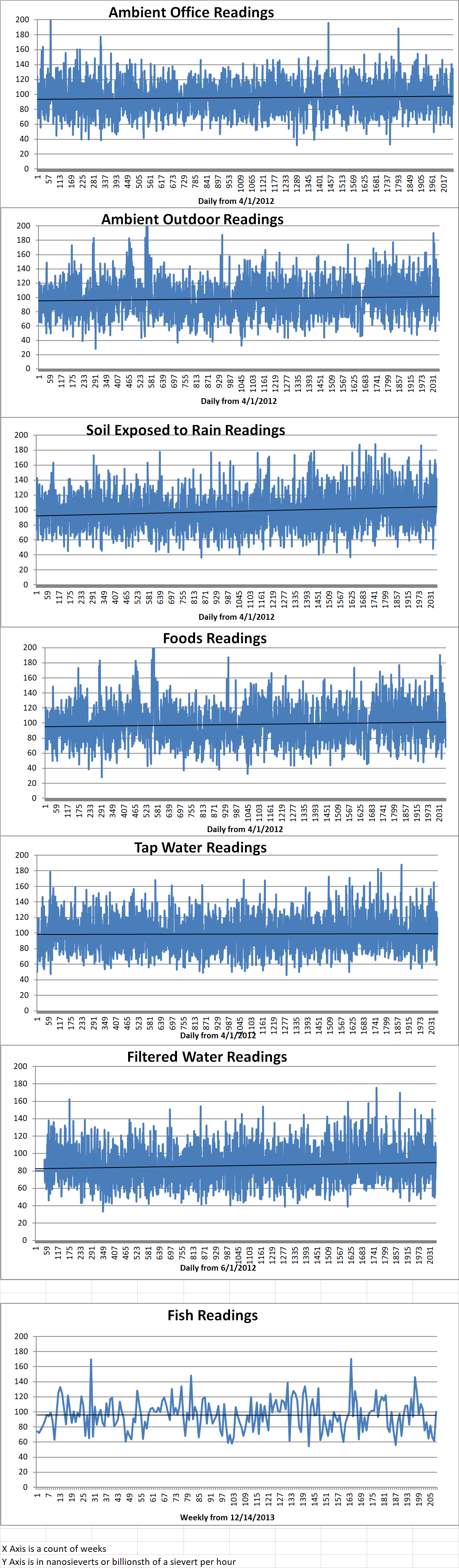
Ambient office = 135 nanosieverts per hourAmbient outside = 140 nanosieverts per hourSoil exposed to rain water = 142 nanosieverts per hourBartlett pear from Central Market = 68nanosieverts per hourTap water = 114 nanosieverts per hourFilter water = 102 nanosieverts per hour -
Nuclear Reactors 539 – Proliferation Concerns Over Saudi Arabia Nuclear Ambitions
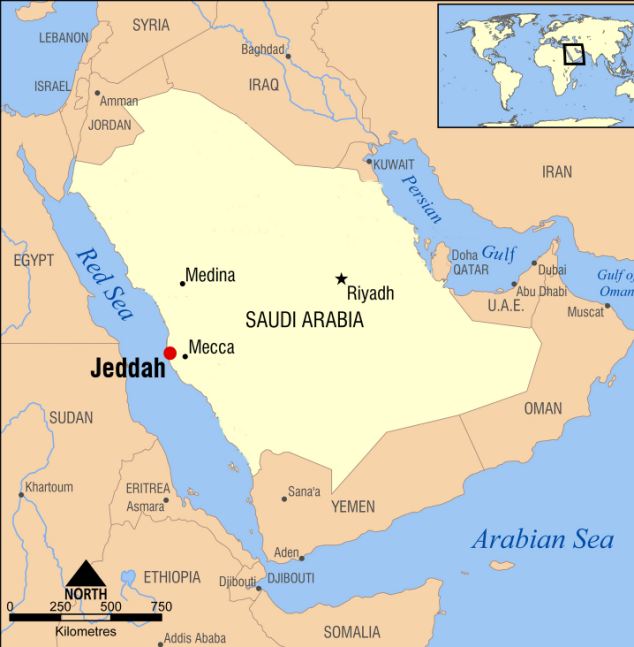
I have written before about the Saudi ambition to have their own nuclear power program. Countries such as China, Russia and Japan which sell nuclear power reactors have been flocking to Saudi Arabia drawn by the prospect of billions of dollars in sales. The U.S. is one of those countries and the Trump administration has been supportive of the Saudi desire to have their own nuclear reactors.
In 2010, Saudi Arabia produced a royal decree that said, “The development of atomic energy is essential to meet the Kingdom’s growing requirements for energy to generate electricity, produce desalinated water and reduce reliance on depleting hydrocarbon resources.”
The Saudi Arabian Foreign Minister said last week at the Munich Security Conference that “We are looking at the issue of the viability of building nuclear reactors in order to produce energy so that we can save the oil and export it in order to generate revenue. The countries that we are talking to are probably roughly 10 countries or so around the world and we have not made a decision yet with regards to which path we will take and which country we will be focusing on more.”
Saudi Arabia consumes about a quarter of the oil that it produces. With projected energy demand increases and a corresponding lack of projected oil production increases, Saudi Arabia will consume more and more of its own oil production as time goes by. A nuclear power program could allow Saudi Arabia to conserve its oil for future export.
Saudi Arabia plans to purchase and construct sixteen nuclear power reactors in the next twenty-five years at an estimated cost of over eighty billion dollars. Saudi Arabia has its own uranium deposits and says that it wants to develop them to produce its own fuel. It has invited U.S. companies to be a part of its nuclear program but in order for any U.S. company to export nuclear technology to Saudi Arabia, they must sign a peaceful nuclear cooperation pact. These pacts are called “123” agreements. The 123 pacts separate civil nuclear facility from military nuclear facilities. The pacts are intended to create barriers between the production of nuclear fuel and production of weapons grade nuclear materials.
The Saudis have been reluctant to sign on to the 123 pacts which are the toughest international controls for the nonproliferation development of nuclear weapons. These controls include prohibitions on enriching uranium to the purity required for nuclear weapons or reprocessing spent nuclear fuel to obtain plutonium for nuclear weapons.
The people fighting for nuclear nonproliferation say that if the U.S. lowers its standards in order to sell reactors to Saudi Arabia, it will send the message that the U.S. is not really that strongly committed to nonproliferation. The people who are supporting the sales of reactors to Saudi Arabia say that they are worth billions of dollars in export sales and that if the U.S. doesn’t sell Saudi Arabia reactors, someone else will.
The Saudis are playing possible reactor providers off against each other. They say that ten different countries are interested in helping them with their nuclear power program. Seventeen U.S. companies have visited Saudi Arabia recently to discuss nuclear reactors and support products and services.
It is believed by many that Saudi Arabia is worried about Iran developing nuclear weapons and is actively working on a nuclear weapons plan of their own.
-
Geiger Readings for Feb 21, 2017
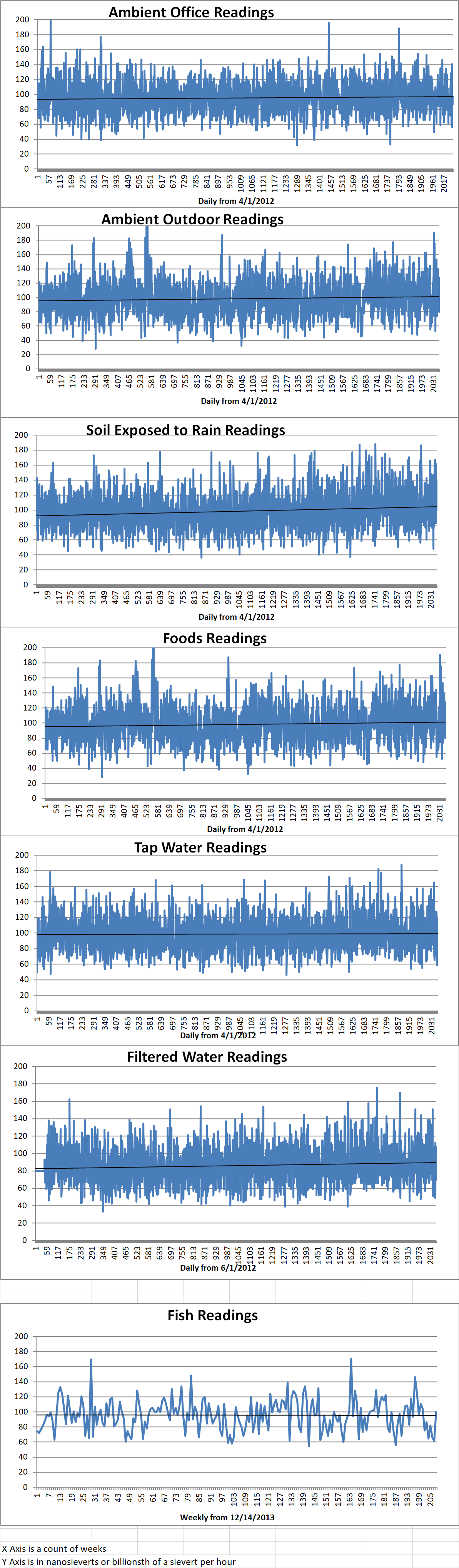
Ambient office = 95 nanosieverts per hourAmbient outside = 141 nanosieverts per hourSoil exposed to rain water = 140 nanosieverts per hourCrimini mushroom from Central Market = 106 nanosieverts per hourTap water = 98 nanosieverts per hourFilter water = 86 nanosieverts per hour -
Radioactive Waste 330 – Trump Administration Wants To Restart The Yucca Mountain Project For The Storage Of Spent Nuclear Waste
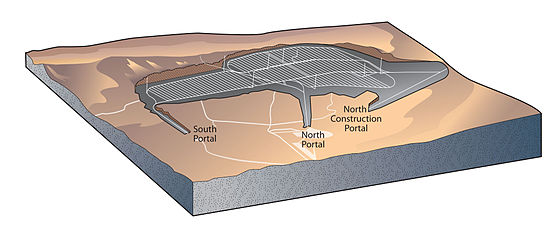
“The Yucca Mountain Nuclear Waste Repository, as designated by the Nuclear Waste Policy Act amendments of 1987, is to be a deep geological repository storage facility within Yucca Mountain for spent nuclear fuel and other high level radioactive waste in the United States. The site is located on federal land adjacent to the Nevada Test Site in Nye County, Nevada, about 80 mi (130 km) northwest of the Las Vegas Valley.” Wikipedia
The U.S. government began charging nuclear power plant operators for storage of their nuclear waste at Yucca Mountain beginning in 1999. However, the actual construction project at Yucca Mountain was approved by Congress and began in 2002. In 2009, Harry Reid, a senator from Nevada and U.S. President Obama worked together to end the Yucca Mountain project. All work was halted in 2009.
The power plant operators who had paid into the storage fee fund began to sue the federal government for the return of their money because the government had failed to build the promised repository. Billions of dollars were paid back a few of the operators from the fund which had grown to over thirty billion dollars.
The cooling pools of U.S. nuclear power reactors continue to fill up. Unless a lot of the spent fuel is moved somewhere, the pools will be totally full in a few years and the reactors will have to be shut down. Absent a geological repository, the only other option is to build concrete and steel “dry casks” to temporarily hold the spent fuel on site or at other locations. The construction of enough dry casks will not be cheap and the legal framework of the storage fund that the federal government collected prevents it from being used to construct dry casks.
This was the situation until the election of a new U.S. President in 2016. In the President’s propose federal budget for 2017, he included one hundred and twenty million dollars to continue safety studies for storing spent nuclear fuel at Yucca Mountain. The money was not allocated by Congress to restart the project. In the President’s propose federal budget for 2017, he once again included one hundred and twenty million dollars for Yucca Mountain.
A congressional expert from Illinois says, “It’s criminal neglect that the last administration broke the law by not funding this project. Now our local communities like Zion are paying that price.” Illinois has more nuclear power reactors than any other state. There are eleven operating nuclear power reactors at six power plants. It is estimated that there are over seventy-six thousand tons of spent nuclear fuel in Illinois, most of which is stored onsite with the operating reactors. The expert believes that it is far past time to move forward at Yucca Mountain.
Many Nevada politicians are strongly resistant to restarting the Yucca Mountain project. One Nevada Senator has sponsored bills to stop the project, saying that it would be catastrophic for Nevada, and he would “make sure that this project doesn’t see the light of day.” A Republican Congressional Representative says that “Rather than pursue a realistic attempt to develop a substantive nuclear waste management program, this is a colossal waste of funding that goes directly against the will of Nevadans.”
Experts that support the project say that interim dry cask storage for a great deal of the spent fuel could be accomplished in five to ten years. They say that Yucca Mountain could be receiving spent nuclear fuel in fifteen to twenty years.
There are serious environmental problems at Yucca Mountain that involve unexpected mobility in the ground water in that area. It would probably be better to find a new location for the geological repository. Current estimates say that a new repository could be sited and constructed by 2050 which is only twelve years after the estimation for opening a repository at Yucca Mountain if the project is restarted. Interim storage would take the pressure off and leave plenty of time to build a safer repository at a new site.
Diagram of proposed Yucca Mountain repository:

-
Geiger Readings for Feb 20, 2017
Ambient office = 87 nanosieverts per hourAmbient outside = 115 nanosieverts per hourSoil exposed to rain water = 113 nanosieverts per hourIceberg lettuce from Central Market = 80 nanosieverts per hourTap water = 118 nanosieverts per hourFilter water = 95 nanosieverts per hour -
Nuclear Reactors 538 – Researchers At U.S. Department Of Energy Study Complex Ceramics Radiation Resistance.
The movement of atoms in complex ceramics is strongly dependent on the local structure. When ceramics are heated or irradiated, the atomic structure is damaged. In order to understand how defects in the atomic structure influence the motion of atoms, it is necessary to understand how the properties of the ceramic materials change and what can be done to restore the original atomic structure. These phenomena are the basis of material properties and lifetimes for radiation resistance during energy generation and in containers for storing nuclear wastes.
Diffusion of atoms in complex ceramic oxides is crucial to how atoms are transported and how the atomic structure of the ceramics evolve under the influence of radiation damages, sintering and aging. Individual atoms in ceramics carry electrical charges that determine atomic structure. Ions that carry a negative electrical charge are called “cations”. Ions that carry a positive electrical charge are called “anions”.
Pyrochlores are complex ceramic oxides which contain more than one type of cation. The diffusion of the cations through the material and the electrical conductivity of the material are strongly influenced by the structure of the crystal in terms of arrangement of cations. Diffusion and conductivity are very sensitive to cation disorder. The ability of these ceramics to maintain their crystallinity is dependent on cation disorder. This particular characteristic is the reason that pyrochlores are being investigated as a possible material to encapsulate nuclear waste. Radiation resistance and conductivity are increased by cation disorder, but it is not well understood exactly how this disorder influences cation transport.
Scientists at the U.S. Department of Energy have been researching the influence of defects on cation diffusion in gadolinium titanium oxide (Gd2Ti207) which is a pyrochlore. The defects are missing atoms in the ceramic crystalline structure. The researchers have been using standard and accelerated molecular dynamics simulations to track the movement of atoms in the crystal and increase their understanding of cation diffusion. These simulations are for cation behavior of microsecond (millionth of a second) duration. Typical atomic simulation track the behavior over nanosecond (billionth of a second) intervals due to the massive computer resources that are required. In the case of the ceramic simulations, new computational techniques have been used to simplify the dynamics of the individual atoms and reduce computational requirements.
The researchers found that cation diffusion through the ceramic crystals is slow when there is a low level of disorder. When the level of disorder reaches a specific value, the diffusion of the cations accelerates. One of the important aspects of this behavior is “anti-side defects.” This occurs when one cation of gallium occupies a position a titanium cation would normally occupy. When the threshold level of disorder is reached, the anti-site defects are so numerous that they are almost touching each other at the atomic level. This creates something called a “percolation network.” This network permits the cations to move rapidly through the crystal. The movement of these cations through the network permits the crystal structure to repair itself by destroying the anti-site defects which slows down the cation diffusion.
This self-healing is different than other behavior models for other complex ceramic oxides and disorder models. This new type of self-healing may be very important in extending the lifetime of complex ceramics that are used in extreme radiation environments.
gadolinium titanium oxide:
-
Geiger Readings for Feb 19, 2017
Ambient office = 97 nanosieverts per hourAmbient outside = 101 nanosieverts per hourSoil exposed to rain water = 100 nanosieverts per hourCelery from Central Market = 128 nanosieverts per hourTap water = 119 nanosieverts per hourFilter water = 108 nanosieverts per hour