Blog
-
Geiger Readings for Feb 11, 2017
Ambient office = 121 nanosieverts per hourAmbient outside = 93 nanosieverts per hourSoil exposed to rain water = 94 nanosieverts per hourBartlett pear from Central Market = 108 nanosieverts per hourTap water = 86 nanosieverts per hourFilter water = 72 nanosieverts per hour -
Geiger Readings for Feb 10, 2017
Ambient office = 128 nanosieverts per hourAmbient outside = 159 nanosieverts per hourSoil exposed to rain water = 159 nanosieverts per hourGinger root from Central Market = 99 nanosieverts per hourTap water = 99 nanosieverts per hourFilter water = 88 nanosieverts per hourDover sole – Caught in USA = 61 nanosieverts per hour -
Nuclear Weapons 343 – Russia Moves Iskander Missiles In Kaliningrad
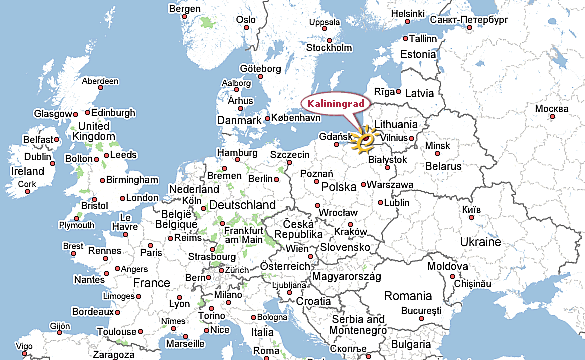
The Kaliningrad Oblast is a Russian enclave located on the Baltic Sea between Poland and Lithuania. It is separated from Russia proper and is the western-most province of Russia. The Kaliningrad Oblast covers about six thousand square miles. It is considered to be the most militarized zone on the entire European continent. The Russian have installed missiles, tanks, warships, soldiers, bases and listening posts.
The Lithuanian president has just confirmed that Russia has shipped nuclear-capable missiles to Kaliningrad. He said “Iskander missiles are being stationed in Kaliningrad for permanent presence as we speak. This is not just a threat to Lithuania, but to half of all European countries.” Lithuanian intelligence agencies monitored the movement of the missiles into Kaliningrad. Iskander missiles are short-range but can carry nuclear warheads.
Such missiles would play a major role in any Russian-NATO conflict. The Russians have stated that they would consider the use of such tactical nuclear weapons if they were losing a conventional ground war against NATO.
Given the present tension between the U.S. and Russia, moving such missiles into Kaliningrad is seen as a major threat to Europe. However, a Kremlin spokesperson said “I want to remind you that the placement of particular armaments and the deployment of specific military units on Russian territory are solely the sovereign issue of Russia.” The Russian defense minister said that the missiles had been deployed in response to NATO operations near Russia. It is interesting to note that while Russia says that its buildup is a private matter, they also say that it is a response to NATO operations in other countries.
NATO often stations troops in Lithuania. There is currently a contingent of German-led troops on alert in Lithuania. Britain’s top general issued a report last month saying that Russia is now a clear and present danger to NATO nations. Russia and NATO continuously argue about who is acting aggressively as they both stage wargames with troops, tanks, ships and planes around eastern Europe near the Russian border.
Russia has been accused of having territorial ambitions in eastern Europe ever since it annexed the Crimea from Ukraine in 2014. The small Baltic countries of Lithuania, Estonia, and Latvia have been especially nervous about Russian actions near their borders. There was an incident last week over the Black Sea in which a Russian jet flew within five feet of a U.S. jet. Russia denies that it has any aggressive intent while accusing the West of wanting to restart the Cold War.
In the past few years, Russia has flown nuclear bombers in and out of the air space of other nations without notice. It has also sailed surface ships and nuclear submarines in and out of the territorial waters of other nations without any notice. They have repeatedly stated the intent to spend hundreds of millions of dollars on modernizing their nuclear forces and developing new nuclear weapons. Many analysts are concerned with how freely the Russians talk about using tactical nuclear weapons. I believe that it is beyond dispute that Russia is acting aggressively to intimidate other nations with its nuclear arsenal and moving Iskander missiles into Kaliningrad is just the lasted move in the game they are playing.
-
Geiger Readings for Feb 09, 2017
Ambient office = 115 nanosieverts per hourAmbient outside = 112 nanosieverts per hourSoil exposed to rain water = 114 nanosieverts per hourCelery from Central Market = 108 nanosieverts per hourTap water = 98 nanosieverts per hourFilter water = 93 nanosieverts per hour -
New Radiation Detector Created With Graphene
Graphene is a form of carbon where a single layer of carbon atoms forms a flat sheet with a hexagonal grid arrangement. It was discovered in 2004 and thought to hold great promise. Research on graphene has uncovered a variety of interesting and potentially useful features including being light weight, strong and a good conductor. Graphene also has the ability to convert heat directly into electricity. Recently, a group of researchers developed a new type of radiation detector based on graphene.
A bolometer is an instrument that can measure electromagnetic radiation through the heating of a material in which the electrical resistance is related to temperature. The new graphene radiation detector is a type of bolometer. The graphene bolometer is able to work over a much broader range of temperatures that existing commercial bolometers. The design for the graphene bolometers is simple and the cost of production is low. There could be a lot of commercial applications for the new bolometer.
Grigory Skoblin does research at the Chalmers University of Technology in Sweden. With respect to graphene, he said, “…there are some strong fundamental limitations for this material. Nowadays, the real industrial applications of graphene are quite limited.” Most current uses of graphene are based on its mechanical properties. Skoblin says that “…our device shows that more fundamental properties can be used in actual applications.”
The graphene bolometer is based on the thermoelectric properties of graphene. Radiation heats a piece of graphene which causes electrons to move through the material. The moving electrons generate an electrical field. A voltage difference is created across the bolometer. The change in voltage can be used to directly measure the radiation.
Other bolometers also use voltage differences to measure radiation, but they need an external power source to generate the initial current. Because the graphene bolometer generates its own current under the influence of the radiation, it is much simpler than other bolometers. The piece of graphene inside the new bolometer is very small so the new bolometer is very fast because it is quickly heated by the radiation being measured.
The new bolometer can measure radiation up to temperatures of two hundred degrees Celsius. There have been other attempts to create graphene-based bolometers, but they used two layers of graphene which makes manufacturing more difficult and expensive. Current bolometers can only work at very low temperatures referred to as “cryogenic.”
An additional innovation in the new bolometers is the material used to coat the instrument. The developers use a dielectric polymer called “Parylene” for the coating. Parylene provides a good combination of performance and scalability. Hexagonal boron nitride offers better performance than Parylene but it is hard to obtain and the processed used to apply the coating would be more difficult to scale up.
The prototype for the new bolometer can only detect microwave radiation at ninety-four gigahertz but the researchers will be working to broaden the detection range of frequencies. The developers are also working on a vapor deposition process to produce bigger pieces of graphene which will help scale up production of the new bolometer.
-
Nuclear News Roundup Feb 08, 2017
-
Geiger Readings for Feb 08, 2017
Ambient office = 108 nanosieverts per hourAmbient outside = 81 nanosieverts per hourSoil exposed to rain water = 79 nanosieverts per hourShallot from Central Market = 74 nanosieverts per hourTap water = 108 nanosieverts per hourFilter water = 97 nanosieverts per hour -
Nuclear Reactors 537 – NextEra Energy Is Suing The Nuclear Energy Institute – Part 2 of 2 Parts
Part 2 of 2 Parts (Please read Part 1 first)
NEE has filed a lawsuit against NEI. In the lawsuit, NEE said, “NEI recently has been vigorously advocating for irrational and unreasonable policies that would distort electric energy markets.” “In this, NEI has also funded studies that call into question the reliability and costs of the electric system, attempting to create a false sense of panic and unfairly and incorrectly maligning the operations of its members, including the NextEra Companies.”
One of the main reasons for the lawsuit is the claim by NEE that the NEI prevented their access to the PADS because they cancelled their membership in the NEI. NEE has six scheduled outages in 2018. It is very important to them to have access to the PADS in order to hire the extra staff that the outages will require. FLP has been a member of the NEI for over twenty years and has consistently paid its dues which helped maintain the PADS system. The terms of membership with respect to access to the PADS state that a NEI member’s access can only be terminated after a minimum of three months advanced notice.
NEE alleges that they were told on January 30th by NEI that they could only access the PADS through March of 2018 if they paid NEI $860,000 dollars. NEE says that most of that money is related to membership charges of the NEI that have nothing to do with access to the PADS. The complaint states that NEI was fully aware of the damage and expense that denying access to the PADS would cause NEE and that they were using that for leverage to force NEE to pay unnecessary membership dues.
A spokesperson for NEE said, “We think this was the very definition of extortion.” “We made a business decision to leave NEI; we thought they had not adapted to changing times. They are simply attempting to retaliate against us by trying to squeeze cash out of us and our customers.”
The NEI president said that her organization, “vehemently denies all of the allegations in NextEra’s lawsuit and will vigorously defend our position in court.” She said, in an email, that when NEE canceled its membership, it lost the right to access the PADS. However, the NEI did say that it would give NEE PADS information so that NEE could fully comply with the relevant Nuclear Regulatory Commission regulations.
The NEI President attacked what she called NEE’s “inflammatory statements,” saying “To call NEI’s approach retaliatory, or even suggest the notion of extortion, is both counter-factual and offensive to the good faith effort the offer represents.” She said that NEI had recently contacted NEE to work on opening a conversation with NEE that would “advance the industry’s interest in remaining unified, or as unified as possible, on regulatory and other policy positions.” She said that NEE reacted by launching a “baseless lawsuit.”
The NEI claims that in considering its support for Perry’s policy proposals, it did extensive polling of its members to decide what its position should be with respect to the policy proposal. They say that regardless of the attitude of NEE towards the Perry proposal, their support of the proposal represented the interests of the majority of their membership.
It will be interesting to see what the result of the NEE lawsuit is.