Blog
-
Geiger Readings for Jan 05, 2017
Ambient office = 108 nanosieverts per hourAmbient outside = 86 nanosieverts per hourSoil exposed to rain water = 87 nanosieverts per hourBartlett pear from Central Market = 55 nanosieverts per hourTap water = 79 nanosieverts per hourFilter water = 72 nanosieverts per hour -
Nuclear Weapons 329 – Israel Destroyed Middle Eastern Nuclear Reactor Reactors- Part 1 of 2 Parts.
Part 1 of 2 Parts
It is widely assumed that Israel has about a hundred nuclear warheads and the means to deliver them. I have written before that I believe that if Israel was attacked and felt that they were on the brink of defeat, they would unleash their nuclear arsenal against their attackers. In any case, in the late 1970s, their Prime Minister promoted the policy that no enemy state should be allowed to acquire nuclear arms.
In 1976, Iraq attempted to buy a gas cooled graphite- moderated plutonium-producing reactor and plutonium reprocessing plant but the French had turned them down. Next, they tried to buy a heavy water moderated Cirene reactor from Italy but that request was also denied. Finally, they managed to convince the French to sell them an Osiris-class research reactor. A small Isis class reactor, about thirty pounds of ninety three percent enriched uranium and training were also part of the deal. The Iraqis claimed that the French reactor which was named Osirak was for peaceful scientific research but the Israeli were suspicious and counter-claimed that it was intended for the production of nuclear weapons.
The Iran-Iraq war began in September of 1980. Eight days after the war started, the Iranians attacked the Iraqi reactor in their Operation Scorched Sword. Four F-4E Iranian Phantom Jets flew into Iraq and proceeded to the town of Tuwaitha where the Osirak reactor was located and proceed to bomb the reactor. There was minimal damage done to the reactor and the attack did not slow down the Iraqi nuclear program.
The Israelis were very concerned about the construction of the Osirak reactor in Iraqi. They had been debating taking action while the sale was being finalized. In 1977, the new Israeli Prime Minister stepped up planning and had a full-scale model of the reactor built to practice bombing.
The Israelis also carried out a series of covert operations to try to slow down construction of the reactor. In April of 1979, the Israelis destroyed the first set of core structures for the Osirak reactor by planting a bomb in France before the structures could be shipped to Iraq. Later in the year, the Prime Minister decided that it was time to authorize a full out attack on the reactor which was referred to Operation Opera. Following that decision, Israel carried out an assassination and more bombing to slow down the Osirak project.
Although it was an enemy of Israel, Iran was so concerned about Iraq completing their reactor, that they cooperated with the Israelis. They provided valuable information about the site and their earlier failed attack. They staged a major strike at the Iraqi air force to help Israel.
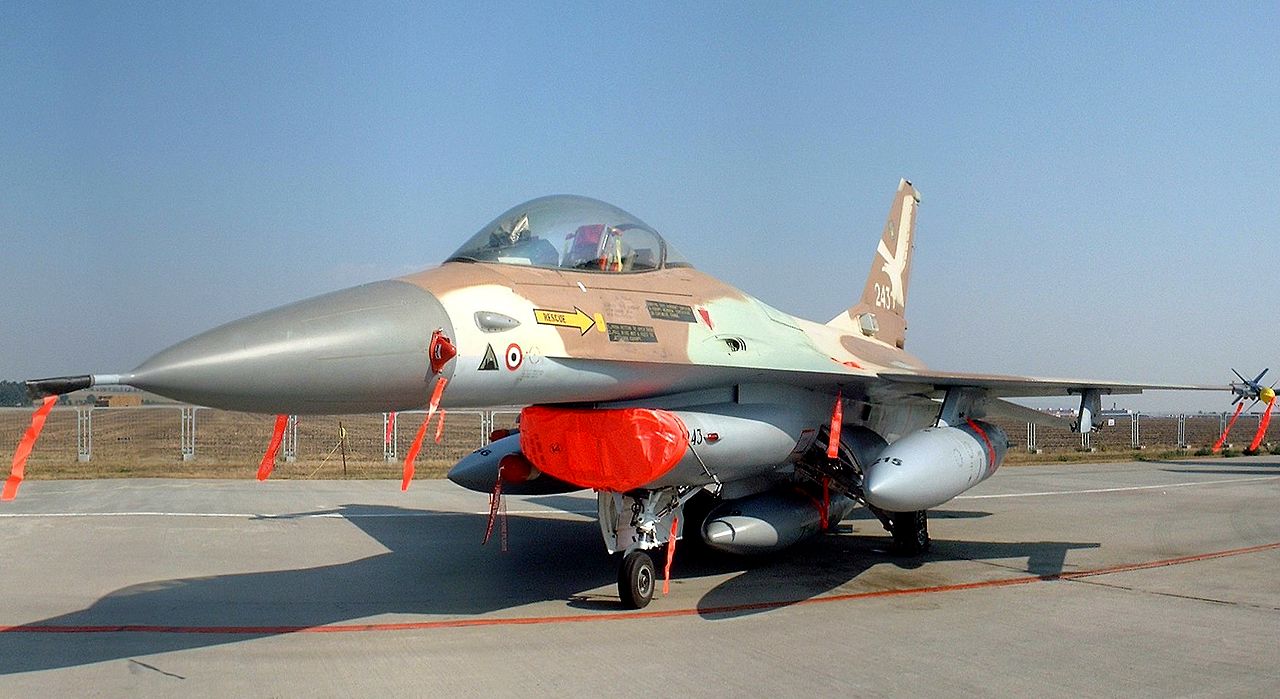
On June 7 of 1981, eight Israeli F-16 fighter-bomber jets left Israel’s Etzion Airbase and flew though Jordanian and Saudi airspace without challenge. During their flight, they crossed over the Gulf of Aqaba where King Hussein of Jorden was sailing his yacht. The King recognized the planes as Israeli and sent a message to his government to warn Iraq. Fortunately for the Israelis, the warning was never received. Within two minutes, the Osirak reactor was bombed into rubble.
The U.N. condemned the Israeli attack on the Iraqi reactor and demanded that Israel pay reparations to Iraq which Israel refused to do. There was some talk of starting up the project again but eventually France withdrew and the Iraqis gave up. The remains of the Osirak were ultimately pulverized in the 1991 Gulf War.
Please read Part 2
Israeli F-16 used in attack on Osirak reactor.

-
Geiger Readings for Jan 04, 2017
Ambient office = 111 nanosieverts per hourAmbient outside = 121 nanosieverts per hourSoil exposed to rain water = 119 nanosieverts per hourCarrot from Central Market = 144 nanosieverts per hourTap water = 117 nanosieverts per hourFilter water = 111 nanosieverts per hour -
Nuclear Weapons 328 – U.K. Has To Draft New Nuclear Safeguards Because Of Brexit
When the United Kingdom voted to leave the European Union, it bought itself a whole lot of problems. As a member of the E.U. the U.K. was automatically included in Europeans associations such as the ones that dealt specifically with nuclear matters such as obtaining nuclear fuel and other nuclear components as well as regulating the construction and operation of nuclear power plants. Now that the U.K. is leaving the E.U., it will have to negotiate a whole series of new arrangements with respect to nuclear power.
Last month, the Nuclear Safeguard Bill was published by the Department for Business, Energy and Industrial Strategies (BEIS). The BEIS is dedicated to developing a domestic safeguards program as a necessary part of the exit of the U.K. from the European Atomic Energy Community (Euroatom). Euroatom is a 1957 treaty governing the peaceful use of nuclear energy in the E.U. Technically, Euroatom is a separate legal entity from the E.U. but the same institutions that govern the E.U. govern Euroatom. Now the U.K. Office of Nuclear Regulation (ONR) has issued two “clarifications” of the impact assessment of the BEIS.
The first clarification sounds like it ought to be a basis assumption that does not need to be explicitly stated. It says that ONR regulates the nuclear industry; it does not provide services to it. The second clarification is that the ONR intends to create a regulator framework which is robust and comprehensive as the Euroatom framework. They say that they are not concerned with assessing efficiencies at this time. When they develop secondary legislation for BEIS, they will provide “advice to the government to inform the anticipated impact assessment for nuclear safeguards regulation.”
The impact assessment last month stated that the civil nuclear sector is subject to strict international non-proliferation regulations including nuclear safeguards. These are required to allow the U.K. to carry out civil nuclear trade which will allow nuclear power to play a major role in energy security for the U.K. as well as lowering U.K. carbon emissions. The primary objective, of course, is to prevent the spread of nuclear weapons.
The current U.K. nuclear safeguard obligations are part of its membership in the E.U. and a new set of safeguards will be needed to meet international standards as the U.K. leaves the E.U. The statement from ONR said, “There are no precedents for a non-EU Member State being a Member State of Euratom, so when we formally notified our intention to leave the EU we also commenced the process for leaving Euratom.”
There are two options for the U.K. to carry out the necessary process of creation new regulations. The preferred option is to adopt domestic nuclear safeguards that are equivalent to the Euroatom safeguards to insure that the U.K. would maintain the highest standards of nuclear safety.
The second option would be to create a domestic nuclear safeguards program that would not be a cloning of the current Euroatom nuclear safeguards. While all regulated facilities would receive vigorous oversight, there would still be a reduction in the frequency and intensity of inspections while still meeting the standards of the International Atomic Energy Agency.
Parliament is divided on the passage of the Nuclear Safeguard Bill at the moment. It is hoped that the BEIS will receive Royal Assent sometime this year.
-
Geiger Readings for Jan 03, 2017
Ambient office = 107 nanosieverts per hourAmbient outside = 108 nanosieverts per hourSoil exposed to rain water = 108 nanosieverts per hourCelery from Central Market = 143 nanosieverts per hourTap water = 112 nanosieverts per hourFilter water = 105 nanosieverts per hour -
Nuclear Weapons 326 – The Soviet Union and China Almost Went To War In 1969 – Part 2 of 2 Parts
Part 2 of 2 Parts (Please read Part 1 first)
A second possible attack scenario might have consisted of only a nuclear strike against facilities housing the Chinese nuclear weapons program with no invasion of Manchuria. China tested their first nuclear weapons in 1964 and carried out their first underground nuclear test in 1969. Their nuclear weapons were probably not ready to be used in any confrontation with the Soviets. However, the Soviets were not sure that this was the case.
One big unanswered questions was whether or not the Soviets would have struck the very seat of the Chinese government in Beijing. One Soviet missile with a 2.3 megaton thermonuclear warhead would have totally destroyed Beijing and killed over half of the 7.6 million people who lived there.
If the Soviets had clashed with the Chinese in a ground war, their modernized army would have made short work of the poorly equipped Chinese infantry and their obsolete tanks. On the other hand, the world would have been shocked and outraged by any nuclear attack and would have harshly condemned the Soviet Union. In any case, the Chinese leadership would have thought nothing of sacrificing millions of Chinese troops and peasants against the Soviet invaders. The Soviets realized that if they invaded China, there would have been a long and exhausting war with no definite ending like their later invasion of Afghanistan.
Another important consideration for the Soviets was the impact that a Chinese war would have had on the Soviet strategic position in Europe. The Soviets would have had to pull tank divisions from bases in the Warsaw Pact nations and western Russia. Protestors against Soviet power in Eastern Europe in such countries as Poland, Czechoslovakia and Hungary would have probably eagerly welcomed the chance to rebel.
China would gain nothing from taking on a country with superiority in conventional weapons and nuclear weapons. It would have been impossible for the Soviets to invade and conquer a country the size of China but China had no way in which to win such a conflict. If the Soviets invaded and occupied Manchuria after nuking Beijing, it would have devastated China and thrown their development back decades. They would have recovered eventually and would probably regained Manchuria from the Soviets or Russians but at great expense and with great human suffering.
If the tensions between the Soviets and China had not been resolved without a major war, the history of the world for the following decades would have been very different. It is likely that the Soviet Union would have collapsed much earlier than it did, especially if the Soviet Union lost control of countries in eastern Europe much earlier than they did. Embroiled in a major war in the East, Soviet influence in Europe would have been much diminished. The development of the European Union might have been slowed without the threat of the Soviet armies in eastern Europe. The Cold War might have taken a different course depending on the reaction of the U.S. to the Sino-Soviet war. Hopefully, the rest of the nations of the world would have stayed out of the fight and there would not have been another World War.
Zhenbao (Damansky) Island:
-
Geiger Readings for Jan 02, 2017
Ambient office = 72 nanosieverts per hourAmbient outside = 100 nanosieverts per hourSoil exposed to rain water = 103 nanosieverts per hourWhite onion from Central Market = 104 nanosieverts per hourTap water = 123 nanosieverts per hourFilter water = 107 nanosieverts per hour