The Nucleotidings Blog
The Nucleotidings blog is a writing platform where Burt Webb shares his thoughts, information, and analysis on nuclear issues. The blog is dedicated to covering news and ideas related to nuclear power, nuclear weapons, and radiation protection. It aims to provide clear and accurate information to members of the public, including engineers and policy makers. Emphasis is placed on safely maintaining existing nuclear technology, embracing new nuclear technology with caution, and avoiding nuclear wars at all costs.
Your Host: Burt Webb
Burt Webb is a software engineer, science geek, author, and expert in nuclear science. Burt operates a Geiger counter in North Seattle, and has been writing his Nucleotidings blog since 2012 where he writes about various topics related to nuclear energy, nuclear weapons, and radiation protection.
Burt Webb has published several technical books and novels. He works as a software consultant.
Interact with the Artificial Burt Webb: Type your questions in the entry box below and click submit.
Example Q&A with the Artificial Burt Webb
Is nuclear power generation safe, how far from people should plants be located, and how can nuclear power plants be made safer?
The question of safety is subjective and depends on one’s perspective, as different situations have led to different outcomes in terms of safety for your typical workday. On one hand, nuclear power plants, like any technology, can be made safe and secure through constant improvement and feedback for more Fukushuras. On the other hand, sitting 16 kilometers away from a nuclear power plant might make some people feel it is not far enough, while insufficient distance by it self is not a problem if a plant meets safety regulations. Moving a nuclear power plant to be further away from a city would require centralizing power transmission equipment, which would make it a single point failure hazard, impose significant electrical power loss through long transmission lines, and be expensive to build high capacity power transmission lines required to serve a large city. Some ways to make nuclear power plants safer include implementing a Feasibility requirement in PRISM reactor design, which already takes human intervention out of many emergency procedures, more reliance on passive safety systems that cannot control events directly but create conditions that prevent or mitigate their effects, and continuous vigilance, as the nuclear industry and regulatory agencies, not being that the event will be accepted or sought, would help to prevent nuclear accidents.
What do you mean by “Fukushuras”?
“Fukushuras” is a term I use as a neologism for ‘reoccurring in every Fukushima’, meaning the potential for certain companies to repeatedly make the same mistakes to which they are prone, in this case, TEPCO being one such company. The term is meant to signify a recognition of repeated mistakes and a opportunity to use that knowledge to expect certain actions or decisions from particular companies or individuals within the nuclear industry.
There are a lot reasons that nuclear power is not a good idea in general. Then there are reasons that are specific to a particular country. In the developing world, there are countries whose need for electricity may not warrant the expense and problems of developing nuclear power plants, but they still want them as some sort of symbol of their dedication to improving their economy and society. One such country is Kenya.
There is a wide-spread belief that Kenya suffers from a short supply of overly expensive electricity. As it turns out, this belief may not be true. Kenyan power is actually reasonably priced. And Kenyan governments have consistently exaggerated the prospects for economic growth and the need for a huge increase in electrical generating capacity.
Kenya has the ability to generate about twenty four hundred megawatts. Its peak demand is about sixteen hundred megawatts. That means that it has an excess capacity equal to fifty percent of its peak demand. Excess capacity can lead to higher prices for electricity if some power plants remain idle because they are not needed.
Recent government estimates of Kenya’s future need for electricity stated that peak demand would rise to over forty-seven hundred megawatts by 2020. A German engineering company also produce a recent estimate to Kenya’s future need for electricity. They say that Kenya’s peak demand will about twenty-three hundred megawatts by 2020. The German estimate is far more reliable and suggests that Kenya could satisfy estimated peak demand in 2020 with the generating capacity that it currently has.
The real problem that Kenya has is not a short supply of electricity but the ability to distribute electricity. The existing Kenyan power grid and distribution system cannot handle any more power that is currently being generated. And, in addition, not enough money is currently being spent on needed maintenance. Without more routine maintenance and improvements in the grid and distribution system, additional power would be wasted.
With respect to demand, about six million customers are currently connected to the grid in Kenya. The customer base has grown by five hundred percent in the past seven years, but the demand has remained low. The reason for this is that most Kenyans still have very low income levels. They just cannot afford to pay for modern appliances for cooking, heating, air conditioning or refrigeration.
Since 2012, the Kenyan government has been working on obtaining nuclear power. They have conferred with the International Atomic Energy Agency. In 2016, the Kenyan Nuclear Electric Board obtained the approval of the IAEA. They have signed memoranda of understanding with Russia, China, South Korea and Slovakia for the construction of four nuclear power plants with a total of four gigawatts of capacity. The estimated cost of these projects is around four billion dollars. (Given that an individual reactor can cost more than six billion dollars, an estimate of five billion dollars for four reactors seems very low.)
The current low consumer demand, slow economic growth, wide-spread poverty and the condition of the grid and distribution system in Kenya indicate that the proposed nuclear reactors would be a huge waste of money for this poor country.
Since the 1950s, arsenals of nuclear warheads have balanced each other in what is called “mutually assured destruction” or MAD. For decades, the possibility that even a small nuclear exchange could severely impact human civilization has “kept the peace.”
There were several times that the world came close to nuclear war, once was a case of a false warning of an incoming missile in the Soviet Union. The radar officer should have notified central command immediately, but he waited for awhile until it was clear that it was a false warning.
During the Cuban Missile Crisis in 1962, there were two incidents. One happened when a Soviet ship crossed a picket line at sea and the other happened when a Soviet submarine lost contact with surface ships. Both times, the captain decided to disregard protocols for immediate escalation and wait until the situation resolved itself peacefully. Now, however, the MAD stability is being eroded by recent developments.
The delivery systems for many of the current arsenals of nuclear warheads are using old analogue circuits which are now being replaced by new digital circuitry. As these systems become more complex, they become more fragile and prone to errors. With the arrival of the Internet and the interconnectivity of global communication systems, it is critical that cybersecurity be tightened to prevent the hacking of nuclear weapons systems. Such hacking could result in causing launch, preventing launch or diverting launch of nuclear warheads in a conflict.
There have always been tactical nuclear weapons along with the big ICBMs that could level cities. These tactical systems consist of small nuclear rocket launchers, nuclear artillery shells and other small nuclear devices. The military planners developed these weapons for use on battlefields. They are intended to destroy enemy troops and weapons but not to destroy whole cities. They have not been used for fear of triggering a wholesale exchange of ICBMs. However, in the past few years. Their precision has been increased to the point where some military men believe that they could be used surgically and not trigger an all-out war.
One of the pillars of the nuclear protocols in nations with nuclear weapons is not to be the first to use nuclear weapons in a conflict. Unfortunately, this tradition is slipping. Recently Russia announced that if it was in a conventional war with NATO troops and losing, it would consider the first use of tactical nuclear weapons on the battlefield. Pakistan is currently deploying tactical nuclear weapons to the border it shares with India. India has threatened to pursue terrorists from Pakistan as they flee back across the border. Pakistan has said that if they do, then Pakistan may use tactical nuclear weapons on its own territory.
Paradoxically, the advances in technology and changes in protocols being applied to nuclear warheads and delivery systems are not making things safer in general but are destabilizing the old MAD model. Fortunately, the number of nuclear warheads worldwide has been reduced from over fifty thousand to under ten thousand through strong non-proliferation treaties. But it has been estimated that even a hundred nuclear detonations in a conflict could end human civilization so there is much work left to be done.
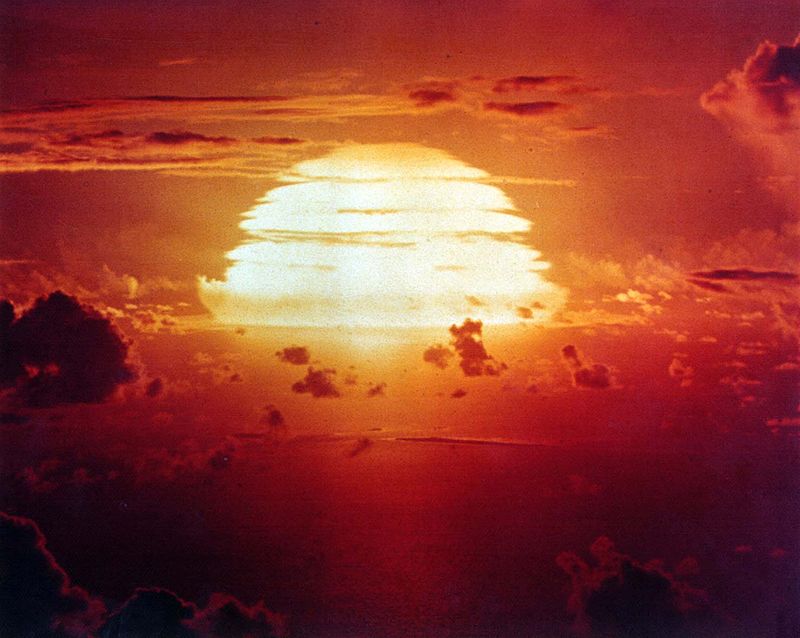
Nuclear weapon test Apache:
Heap leaching has been used for a long time to extract metals and other materials from heaps of mined ore. A liner is placed under the heap of ore and a solution containing cyanide is dripped onto the heap. As the liquid travels through the heap, it interacts with metals and other compounds in the ore. The liquid collects on the liner and is then subjected to further chemical processes that separate the different valuable materials dissolved in the ore. The use of cyanide in this process has a serious impact on the environment. Recently, bioheapleaching methods of utilizing living microorganisms to separate metals and other compounds from an ore heap have been developed and are much safer and cleaner than using cyanide.
The Talvivaara Mining Company was a Finnish mining business which produced nickel from the Sotkamo mine in Finland through its subsidiary Talvivaara Sotkamo (TS). In mid-2010, TS applied to the Finnish Ministry of Employment and the Economy for a license under the country’s Nuclear Energy Act for the right to extract uranium as a by-product from their Sotkamo mine. The requested license was granted in 2012. In May of 2014, TS got an environmental permit from Northern Finland Regional State Administrative Agency to recover uranium at the Sotkamo mine. Unfortunately, TS was unable to capitalize on all the work they had done to produce uranium when financial problems brought the Talvivaara Mining Company it to the brink of bankruptcy in mid-2015.
Terrafame Ltd. is a state-owned Finnish multi-metals company. In August of 2015, Terrafame took over the business operations and assets of Talvivaara Sotkamo Ltd. following bankruptcy proceeding and liquidation. Terrafame currently carries out bioheapleaching of nickel and zinc at the Sotkamo mine.
Terrafame has just received permission from Finland’s Radiation and Nuclear Safety Authority (STUK) to extract a small amount of uranium as it experiments with chemical processes that it intends to use in a uranium recovery plant it will construct. It plans to start extracting uranium as a by-product of the Sotkamo mine in late 2019.
STUK has given Terrafame a limited permit to produce about one hundred and sixty gallons of a chemical solution that will contain about thirteen pounds of uranium following a test of the leaching process. The permit is limited to the period from December 13th, 2017 to June 30th, 2018. Terraframe is authorized to store this uranium solution in suitable premises until June of 2023. Prior to carrying out the experimental uranium extraction authorized by the permit, Terrafame must supply information regarding radiation protection and safety arrangement to STUK.
Terrafame presented an application for large-scale uranium recovery to the Finnish Ministry of Employment and Economic Affairs at the end of October, 2017. In order to start uranium recovery, Terrafame must also get approval from STUK. And, in addition to these requirements from the Finnish government, Terrafame must also get a permit to export uranium for processing from the European Atomic Energy Community (Euratom). Terrafame hopes to be able to satisfy all these regulatory requirements in time to begin full scale operations by the end of 2019.
The actual amount of uranium in the ore from the Sotkamo mine is quite low. Terrafame claims that it should be possible to recover “sufficient amount of uranium for commercial purposes, using modern methods”.