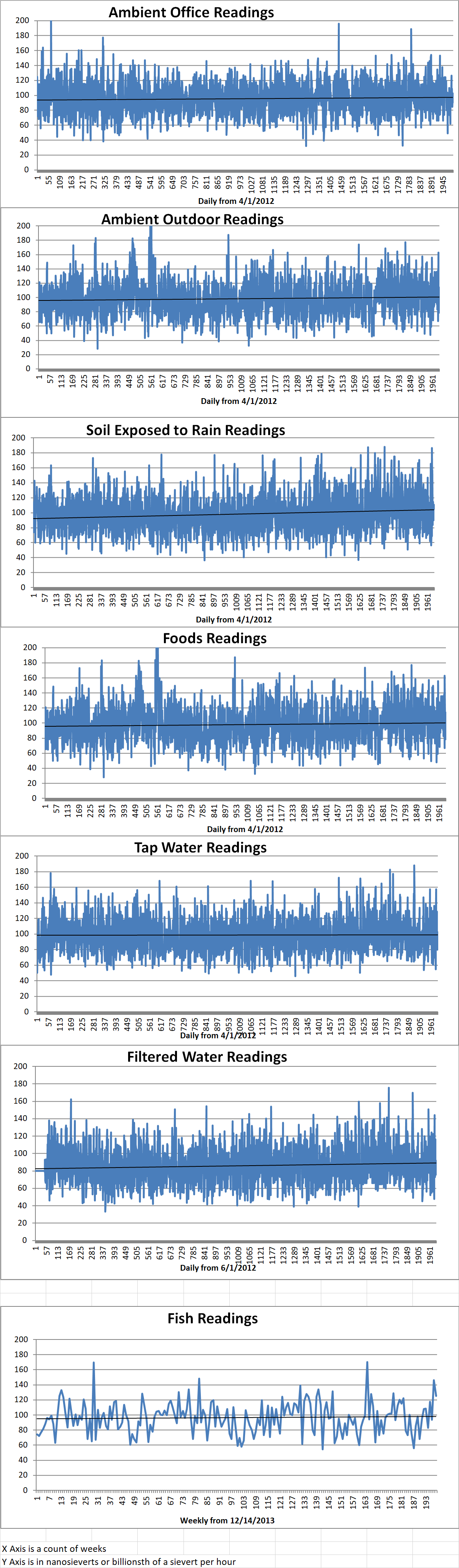
Ambient outside = 107 nanosieverts per hour
Soil exposed to rain water = 110 nanosieverts per hour
Crimini mushroom from Central Market = 79 nanosieverts per hour
Tap water = 95 nanosieverts per hour
Filter water = 87 nanosieverts per hour
The Nucleotidings Blog
The Nucleotidings blog is a writing platform where Burt Webb shares his thoughts, information, and analysis on nuclear issues. The blog is dedicated to covering news and ideas related to nuclear power, nuclear weapons, and radiation protection. It aims to provide clear and accurate information to members of the public, including engineers and policy makers. Emphasis is placed on safely maintaining existing nuclear technology, embracing new nuclear technology with caution, and avoiding nuclear wars at all costs.
Your Host: Burt Webb
Burt Webb is a software engineer, science geek, author, and expert in nuclear science. Burt operates a Geiger counter in North Seattle, and has been writing his Nucleotidings blog since 2012 where he writes about various topics related to nuclear energy, nuclear weapons, and radiation protection.
Burt Webb has published several technical books and novels. He works as a software consultant.
Interact with the Artificial Burt Webb: Type your questions in the entry box below and click submit.
Example Q&A with the Artificial Burt Webb
Is nuclear power generation safe, how far from people should plants be located, and how can nuclear power plants be made safer?
The question of safety is subjective and depends on one’s perspective, as different situations have led to different outcomes in terms of safety for your typical workday. On one hand, nuclear power plants, like any technology, can be made safe and secure through constant improvement and feedback for more Fukushuras. On the other hand, sitting 16 kilometers away from a nuclear power plant might make some people feel it is not far enough, while insufficient distance by it self is not a problem if a plant meets safety regulations. Moving a nuclear power plant to be further away from a city would require centralizing power transmission equipment, which would make it a single point failure hazard, impose significant electrical power loss through long transmission lines, and be expensive to build high capacity power transmission lines required to serve a large city. Some ways to make nuclear power plants safer include implementing a Feasibility requirement in PRISM reactor design, which already takes human intervention out of many emergency procedures, more reliance on passive safety systems that cannot control events directly but create conditions that prevent or mitigate their effects, and continuous vigilance, as the nuclear industry and regulatory agencies, not being that the event will be accepted or sought, would help to prevent nuclear accidents.
What do you mean by “Fukushuras”?
“Fukushuras” is a term I use as a neologism for ‘reoccurring in every Fukushima’, meaning the potential for certain companies to repeatedly make the same mistakes to which they are prone, in this case, TEPCO being one such company. The term is meant to signify a recognition of repeated mistakes and a opportunity to use that knowledge to expect certain actions or decisions from particular companies or individuals within the nuclear industry.
The decision of the U.K. to exit the European Union, referred to as the Brexit, has far reaching ramifications. Among other things, it is causing great turbulence in their nuclear industry. As part of the European Union, they were tied to the continental nuclear industry with treaties that covered research funding, nuclear fuel sources, nuclear waste issues, etc. Now that they are withdrawing, new agreements have to be made to cover a variety of nuclear related issues. In addition, the new nuclear reactor project at Hinkley Point C is behind schedule and over estimated budget to the point where critics are concerned that completing the project might raise the price of electricity and preclude investment in alternative renewable energy sources.
The Institution of Mechanical Engineers (IMechE) is an independent engineering society that represents mechanical engineers and the profession. It is located in central London and has over one hundred and fifteen thousand members in one hundred and forty countries. Engineers working in railway, automotive, aerospace, manufacturing, energy, biomedical and construction are represented in the membership.
IMechE just released a report titled Nuclear Power: A Future Pathway for the UK. The report reviews the state of nuclear policy in the UK following the announcement last week that the UK government will provide more support to develop small modular reactors (SMRs). The report focuses on what it considers to be three immediate and urgent roadblocks that are slowing the progress of nuclear projects in Britain. It also demands that the UK government consider a wider range of nuclear technologies than are currently in use in the UK.
There are three main objectives detailed in the IMechE report. First, all of the existing nuclear capacity should be replaced by new nuclear plants by 2030. Second, a fleet of small modular reactor power stations should be constructed by 2040. Third, Generation IV reactors that operate at much high temperatures than current reactors should be developed along with nuclear fusion reactors by 2050.
There are three roadblocks that are examined in the report. First, the still-unresolved exit from the Euroatom Treaty as a result of leaving the European Union will prevent the entire UK nuclear industry from functioning. Second, there is no firm timetable and plan for construction of the Deep Geological Disposal facility for high-level nuclear waste. Third, the fate of Britain’s one hundred and twelve tons of plutonium is undecided.
The report also calls for an independent review of the Generic Design Assessment (GDA) process. This is the procedure that the government uses to approve new nuclear reactor designs for deployment in the UK. The Office of Nuclear Regulation (ONR) administers the GDA which usually takes around five years. Only two new reactor designs have been approved through this process. The ERP design which will be used in the construction of two new reactors at Hinkley Point C and the AP1000 design which will be built at Moorside in Cumbria. A third new design for the Chinese HPR1000 is about halfway through the process. The report is hopeful that a review of the GDA could prevent unnecessary costs from being added to new reactors and also ensure that any SMRs that are developed can be approved faster. Other recommendations in the report deal with alternative funding options and new facilities and staffing needed to accelerate the development of SMRs.
The head of the IMechE energy and environment department said, “The delays and escalating costs of the Hinkley Point C project has provoked a public backlash in recent years against nuclear power. Yet as a reliable and relatively low carbon source of electricity, it makes sense for nuclear to form a greater part of the UK’s future energy mix, reducing our reliance on coal and gas.” “It is also vital that as the UK prepares to leave the European Union that nuclear construction skills are added to the shortage occupation list ― which would allow experienced workers from oversees to enter the UK.”
There was a big boom in building nuclear power reactors in the U.S. in the 1970s but that faded away and for decades there were no new builds. Then, recently two new projects were announced that the nuclear industry hoped heralded a renaissance for nuclear power expansion in the U.S. Two new reactors were ordered for the VC Summers nuclear plant in South Carolina and two new reactors were ordered for the Vogtle nuclear power plant in Georgia.
In July of this year, the VC Summer reactor project was abandoned before the reactors were completed. The project fell behind schedule as the cost rose far beyond the original estimate. Investigations found that staff running the project were not qualified to properly monitor such a big and complex construction project. It was also found that there were internal reports several years old that detailed serious problems but these reports were suppressed. Last winter, the primary contractor, Westinghouse declared bankruptcy. Different contractors accused each other of being at fault. The state utility commission is still investigating. Arrangements are being made to deal with the debt from the uncompleted project. Ratepayer groups are fighting to escape being charged for the work already done.
Now the focus is on the remaining project in Georgia. The cost of that project has doubled to twenty-seven billion dollars and it is way behind schedule. Westinghouse was also contracted to build the reactors at Vogtle and its bankruptcy hurt the project. Critics of the project demand that it be shut down.
The Public Service Commission of the State of Georgia will decide this week whether or not the project is viable. They will be deciding if the money already spent by Georgia Power which owns forty five percent of the project was a reasonable amount to recover from the ratepayers and whether the estimated future costs would also be reasonable.
The commission may decide that Southern Company, the parent company of Georgia Power should be forced to share some of the costs for the over budget project. If the commission rules against Georgia Power, that will give utilities that asked for the new reactors the ability to pull out of the project. It was just such a decision by one of the utilities that commissioned the new reactors in South Carolina that finally killed that project.
Georgia Power spent about five hundred million dollars in the first half of 2017 to pay contractors who were left unpaid by the Westinghouse bankruptcy to keep working. A decision on the fate was expected by February but the decision has been moved forward because of tax breaks that are set to expire by the end of the year. If it is decided that the project should be cancelled before the end of the year, Georgia would save a billion dollars. The commission has said that the project was no longer economically viable for a number of reasons.
The cancellation of the Vogtle reactors will deal a serious blow to hopes for a renewal of nuclear power in the U.S. Critics of nuclear power are saying that new nuclear power plants cannot be built economically. The Wall Street Journal said, “the era of large scale nuclear power plants in the U.S. is done.” Proponents of nuclear power say that there are economic and national security issues if the U.S. does not maintain a viable domestic and export nuclear industry.
Vogtle Reactor Construction:
I apologize for not posting recently. I just spent four days in the hospital having an operation on my esophagus and another day recovering at home. Prognosis is good but during my stay I did not have access to my computer or my Geiger counter. I am back home now and, hopefully, I can continue posting on my regular schedule.
Part 4 of 4 parts (Please read Part 3 first)
The Saudi interest in the construction of a nuclear power reactor excited efforts on the part of the U.S. government. Rick Perry, the new Secretary of Energy is spearheading the U.S. activities. Perry had heard the IP3 pitch earlier in the year. He is promoting support for coal and nuclear power in the U.S. In September, Perry met with a Saudi delegation that was attending an international conference supporting nuclear power to discuss cooperation on the peaceful use of nuclear energy.
Soon after Perry met with the Saudi delegation, a senior official from the Department of Energy flew to the Saudi capitol to discuss the start of the 123 process. This November, representatives from the U.S. Departments of Energy and State were members of a commercial delegation to Abu Dhabi. The delegation was headed by a member of the Nuclear Energy Institute which is the main nuclear industry lobbying organization in Washington. D.C.
The Assistant Secretary for Nuclear Energy stated that the Trump administration intends to revitalize the U.S. nuclear industry including exporting nuclear reactors to foreign buyers such as Saudi Arabia. The Department of Commerce’s International Trade Administration and the Energy Department are putting together another nuclear industry visit to Saudi Arabia for December.
The Trump administration has not official taken a position on whether it will provide enrichment and reprocessing technology to the Saudis. However, the administration has begun to approach advisors on the potential reaction of Congress to giving Saudi Arabia this sensitive nuclear technology.
Now, at the end of November, some Senators are beginning to raise questions. Recently, the NSC official who has been nominated to lead the State Department’s Bureau of International Security and Nonproliferation has testified to the Senate Foreign Relations Committee that the administration is holding preliminary discussions about nuclear technology but gave no details to the public. He told the Senators, “It remains U.S. policy, as it has been for some time, to seek the strongest possible nonproliferation protections in every instance.” “It is not a legal requirement. It is a desired outcome.” Senator Ed Markey appears to oppose supplying such technology to the Saudis. He said, “If we continue down this pathway, then there’s a recipe for disaster which we are absolutely creating ourselves.”
If the U.S. does cut a deal with Saudi Arabia to provide sensitive nuclear technology, it would not need Senate approval. On the other hand, if a deal is struck, then the two houses of Congress would have ninety days to pass a joint resolution rejecting the deal.
Senator Ben Cardin suggested that Congress would not accept any deal that did not contain the provision about nuclear technology in the UAE and Egyptian agreements. He said, “If we don’t draw a line in the Middle East, it’s going to be all-out proliferation.” “We need to maintain the UAE’s standards in our 123 agreements. There’s just too many other countries that could start proliferating issues that could be against our national interest.”
Senator Bob Corker who is the chairman of the Senate Foreign Relations Committee has been a staunch opponent of the proliferation of nuclear weapons and dual use technology. He was sharply critical of the Obama administration because he felt they were not doing enough to prevent proliferation. At a hearing in 2014, Corker said, “The absence of a consistent policy weakens our nuclear nonproliferation efforts, and sends a mixed message to those nations we seek to prevent from gaining or enhancing such capability.” “Which standards can we expect the administration to reach for negotiating new agreements with Jordan or Saudi Arabia?”