Blog
-
Geiger Readings for Oct 08, 2017
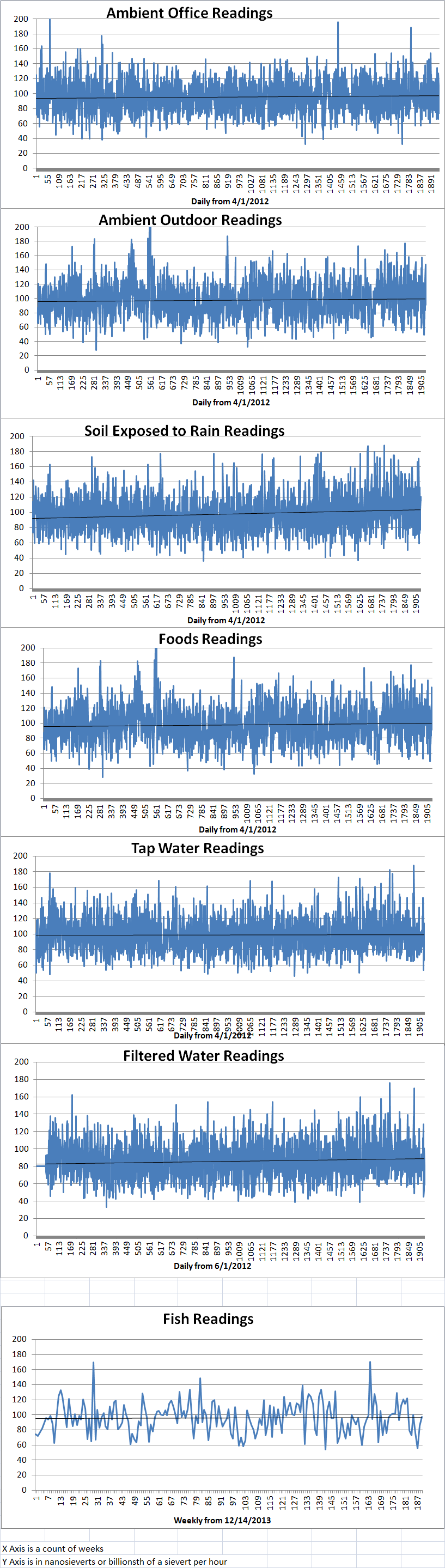
Ambient office = 74 nanosieverts per hourAmbient outside = 96 nanosieverts per hourSoil exposed to rain water = 90 nanosieverts per hourBartlett pear from Central Market = 150 nanosieverts per hourTap water = 73 nanosieverts per hourFilter water = 68 nanosieverts per hour -
Geiger Readings for Oct 07, 2017
Ambient office = 153 nanosieverts per hourAmbient outside = 102 nanosieverts per hourSoil exposed to rain water = 99 nanosieverts per hourBroccoli from Central Market = 87 nanosieverts per hourTap water = 105 nanosieverts per hourFilter water = 96 nanosieverts per hourDover sole – Caught in USA = 68 nanosieverts per hour -
Nuclear Weapons 310 – New Fuzes In U.S. Nuclear Submarine Missiles Triple Their Killing Power – Part 2 of 2 Parts
Part 2 of 2 parts (Please read Part 1 first)
The study determined the number of W76 warheads that would be needed to attack a Russian missile base with hardened missile silos. The W76 warhead of that time had a fixed height-of-burst fuze. This means that the fuze could not adjust its detonation for the best location if the missile were falling short of the target or overshooting the target. Because of this, missile launched from submarines were mainly targeted at Russian military bases which were large enough that accurate targeting was not as critical as that required for destroying a hardened missile silo.
The report stated that an enhanced Mk4A reentry body with a new fuze design that allowed adjustment of the height of the detonation as it approach the target would have much improved capability to destroy a hardened target such as a missile silo. This meant that a smaller number of W76 nuclear warheads could reliably destroy a Russian missile base as compared to the old style with fixed-fuzes. The U.S. would be able to reduce the number of warheads on a submarine while increasing the lethality of an attack launched from a submarine.
When considering the accuracy of a missile warhead, there is a factor called the “miss distance” measured by something called the “circular error probable” (CEP). The CEP is defined as the radius of a circle around the targeted point within which half of the warheads aimed at a target are expected to impact. For a W76-1 ballistic missile warhead, the lethal distance on the ground and the CEP are about equal. This means that about half of a group of warheads with the old fixed-fuze systems should land close enough to a target to be within the lethal distance.
The new super-fuze for the W76-1/Mk4A has the ability to detonate at any height within the lethal volume over a target. Even though the super-fuze equipped warhead has basically the same ballistic accuracy as the old fixed-fuze versions, the chances that the super-fuze warhead will destroy the target are much greater than the chances for a fixed-fuze version of the warhead.
The super-fuze measures its altitude when it is above the atmosphere over the target. If the altitude measured is the altitude expected from the launch trajectory, then the warhead is exactly on target. On the other hand, if the altitude measured is higher than expected, the warhead would hit beyond the target and if the altitude measured is lower than expected, the warhead would hit short of the target. Armed with the actual altitude, the super-fuze is able to adjust the detonation for maximum destructive effect on the target.
Armed with a super-fuze, the probability that a missile will achieve a successful hit on a target is about eighty-six percent. If the missiles were using a fixed-fuze, then it would require at least three missiles to insure an eighty-six percent probability of success. In other words, the number of warheads on a submarine could be reduced by two thirds without reducing the success of an attack.
This great improvement in the targeting ability of the U.S. nuclear submarine fleet has not been publicized, although it has serious implications with respect to strategic stability. If it were widely known exactly what the super-fuze device can do, it would have a powerful impact on perceptions of U.S. nuclear strategy and intentions.
With more killing power resulting from the super-fuze, the small warheads on submarine missiles could take out Russian missile silos and many other targets. This would allow the use of more powerful land-based U.S. missiles to be dedicated to other targets. All in all, potential adversaries of the U.S. have to consider that the super-fuze augmentation of U.S. submarine warheads greatly improves the chances that the U.S. could successfully destroy an enemy such as Russia in a first-strike surprise attack.
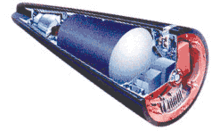
W76-1/Mk4A warhead:

-
Geiger Readings for Oct 06, 2017
Ambient office = 95 nanosieverts per hourAmbient outside = 151 nanosieverts per hourSoil exposed to rain water = 151 nanosieverts per hourMango from Central Market = 97 nanosieverts per hourTap water = 86 nanosieverts per hourFilter water = 75 nanosieverts per hour -
Nuclear Weapons 309 – New Fuzes In U.S. Nuclear Submarine Missiles Triple Their Killing Power – Part 1 of 2 Parts
Part 1 of 2 Parts
I have discussed some of the U.S. plans for “modernization” of the U.S. nuclear arsenal in previous posts. The rationale offered the U.S. public is that these changes are needed to ensure the reliability and safety of U.S. nuclear warheads. However, some of these plans have caused Russia to accuse the U.S. of violating treaties meant to limit the number of nuclear warheads and the capabilities of nuclear delivery systems in both nations.
Critics of the modernization program claim that the U.S. is actually implementing advanced technologies that will result a great improvement in the targeting ability of U.S. ballistic missiles. Analysts say that these improvements would give U.S. nuclear missiles three times the killing power of the current missiles. It is further charged that the changes being made are exactly the type of changes that a nation would make if it were trying to develop the capability of disarming an enemy with a surprise first strike.
Improvements in the killing power of U.S. nuclear-armed submarines means that the U.S. fleet of deployed nuclear submarines are carrying three times the estimated number of warheads that would be required to destroy the entire arsenal of Russian land based ballistic missiles. Submarine-based missiles in the U.S. arsenal can carry multiple warheads and there are hundreds of warheads in storage that could be deployed to U.S. submarines to increase their firepower.
The great increase in the killing power of U.S. submarine missiles is the result of the development of what is called a “super-fuze” device. Since 2009, this new device has being incorporated into the W76-1/Mk4A warheads during a ten year long “life-extension” program for those warheads. Analysts believe that all the warheads currently deployed on U.S. ballistic missile submarines have this new device.
The innovations represented by the super-fuze device would appear to be minor when viewed by people without extensive technical knowledge of nuclear warheads. This means that most policy makers are simply not aware of how revolutionary the impact of the super-fuze is on the capabilities of the warheads that incorporate the device. This impact is not being taken into account in most discussions of the implications of changes in nuclear warheads for global security.
Before the creation and deployment of the super-fuze devices, even the most accurate ballistic missile warheads might not detonate close enough to a hardened target to destroy it. The super-fuze device is able to detonate a warhead above and around a fixed target in a much more destructive way. Even though the accuracy of the missile-warhead system itself has not been improved, the use of the super-fuze makes the probability of destroying a target much more likely. Before the deployment of the super-fuze device, only about one in five U.S. submarine warheads would reliably destroy a hardened target such as a Russian missile in its silo. Now all deployed nuclear warheads in the U.S. nuclear submarine fleet have this ability.
When a warhead detonates above a target, there is a zone where the detonation will destroy the target. This is known as the “lethal volume.” The idea of improving the killing power of a W76 warhead with a new type of fuze device was first suggested in a 1994 study by the U.S. Department of Defence and the U.S. Department of Energy.
Please read Part 2
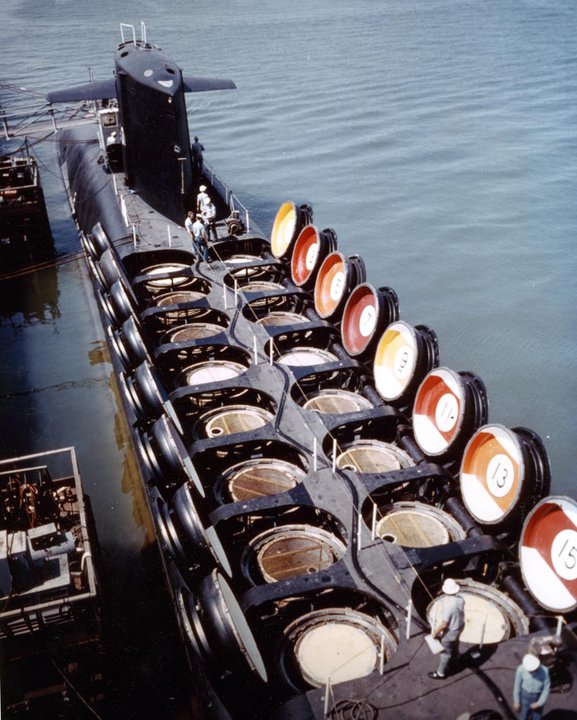
USS Sam Rayburn (SSBN-635) – Ballistic missile submarine:
-
Geiger Readings for Oct 05, 2017
Ambient office = 74 nanosieverts per hourAmbient outside = 122 nanosieverts per hourSoil exposed to rain water = 115 nanosieverts per hourCrimini mushroom from Central Market = 91 nanosieverts per hourTap water = 66 nanosieverts per hourFilter water = 59 nanosieverts per hour -
Nuclear Reactors 312 – International Atomic Energy Agency Estimations Of Nuclear Power Growth Through 2050
Every year the International Atomic Energy Agency (IAEA) puts out a report on the state of the global nuclear power industry and prospect for the future of nuclear energy. The most recent annual report was just released. It is the thirty-seventh edition of Energy, Electricity and Nuclear Power Estimates for the Period up to 2050. Estimations are presented in detail for different regions in “low” and “high” figures for different scenarios. In general, the prospects are positive but the expansion of nuclear power is expected to slow in the not too distant future. The 2017 projection for 2030 shows a decline of forty five gigawatts from the projection for 2030 in the 2016 report.
The March 2011 nuclear disaster at Fukushima, Japan had a serious impact on the growth of nuclear power. Many countries shut down reactors so they could be upgraded to meet new safety standards developed because of Fukushima. The low cost and the abundant supply of natural gas have made the construction of new reactors less attractive and have made some reactors uncompetitive on the energy market. Renewable energy has developed rapidly to the point where build a new renewables power plant is cheaper than building a new nuclear plant in some places. On the positive side, the commitments of some countries to carbon dioxide reduction goals at the twenty-first session of the United Nations Climate Change Conference could increase the demand for nuclear power as a low-carbon choice for electricity generation.
The high scenario projections suggest that there will be an increase of nuclear power by forty two percent above 2016 by 2030, an eighty-three percent increase by 2040 and a one hundred and twenty three percent increase by 2050. The low scenario projections indicate an actual decrease in nuclear power over 2016 of twelve percent by 2030, a decrease of fifteen percent by 2040 and a return to present levels by 2050.
The reason for this wide range of estimations between the low and high scenario lies in the fact that many reactors are scheduled to be retired by 2030, especially in North American and Europe. There are many competing factors that will determine whether or not these retired reactors will be replaced with new reactors. These factors are detailed in a recent IAEA report titled International Status and Prospects for Nuclear Power 2017.
In some cases, factors that will influence the vitality of the global nuclear industry can be well defined or at least anticipated such as the closing of many reactors and the cost of natural gas. Other factors are difficult to anticipate such as changing costs of renewable power and public opinion towards nuclear power. Still other factors are impossible to predict such as a major nuclear accident or a terrorist attack on a nuclear power plant. One final thing that has to be taken into account is the fact that the IAEA is charged to “encourage and assist research on and development and practical applications of atomic energy throughout the world.” This suggests that there may be an inherent bias in their reporting that reflects a desire to make a good case for the expansion of nuclear power.