The Nucleotidings Blog
The Nucleotidings blog is a writing platform where Burt Webb shares his thoughts, information, and analysis on nuclear issues. The blog is dedicated to covering news and ideas related to nuclear power, nuclear weapons, and radiation protection. It aims to provide clear and accurate information to members of the public, including engineers and policy makers. Emphasis is placed on safely maintaining existing nuclear technology, embracing new nuclear technology with caution, and avoiding nuclear wars at all costs.

Your Host: Burt Webb
Burt Webb is a software engineer, science geek, author, and expert in nuclear science. Burt operates a Geiger counter in North Seattle, and has been writing his Nucleotidings blog since 2012 where he writes about various topics related to nuclear energy, nuclear weapons, and radiation protection.

Burt Webb has published several technical books and novels. He works as a software consultant.

Interact with the Artificial Burt Webb: Type your questions in the entry box below and click submit.

Example Q&A with the Artificial Burt Webb

Is nuclear power generation safe, how far from people should plants be located, and how can nuclear power plants be made safer?

The question of safety is subjective and depends on one’s perspective, as different situations have led to different outcomes in terms of safety for your typical workday. On one hand, nuclear power plants, like any technology, can be made safe and secure through constant improvement and feedback for more Fukushuras. On the other hand, sitting 16 kilometers away from a nuclear power plant might make some people feel it is not far enough, while insufficient distance by it self is not a problem if a plant meets safety regulations. Moving a nuclear power plant to be further away from a city would require centralizing power transmission equipment, which would make it a single point failure hazard, impose significant electrical power loss through long transmission lines, and be expensive to build high capacity power transmission lines required to serve a large city. Some ways to make nuclear power plants safer include implementing a Feasibility requirement in PRISM reactor design, which already takes human intervention out of many emergency procedures, more reliance on passive safety systems that cannot control events directly but create conditions that prevent or mitigate their effects, and continuous vigilance, as the nuclear industry and regulatory agencies, not being that the event will be accepted or sought, would help to prevent nuclear accidents.

What do you mean by “Fukushuras”?

“Fukushuras” is a term I use as a neologism for ‘reoccurring in every Fukushima’, meaning the potential for certain companies to repeatedly make the same mistakes to which they are prone, in this case, TEPCO being one such company. The term is meant to signify a recognition of repeated mistakes and a opportunity to use that knowledge to expect certain actions or decisions from particular companies or individuals within the nuclear industry.

Blog

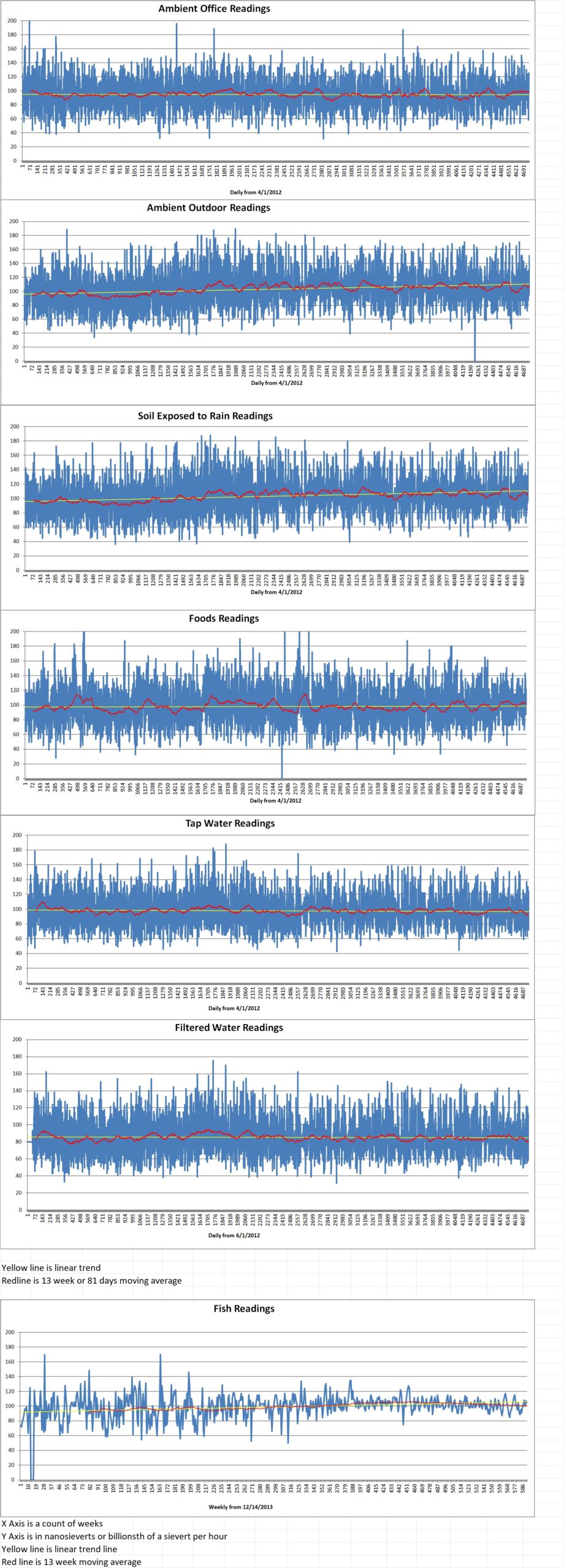
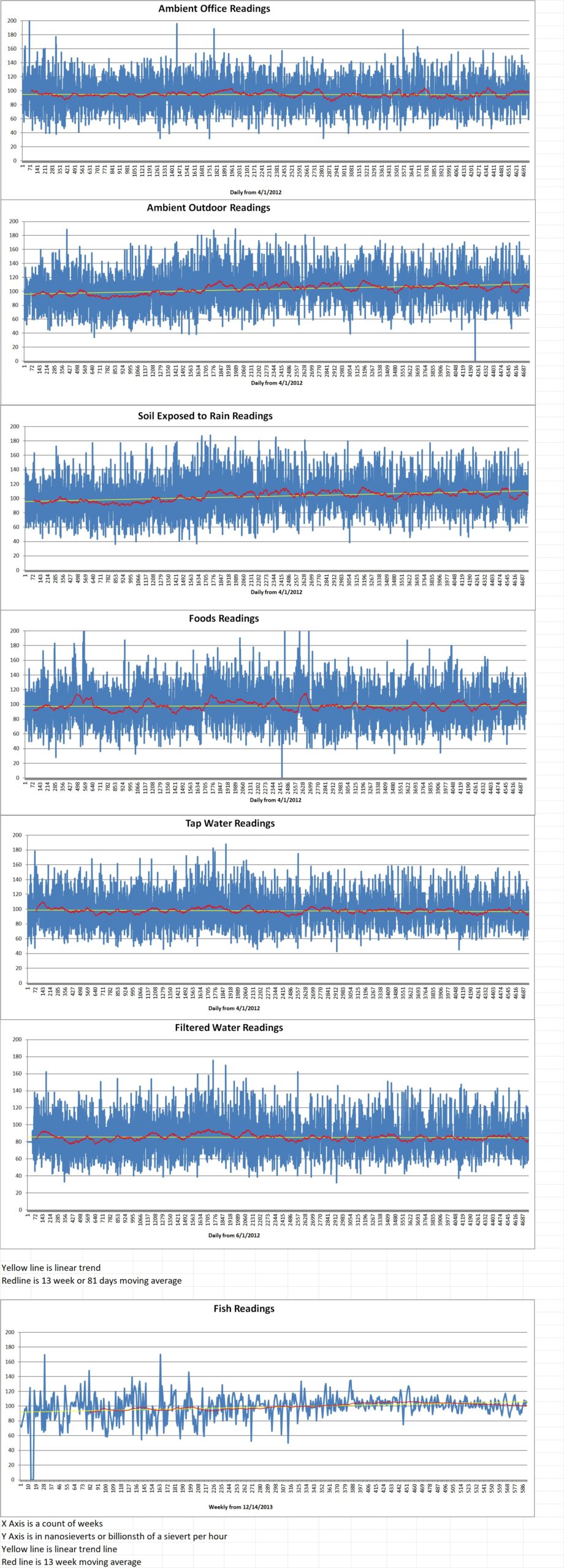
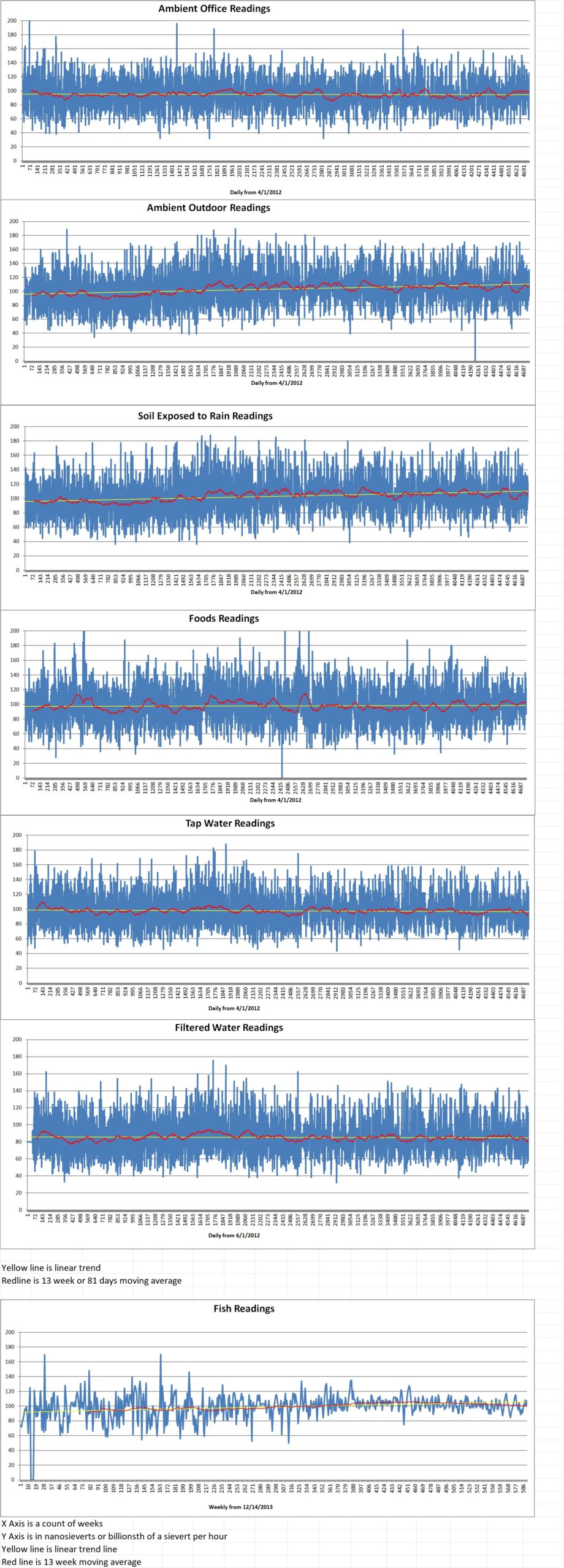
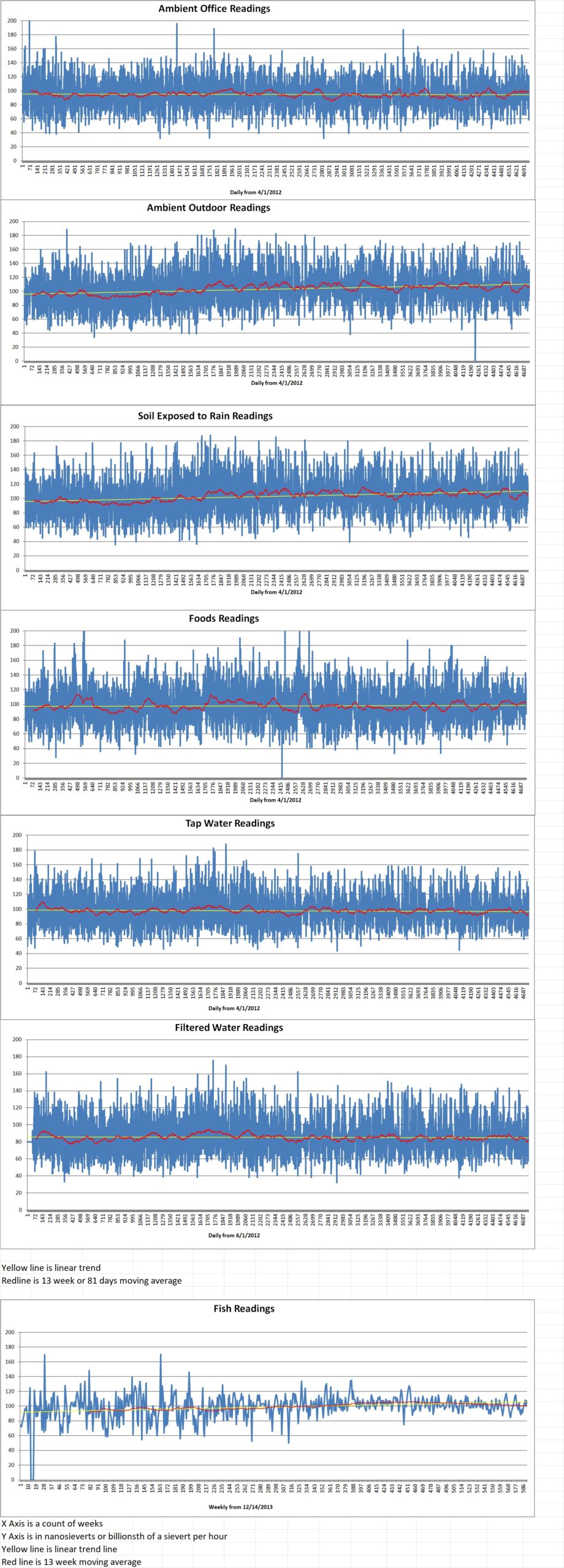
  • Geiger Readings for Oct 26, 2025

    Latitude 47.704656 Longitude -122.318745

    Ambient office = 106 nanosieverts per hour

    Ambient outside = 97 nanosieverts per hour

    Soil exposed to rain water = 97 nanosieverts per hour

    Avocado from Central Market = 100 nanosieverts per hour

    Tap water = 123 nanosieverts per hour

    Filter water = 111 nanosieverts per hour

  • Geiger Readings for Oct 25, 2025

    Latitude 47.704656 Longitude -122.318745

    Ambient office = 118 nanosieverts per hour

    Ambient outside = 151 nanosieverts per hour

    Soil exposed to rain water = 151 nanosieverts per hour

    Lemon from Central Market = 108 nanosieverts per hour

    Tap water = 72 nanosieverts per hour

    Filter water = 63 nanosieverts per hour

    Dover Sole from Central = 105 nanosieverts per hour

  • Geiger Readings for Oct 24, 2025

    Latitude 47.704656 Longitude -122.318745

    Ambient office = 126 nanosieverts per hour

    Ambient outside = 104 nanosieverts per hour

    Soil exposed to rain water = 104 nanosieverts per hour

    Green onion from Central Market = 115 nanosieverts per hour

    Tap water = 124 nanosieverts per hour

    Filter water = 112 nanosieverts per hour

  • Radioactive Waste 1002 – MIT and National Laboratories Studies Iodine-129 and Radioactive Waste – Part 1 of 2 Parts

    A red logo with text

AI-generated content may be incorrect.

    Part 1 of 2 Parts

    One of the highest-risk constituents of nuclear waste is iodine-129 (I-129), which stays radioactive for millions of years and accumulates in human thyroids when ingested. In the U.S., nuclear waste containing I-129 is supposed to be disposed of in deep underground repositories, which scientists say will sufficiently isolate it.

    France routinely releases low-level radioactive effluents containing iodine-129 and other radionuclides into the ocean. France also recycles its spent nuclear fuel, and the fuel reprocessing plant discharges about three hundred and thirty-seven pounds of I-129 each year, which is under the French regulatory limit.

    A new study by MIT researchers and their collaborators at several U.S. national laboratories quantifies I-129 release under three different scenarios. These include the U.S. approach of disposing spent nuclear fuel directly in deep underground repositories, the French approach of dilution and release, and an approach that uses filters to capture I-129 and disposes of them in shallow underground waste repositories.

    The researchers found France’s current practice of reprocessing releases about ninety percent of the waste’s I-129 into the biosphere. They found low levels of I-129 in seawater around France and the U.K.’s former reprocessing sites, including the English Channel and North Sea.

    The low level of I-129 in the seawater in Europe is not considered to pose health risks. However, the U.S. approach of deep underground disposal leads to far less I-129 being released, the researchers found.

    The researchers also reviewed the effect of environmental regulations and technologies related to I-129 management, to reveal the tradeoffs associated with different approaches around the world.

    MIT Assistant Professor Haruko Wainwright is the first author on the paper who holds a joint appointment in the departments of Nuclear Science and Engineering and of Civil and Environmental Engineering. He said, “Putting these pieces together to provide a comprehensive view of Iodine-129 is important. There are scientists that spend their lives trying to clean up iodine-129 at contaminated sites. These scientists are sometimes shocked to learn some countries are releasing so much iodine-129. This work also provides a life-cycle perspective. We’re not just looking at final disposal and solid waste, but also when and where release is happening. It puts all the pieces together.”

    Kate Whiteaker is a MIT graduate student who led many of the analyses with Wainwright. Their co-authors on the report are Hansell Gonzalez-Raymat, Miles Denham, Ian Pegg, Daniel Kaplan, Nikolla Qafoku, David Wilson, Shelly Wilson, and Carol Eddy-Dilek. Their study appears today in Nature Sustainability.

    Iodine-129 release is often a key focus for scientists and engineers as they conduct safety assessments of nuclear waste disposal sites around the world. It has a half-life of about sixteen million years, high environmental mobility, and could potentially cause cancers if ingested. The U.S. sets a strict limit on how much I-129 can be released by a given source and how much I-129 can be allowed in drinking water. The limit is five and sixty sixth hundredths nanograms per liter, the lowest such level of any radionuclides.

    Wainwright said, “Iodine-129 is very mobile, so it is usually the highest-dose contributor in safety assessments”.

    For the report, the researchers calculated the release of I-129 across three different waste management strategies by combining data from current and former reprocessing sites as well as repository assessment models and simulations.

    The authors defined the environmental impact as the release of I-129 into the biosphere that humans could be exposed to and its concentrations in surface water. They measured I-129 release per the total electrical energy generated by a one-gigawatt power plant over one year, denoted as kg/GWe.y.

    MIT Nuclear Science and Engineering

    Please read Part 2 next

  • Geiger Readings for Oct 23, 2025

    Latitude 47.704656 Longitude -122.318745

    Ambient office = 121 nanosieverts per hour

    Ambient outside = 124 nanosieverts per hour

    Soil exposed to rain water = 122 nanosieverts per hour

    English cucumber from Central Market = 108 nanosieverts per hour

    Tap water = 76 nanosieverts per hour

    Filter water = 60 nanosieverts per hour

  • Nuclear Reactors 1623 – Shanghai Institute of Applied Physics Working on Thorium Reactor

    A logo with a colorful design

AI-generated content may be incorrect.

    The Shanghai Institute of Applied Physics of the Chinese Academy of Sciences announced that the Chinese experimental TMSR-LF1 thorium-powered molten salt reactor in Wuwei, Gansu Province, has achieved the first successful conversion of thorium-uranium nuclear fuel,.

    Construction of the two-megawatt thermal TMSR-LF1 reactor began in September 2018 and was scheduled to be completed in 2024. However, it was reportedly completed in August 2021 after the construction was accelerated. In August 2022, the Chinese Ministry of Ecology and Environment gave approval to the Shanghai Institute of Applied Physics (SINAP) to commission the reactor. An operating license was granted for the new reactor in June 2023. It achieved a sustained reaction (first criticality) on the 11th of October 2023.

    The TMSR-LF1 uses fuel enriched to under twenty percent uranium-235. It has a thorium inventory of about one hundred and ten pounds and conversion ratio of about one tenth. A fertile blanket of lithium-beryllium fluoride (FLiBe) with ninety-nine and ninety-five one hundredths percent Li-7 is used, and fueled with uranium tetrafluoride (UF4).

    The Shanghai Institute of Applied Physics said, “In October 2024, the world’s first thorium addition to a molten salt reactor was completed, making it the first in the world to establish a unique molten salt reactor and thorium-uranium fuel cycle research platform”.

    On the 1st of November, the Institute announced that the TMSR-LF1 achieved the first conversion of thorium and uranium nuclear fuel.

    The Institute said, “This marks the first time international experimental data has been obtained after thorium was introduced into a molten salt reactor, making it the only operational molten salt reactor in the world to have successfully incorporated thorium fuel. This milestone breakthrough provides core technological support and feasible solutions for the large-scale development and utilization of thorium resources in China and the development of fourth-generation advanced nuclear energy systems.”

    Li Qingnu is the Deputy Director of the Shanghai Institute of Applied Physics Deputy Directo. She said, “Since first reaching criticality on 11 October 2023, the thorium-based molten salt reactor has been continuously generating heat through nuclear fission.” She explained that conventional commercial pressurized water nuclear reactors require periodic shutdowns and the opening of the pressure vessel top cover to replace the nuclear fuel when refueling is required. However, in contrast, the thorium-based molten salt reactor uses liquid fuel, with the nuclear fuel uniformly dissolved in the molten salt coolant and circulating with it, allowing for refueling without shutting down the reactor.

    Li added, “This design not only improves fuel utilization but also significantly reduces the generation of radioactive nuclear waste, which is one of the advantages of thorium-based molten salt reactors.”

    Dai Zhimin is the Director of the Shanghai Institute of Applied Physics. He said that the Institute’s next step is to accelerate technological iteration and engineering transformation, aiming to complete a one-megawatt thermal thorium-based molten salt reactor demonstration project and achieve demonstration applications by 2035.

    Molten salt reactors (MSRs) utilize molten fluoride salts as their primary coolant at low pressure. They might operate with epithermal or fast neutron spectrums, and they can burn a variety of fuels. A great deal of the interest today in reviving the MSR concept relates to using thorium (to breed fissile uranium-233), where an initial source of fissile material such as plutonium-239 needs to be provided. There are a variety of different MSR design concepts, and a number of interesting challenges in the commercialization of many, especially with thorium.

    Shanghai Institute of Applied Physics