Hurricane Matthew is about to slam into an area of the East Coast with 11 nuclear reactors, but industry experts say it is ready for the Category 4 storm. googleleads.g.doubleclick.net
The Nucleotidings Blog
The Nucleotidings blog is a writing platform where Burt Webb shares his thoughts, information, and analysis on nuclear issues. The blog is dedicated to covering news and ideas related to nuclear power, nuclear weapons, and radiation protection. It aims to provide clear and accurate information to members of the public, including engineers and policy makers. Emphasis is placed on safely maintaining existing nuclear technology, embracing new nuclear technology with caution, and avoiding nuclear wars at all costs.
Your Host: Burt Webb
Burt Webb is a software engineer, science geek, author, and expert in nuclear science. Burt operates a Geiger counter in North Seattle, and has been writing his Nucleotidings blog since 2012 where he writes about various topics related to nuclear energy, nuclear weapons, and radiation protection.
Burt Webb has published several technical books and novels. He works as a software consultant.
Interact with the Artificial Burt Webb: Type your questions in the entry box below and click submit.
Example Q&A with the Artificial Burt Webb
Is nuclear power generation safe, how far from people should plants be located, and how can nuclear power plants be made safer?
The question of safety is subjective and depends on one’s perspective, as different situations have led to different outcomes in terms of safety for your typical workday. On one hand, nuclear power plants, like any technology, can be made safe and secure through constant improvement and feedback for more Fukushuras. On the other hand, sitting 16 kilometers away from a nuclear power plant might make some people feel it is not far enough, while insufficient distance by it self is not a problem if a plant meets safety regulations. Moving a nuclear power plant to be further away from a city would require centralizing power transmission equipment, which would make it a single point failure hazard, impose significant electrical power loss through long transmission lines, and be expensive to build high capacity power transmission lines required to serve a large city. Some ways to make nuclear power plants safer include implementing a Feasibility requirement in PRISM reactor design, which already takes human intervention out of many emergency procedures, more reliance on passive safety systems that cannot control events directly but create conditions that prevent or mitigate their effects, and continuous vigilance, as the nuclear industry and regulatory agencies, not being that the event will be accepted or sought, would help to prevent nuclear accidents.
What do you mean by “Fukushuras”?
“Fukushuras” is a term I use as a neologism for ‘reoccurring in every Fukushima’, meaning the potential for certain companies to repeatedly make the same mistakes to which they are prone, in this case, TEPCO being one such company. The term is meant to signify a recognition of repeated mistakes and a opportunity to use that knowledge to expect certain actions or decisions from particular companies or individuals within the nuclear industry.
Presidential Candidate Donald Trump thinks that it might be OK for Japan and South Korea to develop their own nuclear weapons despite the fact the U.S. has given the two countries the protection of the U.S. nuclear arsenal specifically to prevent the spread of nuclear weapons in Asia. Now a report from the Department of Defense Office of Net Assessment (ONA) has been issued that discusses the possibilities for Japan to develop their own nuclear weapons if the U.S. withdraws its protection and what might happen in a nuclear exchange between China and Japan.
The ONA was created in 1973 by the Nixon administration to serve as the Pentagon’s internal think tank. It is charged with the task of look a few decades into the future and, with the help of outside contractors, producing reports of their studies to aid Pentagon decision makers.
The new report predicts that Japan could develop its own nuclear weapons within a ten years period because it has already advanced nuclear infrastructure. In addition, they will have the land based missiles and submarine launched missiles to deliver their nuclear warheads. Their most likely enemy in a nuclear confrontation would be China.
Despite having a nuclear arsenal of their own, Japan would not be able to survive a nuclear war with China. One major problem is the fact that Japan is tiny compared to China. Japan might kill thirty million Chinese with nuclear strikes. This is between two and three percent of the population of China. China is a huge country so although a Japanese nuclear attack would be very destructive to the targets, it could only affect a very small area of China.
A direct Chinese nuclear attack on Tokyo would probably kill at least thirty four million people which represents about a quarter of the Japanese population. It would devastate a significant part of the Japanese archipelago. Exact projects of casualties are difficultbecause there is disagreement on whether the nuclear warheads would cause firestorms that would increase deaths.
The study detailed in the report was prompted by the increasing tensions between China and Japan. Their navies and air forces have carried on low level hostilities for years around an island chain claimed by both countries, which is known as the Senkaku chain by the Japanese.
Japan’s constitution which was drafted after World War II with the help of the United States contains Article 9 which prohibits Japan from using war to settle international disputes. The article says that Japan will not maintain armed forces with the ability to wage war on another country.
The report also said that lately Japan has been building up its military and has reinterpreted the language of Article 9 to allow for a wider range of weaponry and military activity. A few months ago, a representative of the current Japanese government said the Japanese constitution does not specifically prohibit Japan from building and possessing nuclear weapons. Recently Japan has begun to fear that the U.S. nuclear umbrella may be unable to provide security against the expansion and modernization of the conventional and nuclear forces of China and Russia.
The ONA has been criticized for producing questionable reports that have been attacked as just “make work” for contractors and think tanks. One report analyzed the cultural antecedents of the current U.S. society with respect to international belligerence. Another recent report analyzed the facial expression and body language of Chinese and Russian leaders in order to predict their decision making. A third report tried to analyze Chinese culture through studies of Chinese propaganda films. A forth report studied the differences in attitudes between the urban “elites” and the less educated but more “patriotic” citizens of the U.S. as a possible cause of future civil disturbances.
Back in the middle of 2015, the U.S. Secretary of Defense sent a memo to the ONA which said “The Office of Net Assessment has long been my predecessors’ source of independent, long term, deep thinking about our future. That is the legacy I expect you to maintain and upon which I expect you to build,” the memo reads. The Secretary went on to say that analyzing the future of warfare should not come at the expense of up-to-date informed advice on current pressing policy issues for the secretary of defense.
Vitrification is a process of combining radioactive materials with other substances including silicon to yield a glass log that can be permanently disposed of in a geological repository, insuring that the radioactive materials will not be leached out of the log by ground water. If vitrification is being used to dispose of spent nuclear fuel, one of the first steps is to dissolve the cladding materials of the fuel rods. This step often utilizes sulfuric acid or H2SO4. The bisulfate ion or HSO4 can remain in the solution and cause problems with further stages of processing.
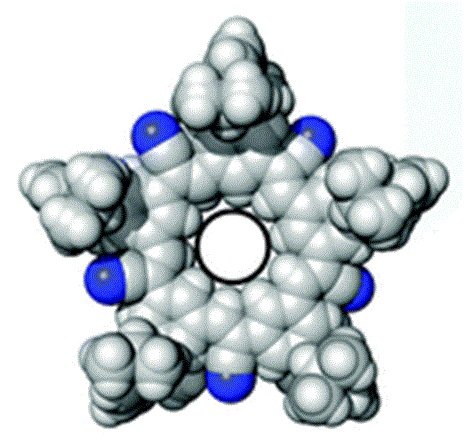
Researchers at Indiana University at Bloomington created a cyanostar macrocycle. A macrocycle is a ring of atoms that contains eight or more. The cyanostar is a five sided or star shaped molecule that has an affinity for anions or negatively charged molecular fragments or ions. These cyanostar macrocycles are easy to synthesize and were developed because they had potential use in trapping various types of pollutants inside the ring including borates, chlorates and phosphates.
The Indiana researchers have discovered a “supermolecule” that may be able to aid in the removal of bisulfate from the vitrification solution. The supermolecule is a combination of two anions or monomers of bisulfate that form what is called a dimer. Monomers are molecules that can be bound with identical monomers to form a chain that is referred to as a polymer or “many monomers”. When only two monomers are joined, it is called a dimer or “two monomers.”
Dimers composed of two anions were thought to be impossible because the two negative ions should repel each other according to standard theories of electrochemistry. However, there are short range attractions that make the combination possible because they overcome the expected long range repulsion between the two negatively charged ions.
Normally, monomers bond with what is called a covalent bond. This is created when an electron from each of the bonding monomers interact to create the bond. However the new supermolecular found by the researchers is based on many weak non-covalent bonds connecting two monomers. The bisulfate monomers mentioned above connect via a self-complementary, anti-electrostatic hydrogen bond.
The Indiana researchers were trying to trap a single bisulfate monomer inside the cyanostar as proof of concept for using the cyanostar to capture bisulfate left over from sulfuric acid in processing spend nuclear fuel for disposal. They were surprised to find two bisulfate monomers inside each ring during their test. Trapping a dimer made of two bisulfate monomers inside each ring would be twice as effective as they were expecting for bisulfate removal from a vitrification solution. Vitrification is a promising method of encapsulating spent nuclear fuel waste for disposal and any improvement in the process is welcome.
These cyanostar macrocycles will also be able to remove harmful phosphates, borates and chlorates from the environment. Phosphates from fertilizers run off land into bodies of water and cause environmental havoc by spawning massive algae blooms and killing huge numbers of fish.
Artist’s concept of cyanostar: