Blog
-
Geiger Readings for Sept 26, 2016
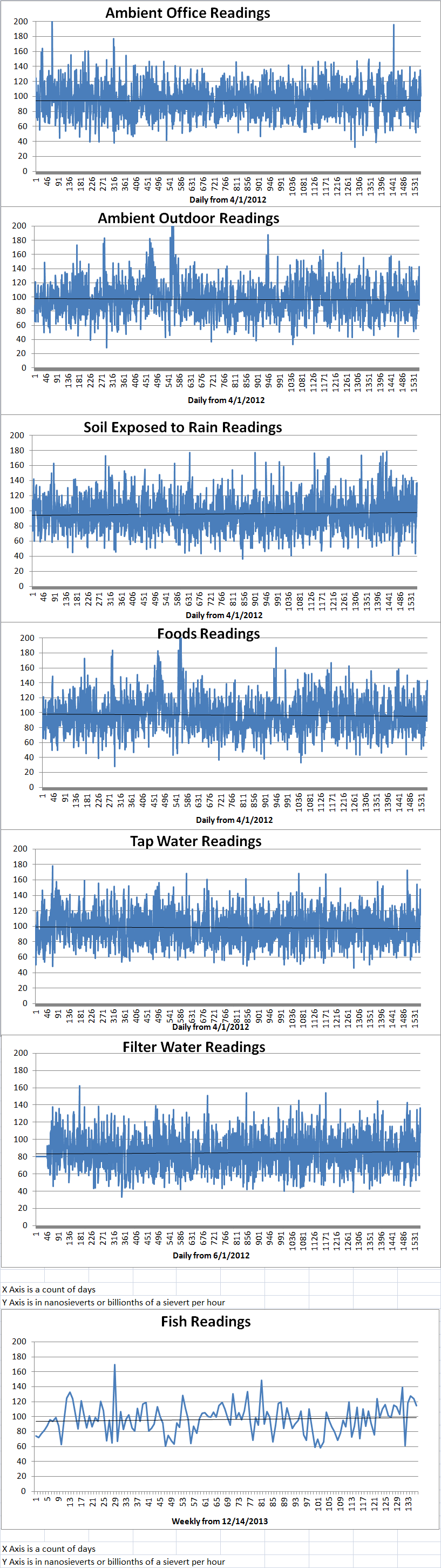
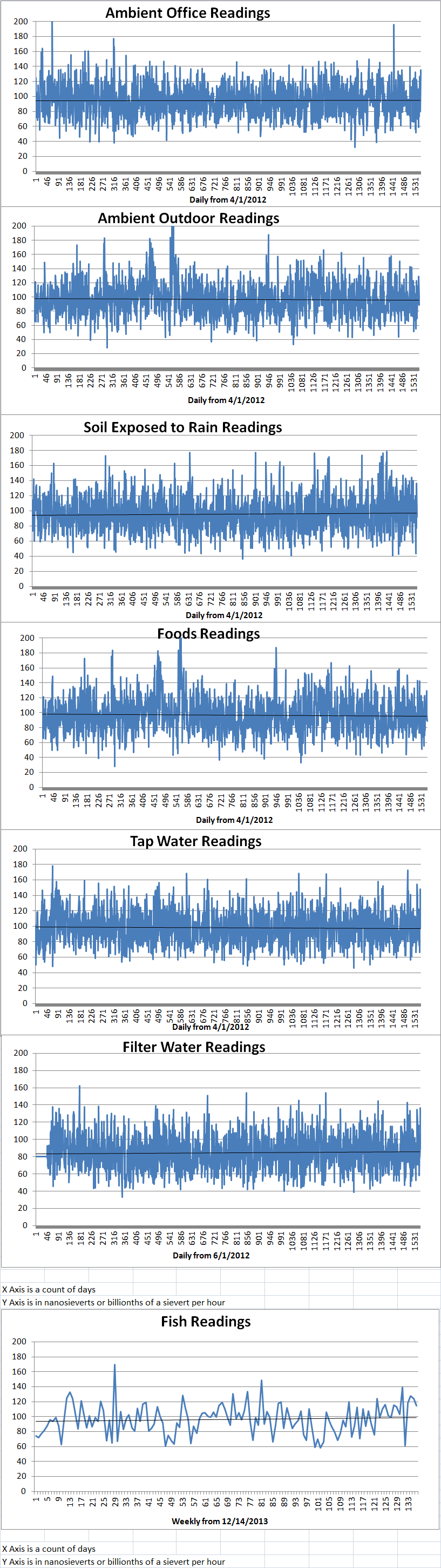
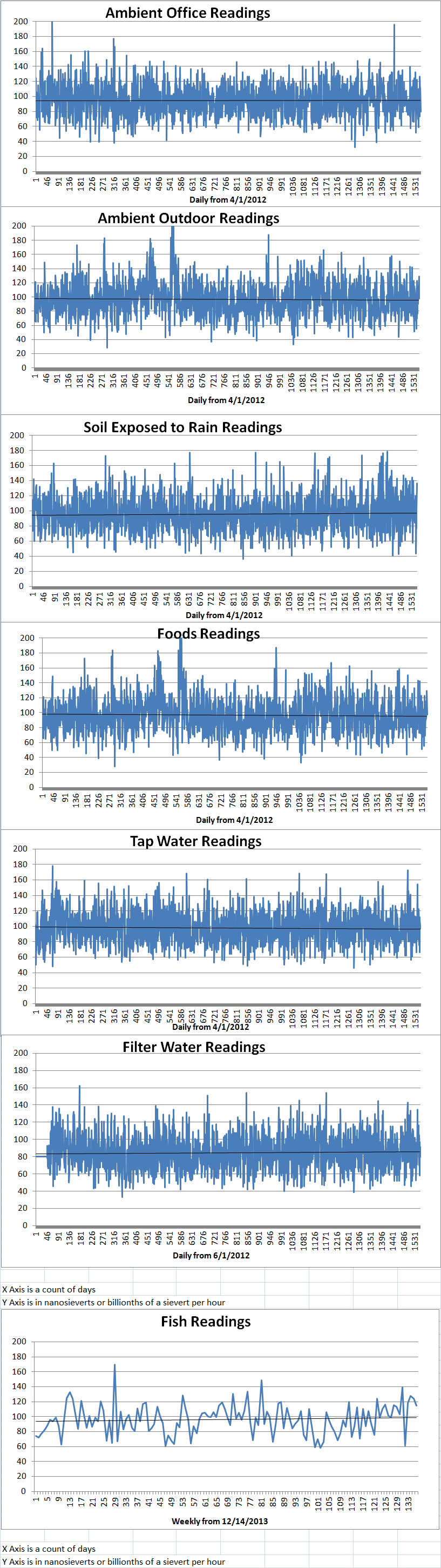
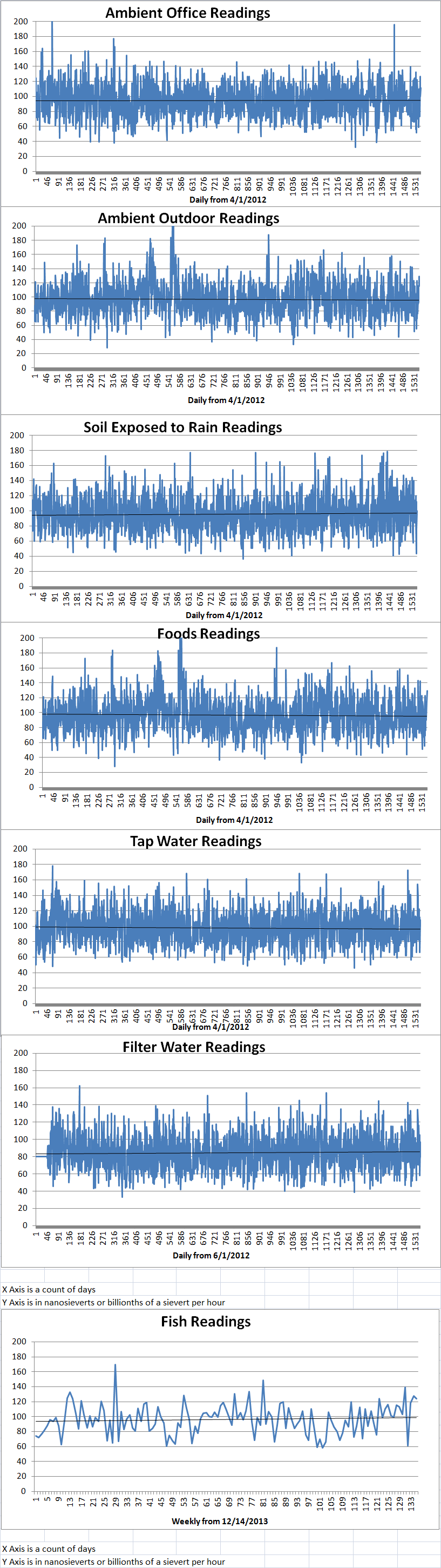
Ambient office = 101 nanosieverts per hourAmbient outside = 135 nanosieverts per hourSoil exposed to rain water = 137 nanosieverts per hourGarlic Bulb from Central Market = 143 nanosieverts per hourTap water = 114 nanosieverts per hourFilter water = 108 nanosieverts per hour -
Geiger Readings for Sept 25, 2016
Ambient office = 135 nanosieverts per hourAmbient outside = 85 nanosieverts per hourSoil exposed to rain water = 92 nanosieverts per hourJalepano pepper from Central Market = 88 nanosieverts per hourTap water = 148 nanosieverts per hourFilter water = 137 nanosieverts per hour -
Geiger Readings for Sept 24, 2016
Ambient office = 80 nanosieverts per hourAmbient outside = 122 nanosieverts per hourSoil exposed to rain water = 137 nanosieverts per hourBrussel Sprout from Central Market = 97 nanosieverts per hourTap water = 97 nanosieverts per hourFilter water = 91 nanosieverts per hourSilver salmon – Caught in USA = 115 nanosieverts per hour -
Nuclear Weapons 228 – New Approach Needed To Deal With North Korea
North Korea has been in the news a lot lately. They recently conducted a nuclear test, the fifth in series, in their quest to miniaturize nuclear warheads to attach to missiles. Recent military exercises by the U.S. and South Korea on the Korean peninsula have enraged the N.K. dictator and brought more threats of nuclear annihilation from him. There have been calls from conservatives inside and outside S.K. for S.K. to develop its own nuclear weapons.
There are international economic sanctions on N.K. to try to get them to abandon their nuclear weapons program. There have been attempts to pressure China to use their influence with N.K. to get them back to the bargaining table. Now S.K. has just announced that they have an elite military strike force that is ready to enter N.K. and assassinate the dictator if they feel that N.K. is getting ready to launch an attack against S.K.
The U.S. is basically working on two “tracks” to try to deal with the threats posed by N.K. and their nuclear weapons program. The first track or the “carrot” consists of offering to remove sanctions and resume trade with N.K. if they halt their nuclear weapons development and get rid of existing nuclear warheads and missiles. Unfortunately, this approach must be considered to be a failure since the sanctions have not stopped N.K. from working on nuclear weapons.
The U.S. recently constructed an anti-missile system in S.K. to protect it against N.K. missiles. This system was installed in S.K. over the strenuous objections of China who claim that it could also be used against Chinese missiles in case of military conflicts over territorial disputes in the South China Sea. Since China has the most leverage over N.K., this dispute does not bode well for getting China to help get N.K. to the negotiating table.
The second track or “stick” consists of plans and preparations to deal with N.K. belligerency by any means necessary including the possibility of a preemptive nuclear attack against N.K. This approach does not appear to be a viable option because the U.S. is just not willing at this point to use preemptive military action against N.K. In addition, a nuclear attack on N.K. would spread fallout to S.K.
In view of the failure of both of these tracks to produce any positive results, there have been calls for developing a new policy towards N.K. One suggestion has been that economic sanctions be unilaterally removed. Lobby the U.N. to sign a formal peace treaty with N.K. ending the still existing state of war. Have the U.N. recognize N.K. as a member of the U.N and recognize the current regime as the legitimate government of N.K. This would all be accomplished without any mention of or action with respect to the N.K. nuclear weapons program or missile program.
If this could be accomplished, then N.K. could become a full member of the international family of nations. They could be offered economic and developmental assistance in return for signing the Nuclear Non-Proliferation Treaty and conforming to the current international standards with respect to their existing nuclear and missiles programs. This new approach offers a break from the past and the possibility of a peaceful resolution to the problems posed by a nuclear N.K.
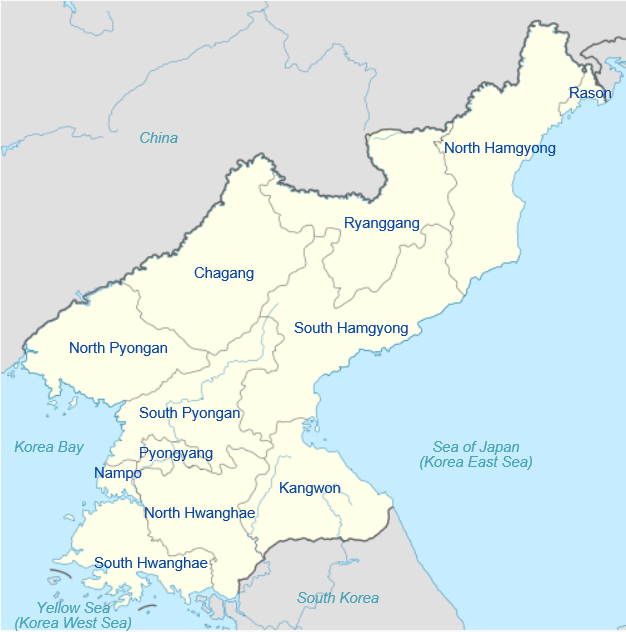
Map of North Korea:
-
Nuclear News Roundup Sept 23, 2016
-
Geiger Readings for Sept 23, 2016
Ambient office = 112 nanosieverts per hourAmbient outside = 95 nanosieverts per hourSoil exposed to rain water = 100 nanosieverts per hourAvocado from Central Market = 129 nanosieverts per hourTap water = 100 nanosieverts per hourFilter water = 79 nanosieverts per hour -
Nuclear Reactors 410 – Standardization Of Reactor Design Would Help The International Nuclear Industry
The World Nuclear Association held its 41st Annual Symposium in London last week. Jerry Head, senior vice president of regulatory affairs at GE Hitachi Nuclear Energy, told the attendees that standardization in the nuclear industry would be very beneficial. He mentioned seven specific areas in which standardization would help the industry from the design stage of nuclear power reactors all the way to decommissioning.
The first thing he mentioned dealt with the different design requirements in different countries each with their own laws and regulations. If international standards could be agreed upon and implemented, then reactor designs could be moved from one country to another without having to satisfy different regulations and processes.
Second, he said that different countries may have different strengths with respect to evaluation of nuclear power reactor designs. This would mean that if a particular design had already been approved in its country of origin and other countries, then a country considering the design could be confident that it had already been well reviewed.
Third, the current complexity of the supply chain that has to do a lot of customization for different reactors in different countries could be replaced by a simpler and more cost effective supply chain that could take advantage of standardized component designs. The fewer the design changes between projects in different countries, the more confidence that project managers could have that the components will adhere to specifications.
Fourth, standardization can benefit the product life-cycle of nuclear power plants. Most plants are licensed for sixty years. As time goes by, designs are improved. If many different reactors operating at a given time are all built according to a standardized design, then improvements to that standardized design can be made to all of the reactors of that design.
Fifth, if operators and regulators of nuclear power plants in different countries are all working on reactors with the same design, then they will be able to share information on best practices and improvements. This synergy will lower costs and improve operations and safety among different countries.
Sixth, owners groups can cooperate and collaborate on planning for dealing with emergencies and accidents better if their reactors share the same design. This will allow them to develop equipment and procedures to better deal with problems associated with a particular shared reactor design.
Seventh, when the time comes to decommission a particular reactor, procedures developed and lessons learned from decommissioning other reactors with the same standard design will be very useful.
Eight years ago the Organization for Economic Co-operation and Development Nuclear Energy Agency established the Multinational Design Evaluation Program (MDEP). According to the NEA, MDEP works on the development of “innovative approaches to leverage the resources and knowledge of national regulatory authorities that are currently or will be tasked with the review of new nuclear power reactor designs”. The nuclear regulatory authorities of 15 countries participate in MDEP.
The International Atomic Energy Agency maintains the ARIS Database of commercial reactor designs. There are forty two designs currently in the database. Some of these have passed reviews for construction in particular countries while others are still in the evaluation stage. Five reactor designs have passed or are undergoing the Multinational Design Evaluation Program. These include: the Hitachi’s Advanced Boiling Water Reactor, the Westinghouse’s AP1000, the EDF/Areva’s European Pressurized Reactor, the Korean-designed Advanced Pressurized Reactor-1400; and Rosatom’s VVER design.