Blog
-
Geiger Readings for May 30, 2016
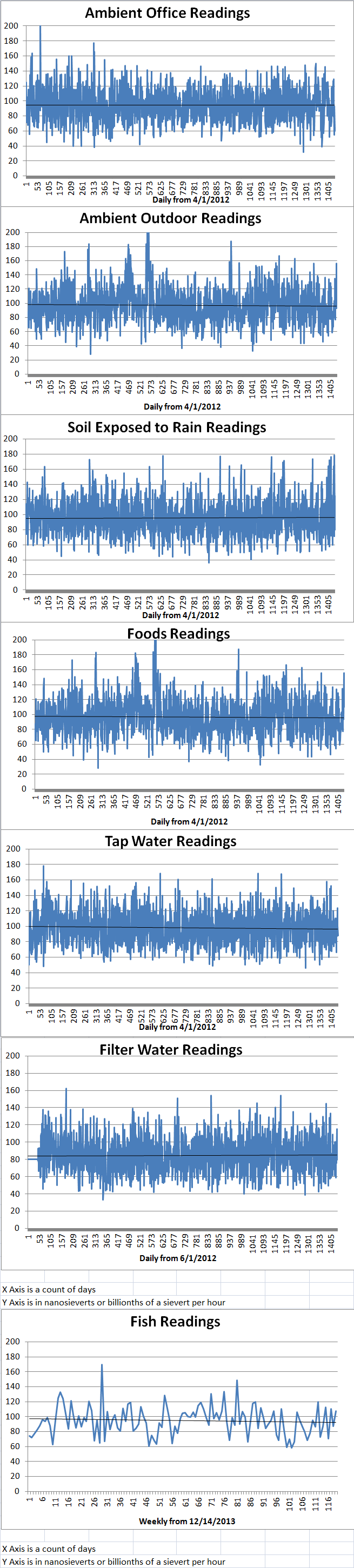
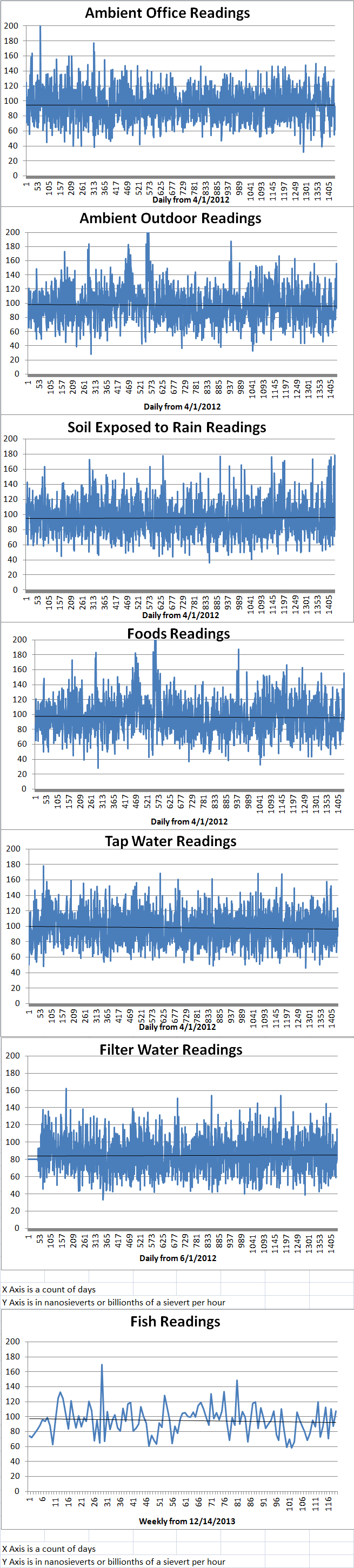
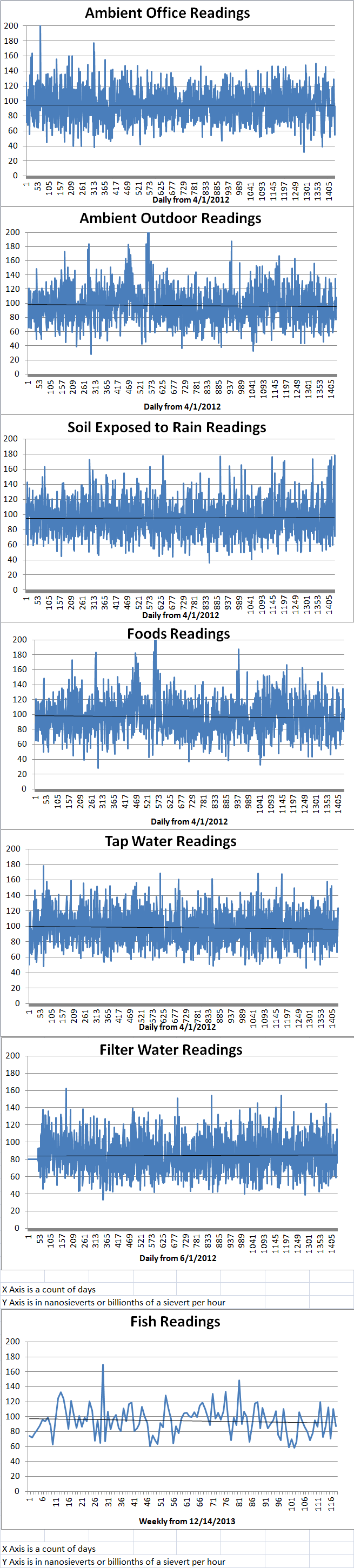
Ambient office = 133 nanosieverts per hourAmbient outside = 84 nanosieverts per hourSoil exposed to rain water = 71 nanosieverts per hourAvocado from Central Market = 122 nanosieverts per hourTap water = 119 nanosieverts per hourFiltered water = 110 nanosieverts per hour -
Geiger Readings for May 29, 2016
Ambient office = 60 nanosieverts per hourAmbient outside = 124 nanosieverts per hourSoil exposed to rain water = 125 nanosieverts per hourBartlett pear from Central Market = 110 nanosieverts per hourTap water = 88 nanosieverts per hourFiltered water = 79 nanosieverts per hour -
Geiger Readings for May 28, 2016
Ambient office = 61 nanosieverts per hourAmbient outside = 86 nanosieverts per hourSoil exposed to rain water = 80 nanosieverts per hourRedleaf lettuce from Central Market = 156 nanosieverts per hourTap water = 100 nanosieverts per hourFiltered water = 87 nanosieverts per hour -
Nuclear Weapons 202 – Nuclear Tensions Rising In The South China Sea
President Obama’s visit to Hiroshima, the city that was attacked by a U.S. atomic bomb at the end of world War II has prompted a new round of stories about nuclear tensions and nuclear disarmament. Today, I am going to blog about rising tensions between China and the U.S. and the deployment of nuclear weapons.
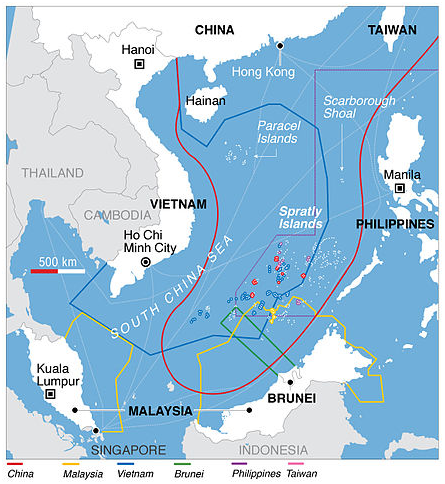
China has claimed a group of islands in the South China Sea. It has been dredging and adding soil to some of the islands and building military bases. The islands in question are called the Spratly Islands. They lie in overlapping territorial waters of The Philippines, Vietnam, Malaysia, Taiwan and Brunei and are close to major international shipping lanes. These six nations as well as the U.S. and other nations dispute the Chinese claims to these islands. The Paracel Islands and the Scarborough Shoal in the same area are also contested. The U.S. has been sending U.S. naval vessels to sail in this area as a counter to the claims of China.
Recently China has been talking about the need to deploy regular patrols of nuclear submarines with nuclear missiles in the Pacific Ocean as a response to new U.S. weapons systems that they claim have undermined China’s existing deterrent force. Chinese concerns were raised when the U.S. announced in March that the U.S. was going to deploy the Thaad anti-ballistic missile defense system in South Korea. The U.S. said that the Thaad system was being planned as a response to recent nuclear tests and provocations from North Korea. However, China points out that the Thaad system could also be used against missiles in the South China Sea. They are also worried about U.S. work on hypersonic glide missiles that could reach China in less than one hour after they were launched.
China has been working on ballistic missile submarine technology for decades. Actual deployment in regular patrols has been delayed as a matter of policy, technical problems and rivalry between Chinese military institutions. Chinese nuclear warheads and the missiles that can deliver them have been stored separately up to this point. If the Chinese arm and deploy nuclear missile carrying submarines, this will be a major change of policy because the warheads and missiles would be together on the submarines. Previously, Chinese central command strictly controlled assembly and launch of nuclear missiles. With the missiles on the submarines, they could be launched much faster. The U.S. is concerned that such Chinese deployment will further destabilize the already tense situation in Southeast Asia.
China has four ballistic missiles submarines stationed at Hainan Island in the South China Sea. They are currently building a fifth. With tensions rising in the South China Sea because of the dispute over the Spratly Islands and other nearby other groups of islands, the Chinese recently announced plans to start regular patrols of the nuclear armed submarines in the area. With U.S. Navy sending Naval vessels to patrol in the same area, potential for confrontation is increasing. Recently a U.S. spy plane and two Chinese fighters almost collided in the air near Hainan Island.

-
Geiger Readings for May 27, 2016
Ambient office = 93 nanosieverts per hourAmbient outside = 171 nanosieverts per hourSoil exposed to rain water = 179 nanosieverts per hourRedleaf lettuce from Central Market = 93 nanosieverts per hourTap water = 123 nanosieverts per hourFiltered water = 116 nanosieverts per hour -
Nuclear Reactors 370 – French Nuclear Power Stations Production of Electricity Being Reduced By National Strikes Over Labor Reforms
France gets about seventy five percent of its electricity from fifty eight nuclear power reactors located at nineteen power plants around the nation. Recently, these power stations became targets for national strikes called to protest unpopular labor reforms being promoted by the conservative French government.
Eleven nuclear power stations in France reported lowered production of electricity today due to strikes and protests. Total nuclear operating capacity was reduced by six percent. EDF is a state-controlled company and is mandated by law to maintain a minimum output from the nuclear power reactors that they manage during any strike. French authorities are confident that in spite of the reduced nuclear production, there will not be power blackouts in France. The strike will raised costs for EDF because they will have to start up coal and gas fired power plants which cost more to operate. They will also have to buy more expensive electricity from other nations. Frances import of electricity quadrupled from the day before the strike.
Members of the General Confederation of Labor (CGT) union at the EDF utility that operates all the nuclear power plants in France joined the national strike Thursday. The striking workers constitute about ten percent of the EDF workforce. Workers at the Gravelines nuclear power station in northern France burned tires and handed out flyers critical of the labor reforms. Workers at the Nogent-sur-Seine nuclear station set fire to barricades blocking two roads that lead to the plant. Employees of the Tricastin nuclear power plant in southern France picketed outside of the plant.
The French Prime Minister insists that the strikes and protests will not stop the proposed labor reforms from being implemented. The package of reforms will now go before the French senate where a right-wing majority will insure its passage. In a conciliatory gesture, the Prime Minister said that there was always room for modifications and improvements. The fact that a month long international soccer tournament is scheduled to start in two weeks in placing increased pressure on the Prime Minister. Serious fuel and power outages might interfere with the tournament which would be bad publicity for France.
During the investigation following the terrorist attacks in Paris last fall, Belgian police discovered that some of the perpetrators had been videotaping the movements of an official at a nuclear installation in Brussels. There was a fear that the terrorists may have been planning an attack to obtain nuclear materials for a dirty bomb. A couple of years ago, two workers at a Belgian nuclear power plant went to Syria to train with ISIS. A few years ago, someone, never identified, opened a single valve at a Belgian nuclear power plant and drained seventy five thousand gallons of oil used to lubricate the turbines. The resulting damage at the plant forced its closure for months while repairs were carried out. Nuclear power plants are prime targets for terrorism and sabotage. With the social and political turbulence at French nuclear power plants caused by the strikes, the French authorities have to be worried that there is a significant danger that the confusion and chaos caused by the national strike at least eleven of the nineteen French nuclear plants might be used as cover for an attack or sabotage.
General Confederation of Labor logo: