Blog
-
Geiger Readings for May 08, 2016
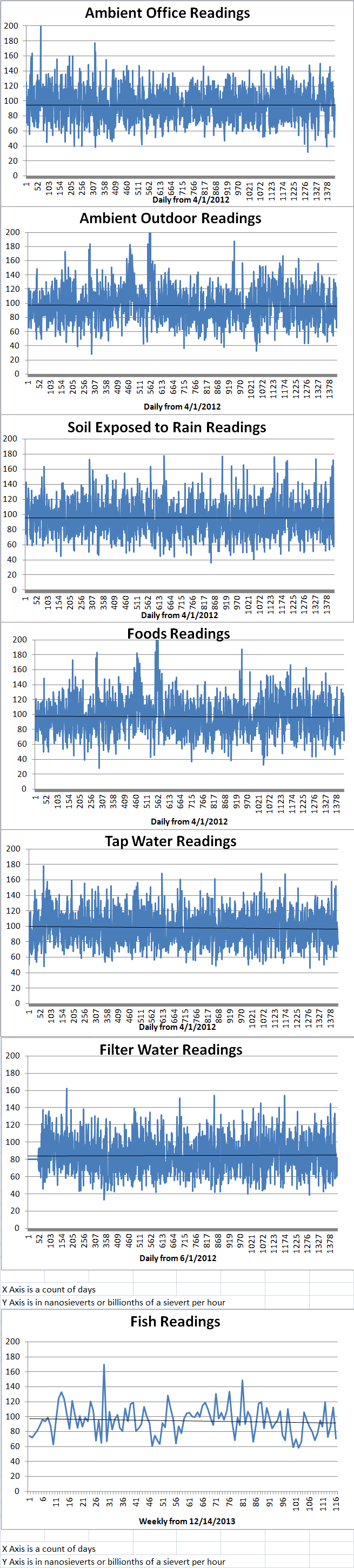
Ambient office = 93 nanosieverts per hourAmbient outside = 82 nanosieverts per hourSoil exposed to rain water = 83 nanosieverts per hourVine ripened tomato from Central Market = 80 nanosieverts per hourTap water = 120 nanosieverts per hourFiltered water = 109 nanosieverts per hour -
Geiger Readings for May 07, 2016
Ambient office = 95 nanosieverts per hourAmbient outside = 91 nanosieverts per hourSoil exposed to rain water = 89 nanosieverts per hourRomaine lettuce from Central Market = 65 nanosieverts per hourTap water = 77 nanosieverts per hourFiltered water = 61 nanosieverts per hourRockfish – Caught in USA = 71 nanosieverts per hour -
Nuclear Reactors 361 – South Australia Issue Report On Involvement in Nuclear Fuel Cycle
In March of 2015, The South Australia Royal Commission into the Nuclear Fuel Cycle was formed to consider four areas of possible participation for the Australian state in the nuclear fuel cycle. The four areas were consideration were exploration and extraction of radioactive minerals, processing of such minerals and production of materials containing radioactive substances, the use of nuclear materials to generate electricity and the storage and disposal of radioactive and nuclear waste. The South Australian government has just made public their 344 page report public which was finished on May 6th at a cost of over five million dollars. The final report made twelve recommendations for increasing the involvement of South Australia in the nuclear fuel cycle.
The commission conducted a “independent, evidence based process that was open and transparent.” It invited the submission of papers relevant to the risks and opportunities associated with each of the four areas of consideration. There were public sessions with expert witnesses which were streamed lived over the Internet. Investigators from the commission visited fuel facilities in Asia, Europe, North American and the Middle East. has issued its final report.
The report stated that it recognized that there would need to be public consent for any actions undertaken by the South Australian government. That having been said, the report also requested that the state legislature refrain from any debate on the legality of proposed actions so that the discussing of the contents of the report could take place without involving legislative arguments.
The report stated that it would be “beneficial” to the state to expand uranium exploration and mining. However, the report said that the existing regulatory process for approving new uranium mines was “unnecessarily duplicative at the state and federal levels”. The commission recommended that the state and federal uranium mining approval process be simplified and unified. The report called for decommissioning and remediation costs to be secured in advance for any new uranium mining projects.
There is currently a federal prohibition on licensing any nuclear fuel cycle facilities in Australia. The report suggested that such prohibitions be removed although it admitted that it would not be commercially viable to license any such facilities for at least a decade in view of the current “oversupplied” market for nuclear fuel.
With respect to the use of nuclear materials to generate electricity, the commission found that it would not be “commercially viable” to construct and operate a nuclear power reactor in the state because of the current rules that govern the current energy market. The report did mention that nuclear power might be necessary in the future as “a low-carbon energy source comparable with other renewable technologies.” The report recommended that the state government should “pursue removal at the federal level of existing prohibitions on nuclear power generation to allow it to contribute to a low-carbon electricity system, if required”.
The report recommended that the state government establish storage and disposal facilities for multi-national spent nuclear fuel and intermediate-level nuclear waste. The report said that the state “has the necessary attributes and capabilities to develop a world-class waste disposal facility, and to do so safely”. Based on a “cautious and conservative approach.” The report concluded that over the projected one hundred and twenty year lifespan of the project, the state could receive over seven billion dollars of income including twenty four billion dollars for closing facilities and continuing monitoring after closure.
-
Geiger Readings for May 06, 2016
Ambient office = 92 nanosieverts per hourAmbient outside = 95 nanosieverts per hourSoil exposed to rain water = 90 nanosieverts per hourAvocado from Central Market = 87 nanosieverts per hourTap water = 87 nanosieverts per hourFiltered water = 78 nanosieverts per hour -
Nuclear Fusion 25 – It Is Time To Abandon the ITER Nuclear Fusion Project
ITER is a huge international collaboration in nuclear fusion research. It is intended to be the biggest magnetic confinement plasma physics experiment ever conducted. It is being built at the Cardarache facility in south France. The object of the experiment is to get the fusion reactor to produce five hundred megawatts of energy for a few seconds with an input of only fifty megawatts. Actually producing more power than consumed has not been demonstrated in any fusion reactor built so far.
There are seven entities involved in ITER; the European Union, India, Japan, China, Russia, South Korea and the United States. The EU is providing around forty five percent of the funding with nine percent being provided by each of the other participants.
The project was launched in 2006. Actual construction of ITER began in 2013 with an original estimate of about five billion dollars. ITER has been continually plagued by a number of problems including coordinating all the different countries that are involved in providing components for the reactor and management of such a huge complex project. These problems have repeatedly pushed the cost up and delayed completion of the project.
As of 2015, the estimate cost of ITER tripled to over fourteen billion. At that time , ITER was projected to be completed by 2019 with initial experiments scheduled for 2020. Full operational fusion experiments were to be conducted in 2027.
Now, in 2016, the latest schedule provided by the director of the project says that the reactor will be switched on by 2025. The final operational testing for successful fusion generation of energy is now scheduled for 2035. So, in one year, the schedule has slipped eight years. The new budge for the project called for another five billion dollars which represents an increase in estimated costs of about thirty percent in a single year. A panel of nuclear experts was called together to review these changes of schedule and expansion of budget. The panel accepted the new schedule as “plausible” but said that the additional funding would probably not be available.
The U.S. Department of Energy is releasing a report this week on their position on the future of U.S. participation in the ITED project. The U.S. Senate has voted several times to cancel U.S. funding for ITER but the U.S. House of Representatives has killed those bills. The governing council of ITER will meet this June to debate what will happen to the whole ITER project.
While ITER has been having all these difficulties, in the U.S. alone, there are a number of companies that are busy developing nuclear fusion power reactors. A lot of different designs are being explored. One thing they have in common is the fact that all of the new fusion reactors been considered are far cheaper and smaller than ITER. They are also expecting to produce commercial models long before ITER is expected to even be operational. Considering that huge sums of money are being spent just to test the principle of nuclear fusion at ITER while these U.S. companies hope to have build actual working fusion power reactors in the same time frame strongly suggests that ITER has outlived its usefulness and should be abandoned.
Model cross section of ITER with human figure for scale:

-
Geiger Readings for May 05, 2016
Ambient office = 52 nanosieverts per hourAmbient outside = 59 nanosieverts per hourSoil exposed to rain water = 58 nanosieverts per hourIceberg lettuce from Central Market = 108 nanosieverts per hourTap water = 93 nanosieverts per hourFiltered water = 82 nanosieverts per hour -
Nuclear Reactors 360 – Quality Control Problems at the Le Creusot Forge in France
One of my major concerns with the increasing manufacture of nuclear power reactors in the world today is the possible failure of manufacturing facilities to maintain high quality control for the components they are making. Japan is a major exporter of nuclear technology and only about half of the products are being inspected by regulatory agencies. South Korea had a scandal where certification documentation was being forged for nuclear components. Now a major supplier of nuclear components in France has being audited for problems with the quality of their products.
AREVA is a French utility company with a majority of shares held by the French government. AREVA manages the fifty eight nuclear power reactors that supply about seventy percent of the electricity consumed in France. AREVA purchases reactors from EDF, another French company which is majority owned by the French government. The steel reactor containment vessels used by EDF for the new European Pressurized Reactor, are made by Le Creusot, a French company which was purchased by AREVA in 2006. An EPR reactor is currently under construction at Flamanville.
Last year it was discovered that the amount of carbon in the containment vessel used for the Flamanville power reactor was too high and the vessel was weaker than it was supposed to be. A reactor vessel intended for use on a project in the United Kingdom was diverted and the steel tested. It also was too weak because of too much carbon in the steel alloy.
AREVA announced a year ago that it would conduct an audit into the quality of forged components from the Le Creusot manufacturing facility. In October of 2015, AREVA submitted its audit results to the French nuclear regulatory agency, ASN. The ASN responded that they “considered that this relatively superficial review – which only went back as far as 2010 – was insufficient and did not give a complete picture of the organization and practices at Creusot Forge, the quality of the parts produced and the safety culture prevailing within the plant”. The ASN insisted that AREVA extend their audit of Le Creusot back to 2004 when the first parts for the new EPR reactor design were manufactured.
At the end of April, AREVA provided their extended audit to ASN. They found evidence of the manufacturing checks on four hundred components forged at Le Creusot since 1965 contained irregularities. The ASN said that “these irregularities comprise inconsistencies, modifications or omissions in the production files, concerning manufacturing parameters and test results.” In some cases, when the tests showed that components were near a limit of acceptability, the testers would rewrite the notes for their test findings to show that the parts were closer to the middle of the accepted range of values.
The ASN demanded that AREVA provide a list of the parts concerned as soon as possible, “along with its assessment of the consequences for the safety of the facilities, jointly with the licensees concerned”. And, the ASN said that “the review process will need to be seen through to completion in order to assess all the anomalies which may have affected past manufacturing operations and draw any relevant conclusions regarding the safety of the facilities.”
The AREVA audit of Le Creusot reveals not only incompetence but also outright fraud in the testing of nuclear components extending over a period of fifty years. How many other reactors around the world contain substandard parts? It is unlikely that we will ever know unless those parts fail and cause serious accidents which is a very real possibility.
Le Creusot forge: