Part 2 of 2 Parts (Please read Part 1 first)
Lewis said in an interview, “The arms control framework that secured the post-Cold War has completely disintegrated. If and when the New START treaty expires in a few months, there will be no limits on US and Russian nuclear forces for the first time in fifty years. In its place is a burgeoning arms race as Russia develops one doomsday weapon after another to defeat US missile defenses.” Lewis added that, with respect to the nuclear-powered cruise missile, “The United States and Russia seem to be stumbling into a new arms race. This is one of a number of dangerous and destabilizing weapons right out of science fiction that Russia is developing to defeat US missile defenses”
Vipin Narang is a nuclear proliferation expert and associate professor at MIT. He says that nuclear-powered cruise missile development is a way that Russia can escape the terms of the New Start treaty. If they are successful, they will have a new nuclear weapon with intercontinental range that can pose a serious challenge to any antimissile system deployed by a targeted nation.
Narang said in an interview that “A nuclear powered cruise missile gives a low-flying, radar-evading, nuclear-capable missile intergalactic range that can pose a challenge to national missile defenses.” He mentioned that there are indications that Russia is working on another test and that this shows “how much our missile defenses drive their developments and how scared they are of them, not today, but tomorrow.”
Narang went on to say that the development of a nuclear power cruise missile was very controversial “because it’s crazy to put an unshielded nuclear reactor on a missile to power it.” He also said that the testing such a weapon could lead to catastrophic consequences if anything goes wrong.
In 2019, Russian state media said that five nuclear agency workers were killed at a military test site in northern Russia. The explosion was detected by seismic monitoring stations and it supposedly occurred during tests of a liquid propulsion system that involved radioactive isotopes. The expected secrecy of the Russian government prevented the release of any details of the accident. Lewis has said that satellite imagery indicated that the event might have been related to the testing of a nuclear-powered cruise missile.
There have been reports that Russia has conducted at least four nuclear-power cruise missile tests. The cruise missile is launched into flight by some sort of conventional engine and then the nuclear engine is turned on. Some analysts say that every one of these tests has failed when they tried to turn on the nuclear engine.
Between 1957 and 1961, the U.S. carried out a well- funded program to develop a nuclear-powered cruise missile. The basic concept was proven to be sound and the five hundred megawatt nuclear engine was successfully test fired in 1961. No actual operational prototype was ever constructed. The U.S. abandoned the project in favor of development of ICBM after 1961.
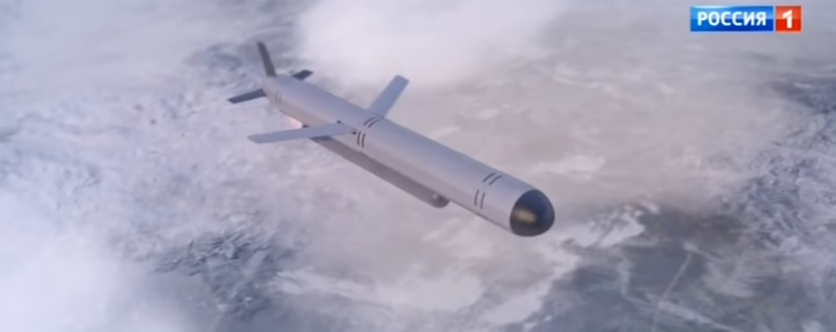
Russian Burevestnik missile
Nuclear Weapons 733 – Russia May Be Preparing To Test It Nuclear-Powered Cruise Missile – Part 2 of 2 Parts