Author: Burt Webb

  • Nuclear Weapons 299 – Debate Over Safety Of Shipments Of Nuclear Weapons Across Scotland

           One concern about nuclear weapons does not get a lot of press. Nuclear weapons have to be transported around countries that possess nuclear arsenals. The convoy of trucks that moves nuclear weapons around are vulnerable to highway accidents and tempting targets for terrorists. There is currently a debate over security of nuclear weapons transportation in Scotland.

            The United Kingdom transports nuclear weapons across Scotland at least eight times a year from the nuclear weapons factory at Aldermaston and Burghfield in Berkshire to the Royal Naval Armaments Depot at Coulport, northwest of Glasgow. The routes pass through fifteen local jurisdictions. Claims are being made that none of them have studied the potential for problems with such shipment nor have any of them warned communities along the route about the potential dangers.

            Nukewatch UK monitors the convoys that carry the nuclear weapons. They have just produced a report titled Unready Scotland. In the report, they accuse the local councils along the route of failing to carry out their obligations under the 2004 Civil Contingencies Scotland Act. This law requires the local councils to carry out risk assessment studies to identify threats to public safety and then warn the public of the dangers that are found. Nukewatch UK also said the report that Scottish members of Parliament did not provide any assistance in the study. The conclusion of the report says “Local authorities are failing in their duties under the Act in respect of nuclear weapon convoys and the Scottish Government is in turn failing to ensure compliance.”

           In case there was an accident on one of the convoys, the U.K. Ministry of Defense would have responsibility to deal with the immediate impact at the site of the accident. The Scottish government would have the responsibility of dealing with the repercussions of the accident away from the exact site of the accident. The Nukewatch UK report says that Scottish ministers are “wholly unprepared to discharge that responsibility.”

           The convoys move their dangerous cargo hundreds of miles through dense urban areas in Scotland but even the police officers along the way do not know about the convoys and their cargo. The Nuclear UK report says “We have now reached the point where concerns about the public safety implications of the UK’s transport of nuclear warheads across Scotland can no longer be waved away. The MoD seems to be more ready to acknowledge the risks of this transport than are the civil authorities in Scotland. The MoD seems to be more ready to acknowledge the risks of this transport than are the civil authorities in Scotland. Oversight of the effectiveness of the civil authority response rests squarely with the Scottish Government and a thorough review of that response is urgently required.”

           The Scottish Green Party has commented that “there is a huge and critical gap in our emergency planning and that action was essential to rebuild public trust. It was disturbing that councils had not examined bomb convoy risks. Councils have not assessed the impact of a release of radioactive material from these convoys yet they have assessed the risk from incidents such as flooding and explosions at industrial sites.”

           Representatives for local Scottish councils reject the accusation that they are not prepared for accidents involving such convoys. They claim that they have assessed the risks of accidents involving hazardous materials shipment and necessary precautions and warnings. They also say that primary responsibility for dealing with any accidents involving the convoys lies with the MoD has the primary responsibility.

           The MoD claims that the Nuclear UK report is “highly speculative and scaremongering.” They say that “Public safety is our absolute priority and robust arrangements are in place to ensure the safety and security of all these convoys. There has never been an incident posing a radiation hazard.”

            It is fortunate that concerns about local and national government readiness to deal with any accidents of nuclear weapons convoys in Scotland are being debated. It appears that there is a serious disagreement about such readiness and it needs to be addressed to find the actual truth of the matter.

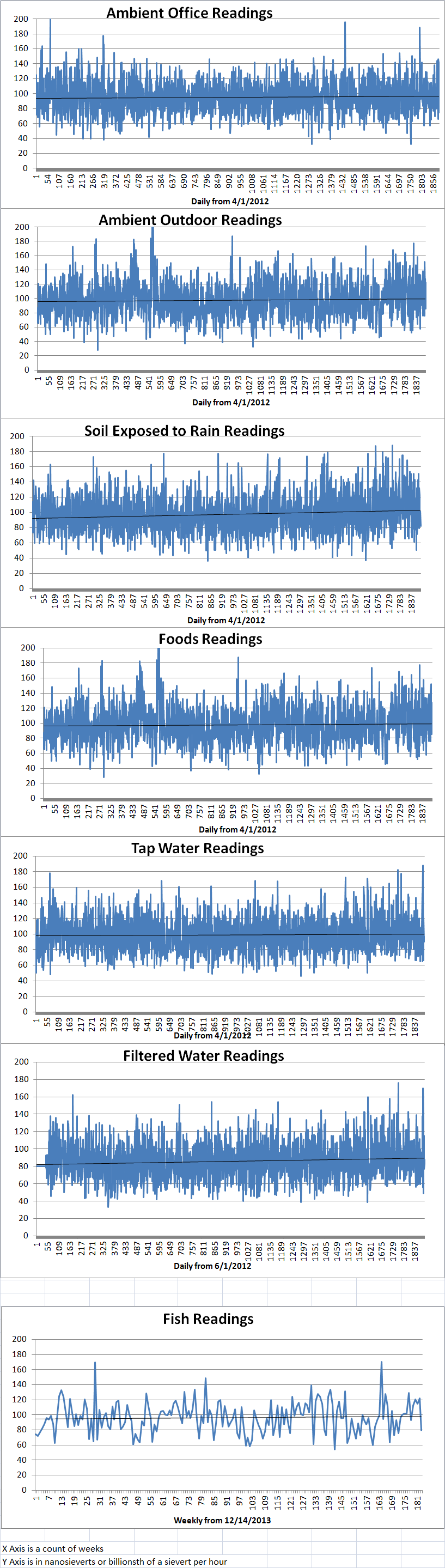
  • Geiger Readings for Aug 21, 2017

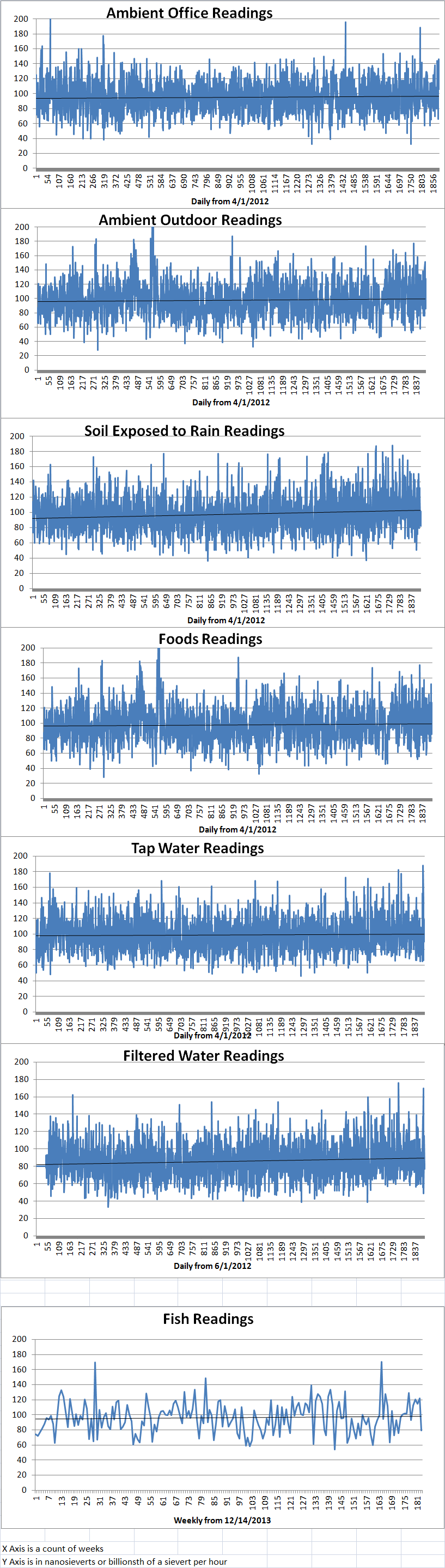
    Ambient office = 74 nanosieverts per hour
     
    Ambient outside = 91 nanosieverts per hour
     
    Soil exposed to rain water = 83 nanosieverts per hour
     
    Snow pea from Central Market = 123 nanosieverts per hour
     
    Tap water = 94 nanosieverts per hour
     
    Filter water = 88 nanosieverts per hour
     
  • Geiger Readings for Aug 20, 2017

    Ambient office =106 nanosieverts per hour
     
    Ambient outside = 80 nanosieverts per hour
     
    Soil exposed to rain water = 82 nanosieverts per hour
     
    Orange bell pepper from Central Market = 86 nanosieverts per hour
     
    Tap water = 97 nanosieverts per hour
     
    Filter water = 83 nanosieverts per hour
     
  • Geiger Readings for Aug 19, 2017

    Ambient office = 141 nanosieverts per hour
     
    Ambient outside = 126 nanosieverts per hour
     
    Soil exposed to rain water = 101 nanosieverts per hour
     
    Carrot from Central Market = 128 nanosieverts per hour
     
    Tap water = 90 nanosieverts per hour
     
    Filter water = 77 nanosieverts per hour  
     
    Dover sole – Caught in USA = 79 nanosieverts per hour
     
     
  • Nuclear Weapons 298 – A Drunk President Nixon Almost Nuked North Korea in 1969

           There have been a lot of stories in the news lately about the possibility of nuclear war. Threats and counter threats have flowed to and from North Korea. One big question that has gotten a lot of ink is how exactly how a nuclear strike would be authorized for the Unites States military.

            Our current system allows the President of the U.S. to unilaterally call for the launch of nuclear weapons against other nations. The window for deciding whether the U.S. should launch nuclear weapons in case another country launched a nuclear weapon against the U.S. is on the order of a few minutes.

            The President would convene senior military leaders in the War Room if he were in residence at the White House. Otherwise, there is a special procedure to verify the President’s identity if he is calling from a remote location. They would have a few minutes to discuss it and try to change his mind if they did not believe that a launch was necessary to protect the country. Regardless of anything that they said, if the President was not convinced to stop, they would be duty bound to communicate the order to launch to our triad of delivery system.

           There has been a lot of discussion in the media lately because some question the mental stability of our current President. Many believe that a decision to participate in a nuclear exchange that could destroy our civilization should never rest with just one man. Bills are being written in Congress to require more checks and more people in any decision to launch our nuclear weapons.

            It turns out that this is not a new problem. Once before in the history of our country, the mental stability of a U.S. President was in question when he ordered the launch of nuclear weapons.

             Richard Nixon was elected President of the United States in the fall of 1968. He was very anti-Communist and had spoken harshly about communist governments including North Korea during the campaign. In early 1969, N.K. shot down an U.S. EC-121 spy plane over the Sea of Japan. This infuriated Nixon and he called on the Joint Chiefs of Staff to draft plans for a nuclear strike on N.K. and suggest targets. It turns out that he was drunk the evening that he made the call.

             An Air Force pilot who was stationed in South Korea at the time of the downing of the EC-121 recalls receiving orders to prepare to drop a three hundred and thirty pound nuclear bomb on an air strip in N.K. He was relieved when the order to stand down came the next day.

             Henry Kissinger recounts that he called the Joint Chiefs following Nixon’s call and requested that they wait until morning when the President was sober and could reconsider his plan to nuke N.K. In the morning, Nixon did reconsider and the plan was cancelled. Kissinger later remarked that Nixon seemed to be eager to engage in nuclear war on a number of occasions. Fortunately for the U.S. and the rest of the world, cooler heads prevailed and he never did unleash the U.S. nuclear arsenal.

           This story highlights the danger of putting the control the U.S. nuclear arsenal in the hands of one man.

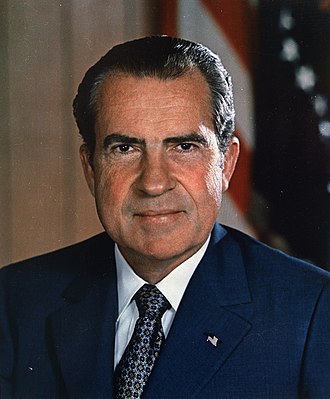
    Richard Nixon, 37th President of the United States:

  • Geiger Readings for Aug 18, 2017

    Ambient office = 146 nanosieverts per hour
     
    Ambient outside = 106 nanosieverts per hour
     
    Soil exposed to rain water = 100 nanosieverts per hour
     
    Okra from Central Market = 108 nanosieverts per hour
     
    Tap water = 119 nanosieverts per hour
     
    Filter water = 115 nanosieverts per hour
     
     
  • Nuclear Weapons 297 – Story In New York Times Accuses A Ukrainian Rocket Company Of Supplying Engines To North Korea

           With all the concern about North Korean missiles and nuclear weapons, attention is being focused on other countries which might be supplying critical technology to North Korea for their nuclear weapons program.

            Last Monday, the New York Times published an article about a report by Michael Elleman that claimed that N.K. may have gotten advanced rocket engines left over from the Soviet Union missile program from a company in Ukraine. Elleman was the director of a cooperative nuclear missile dismantling project in Chelyabinsk, Russia. He ran the program from 1995 to 2001. He is a respected expert in the field of missile defense and arms control. Ellman is now at the International Institute for Strategic Studies.

            In Elleman’s report, he commented that there were similarities between N.K. new missile engines and engines that had been produced by Yuzhmash, a rocket factory in Ukraine. Yuzhmash constructed the Zenit, Dnepr and Cyclone rockets that were used by the Soviet Union to launch satellites. They also constructed the main stage of Orbital ATK’s Antares rocket which NASA used to deliver supplies to the International Space Station.

            The initial reaction of the Ukraine social media was to deny the Ellman report and to attack Ellman. There were some claims that he might be a Russian agent that was deliberately spreading negative news stories to smear Ukraine. The CEO of a Ukrainian communications firm posted some comments on his Facebook page last Wednesday to the effect that Ellman does not like to show pictures of his wife. Along with the comments, the CEO also posted photos of Ellman’s wife in a Russian military uniform. The authenticity of the photo has been questioned. Ellman has deleted his social media accounts and has refused to comment publicly on the matter.

           Ukrainian authorities initially agreed with the claim that the Ellman’s report was Russian disinformation. Following this negative reaction which really had nothing to do with the veracity of Ellman’s report, the Ukranie authorities have now started an investigation into the allegations.

           On Wednesday, two days after the report and the NYT story were published, Petro Poroshenko, the Ukrainian President, issued this statement on his Facebook page. “No matter how absurd the accusations, as responsible partners…we shall carefully verify…the alleged supply of missile engines … to North Korea.” Poroshenko has ordered Yuzhmash and state investigators to carry out a thorough investigation into the charges and report their findings. The investigation is expected to be carried out quickly.

          Also on Wednesday, the research and development branch of Yuzhmash issued a statement refuting the claims of the Ellman report and the NYT story. The statement said that the report and story were full of technical inaccuracies and represented an “amateur level assessments of technology, and a clear lack of understanding of rocket and missile technology.”

            The initial negative reaction by the Ukrainian public and government officials is quite understandable given that the Russians annexed the Crimea from Ukraine a few years ago and they are actively supporting a secessionist movement in Eastern Ukraine.

             An expert with the Russian Center for the Analysis of Strategies and Technologies claims that politics played a role in the creation of the original Ellman report. “This excessive searching for ‘foreign assistance’ in the North Korean missile program is purely political in nature,” Barabanov argued, “and is the result of shock, especially in the United States, from North Korea’s recent missile success.” He went on to say that N.K. had been working on missiles for fifty years. On the other hand, he also said, “This story would be completely in the spirit and customs of Ukrainian military-technical cooperation. Ukraine has a bad reputation with regards to the sale of former Soviet military hardware, including high-tech equipment.”

    Antares rocket launch: