Author: Burt Webb
-
Geiger Readings for Aug 14, 2017
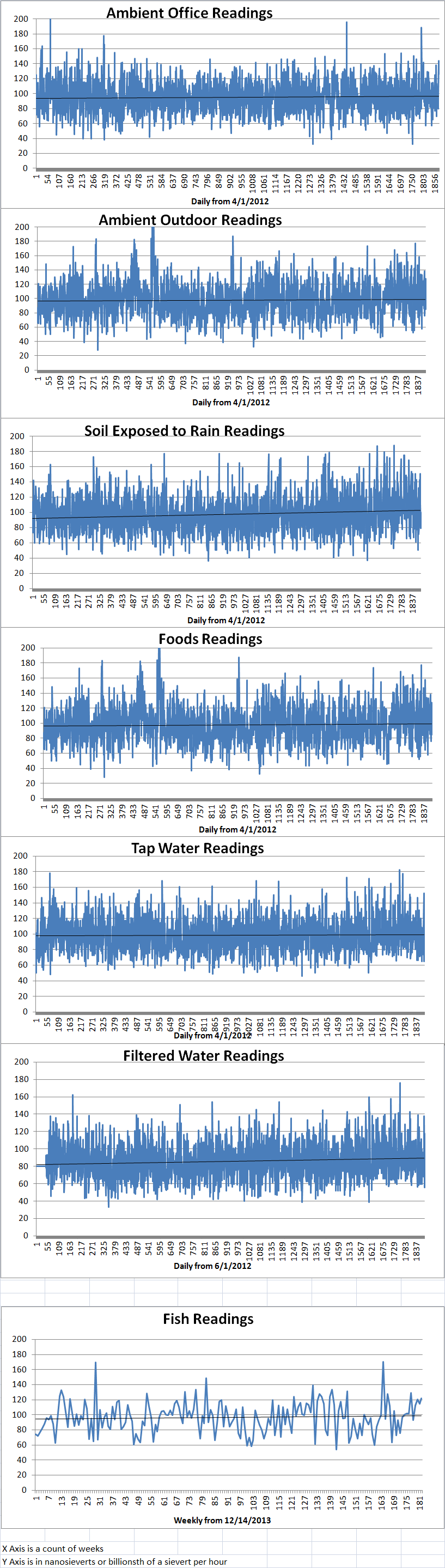
Ambient office = 82 nanosieverts per hourAmbient outside = 137 nanosieverts per hourSoil exposed to rain water = 132 nanosieverts per hourBrussell sprout from Central Market = 76 nanosieverts per hourTap water = 188 nanosieverts per hourFilter water = 170 nanosieverts per hour -
Nuclear News Roundup Aug 13, 2017
Guam releases guidance to prepare residents for North Korean nuclear strike. Washingtonpost.com
Nuclear energy still in the plan, says minister Mmamoloko Kubayi. Businesslive.co.za
Movies to Help Donald Trump Understand Nuclear War warisboring.com
-
Geiger Readings for Aug 13, 2017
Ambient office = 126 nanosieverts per hourAmbient outside = 95 nanosieverts per hourSoil exposed to rain water = 100 nanosieverts per hourJalepano pepper from Central Market = 85 nanosieverts per hourTap water = 135 nanosieverts per hourFilter water = 118 nanosieverts per hour -
Nuclear News Roundup Aug 12, 2017
Following the filing of a lawsuit alleging that Westinghouse Electric Co. violated labor laws by laying off hundreds of workers without proper notice, the bankrupt nuclear company confirmed Friday that it has furloughed 870 employees across the company. Powersource.post-gazette.com
The cleanup of a 44-acre nuclear waste dump in Armstrong County is facing another potentially lengthy delay after the U.S. Army Corps of Engineers announced Friday it will re-evaluate proposals to do the work. Powersource.post-gazette.com
UK estate agent draws map of where to live to avoid ‘nuclear impact zone’ – then says sorry. Cnbc.com
-
Geiger Readings for Aug 12, 2017
Ambient office = 141 nanosieverts per hourAmbient outside = 76 nanosieverts per hourSoil exposed to rain water = 79 nanosieverts per hourRed potato from Central Market = 128 nanosieverts per hourTap water = 65 nanosieverts per hourFilter water = 56 nanosieverts per hourDover sole – Caught in USA = 122 nanosieverts per hour -
Nuclear Reactors 293 – U.S. Office Of Nuclear Energy Has Wasted A Lot Of Time And Money On The Development Of Small Modular Reactors
There has been a lot of discussion in the nuclear industry about the development of a new type of nuclear reactor referred to a “small modular reactor (SMR).” Conventional power reactors are built onsite and can exceed a gigawatt in capacity. The new SMRs will be three hundred megawatts or less. The U.S. Office of Nuclear Energy (ONE) is charged with the task of developing and demonstrating a SMR but no such reactor is even remotely near being deployed. A new study from three universities just published in the Environmental Research Letters offers details of the failure of the ONE to deliver.
This new type of reactor will be non-light water in contrast to the current ubiquitous light-water reactors supplying electricity today. Some of the new designs would allow reactors to operate at higher temperatures and provide superior performance than current reactors. Some designs will be able to operate for decades without refueling which reduces maintenance costs and generates much less waste. Another benefit is supposed to be that these SMRs will be built in factories and be subjected to better and more uniform quality control than is currently possible with the custom onsite construction that is common.
The report goes into depth about how resources were allocated and how the research and development program was run. What the researchers found was that the program “violated much of the wisdom about how to effectively run an applied energy research program.” The lead researcher said “There were often inconsistencies in the annual budget documents. The budget itself varies significantly over the period of study, which is fine if these variations are part of a coherent vision that is being pursued, but that is not the case. At all levels, NE favours existing technologies and fuels over innovation, and, where it does support truly innovative research, it is prone to changing priorities before any concrete progress has been made.”
“One example of this lack of vision is the gap that exists between the advanced reactor and advanced fuel programs. Investing in advanced fuels research is critical to developing a new nuclear reactor technology. However, NE has mostly invested in one fuel type while exploring multiple reactor designs, most of which do not use that fuel. This disjunction between the two programs is naturally problematic.”
The study reported that a lot of the money spent on the program did not go to projects that directly supported the actual development of SMRs. Some of this misspent money was dedicated to defense projects in an echo of the original promotion of nuclear power which was really intended to collect more funding for the Department of Defense nuclear programs. The lead researcher said “Despite substantial expenditure and commitments to this future, NE lacks the funding and programmatic focus required to execute its mission. Even if the program had been well designed, it still would have been insufficient to demonstrate even one non-light water technology.
“It has dedicated only $2 billion over the past 18 years to all advanced reactor and fuel initiatives. While that may appear to be a substantial sum, by NE’s own estimates it is not enough to ready even one such design for commercial deployment.”
The researchers recommended that the ONE do a better job of focusing funding of projects that will actually lead directly to the development of SMRs. They also recommend a more transparent process. The different reactor designs need to be evaluated against a set of key performance requirements. This would allow an informed debated on the relative merits of each design with respect to issues of economics, safety, security and waste.
In a grim prediction of the prospects for SMRs, the lead researcher said, “Without a sense of urgency among NE and its political leaders, the likelihood of advanced reactors playing a substantial role in the transition to a low-carbon US energy portfolio is exceedingly low. From a broader perspective, this failure means that the US will cede its leadership on nuclear matters to other nations, limiting its ability to exert influence in key areas such as safety and non-proliferation as well.”

-
Geiger Readings for Aug 11, 2017
Ambient office = 114 nanosieverts per hourAmbient outside = 111 nanosieverts per hourSoil exposed to rain water = 110 nanosieverts per hourAvocado from Central Market = 119 nanosieverts per hourTap water = 152 nanosieverts per hourFilter water = 138 nanosieverts per hour -
Nuclear Weapons 296 – WAshington State Law Prohibits Planning For Evacuations In Anticipation Of Nuclear Attack
All the concerns about North Korea now having missiles that could reach the U.S. West Coast have prompted questions about just how prepared cities and states on the West Coast are for a possible nuclear attack. During the 1950s, 1960s and 1970s, in the early days of the Cold War, the state of Washington had plans and shelters in place in case of a nuclear attack on the U.S. mainland.
All that changed in 1983 when a new Washington state law was passed entitled Comprehensive Emergency Management Act. The official designation of the bill is RCW 38.52.030. The text of the bill says, “The comprehensive, all-hazard emergency plan authorized under this subsection may not include preparation for emergency evacuation or relocation of residents in anticipation of nuclear attack.”
The rationale for leaving nuclear attack planning out of the Comprehensive Emergency Management Act was that if an enemy saw people in Washington State evacuating major cities in a time of heightened nuclear tensions, they might interpret that as our preparation for a preemptive nuclear strike. Washington State Senator Dick Nelson was the author of the bill to ban nuclear emergency planning. He says that Washington State was inundated with nuclear threats, and the idea was to create an example of peace.
Nelson also believes that if Seattle were the target of a nuclear attack, even with some advanced warning, the possibility of survival would be so low that it would be a waste of time to draw up an evacuation plan. The state law does allow for individual cities to draw up an evacuation plan but the state itself does not have one.
Around the time that the bill was being debated, I was asked by the Physicians for Social Responsibility to review a draft plan for the evacuation of Seattle in case of warnings of a nuclear attack. The plan was to evacuate the citizens of Seattle to Eastern Washington over a three day period. Reviewing traffic flows and major highways, I concluded that every major road out of Seattle to the East would be completely blocked by accidents and stalled cars within twelve hours of the declaration of an evacuation. I reported that it would take more like three weeks than three days to evacuate Seattle and would be an exercise in futility. In addition, the casualty figures might be even higher with all those people trapped in cars without food and water.
State lawmakers from both parties are interested in changing the law to allow for evacuation planning. Washington State Senator Mark Miloscia was a B-52 bomber pilot during the Cold War. He recently said “I couldn’t believe how this thing could go on the books. If we ever have to evacuate or relocate citizens due to a nuclear attack or an impending nuclear attack, right now, we can’t plan for that. It puts like a big stop order on any sort of planning we have to do to prepare for the unthinkable. I think there is right now, a common sense support for repealing this. We’ve just got to educate people that let’s do that soon.”
Washington State Senator David Frockt has joined with Miloscia to sponsor a bipartisan bill to change to the law to allow for planning a nuclear evacuation. Frockt said “Since the state government committee was already planning to update our emergency planning for a large earthquake in the Puget Sound, it makes sense to update this statue at the same time. So, we can improve our planning for both earthquakes and for nuclear strikes.”
-
Nuclear News Roundup Aug 10, 2017
Completion of unit 4 of the Shin Kori nuclear power plant has been delayed by ten months, Korea Hydro and Nuclear Power (KHNP) has said. The APR1400 reactor is now expected to start up in September 2018. World-nuclear-news.org
Workers at the Fukushima nuclear power plant in Japan have unearthed what appeared to be an unexploded wartime bomb. Newsweek.com