Author: Burt Webb

  • Radioactive Waste 288 – France Is Reviewing The Design Of A Permanent Underground Nuclear Waste Repository

           France is working on an underground repository for permanent disposal of radioactive waste. The Industrial Geological Storage Center (Cigéo) will be located in a system of tunnels in a natural layer of clay in Meuse/Haute Marne east of Paris. EDF, Areva and the French Alternative Energies and Atomic Energy Commission are generators of radioactive waste in France including spent nuclear fuel. They will provide the financing for the repository which will be managed by the waste management agency Andra. The application to regulators will be submitted by the end of 2018. Construction will follow in 2020. Actual disposal of waste in the repository could begin as early as 2025.

           Andra has submitted a “safety options dossier” about the Cigéo to the Nuclear Safety Authority (ASN), the French nuclear regulatory agency. This document details objectives, concepts and principles that will be employed to insure that the repository is operated in a safe and efficient manner. The document allows Andra to seek advice from the ASN as they prepare the portion of the license that involves safety protocols at the repository.

            The ASN technical division, Institute for Radiological Protection and Nuclear Safety (IRSN), was asked to review the “safety options dossier”. Their main goal was to “assess the project’s maturity status in order to judge the relevance of the options selected, from the point of view of safety and radiation protection”. The IRSN drafted a report to the ASN after a series of technical meetings with Andra and other stakeholders. The IRSN concluded that the Cigéo project has “overall achieved satisfactory technical maturity at the stage of a safety options dossier and underlines the substantial design and research undertaken by Andra with a view to demonstrate the safety of the installation”. The report from the IRSN did highlighted some areas of concern that may impact the design of the Cigéo repository.

           The IRSN expressed a concern that the design of the facility must be optimized to insure that radioactive material cannot be not released into the environment. The IRSN also said that monitoring systems should be installed to track risk of problems developing. The operators should also be able to intervene “to manage situations likely to lead to contamination of infrastructures”.

           There is a danger of fire in a chamber that will store bituminous waste. The IRSN said that this was their biggest concern and that the Andra design does not have enough safety guarantees. About eighteen percent of the waste to be stored at Cigéo will contain bituminous materials. The IRSN report said that “The problem is that in the event of a fire [the packages of bituminous waste] rise in temperature and are likely to spread a heat wave and eventually spread the fire.”

           The IRSN suggests that Andra and the creators of radioactive waste consider pre-treating waste containing bituminous materials in order to remove its thermal reactivity. Andra could also change their design to prevent the spread of a fire if it should occur. The IRSN said, “In this respect, the work to be carried out by Andra on these issues could have an impact on the outline of the [application for authorization to set up a nuclear installation] or the associated delays.”

          The ASN requested that the International Atomic Energy Agency (IAEA) carry out a peer review of the Cigéo “safety options dossier.” The IAEA reported that it found that Andra’s methodology for evaluating operational safety was comprehensive and systematic. The ASN will soon issue its conclusions with respect to the dossier. The IAEA, IRSN, ASN and Andra will use the reviews of the “safety options dossier” to guide the drafting of the actual license application for the repository.

  • Geiger Readings for Jul 07, 2017

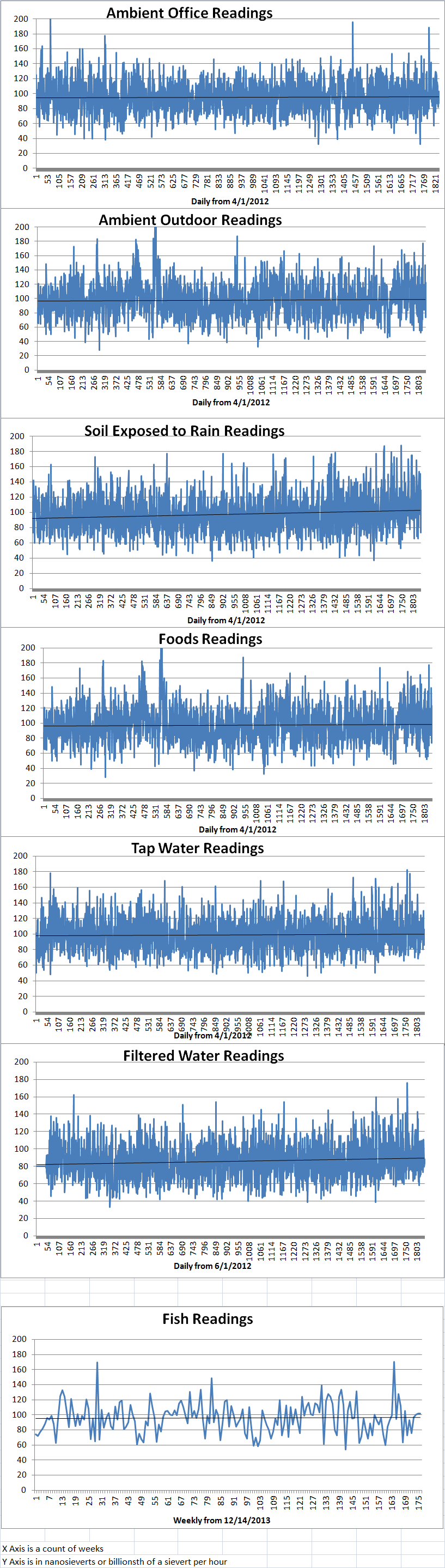
    Ambient office = 95 nanosieverts per hour
     
    Ambient outside = 75 nanosieverts per hour
     
    Soil exposed to rain water = 74 nanosieverts per hour
     
    Ear of Corn from Central Market = 74 nanosieverts per hour
     
    Tap water = 106 nanosieverts per hour
     
    Filter water = 88 nanosieverts per hour  
     
  • Nuclear Fusion 31 – Use of Lithium To Coat Reactor Vessel Walls Leads To Uniform Temperatures In the Plasma

           There is a great deal of research currently being conducted into the creation of commercial nuclear fusion reactors. There are two major problems that confront many fusion reactor designs. In order for a fusion reaction to occur, the plasma must be confined to a certain area within the reactor. This can be very difficult to achieve and maintain. If the plasma is not properly contained, the walls of the reactor vessel are bombarded and damaged by the energetic particles in the plasma. Now researchers at the U.S. Department of Energy’s (DoE) Princeton Plasma Physics Laboratory (PPPL) have found that coating the walls of the reactor vessel with lithium can help solve both of these problems with plasma containment.

          Lithium is a chemical element with the symbol Li and an atomic number of three. It is a soft, silvery-white alkali metal. It is the lightest metal and the lightest solid element. It is also highly reactive and flammable. In its pure form, it has to be stored in mineral oil to prevent spontaneous combustion. It is not found in nature in its pure form.

           Normally, in a fusion reactor there is a temperature gradient from the hot core of the plasma to the outer edge of the plasma. The core may be as hot as one hundred million degrees Centigrade which is much hotter than the core of the sun. A few feet away at the edge of the plasma, the temperature may be as low as a few thousand degrees Centigrade.

           The Lithium Tokomak Experiment at PPPL showed that if the plasma cloud in the reactor vessel is surrounded by lithium, a constant temperature is maintained throughout the plasma cloud. The lithium prevents the plasma from causing cold gas from the walls of the vessel to be injected into the plasma by particles hitting the walls of the vessel. This is the first experiment in the world that has shown that it is possible to have a uniform temperature in a plasma cloud in a fusion reactor.

          One benefit of maintaining a uniform temperature in the plasma is that it reduces the external heat that is usually needed in other reactor configuration to counteract the cooling that occurs between the edge of the plasma cloud and the wall of the vessel. The lithium shell makes the fusion reaction much more efficient. If the temperature in the entire plasma cloud is uniform and hot, then the volume in which a fusion reaction can take place is larger than other designs allow. In addition, the uniform temperature reduces instabilities in the plasma that interfere with plasma confinement.

          In the research at PPPL, both solid and liquid lithium have been tested. They yield similar results but the use of liquid lithium has additional benefits. With solid lithium, the bombardment of highly energetic particles can wear down and crack the lithium shell. A flow of liquid lithium cannot be damaged by the particles.

          Next the researchers will increase the density and heating of the plasma to produce conditions closer to an actual fusion reactor to find out if the use of lithium can still support uniform temperatures. If these tests are successful, the use of lithium will lead to a “new, potentially high-performance plasma regime for fusion devices.”

  • Geiger Readings for Jul 06, 2017

    Ambient office = 87 nanosieverts per hour
     
    Ambient outside = 123 nanosieverts per hour
     
    Soil exposed to rain water = 129 nanosieverts per hour
     
    Avocado from Central Market = 123 nanosieverts per hour
     
    Tap water = 104 nanosieverts per hour
     
    Filter water = 84 nanosieverts per hour  
     
  • Nuclear Weapons 288 – Germany Considers Legality Of Financing And Sharing French Nuclear Weapons

           One important reason for the U.S. participation in NATO was to prevent the spread of nuclear weapons. In return for the promise of U.S. retaliation for any nuclear attacks, NATO members agreed not to build their own nuclear weapons. Now, with the U.S. President criticizing NATO and threatening to withdraw U.S. nuclear protection, European countries are rethinking their stance on developing their own nuclear weapons programs. They are also exploring the idea of collaborating with each other in the development and deployment of nuclear deterrence based on existing French nuclear weapons.

            The German Parliament recently commissioned a study on the question of whether or not they could legally help finance a French nuclear weapons program in return for obtaining protection against nuclear attacks from such a program. The study reached the conclusion that Germany could legally participate in such a project. It would be legitimate for French nuclear weapons to be deployed on German soil. The study also found that the European Union could participate in such a program if they made changes to their budgeting rules.

          Most analysts do not believe that any such arrangement is imminent. German officials generally oppose taking any such action. There is serious public opposition to nuclear weapons in Germany. There would be serious diplomatic problems that would have to be solved in order for any such project to proceed. On the other hand, statements by the U.S. President are forcing Germany to consider responses to the loss of U.S. nuclear protection. Recent Russian aggression in Eastern Europe is also putting pressure on Germany to reconsider their previous opposition to nuclear weapons.

           The study concluded that Germany could have shared control of deployed foreign warheads under a “dual key” system. In a dual key system, two keys wielded by two different people have to be turned simultaneously in order to activate a device such as a missile launch system. Such a system in the present discussion would be having both a German technician and a French technician possess one of the required keys to launch nuclear warheads.

           The study was originally requested by a member of the German Parliament last year. It has been suggested that the reason that the study was only carried out recently may be related to the election of Emmanuel Macron to the Presidency of France. Macron has advocated creating some sort of defensive cooperation between France and Germany.

           Any pan-European nuclear defensive system would require the cooperation of France and Germany. France has an advanced nuclear weapons program and is well suited to develop and deploy tactical nuclear weapons that could be used against Russian aggression. Poland has also expressed support for German involvement in a European nuclear defense program.

           Analysts say that exploring the legality of financing a European nuclear defense program is a small first step. It may very well be that Germany conducted the study as much to persuade the U.S. not to withdraw nuclear protection as to lay the ground work for such a program.

    German Parliament building:


  • Geiger Readings for Jul 05, 2017

    Ambient office = 103 nanosieverts per hour
     
    Ambient outside = 97 nanosieverts per hour
     
    Soil exposed to rain water = 97 nanosieverts per hour
     
    Crimini mushroom from Central Market = 87 nanosieverts per hour
     
    Tap water = 86 nanosieverts per hour
     
    Filter water = 79 nanosieverts per hour
     
  • Nuclear Weapons 287 – Results Of Routine Inspections Of Nuclear Weapons Facilities And Operations Are Now Classified

           One of the big problems with nuclear weapons is a lack of transparency. While it is understandable that national security demands that certain facts about nuclear weapons be kept secret, too often agencies have deliberately kept information secret that should have been made available to U.S. citizens. Sometimes it is an attempt to keep obvious examples of oversight failures and agency incompetence from public view. Now the Pentagon has changed its policy on making reviews of safety and security of nuclear weapons operations public.

           It has been the long-standing standard practice of withholding detained information about reviews of operations at U.S. nuclear weapons bases which is entirely understandable. However, previously, it had been the tradition that the bottom line findings of such reviews such as a “pass-fail” grade have been made public. Now such basic inspection results will no longer be revealed.

          The stated reason for the change in policy is that potential enemies might learn too much about the vulnerabilities of U.S. nuclear weapons facilities. The spokesman for the Joint Chiefs of Staff said that the added secrecy was necessary. He also said, “We are comfortable with the secrecy. As long as nuclear weapons exist, the U.S. will maintain a safe, secure, and effective nuclear stockpile.”

           The decision about reporting on basic inspections about how nuclear weapons are operated, maintained and guarded was based on a secret recommendation developed by detailed Pentagon reviews of problems with the weapons, workers and facilities in the nation’s nuclear force. However, the problems that led to the call for the reviews were not related to reporting inspection results. The problems included poor work performance, security lapses and flawed training. These shortcomings in the nuclear force were partly a result of a shortage of funding and poor leadership.

           In 2013 and 2014, the Associated Press used the public results of nuclear weapons facility performance inspections to report on serious problems in the Air Force nuclear missile corps. The AP articles detailed security lapses, leadership and training failures, morale problems and other issues. The articles prompted the Pentagon to order an in-depth study by an independent group. The review found serious problems and made recommendations. There was also a parallel internal review of problems with the nuclear weapons programs whose findings were kept secret.

           The Defense Secretary who ordered the reviews said, “Trust and confidence of the people is the coin of the realm for leaders and nations. That requires an openness even on sensitive issues. Certain specifics must always stay classified for national security reasons but should be classified only when absolutely necessary. When you close down information channels and stop the flow of information you invite questions, distrust and investigations.”

           The recommendation to not publish the results of the inspections did not come from the independent report. The recommendation came from the internal report that was classified. So it is not possible for the press and public to see and understand the actual reasoning behind the recommendation to hide the basic results of inspections.

           Critics are concerned that it national security may not be the reason for the restriction of reporting on inspections. A government security expert with the Federation of American Scientists said, “They’re acting like they have something to hide, and it’s not national security secrets. I think the new policy fails to distinguish between protecting valid secrets and shielding incompetence. Clearly, nuclear weapons technology secrets should be protected. But negligence or misconduct in handling nuclear weapons should not be insulated from public accountability.”