Jeremy Corbyn has effectively ruled out using nuclear weapons if he is elected prime minister. Ft.com

For the past two days I have been posting about the problems at Hanford with respect to the collapse of the soil above a railroad tunnel filled with radioactive railway cars and contaminated equipment. There have been a flurry of stories since the cave-in two days ago and I thought that I would add some additional information to my coverage of the story.
Prior to May of 2016, the U.S. DoE had been under a court imposed deadline to remove the wastes from the “PUREX tunnels” by 2024. In May of 2016, the DoE was granted an extension of the deadline from 2024 to 2042 over the objection of Hearts of America Northwest, Native American Tribes with Treaty Rights impacted by Hanford’s contamination, the Hanford Advisory Board and other concerned organizations and individuals. These opponents fear that the tunnels could be collapsed by an earthquake and expel radioactive contamination into the environment.
On Wednesday, workers began filling the hole by the PUREX. It took about fifty truck loads of soil to fill the hole according to the news story. An average dump truck carries about ten cubic yards of dirt. So fifty truck loads would be about five hundred cubic yards.
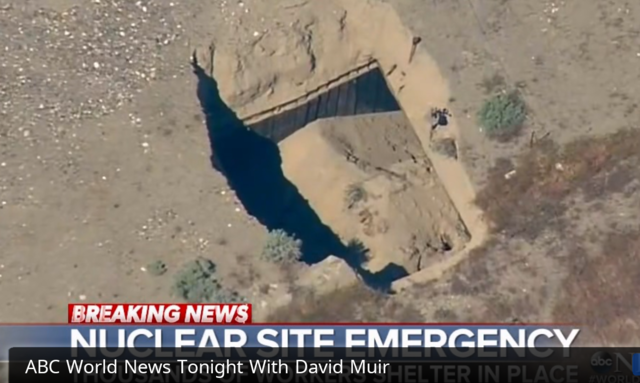
The early reports said that the hole was twenty feet by twenty feet and four feet deep. This would represent about sixty cubic yards of dirty. It would take about six average dump truck loads at ten cubic yards to fill such a hole. This does not make sense because the dirt had to go into the tunnel. As you can see from the picture at the bottom of this post, the walls of the tunnel are exposed. The dirt over the ceiling of the tunnel is eight feet deep. A hole four feet deep would not have exposed the sides of the tunnel. The numbers just don’t add up.
A flat car is about four feet high. The tunnel is about twenty feet high and twenty feet wide. A hole in the top of the tunnel twenty feet long all the way across the width of the tunnel would accept the amount of soil covering the tunnel which would spread out over and beside the railroad cars and flow up and down the tunnel past the edge of the tunnel which matches what is shown in the picture.
About one hundred and fifty cubic yards of dirt would have filled the hole shown in the picture but the workers put in over five hundred cubic yards. This means that much of the dirt had to flow into the tunnel beyond the area where the ceiling collapsed which would have displaced air contaminated with radioactive materials into the outer atmosphere.
Official reports keep saying that no radiation was released following the collapse and that no worker was exposed to any radiation. This is difficult to square with the fact that the tunnel and its contents were so radioactive that one hour of exposure would be lethal and it appears that air from the tunnel reached the outside atmosphere. I would think that there would be radiation danger to the workers who were filling the hole at the very least. If the information from official sources about radiation hazards at Hanford is not true, it would not be the first time.
Yesterday, I talked about the declaration of a state of emergency at the Hanford Nuclear Reservation by the U.S. Department of Energy because the ground above a railroad tunnel had subsided. The tunnel contained radioactive railroad cars that had been used to carry spent nuclear fuel from Hanford reactors to the Plutonium Uranium Extraction Facility (PUREX). The radiation inside the tunnels is so intense that it is estimated that spending one hour inside one of the tunnels without protective gear would result in a lethal dose of radiation in less than one hour. It has now been pointed out by Hearts of America Northwest (HOANW) that problems with the railroad tunnels were not unexpected, they were just neglected.
According to their website, “Heart of America Northwest is a regional non-profit public interest organization. They are the leading grassroots organization working on the clean-up of the Hanford Nuclear Reservation, transportation of nuclear waste to the Northwest, and other hazardous waste issues.” Their mission “is to advance our region’s quality of life through highly credible research, education, and participation of citizens in issues affecting the health, environment, and economy of the Northwest.” Washington State Representative Gerry Pollet founded HOANW in 1987 and serves as its Executive Director.
Pollet and HOANW have been pointing out for the past twenty years the concrete and wood timbers used to build the tunnels were susceptible to degradation by the intense radiation from the railcars, equipment and other materials stored in the tunnels. As the concrete and timbers continued to weaken over time, there was an increasing danger that an earthquake at Hanford could cause collapse of the railroad tunnels which could release a great deal of dangerous radioactive materials into the atmosphere. In the event of a major radiation release from collapsing tunnels, it might be necessary to evacuate people for hundreds of miles around the Hanford Reservation.
The DoE had been working against a deadline of 2024 to remove the railroad cars and other irradiated materials and equipment from the tunnels. Recently, the DoE successfully petitioned a court to allow an extension of their tunnel cleanup deadline to 2042. The State of Washington agreed to the change of deadlines. Part of the argument for the extension was that there would be no danger of a tunnel collapse for thirty years. The subsidence of the soil above the tunnel yesterday would suggest that the projection of stability by the DoE was not accurate.
Pollet believes that the DoE is not willing to spend the money necessary to clean up the railroad tunnels in a timely fashion. The Hanford Nuclear Reservation is in an earthquake prone area. It is not a question of if there will be a significant quake there in the future but only a question of when. Will the DoE expend the resources needed to clean up the railroad tunnels before they collapse? The tunnel cleanup is a race against time and the clock is ticking.
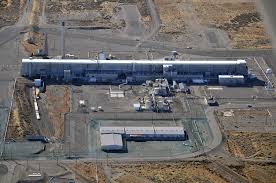
Plutonium Uranium Extraction Facility at Hanford:
I have often blogged about the one hundred and fifty acre Hanford Nuclear Reservation in south central Washington State. After decades of nuclear weapons development which ended around 1990 with the end of the Cold War, the Hanford site is one of the most radioactively polluted areas on Earth. The U.S. government has been slow to clean up the millions of tons and hundreds of billions of gallons of nuclear waste at the site and the State of Washington has repeatedly pulled the Department of Energy into court over problems at Hanford. One big point of contention recently has been the accidental exposure of workers to radioactive materials and the question of how serious that exposure has been to their health. Once again, the Hanford site has experienced a serious accident that may have threatened workers there.
There are hundreds of feet of railroad tunnels underground at Hanford that are covered by about eight feet of soil. These tunnels were used by rail cars which brought spent nuclear fuel from reactors to the Plutonium Uranium Extraction Facility (PUREX) in the 200 East area of Hanford where uranium and plutonium were extracted to make nuclear warheads. The underground tunnels converge at the PUREX. Currently the tunnels are being used to store rail cars and other pieces of equipment which are radioactively contaminated from their use during weapons manufacture.
This morning, it was reported that a twenty foot by twenty foot section of soil had caved in above the junction of two of the underground tunnels next to the PUREX. The collapse of the soil over the tunnel junction prompted the Department of Energy to declare an emergency at the site. “The U.S. Department of Energy (DOE) Richland Operations Office activated the Hanford Emergency Operations Center at 8:26 a.m,” the Department of Energy said in a statement. “There are concerns about subsidence in the soil covering railroad tunnels near a former chemical processing facility. The tunnels contain contaminated materials.”
Authorities say that there has been no release of radioactive materials and no workers have been exposed to such materials. Hanford workers at the site have been evacuated and workers at nearby facilities have been told to stay inside their building for the time being. The workers were advised by a manager to “secure ventilation in your building” and to “refrain from eating or drinking.” Access to the whole 200 East area of Hanford has been restricted.
The Hanford Fire Department is currently on the scene. The responders have reported that what they found when they reached the PUREX was that a four foot by four foot section of soil had subsided over one of the railroad tunnels. The soil appears to have subsided between two and four feet. This particular tunnel is about three hundred and fifty feet long, nineteen feet wide, and twenty two feet high. The walls and ceiling of the tunnel are fourteen inches thick and consist of pressure treated Douglas fir timbers. An anonymous source has been quoted as saying that workers near the PUREX may have created vibrations that caused the soil above the tunnel to collapse through the ceiling into the tunnel.
Plutonium Uranium Extraction Facility at Hanford: