Category: Uncategorized

  • Geiger Readings for Jul 19, 2020

    Geiger Readings for Jul 19, 2020

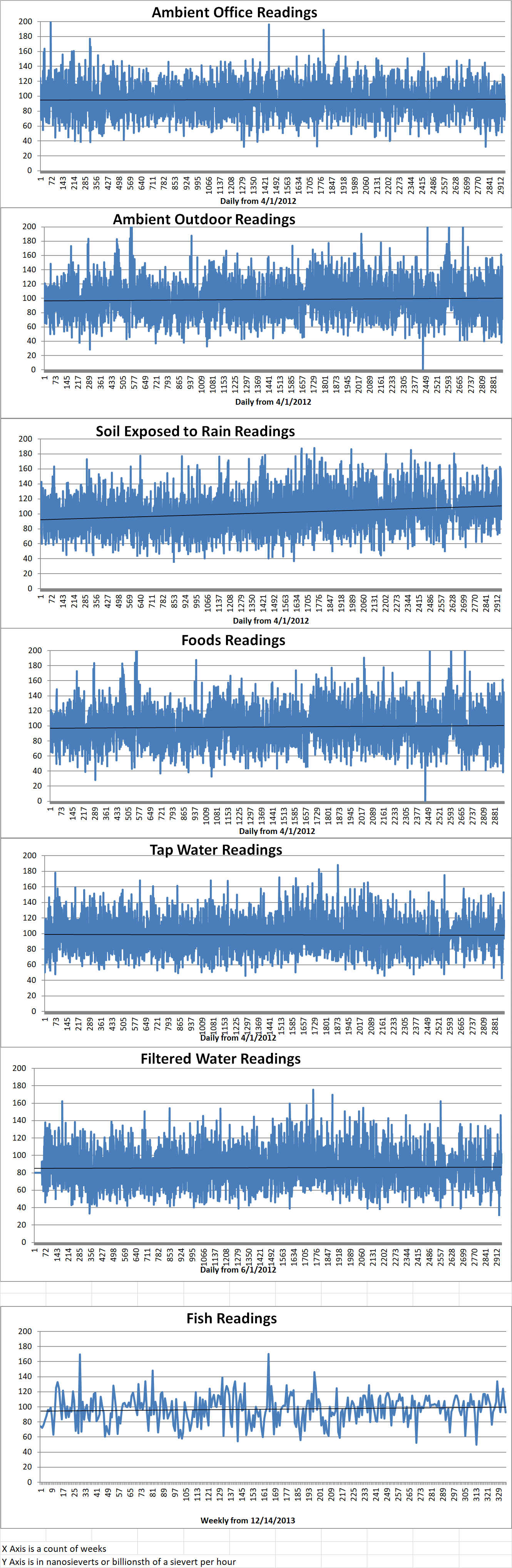
    Ambient office  = 90 nanosieverts per hour

    Ambient outside = 90 nanosieverts per hour

    Soil exposed to rain water = 96 nanosieverts per hour

    Yellow onion from Central Market = 72 nanosieverts per hour

    Tap water = 110 nanosieverts per hour

    Filtered water = 91 nanosieverts per hour

  • Geiger Readings for Jul 18, 2020

    Geiger Readings for Jul 18, 2020

    Ambient office  = 90 nanosieverts per hour

    Ambient outside = 92 nanosieverts per hour

    Soil exposed to rain water = 93 nanosieverts per hour

    Raineer cherry from Central Market = 93 nanosieverts per hour

    Tap water = 117 nanosieverts per hour

    Filtered water = 102 nanosieverts per hour

    Dover sole – Caught in USA = 92 nanosieverts per hour

  • Radioactive Waste 775 – International Team Researches Behavior Of Curium Under Extreme Pressure

    Radioactive Waste 775 – International Team Researches Behavior Of Curium Under Extreme Pressure

        Thomas Albrecht-Schmitt is the Gregory R. Choppin Professor of Chemistry at Florida State University is the leader of an international research team that also includes Manfred Speldrich at Aachen University and chemistry professors Eva Zurek and Larkin Professor of Chemistry Jochen Autschbach at the University of Buffalo. Curium is element 96 in the periodic table. It is one of the highest numbered elements that exists in sufficient quantities to be visible to the naked eye.
         The team has been researching how curium reacts to extremely high pressure when squeezed between two diamonds. It turns out that the outer electrons of curium change their behavior in a way that alters the ability of the element to bond with other elements when the distance to surrounding lighter atoms is reduced. Albrecht-Schmitt said, “This was not anticipated because the chemistry of curium makes it resistant to these types of changes. In short, it is quite inert.”
         Curium’s properties are usually totally resistant to modification, but specific curium compounds display the changes found by Albrecht-Schmitt and his team. The contribution of Albrecht-Schmitt is related to the wider mission of his laboratory to enhance our understanding of heavier elements also known as actinides.
          In 2016, the Department of Energy (DoE) gave Albrecht-Schmitt a grant of ten million dollars to establish the Center for Actinide Science and Technology (CAST). The purpose of the Center is to concentrate on accelerating scientific advancements toward better management of nuclear waste.
         The heavier elements in the periodic table have been known for decades but they are still largely a mystery to scientists, especially when compared to what is known about lighter elements such as nitrogen and oxygen. Albrecht-Schmitt said, “It’s an exciting experiment that showed that we have much greater control of the chemistry of these difficult to control elements than previously thought.”
         Autschbach said, “The curium (3+) ion we studied has a half-filled outer electron shell that is very difficult to engage in chemical bonding. An integrated experimental and theoretical approach showed that the application of high pressure to a crystal contained curium (3+), along with sulfur-organic and ammonium ions, causes the outer shell of curium to participate in covalent chemical bonding with sulfur. This may help guide new ways of studying the mysterious behavior of chemically resistant actinide shells.”
        As more is learned about the heavier side of the periodic table, scientists are discovering new strategies to control processes of chemical separation. These may lead to the design of resilient materials for long-term storage of radioactive elements and nuclear recycling. New knowledge revealed by squeezing heavy elements between diamonds could also be used to manipulate other elements.
         It would not be practical to apply these extreme pressure techniques to a stream of nuclear waste in order to force chemical bonding that would reduce the radioactivity of the nuclear waste. However, what is learned about physical and chemical manipulation of very heavy elements may some day lead to the development of techniques that could be applied to reduce the danger of nuclear waste.

  • Geiger Readings for Jul 17, 2020

    Geiger Readings for Jul 17, 2020

    Ambient office  = 82 nanosieverts per hour

    Ambient outside = 108 nanosieverts per hour

    Soil exposed to rain water = 108 nanosieverts per hour

    Red bell pepper from Central Market = 110 nanosieverts per hour

    Tap water = 112 nanosieverts per hour

    Filtered water = 95 nanosieverts per hour

  • Nuclear Reactors 803 – U.S. House Committee on Appropriations Requests More Information From DoE About Proposed Uranium Reserve

    Nuclear Reactors 803 – U.S. House Committee on Appropriations Requests More Information From DoE About Proposed Uranium Reserve

        The U.S. House Committee on Appropriations (HCA) has refused to provide funding for the U.S. Department of Energy (DoE) to establish a uranium stockpile. The HCA has requested more information about the justification for the proposed uranium reserve before committing any funds. They also requested information about how such a reserve would be implemented.
         On February 10th of this year, the U.S. administration released its 2021 budget request. The request included one hundred and fifty million dollars to establish a uranium reserve in order to address some significant challenges to the domestic production of uranium. The proposed reserve would ensure a backup supply of uranium in case there was an event that caused significant global uranium market disruption. The proposed reserve program would include support for the operation of at least two U.S. uranium mines. It would begin with the purchase of uranium produced from U.S. mines and U.S. uranium conversion services.
         In a July 13 report from the HAC that was attached to the House energy and water development appropriations bill for fiscal 2021, the HAC said that the DoE “has been unable to provide specific information about how it would implement the program, including in congressional justifications, briefings, and in responses to questions from the committee about how the funds would be spent, including the process for the purchase, conversion, or sale of uranium in a reserve”.
         The HAC said that it is concerned “the lack of justification for a reserve and potential market implications of establishing a reserve for commercial purposes”. The report also noted that the DoE “will require a domestic source of uranium for defense purposes in the coming decades”.
         The HAC has requested that DoE provide a plan for the establishment of the proposed uranium reserve within the next one hundred and eighty days. The HAC said that the requested plan must include a listing of the legal authorities currently in place to establish and operate a uranium reserve. This plan will need to include the purchase, conversion and sale of uranium. The plan should cover a ten-year implementation plan of the activities required for the establishment and operation of the uranium reserve and a ten-year cost estimate.
         The report said, “No funds are provided for the establishment of a uranium reserve, and no funds may be spent on activities related to the establishment of a uranium reserve other than the development of the required plan.”
         Uranium production in the U.S. has been steadily declining since 1980. U.S. nuclear power plant operators have been turning to cheaper imported uranium instead of purchasing U.S. uranium. About ninety percent of the uranium currently fueling U.S. reactors comes from foreign sources. The total production of uranium in the U.S. last year was about one hundred seventy-four thousand pounds of uranium. This is the lowest domestic uranium production in seventy years.
          The U.S. Nuclear Fuel Working Group (NFWG) published recommendations to the U.S. administration on April 23rd on reviving the U.S. nuclear fuel cycle. The NFWG strategy includes directly purchasing uranium to create the uranium reserve, dropping the DoE’s practice of bartering uranium and re-evaluating the DoE’s excess uranium management policy. President Trump established the NFWG in July of last year to carry out a fuller analysis of national security considerations with respect to the entire U.S. nuclear fuel cycle.

  • Geiger Readings for Jul 16, 2020

    Geiger Readings for Jul 16, 2020

    Ambient office  = 68 nanosieverts per hour

    Ambient outside = 109 nanosieverts per hour

    Soil exposed to rain water = 109 nanosieverts per hour

    Walla Walla onion from Central Market = 108 nanosieverts per hour

    Tap water = 99 nanosieverts per hour

    Filtered water = 81 nanosieverts per hour