Category: Uncategorized

  • Geiger Readings for Jun 24, 2020

    Geiger Readings for Jun 24, 2020

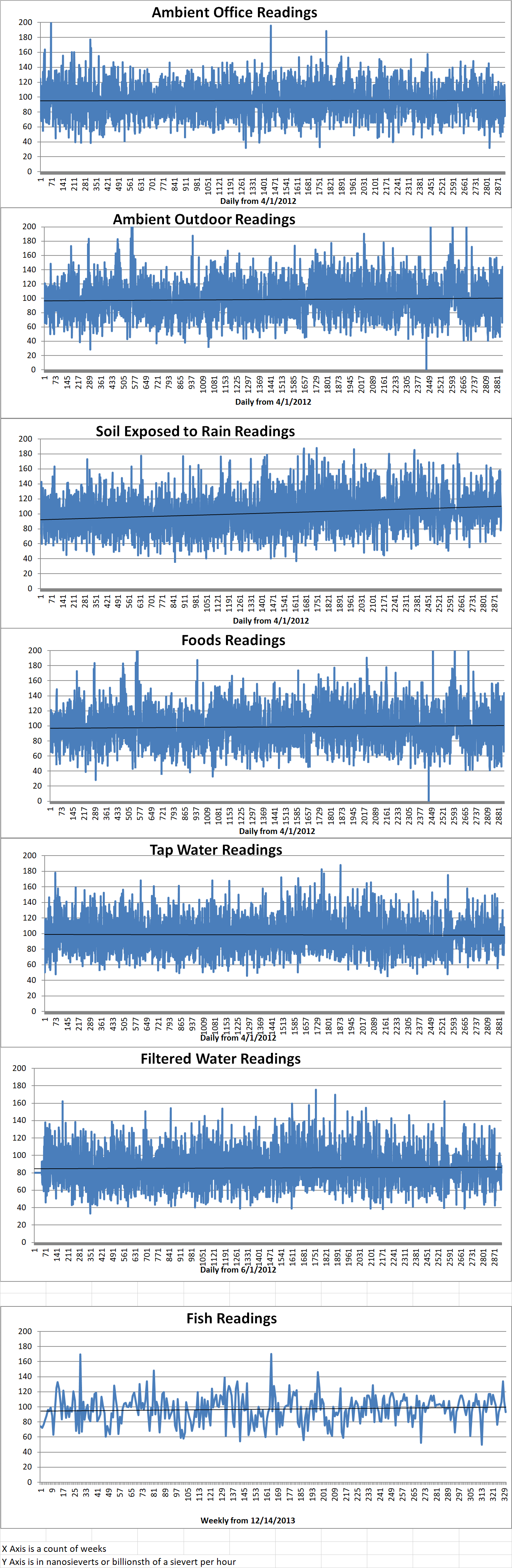
    Ambient office  = 88 nanosieverts per hour

    Ambient outside = 66 nanosieverts per hour

    Soil exposed to rain water = 72 nanosieverts per hour

    Tomato from Central Market = 129 nanosieverts per hour

    Tap water = 136 nanosieverts per hour

    Filtered water = 124 nanosieverts per hour

  • Deinococcus Radiodurans Is An Extremophile That May Help Develop Vaccines More Quickly – Part 2 of 7 Parts

    Deinococcus Radiodurans Is An Extremophile That May Help Develop Vaccines More Quickly – Part 2 of 7 Parts

    Part 2 of 7 Parts (Please read Part 1 first)
         Earlier this year, Daly and his team at USU published a report on their work to develop an inactivated polio vaccine. They took on this project with the biotechnology company Biological Mimetics, Inc (BMI) which was founded by several scientists from the National Cancer Institute. Greg Tobin is the president of BMI and a virologist who had previously led the SAIC-Frederick’s Gene Expression Regulation Group at the institute. He said, “A lot is known about polio So, if you wanted to pick something to characterize immunity, polio is a pretty good ‘proof of concept.’”
         At the heart of Daly’s new vaccine production techniques is a critical mechanism by which D. radiodurans protects itself from cosmic rays and other forms of ionizing radiation. For many years, the prevailing theory among radiobiologists had been that D. radiodurans utilized active cellular mechanisms for the direct protection of its DNA. This was considered to include novel DNA and RNA repair proteins which were produced in response to radiation exposure. But a couple of decades ago, Daly and his team decided that D. radiodurans has a more indirect approach to defending itself against radiation. Its primary defense mechanism is to protect the repair proteins as they cleanup and repair the genome.
         One way of visualizing the damage that radiation does inside a cell is to consider it as being equivalent to boiling a pot of pasta until all the noodles dissolve into blobs of mush. Gamma rays and x-rays energize and decompose water molecules inside a cell during radioactive bombardment. This generates highly chemically reactive “oxidizing” compounds from all the newly generated hydrogen and oxygen ions. More than the incident radiation, it is these oxidizing compounds that do serious damage to all the little organelles and useful macromolecules inside a living cell.
         In order to combat this threat and protect its repair proteins, each D. radiodurans bacterium manufactures a special oxidant compound that contains positively charged manganese ions. (There are some critical antioxidants in human cells such as the enzyme superoxide dismutase that also employ manganese.) By itself, outside of these compounds, manganese is a powerful antioxidant.
        Daly said, “We’ve shown that these manganese complexes are phenomenally good at protecting proteins from oxidants generated during radiation. But, these same manganese antioxidants, they did not protect DNA or RNA. So, as soon as that became very obvious, I said to myself, ‘It sounds like an ideal way of making a vaccine.’”
         Any good vaccine needs to resemble the infectious microbe that it is training the immune system of the body to search and destroy without doing the damage of the infectious agent. This can be a difficult balancing act. In 2012, the Center for Disease Control and Prevention (CDC) documented about forty two thousand new cases of whooping cough. This was the biggest outbreak since 1955. It was not due to poor access to health care or any antivaxxer movement or the evolution of a more virulent strain of pertussis bacteria but to an unreliable vaccine composed of fragmentary cellular material.
    Please read Part 3 ne
    xt

  • Geiger Readings for Jun 23, 2020

    Geiger Readings for Jun 23, 2020

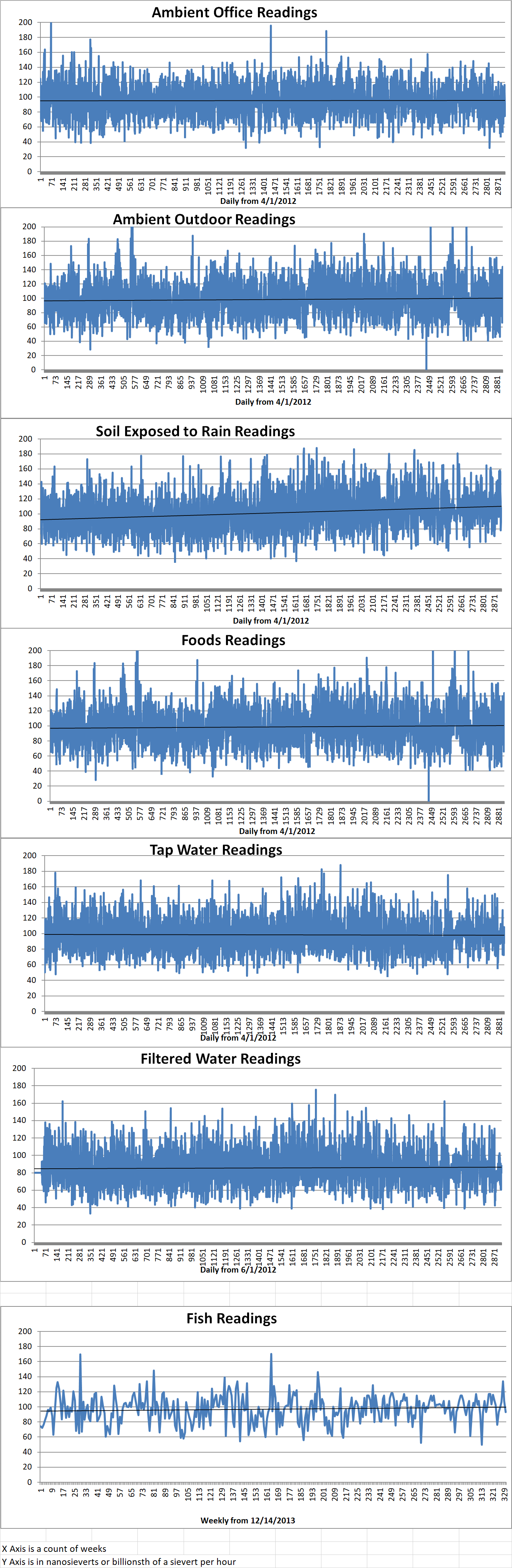
    Ambient office  = 77 nanosieverts per hour

    Ambient outside = 107 nanosieverts per hour

    Soil exposed to rain water = 108 nanosieverts per hour

    Broccoli from Central Market = 86 nanosieverts per hour

    Tap water = 108 nanosieverts per hour

    Filtered water = 88 nanosieverts per hour

  • Deinococcus Radiodurans Is An Extremophile That May Help Develop Vaccines More Quickly – Part 1 of 7 Parts

    Deinococcus Radiodurans Is An Extremophile That May Help Develop Vaccines More Quickly – Part 1 of 7 Parts

    Part 1 of 7 Parts
        “An extremophile is an organism with optimal growth in environmental conditions considered extreme in that it is challenging for a carbon-based life form with water as a solvent, such as all life on Earth, to survive.” They are able to survive and thrive where it is too acidic, toxic, hot, cold or radioactive for other life forms to exist.
        The extremophile bacterium Deinococcus radiodurans was first discovered in 1956 at Oregon State University. It ruined a gamma ray experiment that was intended to sterilize a tin of ground meat. The “sterilized” meat unexpectedly spoiled because of D. radiodurans and its ability to withstand radiation. This microbe can withstand about fifteen hundred times the dose of radiation that would kill a human being.
        D. radiodurans is an unusual specimen of extremophiles. It has evolved to be able to thrive in many different extremely difficult environments. Researchers have dubbed D. radiodurans “a robust generalist” which is capable persevering in the face of prolonged exposure to everything from toxic chemicals and corrosive acids to severe desert heat and subzero temperatures, even the rigors of space. In the decades since its discovery, colonies of D. radiodurans have been found in the coolant water tanks of nuclear reactors and in the weathered granite of Antarctica’s dry valleys. They have even been exposed to the direct sunlight in space as well as the vacuum of space and survived. They have been able to survive in a simulation of the conditions on the surface of Mars.
        How D. radiodurans is able to survive all these harsh conditions is still a controversy today in the community of researchers who study it. Mike Daly is a molecular biologist at Uniformed Services University, a medical college run by the Pentagon in Bethesda, Maryland. He has devoted decades of his life to the study of D. radiodurans. 
         Daly estimates that there are about ten laboratories in the whole world that are dedicated to the study of D. radiodurans. He said, “One of the reasons perhaps that so few people are working on it is because many of the mysteries have been solved. The great questions that we had 20 years ago about what makes this thing so radiation resistant—they have been solved completely in the sense that we have now built on those insights.”
        Both NASA and the National Academy of Sciences have gone to Daly for his insights into D. radiodurans. They were working on the problem of sterilizing satellites to prevent contamination of other worlds and D. radiodurans was difficult to purge. Daly has prepared a modified strain of D. radiodurans for cleaning up radioactive waste sites, reducing toxic hexavalent chromium to nontoxic chromium and decomposing toluene solvent pollutants into safer substances at the U.S. Hanford Reservation in Washington state. Recently, Daly has been studying ways to apply the lessons he has learned about the ability of D. radiodurans to survive radiation to the production of faster, cheaper and safer vaccines.
    Please read Part 2 next

  • Geiger Readings for Jun 22, 2020

    Geiger Readings for Jun 22, 2020

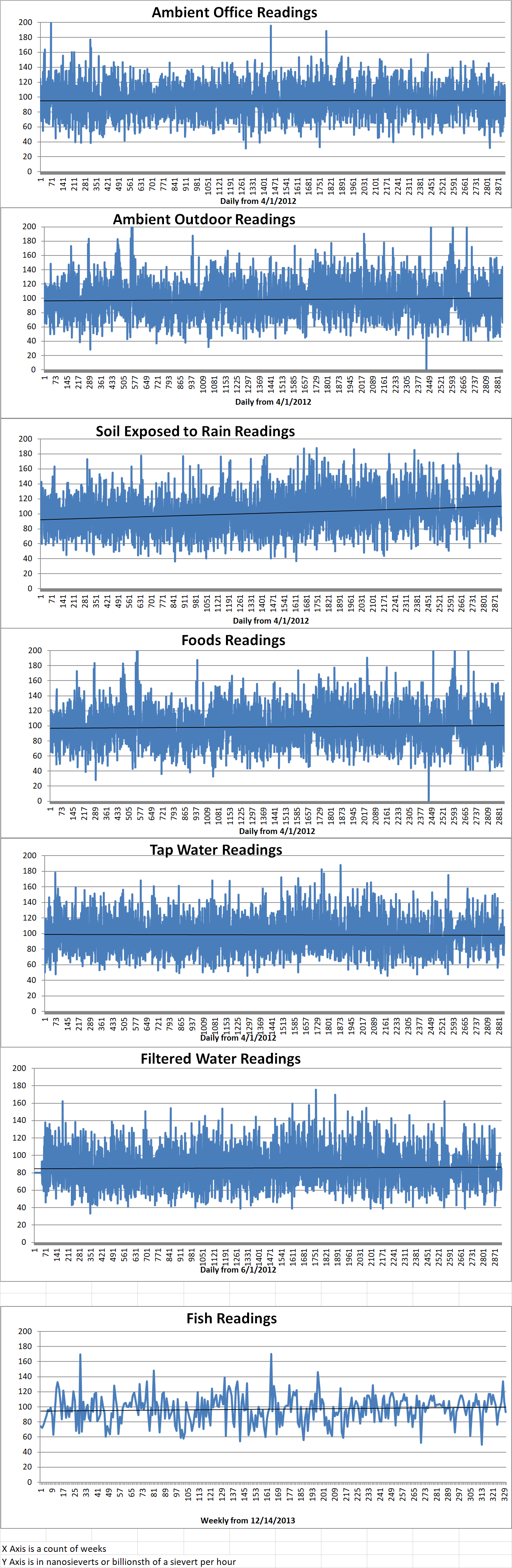
    Ambient office  = 74 nanosieverts per hour

    Ambient outside = 103 nanosieverts per hour

    Soil exposed to rain water = 96 nanosieverts per hour

    Red bell pepper from Central Market = 144 nanosieverts per hour

    Tap water = 88 nanosieverts per hour

    Filtered water = 80 nanosieverts per hour

  • Geiger Readings for Jun 21, 2020

    Geiger Readings for Jun 21, 2020

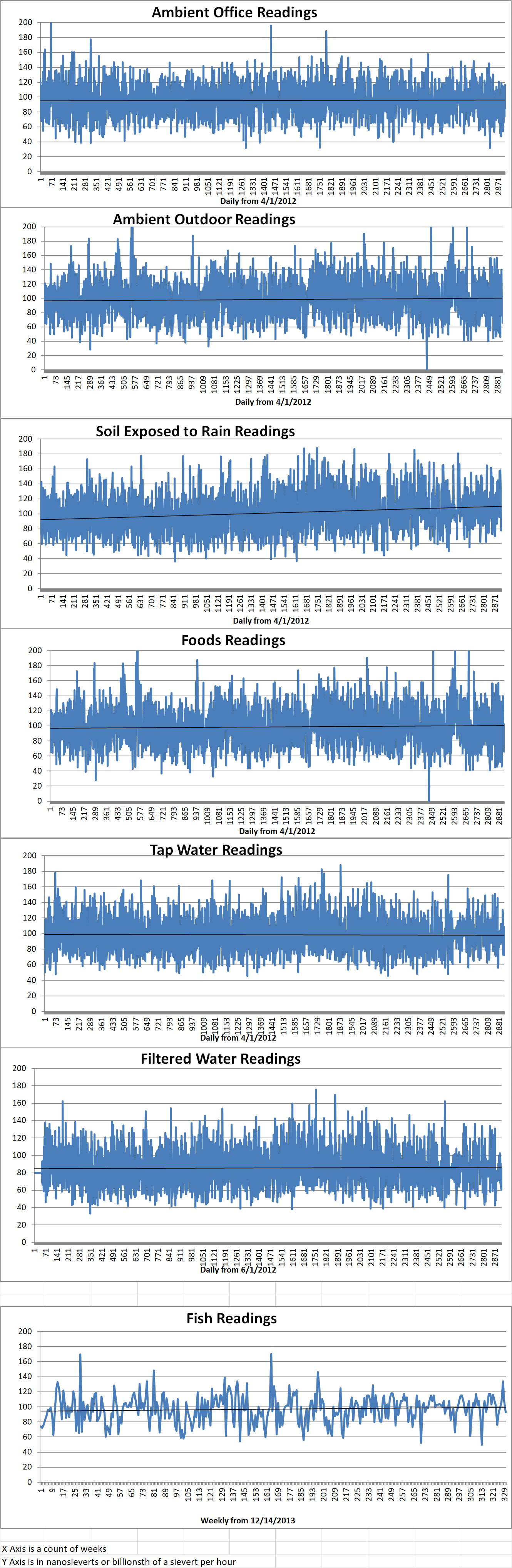
    Ambient office  = 86 nanosieverts per hour

    Ambient outside = 93 nanosieverts per hour

    Soil exposed to rain water = 92 nanosieverts per hour

    Avocado from Central Market = 66 nanosieverts per hour

    Tap water = 97 nanosieverts per hour

    Filtered water = 84 nanosieverts per hour