Category: Uncategorized

  • Geiger Readings for May 12, 2025

    Latitude 47.704656 Longitude -122.318745

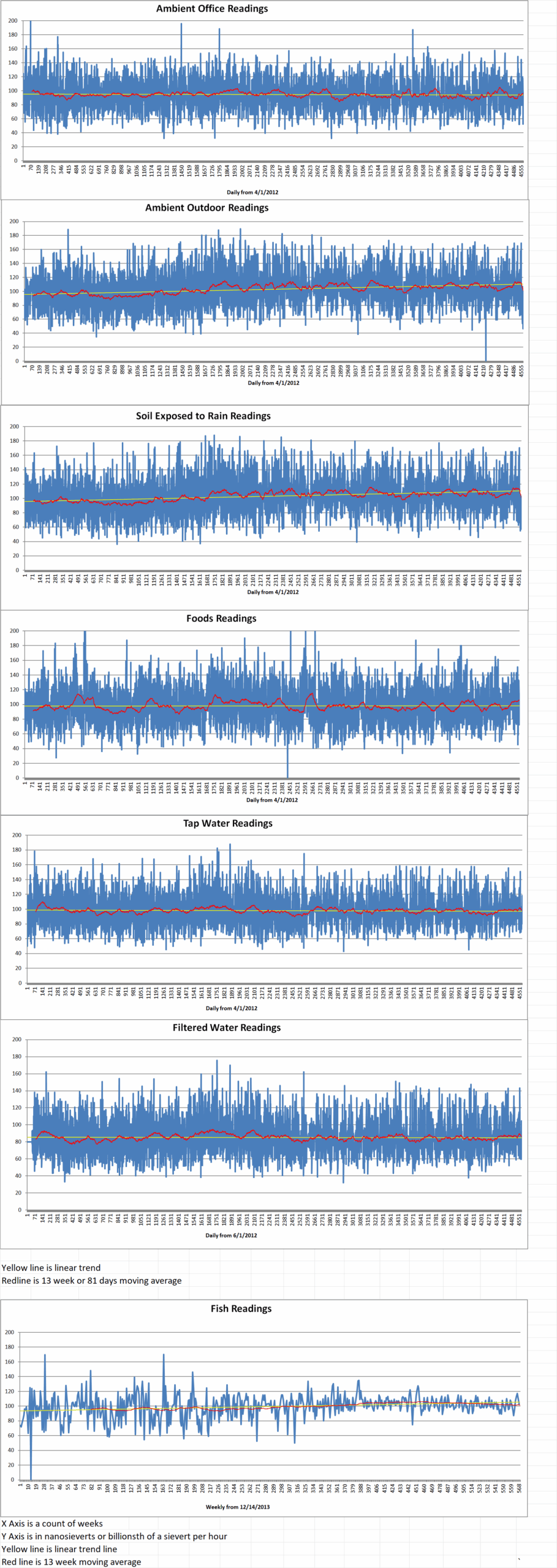
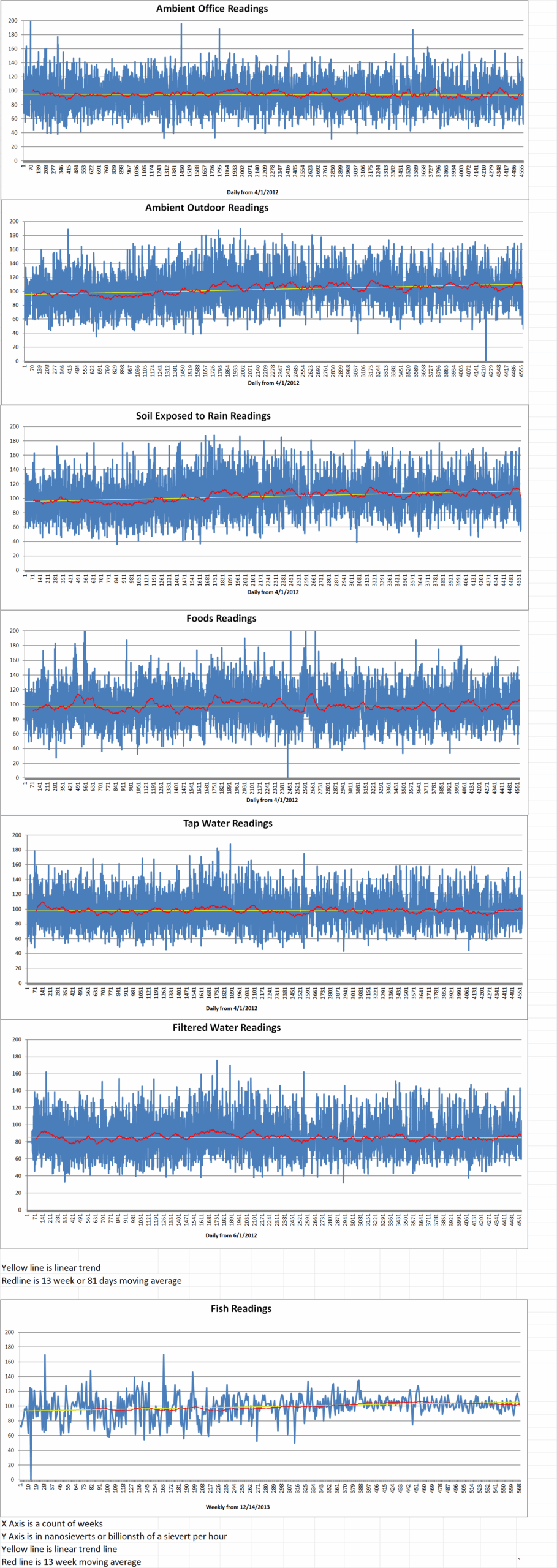
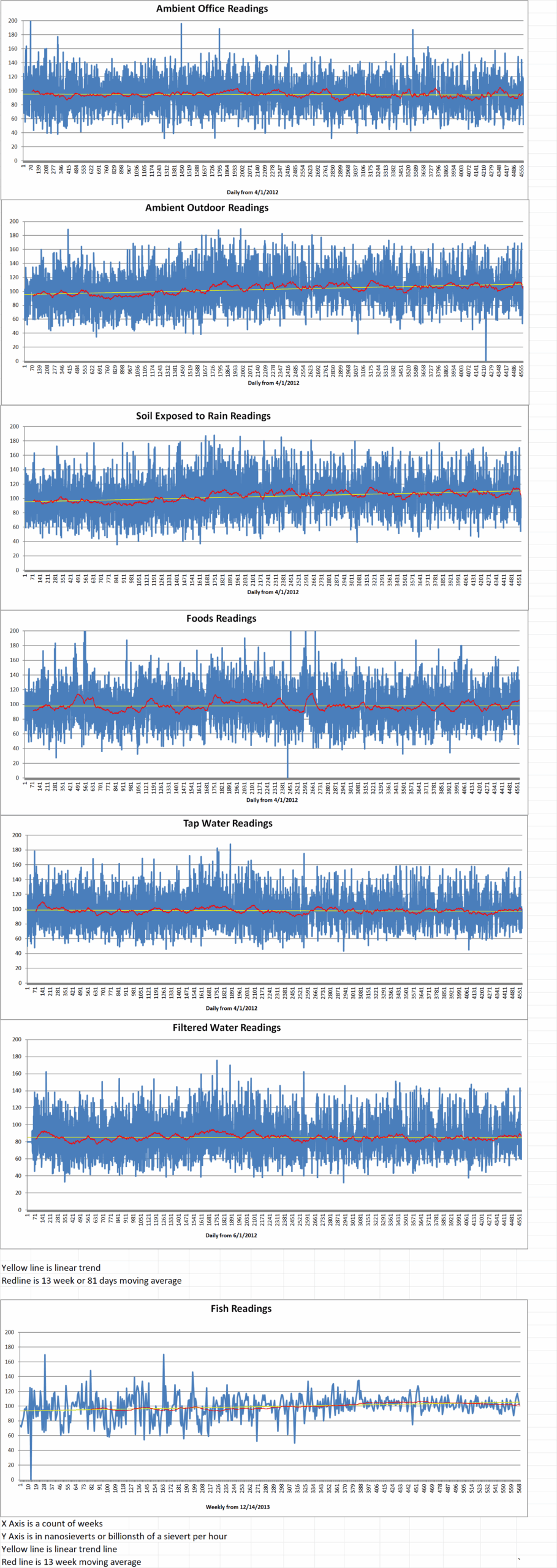
    Ambient office = 107 nanosieverts per hour

    Ambient outside = 102 nanosieverts per hour

    Soil exposed to rain water = 108 nanosieverts per hour

    Green onion from Central Market = 126 nanosieverts per hour

    Tap water = 119 nanosieverts per hour

    Filter water = 108 nanosieverts per hour

  • Geiger Readings for May 11, 2025

    Latitude 47.704656 Longitude -122.318745

    Ambient office = 111 nanosieverts per hour

    Ambient outside = 101 nanosieverts per hour

    Soil exposed to rain water = 102 nanosieverts per hour

    Ginger root from Central Market = 79 nanosieverts per hour

    Tap water = 84 nanosieverts per hour

    Filter water = 76 nanosieverts per hour

  • Geiger Readings for May 10, 2025

    Latitude 47.704656 Longitude -122.318745

    Ambient office = 98 nanosieverts per hour

    Ambient outside = 98 nanosieverts per hour

    Soil exposed to rain water 102 nanosieverts per hour

    Garlic bulb from Central Market = 102 nanosieverts per hour

    Tap water = 85 nanosieverts per hour

    Filter water = 77 nanosieverts per hour

    Dover Sole from Central = 110 nanosieverts per hour

  • Nuclear Reactors 1510 – EDF and Siparex Seeking Funding to Improve Nuclear Industry Supply Chain

    Nuclear Reactors 1510 – EDF and Siparex Seeking Funding to Improve Nuclear Industry Supply Chain

    Following an earlier funding round, France’s EDF and private equity specialist Siparex have announced a second round of funding to strengthen strategic companies in the country’s nuclear industry supply chain.

    The first round of financing was known as the Fonds France Nucléaire (FFN). It was launched in October 2021. When that round concluded at the end of 2024, one hundred and twelve million dollars had been investments in eleven nuclear companies, with contributions from EDF, Framatome, Orano, TechnicAtome, major clients in the nuclear industry, as well as Siparex Associés, sponsor of the Siparex Group funds.

    A second round of funding is named Fonds France Nucléaire 2 (FFN2). It has just been launched as a continuation of FFN with the target of raising EUR300 million.

    EDF said, “The aim of FFN2 is to support SMEs and mid-sized companies with significant expertise in the nuclear sector, in order to address the growing needs of the sector, which contributes to the challenges of energy sovereignty and defense. The FFN2 aims to invest tickets up to EUR50 million, alone or in co-investment, in a majority or minority position.”.

    EDF also said that FFN2 will bring together new leading institutional, industrial, and private investors “seeking to invest in the challenges of industrial and energy sovereignty, reindustrialization, and the decarbonization of the economy, and benefit from the associated strong momentum. Indeed, with more than 2000 companies and 220,000 employees contributing to the economic vitality of the regions, the French nuclear industry is the third-largest industrial sector in France”.

    EDF noted that the FFN2 fund has already made its first investment in the Ekoscan Integrity Group which is a global provider of advanced non-destructive testing solutions for critical industrial and infrastructure applications, along with the company’s founder and management team, Eurazeo, and ALIAD (Air Liquide Venture Capital).

    Benoit Desforges is a Managing Partner at Fonds France Nucléaire. He said, “The establishment of the Fonds France Nucléaire 2 is in line with what the first fund successfully implemented, demonstrating the value of targeting both strategic objectives for industry players and financial performance objectives. I am very pleased to see the industry’s major clients subscribing to the FFN2 alongside EDF, and to see institutional investors joining them, thus strengthening the support system as well as the investment capacity.”.

    Xavier Ursat is the Executive Director of the EDF Group, in charge of the Strategy, Technologies, Innovation and Development Department. He added, “With the Fonds France Nucléaire 2, the objective is to prepare for the future by working alongside companies in the nuclear sector and giving them the means today to develop, innovate and gain sovereignty.”.

    In February 2022, French President Emmanuel Macron announced that the time was right for a nuclear renaissance in France. He said that the operation of all existing reactors should be extended without compromising safety. He unveiled a proposed program for six new EPR2 reactors, with an option for a further eight EPR2 reactors to follow. The first three pairs of EPR2 reactors are to be constructed, in order, at the Penly, Gravelines and Bugey sites. Construction is expected to start in 2027.

    Électricité de France
     

  • Geiger Readings for May 09, 2025

    Latitude 47.704656 Longitude -122.318745

    Ambient office = 87 nanosieverts per hour

    Ambient outside = 46 nanosieverts per hour

    Soil exposed to rain water = 58 nanosieverts per hour

    English cucumber from Central Market = 112 nanosieverts per hour

    Tap water = 119 nanosieverts per hour

    Filter water = 105 nanosieverts per hour

  • Nuclear Reactors 1509 – The New Safe Confinement Shelter at Chernobyl Was Damaged by Russian Drone Strike in February of this Year – Part 2 of 2 Parts

    Nuclear Reactors 1509 – The New Safe Confinement Shelter at Chernobyl Was Damaged by Russian Drone Strike in February of this Year – Part 2 of 2 Parts

    Part 2 of 2 Parts (Please read Part 1 first)

    It has two layers of internal and external cladding around the main steel structure – about thirteen yards apart – with both layers being breached in the drone incident. The NSC was designed to allow for the eventual dismantling of the ageing makeshift shelter from 1986 and the management of the radioactive waste that it contained. It is also designed to withstand temperatures ranging from minus one hundred- and nine-degrees Fahrenheit to plus one hundred- and thirteen-degrees Fahrenheit, a class-three tornado, and an earthquake with a magnitude of six on the Richter scale.

    According to the World Nuclear Association, the hermetically-sealed NSC allows “engineers to remotely dismantle the 1986 structure that has shielded the remains of the reactor from the weather since the weeks after the accident. It will enable the eventual removal of the fuel-containing materials in the bottom of the reactor building and accommodate their characterization, compaction, and packing for disposal. This task represents the most important step in eliminating nuclear hazard at the site – and the real start of dismantling”.

    The NSC was financed via the Chernobyl Shelter Fund which is run by the European Bank for Reconstruction and Development (EBRD). It received one billion seven hundred million dollars from forty-five donor countries and the EBRD provided five hundred and thirty-six million dollars of its own resources.

    On the 4th of March, the EBRD allocated four hundred and forty-seven dollars from the administrative budget of the continuing fund for specialist-led damage assessment.

    The IAEA reported that the Ukrainian Zaporizhzhia nuclear power plant lost one of its two remaining external power lines on Wednesday. The Ukraine’s Ministry of Energy told them that the loss of the power line was the result of Russian military activity. Before the war, the plant had ten external power lines.

    Grossi said, “A secure supply of off-site power from the grid for all nuclear sites is one of the seven indispensable pillars of nuclear safety and security that we outlined early in the war. It is obvious that this supply is far from being secure. The vulnerability of the grid remains a deep source of concern for nuclear safety.”.

    The Zaporizhzhia plant has been under Russian military control since March 2022. It is located on the line between Russian and Ukrainian forces and has lost access to off-site power on eight occasions during the war The plant has to rely on emergency diesel generators to provide the power needed for safety functions.

    Grossi said that he has been in touch with both sides in the conflict as he seeks to organize the next rotation of the IAEA experts stationed at the plant. Differences over the route to be taken – via Ukraine or from the Russian side – and the safety situation has resulted in the current team now being at the plant for over two months.

    The IAEA teams currently based at Ukraine’s three operating nuclear power plants and at Chernobyl “have continued to report about air raid alarms on most days over the past week”, the IAEA added.

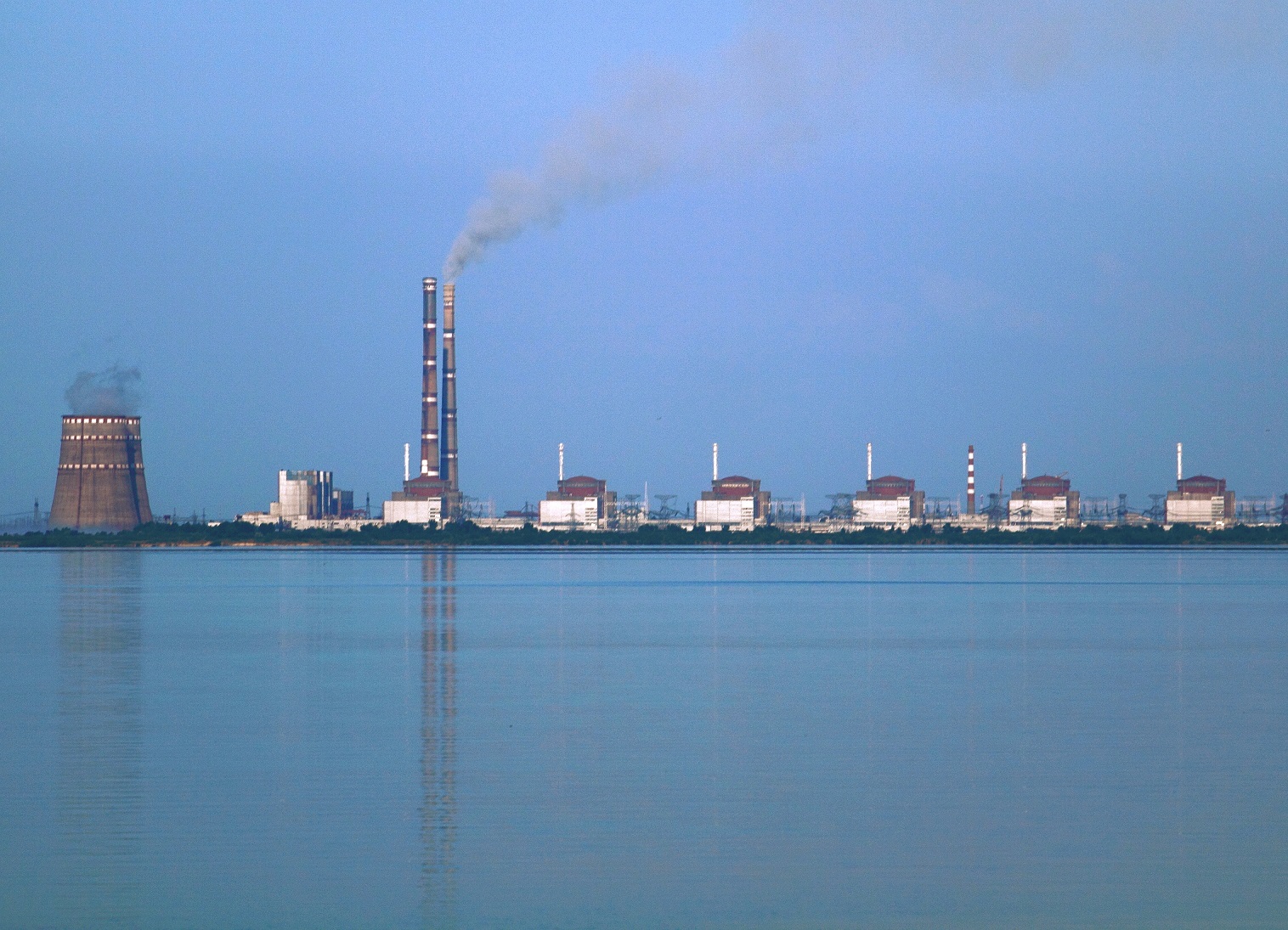
    Zaporizhzhia