Blog
-
Geiger Readings for June 19, 2015
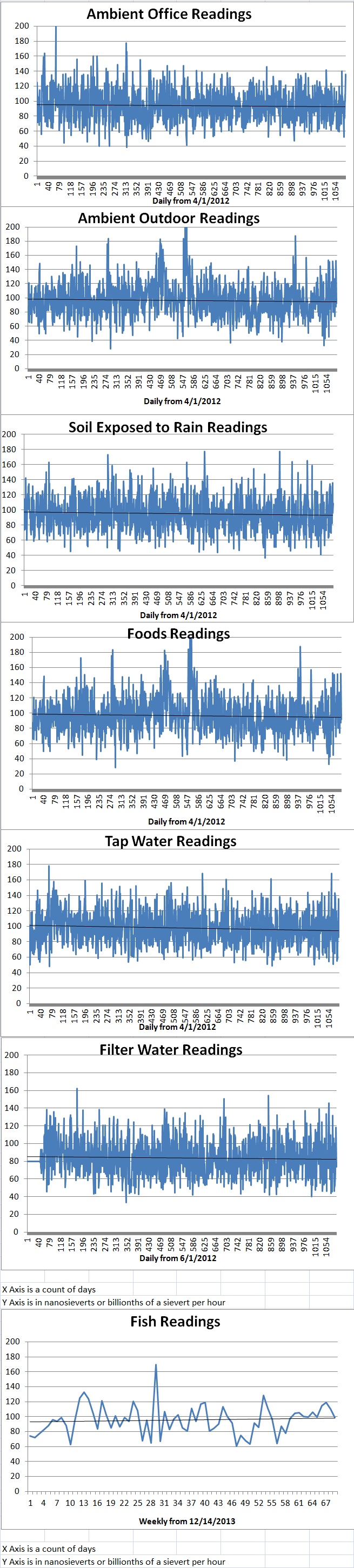
Ambient office = 136 nanosieverts per hourAmbient outside = 129 nanosieverts per hourSoil exposed to rain water = 109 nanosieverts per hourMango from Central Market = 94 nanosieverts per hourTap water = 86 nanosieverts per hourFiltered water = 74 nanosieverts per hour -
Nuclear Reactors 257 – Unions and Academics Criticize Financing and Construction Plans for U.K. Hinkley Point EPR Project
I recently blogged about the U.K. Hinkley Point reactor project which has been encountering problems with confidence in the French reactor designed by AREVA, price guarantees and foreign financing. Today I am going to write in more detail about the criticisms of the international financing plans for the project. EDF, the French utility that owns the construction site at Hinkley point has yet to announce its list of investors who are going to underwrite the thirty eight billion dollar cost of the Hinkley Point project.
Dieter Helm, a professor of energy policy at Oxford University rejects the whole idea of depending on financing from Chinese sources. He wants the British government to issue debt or nuclear guaranteed bonds. He says that this would lower the price of securing the financing from 10% to 2%. In addition, he points out the national security issues with letting Chinese companies become involved with the British nuclear industry. Helms serves on the economic advisory committee for the Department of Energy and Climate (DECC) change and is usually a proponent of the free market.
Amber Rudd, the DECC secretary said that the Chinese might be allowed to build, own and operate a new nuclear power plant at Bradwell in Essex. Apparently the British government is ready to allow the Chinese to use their own equipment and supply chain at Bradwell in return for Chinese financing of Bradwell and Hinkley Point.
Gary Smith, the national secretary for energy of the General, Municipal, Boilermakers union in England, has expressed criticism of Chinese involvement in the Hinkley Point project. Smith charges that the British government appears willing to risk national security and sacrifice the jobs of British workers in return for keeping the debt from Hinkley and Bradwell off the government books. Smith pointed out that one of China’s own nuclear experts has recently express doubts about the safety and reliability of Chinese nuclear components.
DECC has responded to CMB safety concerns by saying “Any proposal to build a power station would be subject to the UK regulatory regime. The same goes for components. All of them would have to be scrutinized by the (UK) office for nuclear regulation and not any regulator in any other jurisdiction.” With respect to British jobs, DECC said ” “That (issue) is some way down the line but the government still wants to maximize opportunities for British manufacturers and the British supply chain.”
Critics of the Hinkley Point financing plan suggest that Beijing is trying to use the desperation of EDF and England to find outside financing for Hinkley Point to force England to accept the Chinese demand to be allowed to build, own and operate a reactor at the Bradwell site. The GMB union and other nuclear industry sources in England charge that the Chinese want to use the Bradwell reactor as a showcase for the products and services of the Chinese National Nuclear Corporation to obtain other international reactor contracts.
It will be interesting to watch the negotiations proceed on the Hinkley Point project. With so many players and so many problems, it may ultimately be cancelled.
Artist’s concept of new Hinkley Point reactors:

-
Radiation News Roundup June 18, 2015
Canadian government has recently detected airborne elements of radioactive pollutant from Fukushima. enenews.com
Atomstroyexport, part of the ASE-NIAEP-AEP engineering subsidiary of Russia’s Rosatom, has closed down its office in Ukraine. The closure was announced yesterday in the Ukrainian parliamentary newspaper Golos Ukraini. world-nuclear-news.org
-
Geiger Readings for June 18, 2015
Ambient office = 100 nanosieverts per hour
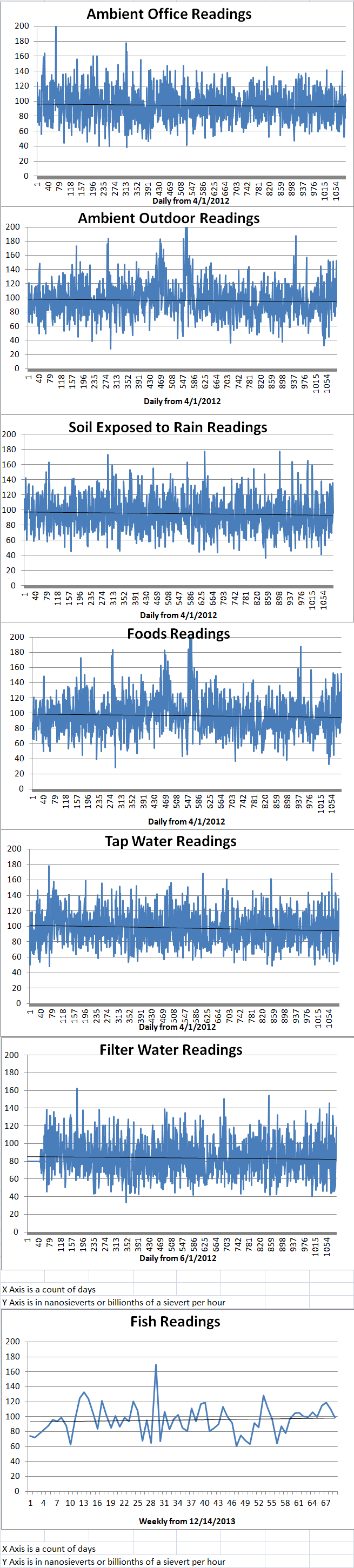
Ambient outside = 104 nanosieverts per hourSoil exposed to rain water = 96 nanosieverts per hourIceberg lettuce from Central Market = 92 nanosieverts per hourTap water = 135 nanosieverts per hourFiltered water = 119 nanosieverts per hour -
Radioactive Waste 133 – Waste Control Specialists Seek Nuclear Waste Fund Money For New Consolidated Interim Storage Facility in Texas
Fifteen years ago, the United States Department of Energy was directed by law to take the title to spend nuclear fuel from commercial nuclear power plants for the purpose of permanent storage. There was suppose to be a permanent disposal site available by 1999 but no such site exists today. Currently, spent nuclear fuel is distributed across the U.S. at seventy five operating and decommissioned nuclear power plant sites in thirty three states. So far, the U.S. taxpayers have paid four and a half billion dollars because the U.S. DoE has violated contractual obligations to U.S. utilities. If the DoE does not take possession of the spent nuclear fuel by 2020, it is estimated that the cost to taxpayers will grow to twenty seven billion dollars.
In order to fulfill its contractual obligations, the DoE must have a site where it can collect, manage and dispose of spent commercial nuclear fuel. An underground geological repository in an old salt mine beneath Yucca Mountain in Nevada was mandated by law to be that permanent disposal site. However, due to issues with the movement of ground water and the question of the reliability of the initial environmental impact statement, the Obama administration and Nevada Congressmen cancelled the Yucca Mountain repository project in 2009. The U.S. government is working on securing another site for permanent disposal of spent nuclear fuel but the soonest an alternative site could be available would be 2050. The Nuclear Waste Fund (NWF) was also created by the original legislation and has collected almost thirty billion dollars from nuclear power utilities but some of that money has been returned as a result of lawsuits.
Waste Control Specialists (WCS) has applied for a permit to construct and operates a “consolidated interim storage facility” by 2020 at an existing waste disposal site in Andrews County, Texas which already takes low-level nuclear waste. WCS would provide transportation and storage for sites around the U.S. with emphasis on dealing with spent fuel from decommissioned nuclear power reactors first. WCS has formed a partnership with AREVA, a French nuclear contractor, and NAC International (NACI) , a firm that constructs dry cask storing spent nuclear fuel, to license and develop the site. Technology supported by AREVA and NACI is currently utilized for sixty two percent of the dry cask storage in the U.S. which includes eighty percent of dry cask storage at decommissioned sites. Both companies are also leaders in the transportation of spent nuclear fuel around the world.
In order for the CISF project in Andrews Country, Texas to proceed, WCS will have to have assurances that the U.S. Secretary has the legal authority to enter into contracts with private firms such as WCS for the storage of spent nuclear fuel and other high level radioactive waste. WCS is asking for money in the Nuclear Waste Fund to be allocated for this purpose. The Senate Appropriations Committee recently included text in the annual Energy and Water Development Bill that provides for the use of NWF money to be for contracting private firms to store nuclear waste. The appropriations committees in the House and Senate will spend the next couple of months considering options for spent nuclear fuel management.
The spent nuclear fuel pools are quickly being filled at the operating nuclear power plants in the U.S. If new storage options are not in place within five years, some plants may have to be shut down. The spent fuel will either have to be stored onsite at the power plants or in a facility like the CISF in Texas. Given that the NWF exists, if it cannot be utilized for interim storage, the Fund may be depleted by lawsuits unless a solution such as the CISF can be created and funded.
Artist’s concept of the consolidated interim storage facility in Andrews County, Texas:
-
Radiation News Roundup June 17, 2015
Fukushima radiation will cause long-term harm to Pacific salmon population. enenews.com
An uprate of unit 2 of the Oskarshamn nuclear power plant in Sweden that would have increased its generating capacity by 27% has been indefinitely postponed, plant operator OKG announced today. world-nuclear-news.org
-
Geiger Readings for June 17, 2015
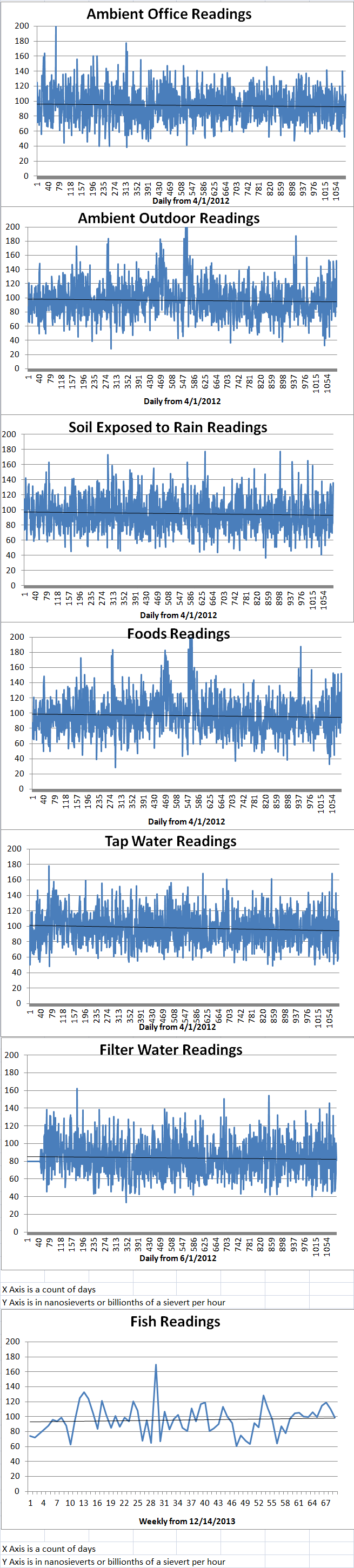
Ambient office = 109 nanosieverts per hourAmbient outside = 135 nanosieverts per hourSoil exposed to rain water = 136 nanosieverts per hourAvacado from Central Market = 152 nanosieverts per hourTap water = 88 nanosieverts per hourFiltered water = 81 nanosieverts per hour -
Radioactive Waste 132 – Rutgers University Finds Bacteria That Can Lock Uranium in Soil
One of the major problems plaguing uranium mines, nuclear waste dumps and areas where depleted uranium was widely used in munitions during wars is the leaking of radioactive materials into the ground which wind up polluting the ground water underneath the dump. This pollution can make its way through the water table to the site of wells that supply drinking water or into surface water, posing a threat to the people in the area. One of the worst examples of this is at the Hanford Nuclear Reservation where millions of gallons of radioactive liquid from nuclear bomb manufacture were poured into unlined dirt trenches and allowed to soak into the soil. This happened decades ago but radioactive materials are still moving through the ground and out into the Columbia River. Various schemes have been proposed and some are being tested to halt this leakage but none are guaranteed to work.
Now a research team at the School of Environmental and Biological Sciences at Rutgers University have found a soil bacteria of a type called betaproteobacteria in an old uranium mine in Rifle, a town near Denver, Colorado which may be the answer to this problem. There have been suggestions that bacteria could be used for radioactive pollution cleanup, but this is the first betaproteobacteria that has been found that can utilize oxygen or uranium for the energy needed to drive metabolism. This is unique. Other types of metal consuming bacteria exist but they cannot consume oxygen as an alternative energy source and must rely on metals such as iron.
If the new betaproteobacteria is utilizing uranium for energy, the uranium is immobilize in the soil. After this betaproteobacteria interacts with uranium compounds dissolved in water, the uranium is precipitated out of solution and turned into solid uranium nanoparticles no longer dissolved in the water. This means that the uranium cannot be carried out of the ground and contaminate drinking water.
Considering the thousands of sites around the world that have soil contaminated with radioactive materials, this betaproteobacteria could be used for what is called bioremediation to lock the radioactive contamination in the soil and prevent ground water from carrying it to the surface. While chemical solutions have been researched for immobilizing radioactive materials in soil, these chemicals are toxic and expensive to deploy in large areas. It would be much better to use an existing soil betaproteobacteria for such work.
Metastudies of epidemiological data have shown that there is no safe level for radioactive materials in the environment. Even the natural background radiation from natural uranium in the soil is a threat to human health. Natural background radiation varies from place to place. If an effective and inexpensive bioremediation process could be developed based on the new betaproteobacteria, it might make sense to apply it in places where the natural background radiation is highest even though no human activity contributed to the level of radiation.
Rutgers University School of Environmental and Biological Sciences:
-
Radiation News Roundup June 16, 2015
Reconstruction of the regions in northeastern Japan, which were struck four years ago by a devastating earthquake and ensuing tsunami, remains slow. news.xinhuanet.com
South Korea’s oldest operating reactor unit will close in 2017 without a licence extension, said operator Korea Hydro and Nuclear Power (KHNP). world-nuclear-news.org
-
Geiger Readings for June 16, 2015
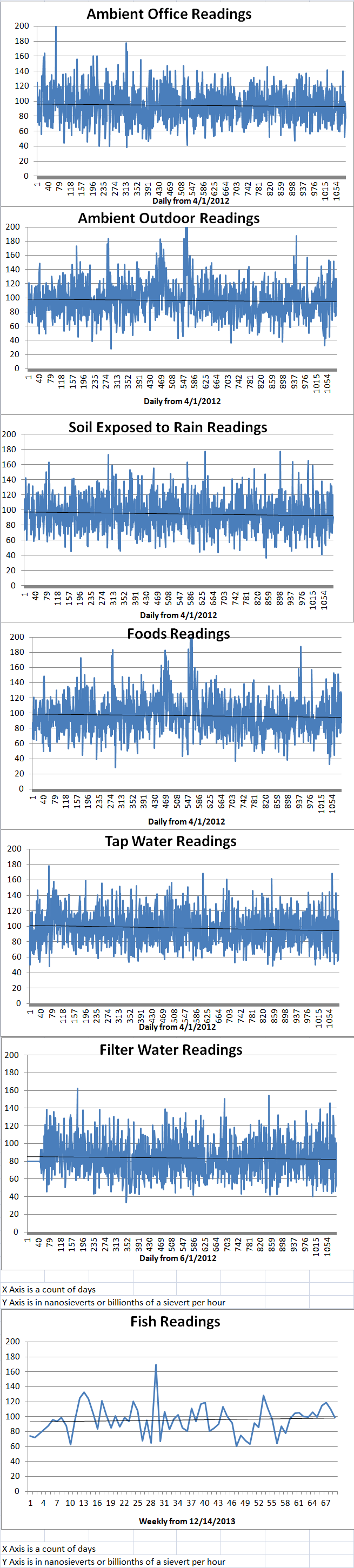
Ambient office = 97 nanosieverts per hourAmbient outside = 109 nanosieverts per hourSoil exposed to rain water = 82 nanosieverts per hourMango from Central Market = 88 nanosieverts per hourTap water = 107 nanosieverts per hourFiltered water = 101 nanosieverts per hour