Blog
-
Geiger Readings for April 17, 2015
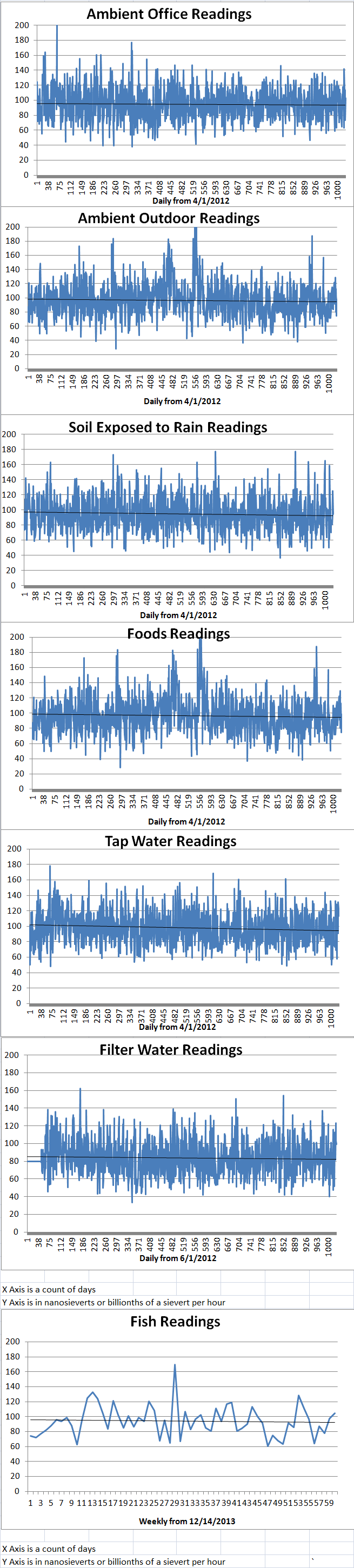
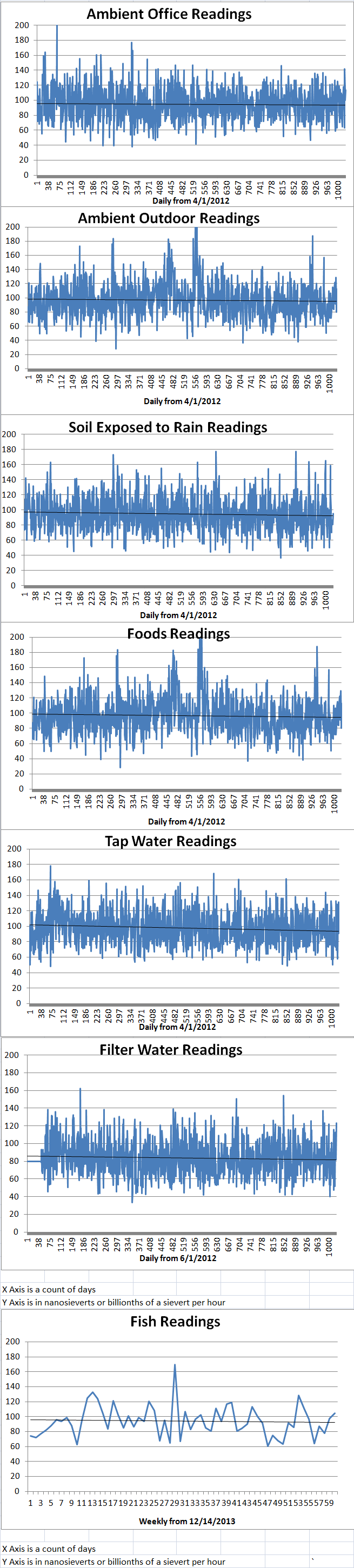
Ambient office = 103 nanosieverts per hourAmbient outside = 99 nanosieverts per hourSoil exposed to rain water = 95 nanosieverts per hourBrussel sprout from QFC = 99 nanosieverts per hourTap water = 113 nanosieverts per hourFiltered water = 99 nanosieverts per hour -
Radiation News Roundup April 17, 2015
CBS says that the worst may not be over from Fukushima because the effects of Fukushima radiation have become much more severe. enenews.com
The radiological event at the Waste Isolation Pilot Plant (WIPP) in New Mexico in February 2014 resulted from shortcomings within both contractor and federal processes, the accident investigation board has concluded. The release, it said, was preventable. world-nuclear-news.org
Latest reliability and safety indicators for US nuclear power plants continue a pattern of consistently high results dating back more than ten years, according to the US Nuclear Energy Institute (NEI). world-nuclear-news.org
Nuclear can still have a key role to play in Japan’s energy policy, but the restart process for the country’s offline reactor fleet is strict and time-consuming, Japan Atomic Industrial Forum president Takuya Hattori told NucNet. nucnet.org
-
Radioactive Waste 129 – Deep Borehole Disposal Will Be Tested At Hanford – Part 1
(Part One of a two part article.)
I have posted many essays about the disposal of radioactive materials. In the early days of the nuclear age when the thrust was to develop nuclear weapons, nuclear waste from production was often poured or dumped in trenches and holes. Some nuclear waste was just dumped in the ocean. As time went by, better methods of storing and disposing of nuclear waste were suggested and some were tested. Spent nuclear fuel began to accumulate at nuclear power plants. It was decided that the best thing to do with nuclear waste would be to bury it deep in the ground in permanent mined geological repositories. (MGR) Germany used an old salt mine for a repository but it had to be abandoned because of ground water penetration.
A decade and millions of dollars were spent by the U.S. government on what was going to be a permanent spent nuclear fuel repository in an old salt mine under Yucca Mountain in Nevada. The project was cancelled in 2009 because of problems with ground water. An underground repository in New Mexico that was specifically intended for waste from the production of nuclear weapons was recently closed because of an explosion that released radioactive particles into the environment. It will take years and millions of dollars to reopen the repository.
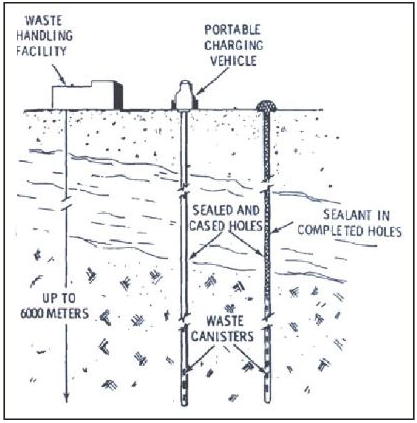
In the U.S., the spent fuel pools are filling up at nuclear power reactors and temporary dry cask storage seems to be the only short term solution although there are problems with cask design. One of the proposals that I have covered was the idea of drilling sixteen thousand foot deep holes and dumping the waste in. This option which is referred to as “deep borehole disposal ” (DBD) has not been done but may be the best of many alternatives.
Researchers from the University of Sheffield in Britain will present their latest findings with regard to the borehole option at the American Nuclear Society meeting next week in Charleston, South Carolina. Professor Fergus Gibb from the University of Sheffield has said, “DBD is particularly suitable for high level nuclear waste, such as spent fuel, where high levels of radioactivity and heat make other alternatives very difficult. Much of the drilling expertise and equipment to create the boreholes already exists in the oil and gas and geothermal industries. A demonstration borehole — such as is planned in the US — is what is now needed to move this technology forward.” The Sheffield team has been researching the nuclear waste at the Hanford Nuclear Reservation in Washington State. They estimate that forty percent of the most radioactive waste at Hanford could be disposed of in a single borehole.
The biggest concern with the DBD approach is the fear that the radioactive materials might escape from the borehole. A way of covering the holes securely must be developed and thoroughly tested. Professor Gibb has suggested that a layer of granite could be melted above the waste. It would solidify and behave the same way as natural rock to seal the borehole. Professor Gibb and his team are also working on processes for surrounding the waste with special cement that can withstand the temperatures and pressures found in deep boreholes.
(Please read Part Two of this article next.)
-
Geiger Readings for April 16, 2015
Ambient office = 73 nanosieverts per hourAmbient outside = 103 nanosieverts per hourSoil exposed to rain water = 126 nanosieverts per hourBrussel sprout from QFC = 74 nanosieverts per hourTap water = 122 nanosieverts per hourFiltered water = 103 nanosieverts per hour -
Radioactive Waste 128 – Energy Solutions Wants to Bury 350,000 Tons of Depleted Uranium in Utah – Part 2
(This is the second section of a two-part article – Please read Part 1 before reading this post.)
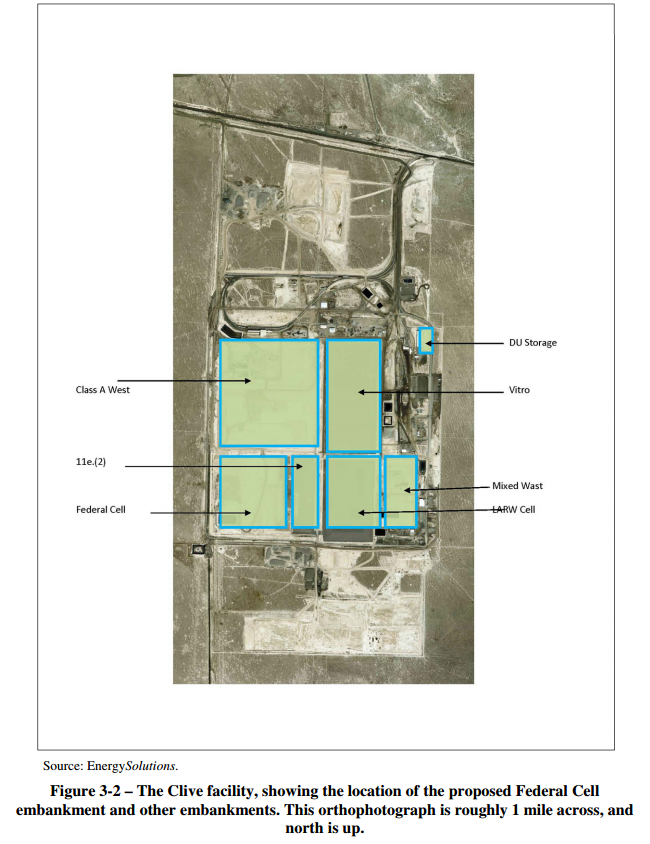
EnergySolutions (ES) is a company that focuses on nuclear waste recycling, nuclear waste disposal, and environmental remediation. ES operates the Clive landfill 80 miles west of Salt Lake City in Utah.
ES has been asking the state of Utah for permission to bury three hundred and seventy five thousand tons (or about one half) of the U.S. stockpile of depleted uranium in the Clive landfill. The Utah Department of Environmental Quality listed eight conditions that they say ES must satisfy before they are allowed to ship hundreds of thousands of drums of nuclear waste to Utah for burial. They also listed seven questions that ES must answer before its proposal will be accepted.
(Please see Part 1 for a list of the eight issues.)
In addition to the eight issues, there are is set of seven questions that the DEQ requires ES to answer including:
“1. Agreement with Department of Energy (DOE) Prior to disposal of DU waste, EnergySolutions shall provide a written agreement letter between DOE and EnergySolutions indicating that DOE will accept title to the Federal Cell after closure.
2. Disposal below grade DU waste must be disposed of below the original-grade level of the proposed Federal Cell.
3. Depleted uranium as Class A waste EnergySolutions shall provide documentation that the Nuclear Regulatory Commission (NRC) does not plan to reclassify DU.
4. Modeling of the remainder of waste. EnergySolutions shall submit for DEQ approval a revised performance assessment that addresses the total quantities of concentrated DU and other wastes before any radioactive wastes other than the DU waste are emplaced in the proposed Federal Cell.
5. Waste acceptance criteria Prior to any land disposal of significant quantities of concentrated DU, the EnergySolutions shall submit a written Waste Acceptance Criteria plan designed to ensure that all DU waste received by EnergySolutions conforms with all physical, chemical, and radiologic properties assumed in the DU PA modeling report.
6. Prohibition of recycled uranium in DU waste ES is prohibited from land disposal of any quantity of DU that was produced at DOE facilities from uranium-bearing materials containing recycled uranium.
7. Hydrological and hydrogeological properties of lower confined aquifer EnergySolutions will develop and implement a program to provide more detailed site characterization and hydrogeological evaluation of aquifers in the area, particularly the deeper confined aquifer.”
Critics of the plan to bury depleted uranium at Clive landfill say that they do not believe that ES will be able to satisfy the requirements of the DEQ. Even if the DEQ requirements are satisfied, there are still potentials problems. A waste facility in Germany had to be permanently closed because of unanticipated problems with ground water moving though the old salt mine. Part of the reason that the Yucca Mountain Nuclear Repository project was abandoned was because the initial assumptions about ground water movement in the area proved to seriously underestimate the amount and speed of ground water in the area. Even with the best planning and modeling possible, the only way to be sure if the plan will work as projected would be to create a test dump and monitor it for decades. This is unlikely to happen.
-
Geiger Readings for April 15, 2015
Ambient office = 114 nanosieverts per hourAmbient outside = 122 nanosieverts per hourSoil exposed to rain water = 95 nanosieverts per hourIceberg lettuce from Central Market = 113 nanosieverts per hourTap water = 131 nanosieverts per hourFiltered water = 123 nanosieverts per hour -
Radioactive Waste 127- Energy Solutions Wants to Bury 350,000 Tons of Depleted Uranium in Utah – Part 1
(This is Part 1 of a two part article)
EnergySolutions (ES) is a company that focuses on nuclear waste recycling, nuclear waste disposal, and environmental remediation. ES operates the Clive landfill 80 miles west of Salt Lake City in Utah. The Clive landfill already had already taken in a small amount of radioactive material before the state of Utah recently banned radioactive waste.
ES has been asking the state of Utah for permission to bury three hundred and seventy five thousand tons (or about one half) of the U.S. stockpile of depleted uranium in the Clive landfill. This is the uranium left over after uranium ore has been subjected to the the enrichment process that raises the ratio of U-235 to U-238 for use in fuel and weapons. Depleted uranium is low-level radioactive waste now but it will get more and more radioactive over the next million years. Currently there are seven hundred and fifty thousand tons of depleted uranium at three sites in the U.S. including Kentucky, Ohio and South Carolina. EnergySolutions is proposing to ship the one ton drums of waste to the Clive landfill over the next 30 years. Once the drums arrive, they are to be covered with concrete, clay and rocks in pits lined with clay.
This Monday, the Utah Department of Environmental Quality (DEQ) released a new evaluation of safety concerns about the project. The DEQ listed eight conditions that they say ES must satisfy before they are allowed to ship hundreds of thousands of drums of nuclear waste to Utah for burial. These issues are listed as unresolved but none of them are considered to be unresolvable. They also listed seven questions that ES must answer before its proposal will be accepted.
ES asked the state of Utah to suspend the application process temporarily. While ES is sure that they can meet the eight state requirements and answer the seven questions, the company said that they wanted to have time to work on compliance before a mandated public hearing on the project. Once all the issues have been resolved and the questions answered to the satisfaction of the DEQ, then ES will request that the normal proposal acceptance process resume, including meetings to solicit public input.
The DEQ evaluation found that ES had not resolved the following issues:
· Evapotranspiration cover – Evapotranspiration is a combination of evaporation and plant transpiration. ES must satisfy DEQ that the cover over the drums of waste they are proposing would prevent evapotranspiration of radioactive materials.
· Infiltration – Infiltration is a measure of how quickly surface water soaks into the ground. ES must have a satisfactory way to prevent such infiltration into the waste dump area.
· Erosion of cover – ES must show DEQ that the combination of materials which will be used to cover the waste drums are secure against erosion.
· Frost damage – ES must take measures to prevent frost damage to the integrity of the cover materials over the disposal area.
· Effects of biological processes on radionuclide transport – ES must insure that biological processes including bacteria, fungus and plant roots do not invade the waste disposal area and move radioactive particles out of the landfill.
· Clay liner – ES must show DEQ that the clay liner proposed for the nuclear waste dump area is adequate to prevent ground water from leaching radioactive materials from the dump and moving them through the water table into surface water and aquifers that supply wells.
· GoldSim quality assurance – ES must apply the widely-used GoldSim modeling process to risks associated with the behavior of radioactive materials underground. Possible escape of radon gas is of special interest in this analysis.
· Deep time analysis – ES must submit an projection of geological processes and radioactive activity in the dump into the far future.
(See Part 2 for the list of questions.)