Blog
-
Geiger Readings for April 14, 2015
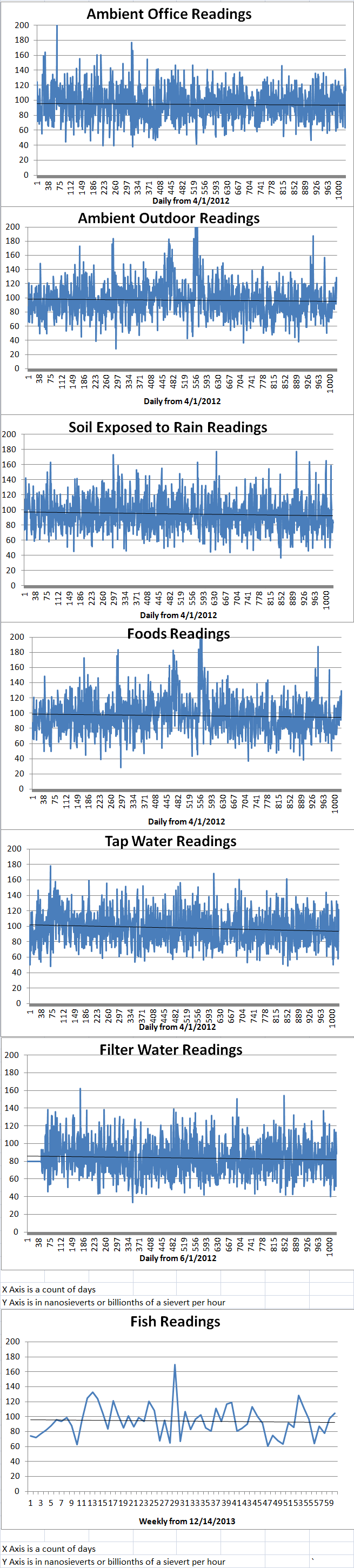
Ambient office = 100 nanosieverts per hourAmbient outside = 93 nanosieverts per hourSoil exposed to rain water = 81 nanosieverts per hourOrange Bell Pepper from Central Market = 80 nanosieverts per hourTap water = 91 nanosieverts per hourFiltered water = 81 nanosieverts per hour -
Radioactive Waste 126 – Three Methods Considered For Removing Melted Cores as Fukushima
Three of the six nuclear reactors at the Fukushima nuclear plant melted down in March of 2011. The Fukushima Unit One, Unit Two and Unit 3 reactors were destroyed in the disaster. The combination of melted nuclear fuel rods and the rest of the core structure produced by a meltdown are known as corium.
It is still not clear exactly where the melted cores are currently located. The big question is whether or not the melting cores are still within the containment vessels. There is speculation that the corium has sunk into the ground under the power plant. The facility is so radioactive that workers cannot get in to find out where the corium is. Current radiation in the ruins of Unit One would kill a human in an hour. A robot that was sent in to check Unit One ceased functioning in three hours. A muon detector system was set up to locate the corium and basically found out where the corium was not.
Once the corium has been located, then there is the question of how to retrieve it. Some analysts say that there is no technology that exists that could be used to get to the corium and remove it from the ruins of the Fukushima nuclear plant.
Now there are three proposals from the Japanese Nuclear Damage Compensation and Decommissioning Facilitation Corporation (NDF) for how to get the corium out. The NDF is developing a “road map” schedule for use by the Japanese government and TEPCO with respect to technical issues with the corium removal.
The first approach which has been the only one considered before the roadmap consists of flooding the containment vessels with water and removing the corium by going in through the top of the vessels. The water would help protect the workers from the radiation. This process is called the “water-covered method.” If the containment vessel has corroded through or has cracks, water would leak out. In addition, filling the containment vessels with water would make them less able to withstand an earthquake.
The second approach would be to just go in through the top of the containment vessels with water only in the bottom of the containment vessel. This approach is called an “airborne method.” The big danger here is the intense radiation that exists in the containment vessels is lethal. As mentioned above, even specially-designed robots cannot withstand the radiation for more than a few hours. The third approach would be to drill a hole in the bottom of the containment vessel to take out the corium.This is also an “airborne method.” There is still the problem with the radiation in this process.
At this point, there are too many unknowns and dangerous knowns to really evaluate which of these methods offers the best chance of getting the corium out.
-
Radiation News Roundup April 13, 2015
Areva has signed two agreements with Indian companies in preparation for the project to construct six EPR units at Jaitapur in Maharashtra state. world-nuclear-news.org
Porvair Filtration Group has announced its role in the High Temperature Gas-Cooled Reactor (HTGR) currently being developed at Tsinghua University in China. world-nuclear-news.org
-
Geiger Readings for April 13, 2015
Ambient office = 113 nanosieverts per hourAmbient outside = 89 nanosieverts per hourSoil exposed to rain water = 83 nanosieverts per hourKale from Central Market = 129 nanosieverts per hourTap water = 94 nanosieverts per hourFiltered water = 89 nanosieverts per hour -
Radiation News Roundup April 12, 2015
-
Geiger Readings for April 12, 2015
Ambient office = 142 nanosieverts per hourAmbient outside = 95 nanosieverts per hourSoil exposed to rain water = 87 nanosieverts per hourBanana from QFC = 115 nanosieverts per hourTap water = 121 nanosieverts per hourFiltered water = 113 nanosieverts per hour -
Radiation News Roundup April 11, 2015
-
Geiger Readings for April 11, 2015
Ambient office = 63 nanosieverts per hourAmbient outside = 56 nanosieverts per hourSoil exposed to rain water = 78 nanosieverts per hourBanana from QFC = 91 nanosieverts per hourTap water = 58 nanosieverts per hourFiltered water = 52 nanosieverts per hourPacific Cod – Caught in USA = 104 nanosieverts per hour -
Nuclear Weapons 137 – Was Mars Devastated By A Huge Nuclear Explosion In The Distant Past
And now for something completely different as the Monty Python crew liked to say. I usually try to be as accurate as I can in these posts. I welcome any feedback that will help me correct mistakes. There has been a massive die-off of sea life on the West Coast of the United States that some have attributed to radiation released from Fukushima. I have not reported on it because there has been no definitive proof that Fukushima is reponsible. However, sometimes you encounter what seems to be a really far out idea but a scientist is offering evidence for that idea. I just couldn’t resist mentioning the proposal that there were several huge devastating nuclear explosions on Mars that heavily impacted the surface of that planet.
Dr. John Bradenburg is a senior propulsion scientist at Orbital Technologies Corporation. In a recent interview, he stated that, “The Martian surface is covered with a thin layer of radioactive substances including uranium, thorium and radioactive potassium — and this pattern radiates from a hot spot [on Mars]… A nuclear explosion could have sent debris all around the planet,” he said. “Maps of gamma rays on Mars show a big red spot that seems like a radiating debris pattern … on the opposite side of the planet there is another red spot.”
Bradenburg is suggesting that there was a natural nuclear explosion on Mars that was equivalent to a terraton of TNT (One terraton equals one million megatons) in the northern part of the Mare Acidalium region of Mars where there is a lot of radioactivity. The explosion would have thrown up the radio-isotopes which have been detected by gammar ray spectrometry. Xenon 129 is present in the Martian atmosphere. This isotope has been seen on Earth where there was a nuclear explosion or meltdown.
Skeptics say that the evidence presented by Bradenburg is ambiguous and could be accounted for by natural non-nuclear processes that took millions of years. Even if there was a natural nuclear explosion in the remote past on Mars, researching it would not take precedence over many of the current Mars projects such as the search for life.
In response, Bradenburg says that he has talked to defense specialists who agree with him that there is evidence on Mars for a massive nuclear explosion. He points out that there was a natural nuclear reactor on Earth. About two billion years ago, a water soaked uranium rich ore deposit in Gabon, Africa actually started a self-sustaining nuclear reaction.
Critics point out that any such enormous nuclear explosion on Mars would leave huge craters that should be visible today. Bradenburg says that the craters from a two hundred million year old explosion could have been completely filled with sand in the intervening years. On the other hand, if the explosion occurred above the ground like the Tunguska event in Russia about, a huge crater may not have been created.
Currently, Bradenburg is leaving the question of what could have caused such an explosion open. In the past, he has suggested that there could have been an ancient civilization on Mars that was responsible for the big nuclear explosions. Needless to say, this idea did not find a great deal of support even among scientists who say that Bradenburg has raised some valid questions about Martian surface radioactivity.

-
Radiation News Roundup April 10, 2015