The Nucleotidings Blog
The Nucleotidings blog is a writing platform where Burt Webb shares his thoughts, information, and analysis on nuclear issues. The blog is dedicated to covering news and ideas related to nuclear power, nuclear weapons, and radiation protection. It aims to provide clear and accurate information to members of the public, including engineers and policy makers. Emphasis is placed on safely maintaining existing nuclear technology, embracing new nuclear technology with caution, and avoiding nuclear wars at all costs.
Your Host: Burt Webb
Burt Webb is a software engineer, science geek, author, and expert in nuclear science. Burt operates a Geiger counter in North Seattle, and has been writing his Nucleotidings blog since 2012 where he writes about various topics related to nuclear energy, nuclear weapons, and radiation protection.
Burt Webb has published several technical books and novels. He works as a software consultant.
Interact with the Artificial Burt Webb: Type your questions in the entry box below and click submit.
Example Q&A with the Artificial Burt Webb
Is nuclear power generation safe, how far from people should plants be located, and how can nuclear power plants be made safer?
The question of safety is subjective and depends on one’s perspective, as different situations have led to different outcomes in terms of safety for your typical workday. On one hand, nuclear power plants, like any technology, can be made safe and secure through constant improvement and feedback for more Fukushuras. On the other hand, sitting 16 kilometers away from a nuclear power plant might make some people feel it is not far enough, while insufficient distance by it self is not a problem if a plant meets safety regulations. Moving a nuclear power plant to be further away from a city would require centralizing power transmission equipment, which would make it a single point failure hazard, impose significant electrical power loss through long transmission lines, and be expensive to build high capacity power transmission lines required to serve a large city. Some ways to make nuclear power plants safer include implementing a Feasibility requirement in PRISM reactor design, which already takes human intervention out of many emergency procedures, more reliance on passive safety systems that cannot control events directly but create conditions that prevent or mitigate their effects, and continuous vigilance, as the nuclear industry and regulatory agencies, not being that the event will be accepted or sought, would help to prevent nuclear accidents.
What do you mean by “Fukushuras”?
“Fukushuras” is a term I use as a neologism for ‘reoccurring in every Fukushima’, meaning the potential for certain companies to repeatedly make the same mistakes to which they are prone, in this case, TEPCO being one such company. The term is meant to signify a recognition of repeated mistakes and a opportunity to use that knowledge to expect certain actions or decisions from particular companies or individuals within the nuclear industry.
Having failed to demonstrate that nuclear power is cheap or safe, the nuclear industry and its supporters have turned to climate change for a selling point. They say that nuclear power is a “low carbon” source of electricity. They have been working to get states and nations to classify nuclear power as low carbon in order to get special consideration. The government of the U.K. is pushing for massive investment in nuclear power on the low carbon argument. (In this post, references to carbon emissions are intended to include any other greenhouse gas, such as methane, that might be emitted by power generation.)
The U.K. Committee on Climate Change (CCC) has said that in order to ameliorate climate change, “by 2030 all electricity should be generated with less than 50 grams of carbon dioxide emitted for each kilowatt-hour (50 gCO2/kWh).” A recent paper in Energy Policy reviewed the Life Cycle Analysis of renewable energy sources with respect to carbon emission and concluded that all the sources studied came in under the 50 gram limit. Hydro power was lowest at about 10 grams. Biogas generated by anaerobic digestion was about 11 grams. An average figure for wind power is around 34 grams. PVC solar power is very close to 50 grams but that number is going down steadily.
There have been studies of carbon emissions from the construction and operation of nuclear power plants but there is no scientific consensus on their average carbon emissions. There have been over three hundred papers published in scientific journals about the carbon emissions for nuclear power. A recent meta-analysis of a hundred papers were winnowed down to twenty studies that were rigorous in their approach. The average carbon footprint for nuclear power was around 66 grams, which is more than thirty percent over the CCC limit. Another meta-analysis took two hundred and seventy five studies and winnowed them down to a hundred studies finding that half the studies were lower than 13 grams. This analysis was critiqued with respect to assumptions about modeling that were questionable because they did not deal with all five stages of the life cycle of nuclear power.
Construction, operation, fuel production, dismantling and waste disposal at a nuclear power plant all emit carbon dioxide. If life cycle analyzes do not include all of these then the estimate of carbon emission will be much lower. The contribution from fuel production will vary in proportion to the concentration of uranium ore that is being mined and refined. A meta-analysis of the meta-analyses yielded eight analyses that were rigorous and thorough. Half were above 50 grams and half were below. Further examination indicated that the varying concentration of uranium ore and the assumptions about the energy that has to be provided during the extraction, preparation and enrichment accounted for some of the wide variation. Assumptions with respect to decommissioning a nuclear power plant and disposing of nuclear waste also contributed to the variation.
As high grade uranium ore is exhausted and lower grades are exploited, the net gain in energy diminishes. When the ore concentration falls below .005%, it is estimated that the carbon footprint of the nuclear plant will be bigger than an equivalent natural gas power plant. It is also estimated that the energy consumed during the life cycle of a nuclear power plant may actually be more than all the energy ever generated by the plant.
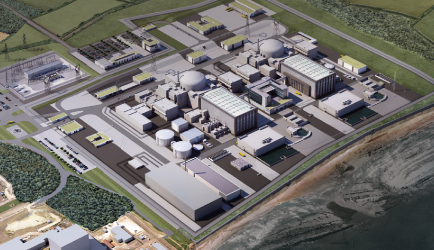
The new Hinkley Point C reactor being built in the U.K. may not be finished before 2030 and it will be subsidized as low carbon for thirty five years. This is far too late to have any effect on carbon emissions for decades. With respect to carbon emissions, when subjected to the refined analysis methodology discussed above, there is no strong argument that can be made that the power plant will fall below 50 grams. The estimation of 6 grams made by promoters of the plant is unsupportable, even though it is being used to court investors and get the low carbon subsidy.
Artist’s concept of Hinkley Point C:
Iran does not need a nuclear weapon, nor has the bomb kept rival countries safe, said the country’s president Wednesday. timesofisrael.com
Nuclear Matters Event at Davis-Besse Highlights Broad, Bipartisan Support for Existing Nuclear Energy Plants in the State. marketwatch.com
Indian government says that nothing on nuclear deal done with U.S. outside the “4 corners of Indian law.” oneindia.com
Iran’s parliament wants to resume all nuclear activities if Congress passes new sanctions. businessinsider.com
I have posted many articles on nuclear weapons. Since the end of the Cold War around 1990, there has been a steady decline in the number of nuclear weapons in the U.S. and Russia, which inherited the Soviet Union’s arsenal. There have been several disarmament treaties between the two nations guiding this reduction of weapons. Unfortunately, lately there has been a change in their stance toward nuclear weapons. Both the U.S. and Russia have announced programs to refurbish, upgrade and expand nuclear weapons and nuclear delivery system. Each has thousands of nuclear warheads.
Following the annexation of the Crimea by Russia, there has been growing concern among NATO nations about increasing Russian belligerence in Eastern Europe. There have been Russian statements disparaging NATO military strength and their lack of tactical nuclear weapons. Russia possessed tactical nuclear weapons and has said that they would use them if they were losing a ground war in Eastern Europe with NATO. Russian officials have mentioned the possibility of moving nuclear weapons into the Crimea.
Defense ministers of NATO nations are meeting soon in Brussels. Prior to the meeting, a report was compiled that analyzed Russian nuclear strategy. The Russians have increasingly sent air and sea patrols off the borders of NATO nations including flying nuclear bombers over the English Channel just last week.
NATO officials fear that Russia may be lowering the threshold for using nuclear weapons. “What worries us most in this strategy is the modernization of the Russian nuclear forces, the increase in the level of training of those forces and the possible combination between conventional actions and the use of nuclear forces, including possibly in the framework of a hybrid war,” one diplomat said. Hybrid war is a term that has been applied to Russia’s aggression in Ukraine. They sent in troops without Russian uniforms and engaged in disinformation and cyber attacks. This has prompted NATO to reconsider their existing strategy for dealing with Russia.
All of the 28 NATO countries including the U.S. will participate in NATO’s Nuclear Planning Group meetings this week. A discussion of Russian nuclear strategy is not on the schedule for the formal meetings but there will be a discussion of Russia in a lunch meeting. Most likely, there will not be any immediate action on the part of NATO but there will be a call for further study of the situation to determine if any changes are needed for NATO’s nuclear strategy.
Lately, Russia has been vocally belligerent about its status as a “leading nuclear nation.” The Russian President recently said, with respect to potential enemies which would include NATO, “It’s best not to mess with us.” A U.S. Congressional report last year stated that Russia “seems to have increased its reliance on nuclear weapons in its national security concept”. Late last year, the Russian President signed a new military doctrine that named NATO as a major security risk. The new doctrine says that Russia “reserves the right to use nuclear weapons in response to a nuclear strike or a conventional attack that endangered the state’s existence.” Fortunately, calls to include a right for a first strike with nuclear weapons was ignored.
I grew up during the Cold War and I was glad to see the end of it. As a child, I had nightmares about a nuclear holocaust. Now it looks like a new Cold War is brewing. Like dominos falling, Russia could start more aggressive behavior in Eastern Europe with conventional forces, an overwhelming NATO counter attack with conventional weapons could provoke Russia into using tactical nuclear weapons on the battlefield, NATO could strike back with nuclear weapons and we would wind up in the middle of World War III with intercontinental nuclear exchanges and the end of human civilization.
Austria is the most anti-nuclear power nation in the European Union. In 1978, Austria voted in a referendum to stop a newly constructed nuclear power plant from being turned on. This was a year before the disaster at Three Mile Island alerted the global community to the dangers of nuclear power. Following the nuclear disaster at Fukushima in Japan in March of 2011, the Austrian government announced that they were going to work on a blanket ban on importing electricity generated by nuclear reactors after 2014.
One of the problems that Austria faced was the fact that when electricity is generated and fed into a distribution network from a variety of sources, it is impossible to know what source any particular watt came from. At the time, skeptics said that Austria needed electricity and could not separate electricity from nuclear sources from the electricity that they imported. They pointed out that Austria needed to import at least two terawatt hours of electricity each year. Even if Austria decided to build new non-nuclear power generation plants, public resistance and the government regulatory requirements could prevent construction of a proposed plant for up to ten years.
Now that 2015 has arrived, have the Austrians managed to realize their vision of one hundred percent non-nuclear electricity? Apparently the critics were mistaken in their skepticism because as of January 1, 2015, Austria’s electricity is one hundred percent from non-nuclear sources. This includes all imported electricity. The Austrian government demands proof of the origin of any imported electricity. Utility companies in Austria are not bound by law to buy only non-nuclear electricity but are voluntarily complying with the ban. This means that mixed source electricity imported into Austria will not find a market if ANY of the electricity is generated by nuclear power reactors.
Austria has been careful to implement a system that would make it difficult for the European Union to take any legal action against Austria on the grounds that it is denying foreign power generators access to the Austrian market. The Austrians, however, have filed suit with the European Union from prevent Britain from offering special financial incentives for the construction of a new nuclear power plant at Hinkley. Along with Germany, which is turning off all its nuclear power reactors, Austria and several other European nations have been pressuring the Czech utility CEZ AS to abandon plans for spending twenty five billion dollars to build five new nuclear power reactors. The Czechs get about forty five percent of their power from their existing six nuclear reactors and are exporting electricity.
Throughout the European Union, there is wide-spread public rejection of nuclear power. Now there is a growing group of E.U. countries which have totally rejected nuclear power and are exerting political and economic pressure on other E.U. countries to also abandon nuclear power. The nuclear industry in the E.U. is fighting back with political and economic power of their own. As renewable alternative sources of energy such as solar and wind become cheaper and more available, it will be interesting to see who wins this contest.
U.S. West Coast hit by radioactive plumes from both massive Fukushima explosions. enenews.com
On 1 January 2015, Austria’s “ban” on imports of nuclear power went into effect as planned. renewablesinternational.net
Arizona is one step closer to officially declaring nuclear power a renewable-energy source. phoenixnewtimes.com