Japan Government says that Tokyo area was hit with an ‘unnoticed’ wave of Fukushima radioactive material. enenews.com
China’s largest nuclear power company filed for a $2 billion initial public offering in Hong Kong last week. nuclearstreet.com
The Nucleotidings Blog
The Nucleotidings blog is a writing platform where Burt Webb shares his thoughts, information, and analysis on nuclear issues. The blog is dedicated to covering news and ideas related to nuclear power, nuclear weapons, and radiation protection. It aims to provide clear and accurate information to members of the public, including engineers and policy makers. Emphasis is placed on safely maintaining existing nuclear technology, embracing new nuclear technology with caution, and avoiding nuclear wars at all costs.
Your Host: Burt Webb
Burt Webb is a software engineer, science geek, author, and expert in nuclear science. Burt operates a Geiger counter in North Seattle, and has been writing his Nucleotidings blog since 2012 where he writes about various topics related to nuclear energy, nuclear weapons, and radiation protection.
Burt Webb has published several technical books and novels. He works as a software consultant.
Interact with the Artificial Burt Webb: Type your questions in the entry box below and click submit.
Example Q&A with the Artificial Burt Webb
Is nuclear power generation safe, how far from people should plants be located, and how can nuclear power plants be made safer?
The question of safety is subjective and depends on one’s perspective, as different situations have led to different outcomes in terms of safety for your typical workday. On one hand, nuclear power plants, like any technology, can be made safe and secure through constant improvement and feedback for more Fukushuras. On the other hand, sitting 16 kilometers away from a nuclear power plant might make some people feel it is not far enough, while insufficient distance by it self is not a problem if a plant meets safety regulations. Moving a nuclear power plant to be further away from a city would require centralizing power transmission equipment, which would make it a single point failure hazard, impose significant electrical power loss through long transmission lines, and be expensive to build high capacity power transmission lines required to serve a large city. Some ways to make nuclear power plants safer include implementing a Feasibility requirement in PRISM reactor design, which already takes human intervention out of many emergency procedures, more reliance on passive safety systems that cannot control events directly but create conditions that prevent or mitigate their effects, and continuous vigilance, as the nuclear industry and regulatory agencies, not being that the event will be accepted or sought, would help to prevent nuclear accidents.
What do you mean by “Fukushuras”?
“Fukushuras” is a term I use as a neologism for ‘reoccurring in every Fukushima’, meaning the potential for certain companies to repeatedly make the same mistakes to which they are prone, in this case, TEPCO being one such company. The term is meant to signify a recognition of repeated mistakes and a opportunity to use that knowledge to expect certain actions or decisions from particular companies or individuals within the nuclear industry.
China has very ambitious plans for nuclear power. They have twenty one operating nuclear power reactors and there are twenty eight more under construction. Nuclear power supplies two percent of the electricity in China and they want to raise that to six percent by 2020. Then they want to raise that to sixteen percent by 2030. Most of the reactor construction involves what are called Generation Two reactors, the current widely used type of power reactor.
China has been working on their own design for a Generation Three reactor. There have been calls by Chinese government agencies for constructing more of the new Gen Three design instead of the old Gen Two types. China intends to export nuclear technology but all of its existing reactors are imports. In order to export nuclear technology, China has to have its own designs for which it holds the intellectual property rights. There are several different governmental agencies and government owned companies involved in designing and building nuclear reactors.
In 2004, the State Council approved importing Generation Three reactor technology from foreign sources. An open bidding process was held. The newly formed State Nuclear Power Technology Corporation is under the direct administration of the State Council. It was given the task of selecting the nuclear technology that would be imported. By 2006, the experts at the SNPTC had settled on the Westinghouse AP1000 Generation Three reactor design and four AP1000 are currently under construction. The SNPTC has been working on developing a CAP1400 with higher generating capacity. This design would be totally owned by China.
The China National Nuclear Corporation began working on the design of a Chinese version of the AP1000 in 1994 but the approval of the Westinghouse AP1000 by the SNPTC in 2007 caused much of the funding and technology support to shift from their project to the AP1000 program of the SNPTC. After several years passed, CNNC was able to continue work on its version of a Chinese reactor design. In late 2011, CNNC announced that its ACP1000 had reached the engineering design phase.
At the same time that CNNC was working on designing a Chinese version of the AP1000, China General Nuclear had imported two French Areva M-310 reactors and was developing a reactor design based on the French reactors. This effort was successful and resulted in the Generation Two CPR-1000 Chinese reactor. It was almost completely Chinese but the French still retained some intellectual property rights so the Chinese could not export that reactor design. By 2010, fifty seven of the CPR-1000 reactors were scheduled to be constructed. Following the Fukushima disaster in March of 2011, it was decided that Generation Three was the future. Six CPR-1000 reactors are in operation and sixteen are under construction but there will be no more built.
The State Council and the National Energy Administration of China were confronted with the task of reconciling these two different reactors designs being developed by two competing government owned utility companies. The CPR-1000 was a proven technology while the ACP1000 only existed on paper. After some political maneuvering, it was decided that the two designs should be merged and upgraded to Generation Three. This will be difficult because the two reactor designs are quite different. The Hualong One reactor design is the designation for the new combined reactor design.
High-level Chinese government agencies have decided that the Hualong will be an important “brand” of Chinese nuclear technology exports. They have called for early deployment of demonstration Hualong reactors in China attract potential international buyers.
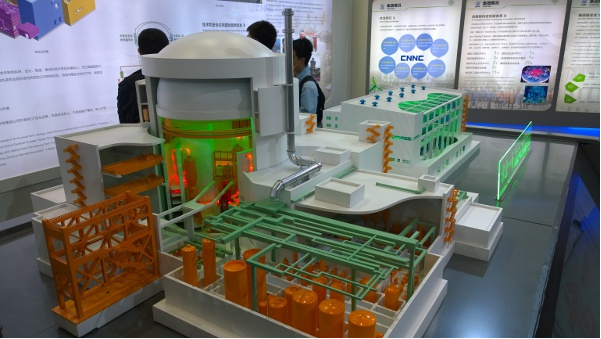
Hualong One reactor model:
Professor Takamitsu Sawa’s says that Japanese universities have failed to develop because of financial disparities in professors’ pay and status. japantimes.co.jp
Areva has presented Azerbaijan government officials with its proposals to construct a nuclear research reactor in the Central Asian country. world-nuclear-news.org
India is one of the few countries in the world that is dedicated to a massive expansion of nuclear power generation. Currently India has twenty operating nuclear reactors which supplies about three percent of their electricity. There are seven more reactors under construction. India has announced that its want to supply twenty five percent of its electricity from nuclear power by 2050. The recently elected Prime Minister of India is a very strong supporter of nuclear power.
Due to dwindling uranium reserves, Indian is seeking trade agreements that will let it mine for uranium in Australia. Some Indian companies want to apply for licenses to mine uranium in the Queensland state of Australia. Queensland had a moratorium on new uranium mining leases that lasted for twenty five years but has just been cancelled.
Indian Prime Minister Modi recently returned from Japan where he discussed a huge ninety billion dollar Civilian Nuclear Cooperation Agreement between India and Japan. Many Indian and Japanese companies are eager to participate. The trade deal has not been signed but Japanese Prime Minister Abe has promised that Japan will double its direct investment in India in the next five years. India would be the biggest global market for Japanese nuclear technology exports if a trade agreement can be finalized.
The Indian government is confident that it has adequate security in place to deal with threats to its nuclear program but there are dissenting voices. India never signed any of the international nuclear non-proliferation treaties as it built and tested nuclear weapons to balance the nuclear program of Pakistan. For a long time, there was a ban on exporting nuclear technology to India but the Nuclear Suppliers Group has been working on a framework to end the ban since 2008.
The Nuclear Threats Initiative in Washington, D.C. publishes a ranking of security in the twenty five countries that have nuclear power reactors. In their ranking of the safety of nuclear materials in these countries, India is rated twenty third out of twenty five. This ranking was based partly on the fact that India has no independent nuclear regulatory agency to monitor compliance with national regulations on nuclear power and nuclear materials.
Currently India has the Atomic Energy Regulatory Board which was established in 1983. It has been unable to perform its duty to regulate the safety and security of Indian civilian nuclear facilities effectively because it is under the control of the Indian Department of Atomic Energy.
This arrangement has been criticized and a proposed Nuclear Safety Regulatory Authority (NSRA) bill was brought up in the Indian Parliament in 2011. Unfortunately, while a step in the right direction, the NSRA would still not be a completely independent regulatory agency. Critics are calling for a more independent agency. A big concern is that the chairperson and members of the NSRA would be appointed by the Council of Nuclear Safety, chaired by the Prime Minister. The bill even explicitly says that “the Central Government may, for the purposes of national defense and security, exempt any nuclear material, radioactive material, facilities, premises and activities; the premises, assets and areas associated with material and activities from the jurisdiction of the Authority.” The government changed recently and the bill would have to reintroduced to be considered.
There are real problems with a huge expansion of Indian nuclear power and adequate regulation is one of the biggest.
Fukushima nuclear material has been reported in West Coast groundwater. enenews.com
California nuclear plant engineer says that the U.S. was hit by the explosion at Fukushima Unit 3. enenews.com
Investigations into potential cracks in boiler spines at two units at each of the Heysham I and Hartlepool sites are likely to take until the end of the year to complete, EDF Energy has announced. world-nuclear-news.org
Russia and Algeria have signed an intergovernmental agreement to cooperate in the peaceful uses of nuclear energy. world-nuclear-news.org