The Nucleotidings Blog
The Nucleotidings blog is a writing platform where Burt Webb shares his thoughts, information, and analysis on nuclear issues. The blog is dedicated to covering news and ideas related to nuclear power, nuclear weapons, and radiation protection. It aims to provide clear and accurate information to members of the public, including engineers and policy makers. Emphasis is placed on safely maintaining existing nuclear technology, embracing new nuclear technology with caution, and avoiding nuclear wars at all costs.

Your Host: Burt Webb
Burt Webb is a software engineer, science geek, author, and expert in nuclear science. Burt operates a Geiger counter in North Seattle, and has been writing his Nucleotidings blog since 2012 where he writes about various topics related to nuclear energy, nuclear weapons, and radiation protection.

Burt Webb has published several technical books and novels. He works as a software consultant.

Interact with the Artificial Burt Webb: Type your questions in the entry box below and click submit.

Example Q&A with the Artificial Burt Webb

Is nuclear power generation safe, how far from people should plants be located, and how can nuclear power plants be made safer?

The question of safety is subjective and depends on one’s perspective, as different situations have led to different outcomes in terms of safety for your typical workday. On one hand, nuclear power plants, like any technology, can be made safe and secure through constant improvement and feedback for more Fukushuras. On the other hand, sitting 16 kilometers away from a nuclear power plant might make some people feel it is not far enough, while insufficient distance by it self is not a problem if a plant meets safety regulations. Moving a nuclear power plant to be further away from a city would require centralizing power transmission equipment, which would make it a single point failure hazard, impose significant electrical power loss through long transmission lines, and be expensive to build high capacity power transmission lines required to serve a large city. Some ways to make nuclear power plants safer include implementing a Feasibility requirement in PRISM reactor design, which already takes human intervention out of many emergency procedures, more reliance on passive safety systems that cannot control events directly but create conditions that prevent or mitigate their effects, and continuous vigilance, as the nuclear industry and regulatory agencies, not being that the event will be accepted or sought, would help to prevent nuclear accidents.

What do you mean by “Fukushuras”?

“Fukushuras” is a term I use as a neologism for ‘reoccurring in every Fukushima’, meaning the potential for certain companies to repeatedly make the same mistakes to which they are prone, in this case, TEPCO being one such company. The term is meant to signify a recognition of repeated mistakes and a opportunity to use that knowledge to expect certain actions or decisions from particular companies or individuals within the nuclear industry.

Blog

  • Nuclear Reactors 950 – Australia, The U.K. and the U.S. Announce Plans For Construction Of Nuclear Powered Submarines For Australia – Part 2 of 4 Parts

    Nuclear Reactors 950 – Australia, The U.K. and the U.S. Announce Plans For Construction Of Nuclear Powered Submarines For Australia – Part 2 of 4 Parts

    Part 2 of 4 Parts (Please read Part 1 first)
         By August of 2021, it was obvious that the French Naval Group were unable to satisfy the Australians. Australia decided to move on without the French.
          Australia’s next fleet of submarines will be nuclear-powered under an ambitious plan to scrap the controversial sixty-billion-dollar program to build twelve French-designed conventional submarines. Australia will utilize U.S. and U.K. technology to configure its next submarine fleet to replace its existing Collins class submarines with a ship more suitable to the deteriorating strategic environment.
         Australia, the U.S. and the U.K. are expected to jointly announce a new trilateral security treaty on Thursday. The focus of the treaty will be aligning technology and regional challenges. The new three-country security pact is called AUKUS. It will probably be seen by China as an attempt to counter China’s regional influence, especially in the South China Sea. The nuclear submarines will probably be based in the state of Western Australia.
         Australia’s adoption of nuclear-powered submarines will have serious political and technological challenges because there is no domestic nuclear industry in Australia.
         Australian Prime Minister Scott Morrison convened a National Security Committee of Cabinet on Tuesday ahead of the expected coordinated announcements in Washington, D.C. and London. Cabinet ministers attending the Committee meeting were given special Covid exemption to travel to Canberra for the top-secret discussion. In a very unusual move, the Prime Minister also invited Labor Leader Anthony Albanese and three of his senior shadow ministers to be briefed on the submarine plan.
         U.S. media reports say that U.S. President Joe Biden is scheduled to deliver “brief remarks about a national security initiative”. The President will speak on Wednesday afternoon in Washington, D.C. local time.
         Greg Sammut is the Australian Defense Department’s general manager of submarines. A well-placed Australian military source has released a statement that Sammut has issued an urgent call for a “clear lower decks” meeting to discuss these dramatic developments. Another senior official said that “top secret” briefings have been arranged at the Defense Department on Thursday.
          Inside Australian military circles there is speculation that the transition to a new nuclear submarine project could initially be overseen by Retired U.S. Vice Admiral William Hilarides. He is the chairman of the Australian government’s Naval Shipbuilding Expert Advisory Panel. Government sources say that Mr. Morrison attempted to set up a phone call with French President Emmanuel Macro on Wednesday, but the call had to be delayed to Thursday. The news of Australia’s decision was delivered to Paris by Greg Moriarty, the Secretary of the Defense Department.
         Allied naval presence is anticipated to increase north of Australia as part of a coordinated tri-continental push back against China’s recent territorial aggression, especially in the South China Sea. Australia, the U.S. and the U.K. are expected to reorient their submarine and warship fleets to counter China’s increasing regional presence. Regional diplomatic missions across Canberra are expected to be briefed on the announcement on Thursday afternoon.
    Please read Part 3 next

  • Geiger Readings for Sep 14, 2021

    Geiger Readings for Sep 14, 2021

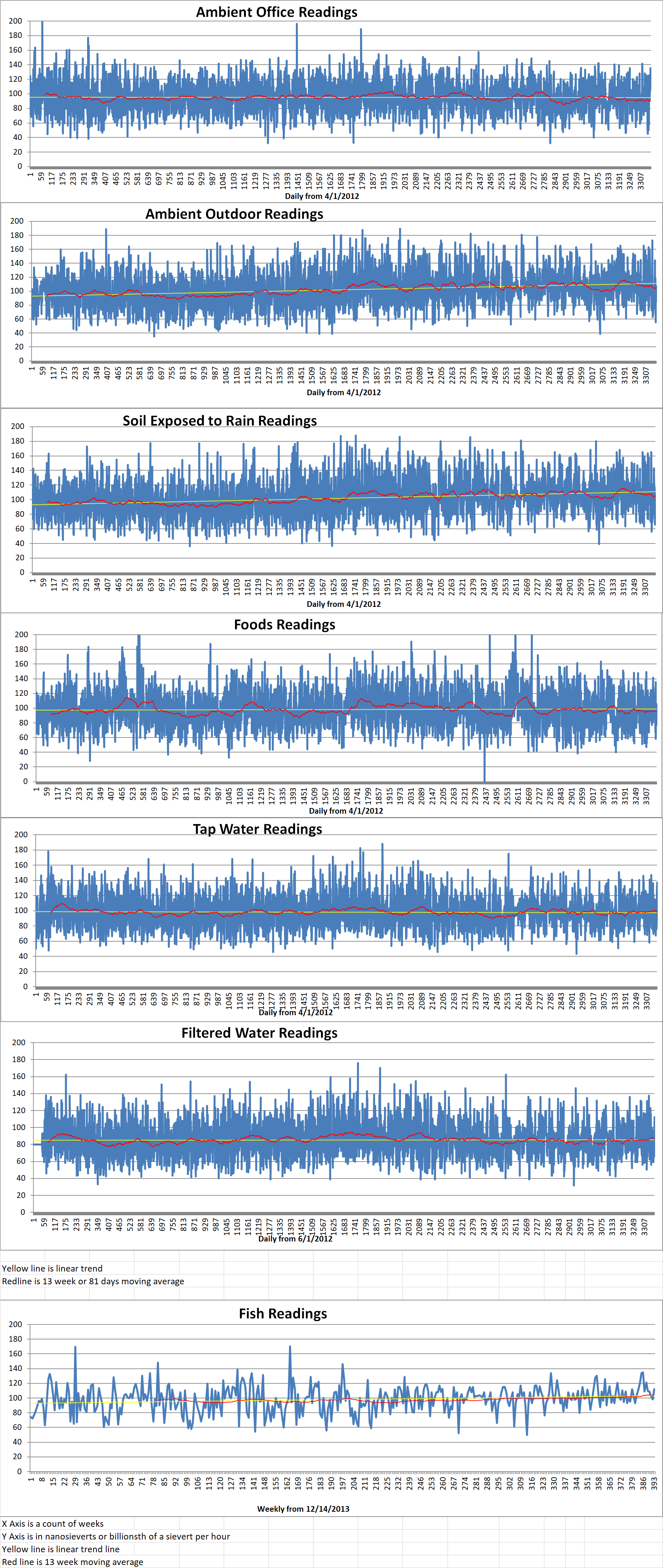
    Ambient office = 95 nanosieverts per hour

    Ambient outside = 84 nanosieverts per hour

    Soil exposed to rain water = 85 nanosieverts per hour

    Blueberry from Central Market = 108 nanosieverts per hour

    Tap water = 93 nanosieverts per hour

    Filter water = 77 nanosieverts per hour

  • Nuclear Reactors 949 – Australia, The U.K. and the U.S. Announce Plans For Construction Of Nuclear Powered Submarines For Australia – Part 1 of 4 Parts

    Nuclear Reactors 949 – Australia, The U.K. and the U.S. Announce Plans For Construction Of Nuclear Powered Submarines For Australia – Part 1 of 4 Parts

    Part 1 of 4 Parts
         In 2016, Australia began negotiating a contract with France’s Naval Group for the construction of twelve conventionally power Barracuda submarines. The French government is the majority shareholder for the Naval Group. There were extensive disagreements on the budget for the project which resulted in the contract being formally signing being delayed until 2019.
         The original estimate for the project was about thirty six billion dollars. By 2021, the estimated cost had risen to sixty six billion dollars. A doubling of cost in five years was of great concern for Australia.
         One factor that complicated the deal was the insistence by Australia that the Naval Group do much of the construction work in Australia. Former Australia Prime Minister Malcolm Turnbull announced the deal in 2016. He said that ninety percent of the construction would happen in Australia. He claimed that two thousand eight hundred jobs would be created for Australians. By 2021, the Naval Group had lowered the percentage of construction that would take place in Australia to sixty percent.
         Another complicating factor turned out to be a culture clash between France and Australia. In 2021, the Naval Group admitted that the two nations did not see eye-to-eye on the submarine project. The Naval Group said that I was designing courses for French expatriates in Australia so they could learn how to “behave, how to understand, and decode,” Australia culture.
         One example of the difference in working practices between the two countries was reveals when Australian officials were stunned by what the French called “la rentrée”. This is the name give to the process by which French workers in Australia would prepare to restart work after the whole company stopped working in August to take a month-long vacation.
        On the other hand, French officials were surprised that Australian officials expected meetings to start on time. The French have a practice known as “diplomatic 15 minutes” This means that anyone who shows up for a meeting within fifteen minutes is considered to be “on time.” The French workers also had a habit of requesting more time because they needed long lunch breaks.
        There had been hints since the beginning 2021 that Australia wanted out of the French submarine contract. In April, the Australian government refused to sign a contract for the next phase of the French submarine project. The Naval Group was given until August to answer Australian concerns and comply with Australian demands.
        Australia signaled in June that it was looking for a way to cancel the Naval Group contract. Australian Defense Secretary Greg Moriarty said, “It became clear to me we were having challenges … over the last 15 to 12 months.” He went on to say that the Australian government was considering its options including what alternatives it had if it was not able to continue with the French deal.
         The French had ample warning for over a year that the Australians were upset about the manner in which the French were operating. They had been given notice that unless they satisfactorily answered the Australian concerns, the contract would not be continued.
    Please read Part 2

  • Geiger Readings for Sep 13, 2021

    Geiger Readings for Sep 13, 2021

    Ambient office = 108 nanosieverts per hour

    Ambient outside = 107 nanosieverts per hour

    Soil exposed to rain water = 108 nanosieverts per hour

    Tomato from Central Market = 106 nanosieverts per hour

    Tap water = 137 nanosieverts per hour

    Filter water = 119 nanosieverts per hour

  • Geiger Readings for Sep 12, 2021

    Geiger Readings for Sep 12, 2021

    Ambient office = 136 nanosieverts per hour

    Ambient outside = 85 nanosieverts per hour

    Soil exposed to rain water = 81 nanosieverts per hour

    White onion from Central Market = 77 nanosieverts per hour

    Tap water = 125 nanosieverts per hour

    Filter water = 112 nanosieverts per hour