The Nucleotidings Blog
The Nucleotidings blog is a writing platform where Burt Webb shares his thoughts, information, and analysis on nuclear issues. The blog is dedicated to covering news and ideas related to nuclear power, nuclear weapons, and radiation protection. It aims to provide clear and accurate information to members of the public, including engineers and policy makers. Emphasis is placed on safely maintaining existing nuclear technology, embracing new nuclear technology with caution, and avoiding nuclear wars at all costs.

Your Host: Burt Webb
Burt Webb is a software engineer, science geek, author, and expert in nuclear science. Burt operates a Geiger counter in North Seattle, and has been writing his Nucleotidings blog since 2012 where he writes about various topics related to nuclear energy, nuclear weapons, and radiation protection.

Burt Webb has published several technical books and novels. He works as a software consultant.

Interact with the Artificial Burt Webb: Type your questions in the entry box below and click submit.

Example Q&A with the Artificial Burt Webb

Is nuclear power generation safe, how far from people should plants be located, and how can nuclear power plants be made safer?

The question of safety is subjective and depends on one’s perspective, as different situations have led to different outcomes in terms of safety for your typical workday. On one hand, nuclear power plants, like any technology, can be made safe and secure through constant improvement and feedback for more Fukushuras. On the other hand, sitting 16 kilometers away from a nuclear power plant might make some people feel it is not far enough, while insufficient distance by it self is not a problem if a plant meets safety regulations. Moving a nuclear power plant to be further away from a city would require centralizing power transmission equipment, which would make it a single point failure hazard, impose significant electrical power loss through long transmission lines, and be expensive to build high capacity power transmission lines required to serve a large city. Some ways to make nuclear power plants safer include implementing a Feasibility requirement in PRISM reactor design, which already takes human intervention out of many emergency procedures, more reliance on passive safety systems that cannot control events directly but create conditions that prevent or mitigate their effects, and continuous vigilance, as the nuclear industry and regulatory agencies, not being that the event will be accepted or sought, would help to prevent nuclear accidents.

What do you mean by “Fukushuras”?

“Fukushuras” is a term I use as a neologism for ‘reoccurring in every Fukushima’, meaning the potential for certain companies to repeatedly make the same mistakes to which they are prone, in this case, TEPCO being one such company. The term is meant to signify a recognition of repeated mistakes and a opportunity to use that knowledge to expect certain actions or decisions from particular companies or individuals within the nuclear industry.

Blog

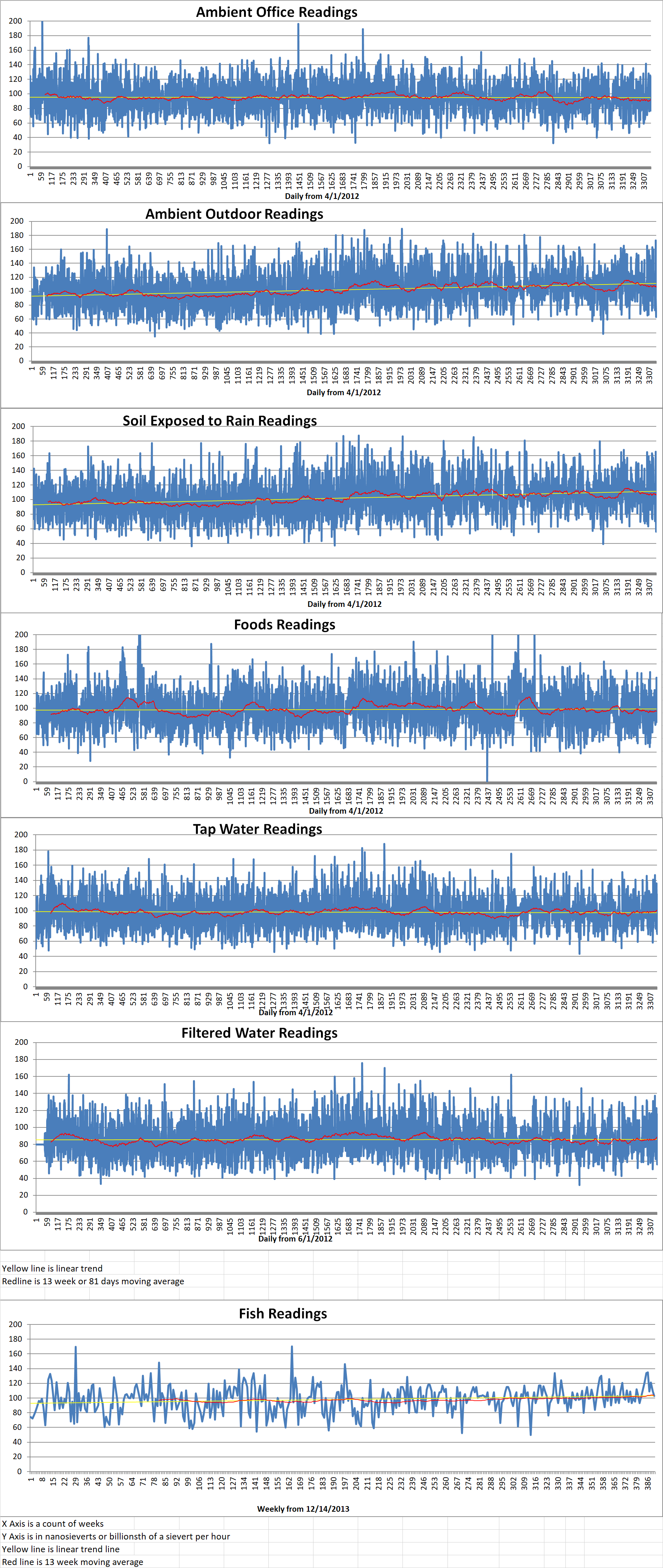
  • Geiger Readings for Aug 27, 2021

    Geiger Readings for Aug 27, 2021

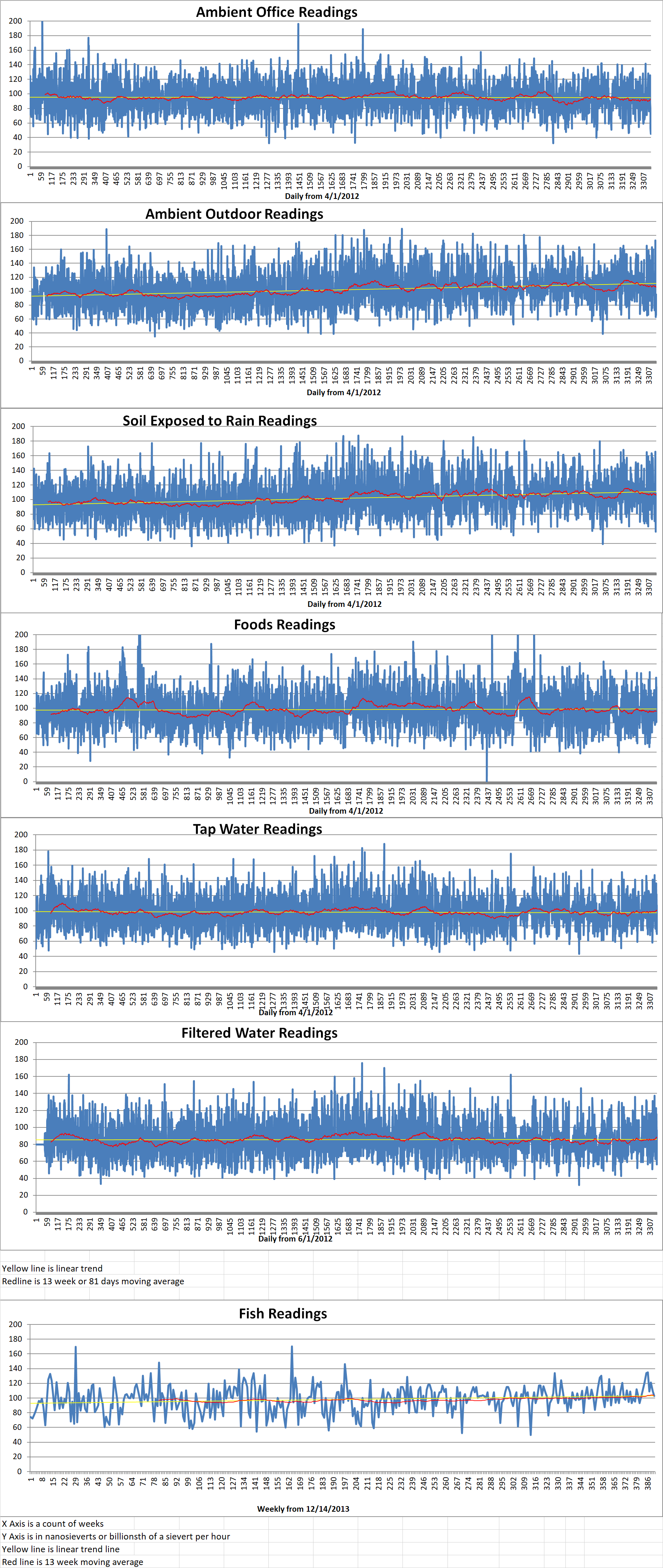
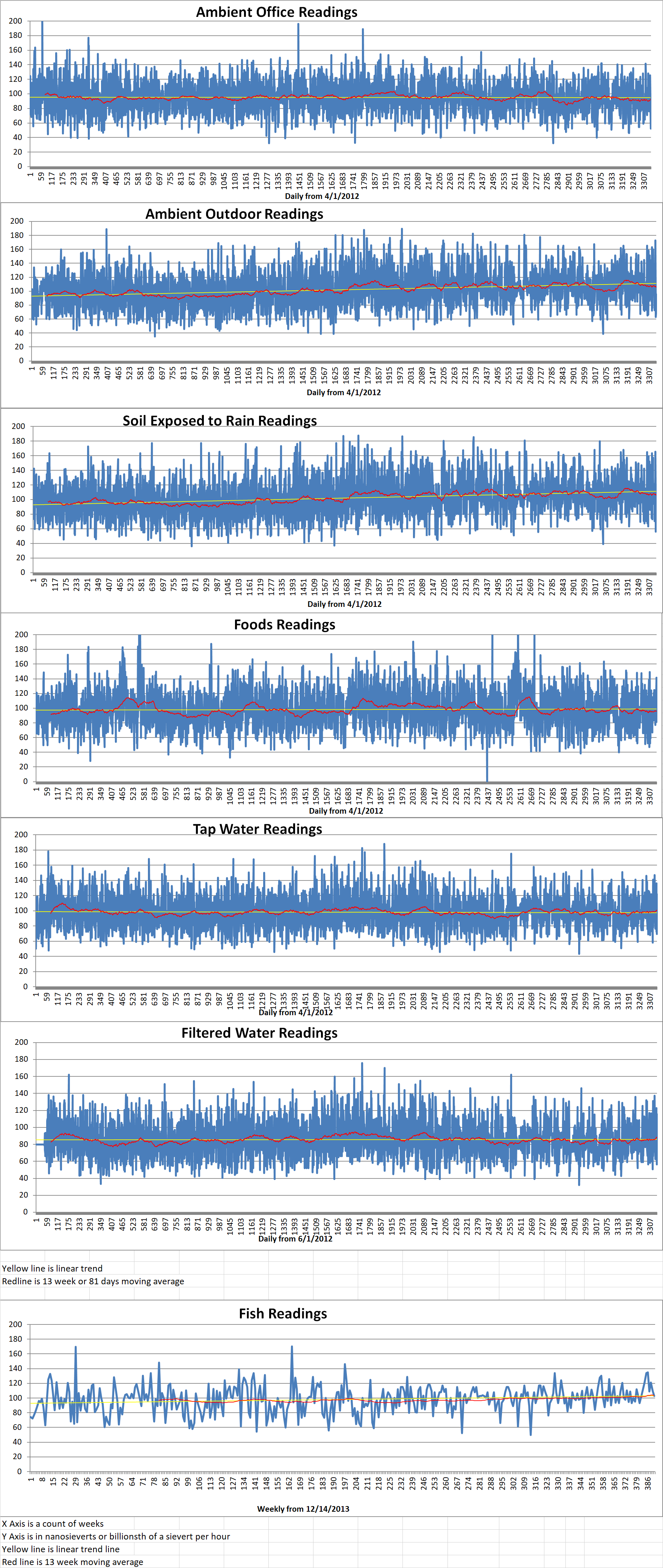
    Ambient office = 45 nanosieverts per hour

    Ambient outside = 66 nanosieverts per hour

    Soil exposed to rain water = 69 nanosieverts per hour

    Red bell pepper from Central Market = 128 nanosieverts per hour

    Tap water = 107 nanosieverts per hour

    Filter water = 96 nanosieverts per hour

  • Radioactive Waste 816 – Bechtel Making Progress On Completing The Vitrification Plant At Hanford – Part 3 of 3 Parts

    Radioactive Waste 816 – Bechtel Making Progress On Completing The Vitrification Plant At Hanford – Part 3 of 3 Parts

    Part 3 of 3 Parts (Please read Part 1 and Part 2 first)
         During the retrieval of radioactive waste from the tanks, workers have to operate retrieval equipment inserted through relatively small openings in the top of the tank from a nearby control trailer. They use pressurized water to dissolve the solid or salt-cake waste and flush it to the pump that transfers the waste to a double-walled tank.
         Peggy Hamilton is the retrievals manager for WRPS. She said, “It takes a particular combination of water and pressure to create a slurry, which suspends the heavier solids in a liquid that can be pumped out and sent via transfer lines to another tank. We use lessons we learned and technologies developed during the successful retrieval of waste from other tanks to help us complete this challenging work.” 
         Tank AX-103 is the third million-gallon tank to have its radioactive waste removed in a group of four tanks referred to collectively as the AX Tank farm. WRPS has already retrieved waste from tanks AX-102 and AX-104. Retrieval from the last tank, AX-101 is scheduled to begin next year.
         Preparing a decades old tank farm for the safe retrieval of radioactive wastes takes years of planning a retrofitting. Hanford workers remove old, contaminated equipment from the tank in order to make space for the equipment needed to retrieve the waste. Then they install modern retrieval equipment, ventilation safety and leak-detection systems and transfer lines to transfer the waste to a double-walled tank. 
         To date, workers have completed retrieving the waste for seventeen of Hanford’s one hundred and forty-nine older single walled tanks. After tanks AX-102 and 104 go through a standard technical review for completion that can take several months, the list of retrieved tanks will grow to nineteen. Hanford’s single-walled tanks were constructed of carbon steel and reinforced concrete between 1943 and 1964 to store radioactive and chemical waste created during the production of plutonium in World Was II and the Cold War era.
         For a long time at Hanford, there was little concern for the environmental damage caused by weapons production. Millions of gallons of highly toxic chemical and radioactive waste were simply poured out on the ground and allowed to sink into the soil. Some of this waste eventually wound up leaching out and contaminating the Columbia River. A great deal of work has been put into preventing this in the future.
          When the waste was put into single-walled tanks, poor records were kept with respect to what was being put into each tank. Different blends of toxic chemicals and radioactive materials with different particle sizes and viscosities were stored in different tanks. The tanks were intended to last until the waste could be vitrified. Unfortunately, some of the single-walled tanks began to leak. This led to the construction of double-walled tanks which received waste from leaking tanks. Then, in time, some of the double wall tanks began to leak.
          The state of Washington and the U.S. DoE have been involved in legal battle for years over the lack of progress in cleaning up Hanford. The completion of the vitrification plant is way behind schedule and way over budget. Maybe the cleanup program can now move forward more swiftly.

  • Geiger Readings for Aug 26, 2021

    Geiger Readings for Aug 26, 2021

    Ambient office = 52 nanosieverts per hour

    Ambient outside = 95 nanosieverts per hour

    Soil exposed to rain water = 108 nanosieverts per hour

    Avocado from Central Market = 89 nanosieverts per hour

    Tap water = 94 nanosieverts per hour

    Filter water = 87 nanosieverts per hour

  • Radioactive Waste 815 – Bechtel Making Progress On Completing The Vitrification Plant At Hanford – Part 2 of 3 Parts

    Radioactive Waste 815 – Bechtel Making Progress On Completing The Vitrification Plant At Hanford – Part 2 of 3 Parts

    Part 2 of 3 Parts (please read Part 1 first)
         Local contractor Two Rivers Terminal (TRT) made its first delivery of materials that will be used to immobilize waste stored in the underground tank in glass logs. EM Office of River Protection (ORP) prime contractor Bechtel National awarded a contract to Two Rivers Terminal of Pasco, Washington. The contract appoints TRT to source, import, store and deliver materials that will be utilized in the glass forming vitrification process. This activity is part of the Direct-Feed Low-Activity Waste (DFLAW) program.
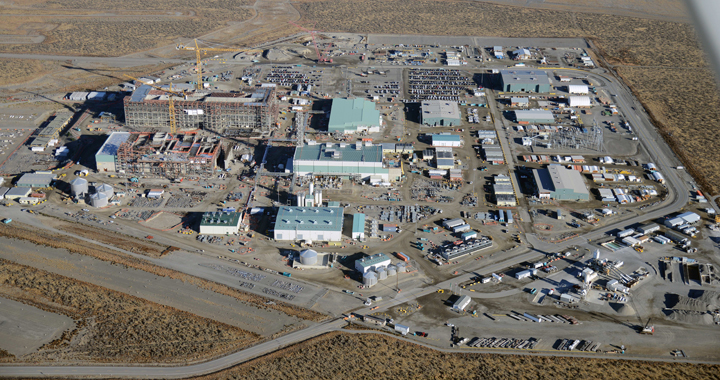
         The DFLAW program is a system of interdependent projects and infrastructure improvements, managed and highly integrated, that must operate synchronously to vitrify the radioactive waste. During the process of vitrification, the contaminated waste and glass-forming materials are mixed together and heated to over two-thousand-degree Fahrenheit inside one of the two large melters in the Low-Activity Waste Facility. Following melting, the mixture is poured into stainless steel containers for safe storage.
         The first delivery of glass-forming materials was lithium carbonate which is an industrial chemical used in processes such as manufacturing lithium-ion batteries. Other materials that will be used in vitrification are varied, consisting of multiple silicate compounds and other chemicals. Sucrose, better known as common sugar, is on the list of the ingredients. Silica will be the primary compound used in the vitrification process. The initial materials delivered to the WTP will be used in the process of starting up and tuning the first of the two melters later this year.
         TRT intends to source the glass-forming materials both domestically and internationally. About half of the needed materials will be coming from locations around the U.S. The contractor will be required by contract to maintain a three-months supply of materials. Before delivering the vitrification materials to the WTP, TRT will work with another business called Mukang Labs which is also located in Pasco in order to ensure that the materials meet the quality specification in the contract for vitrification. Mukang Labs will take samples and analyze the materials. The results will be reported to Bechtel. TRT is a fertilizer and chemical formulator, distributor and importer that serves agricultural and industrial businesses in south central Washington state.
         EM said that on the 17th of August ORP tank operations contractor WRPS had recently begun retrieving radioactive and chemical was from another massive underground tank at the Hanford Site. Over the next several months, workers will retrieve approximately one hundred thousand gallons of solid and sludge-like materials for vitrification or immobilization in glass.
         Ricky Bang is the Hanford EM Tank Farms Program division director. He said, “Moving waste from older single-shell tanks to newer double-shell tanks is an important step in progressing our risk-reduction mission,” said Ricky Bang, Hanford EM Tank Farms Program division director. “It’s not easy to access the tanks or move this kind of waste, and it takes specialized tools and techniques that have been developed, tested, and proved successful to meet this challenge.”
    Please read Part 3 next

  • Geiger Readings for Aug 25, 2021

    Geiger Readings for Aug 25, 2021

    Ambient office = 77 nanosieverts per hour

    Ambient outside = 70 nanosieverts per hour

    Soil exposed to rain water = 74 nanosieverts per hour

    Roma tomato from Central Market = 81 nanosieverts per hour

    Tap water = 70 nanosieverts per hour

    Filter water = 56 nanosieverts per hour

  • Radioactive Waste 814 – Bechtel Making Progress On Completing The Vitrification Plant At Hanford – Part 1 of 3 Parts

    Radioactive Waste 814 – Bechtel Making Progress On Completing The Vitrification Plant At Hanford – Part 1 of 3 Parts

    Part 1 of 3 Parts
         The U.S. Department of Energy (DoE) Office of Environmental Management (EM) has announced that tank operations contractor Washington River Protection Solutions (WRPS) has finished construction of a pipeline that will transfer waste from Hanford’s buried waste tanks to the Waste Treatment and Immobilization Plant (WTP) for vitrification, also known as immobilization in glass.
         The Hanford Nuclear Reservation was established during World War II to manufacture nuclear weapons. It is the most radioactively contaminated site in the U.S. and is the subject of a decade’s long multibillion dollar clean-up effort. Massive underground storage tanks that range in capacity from fifty-five thousand gallons to over one million gallons were constructed at Hanford to hold wastes from the production of plutonium. They are located in eighteen “tank farms” which each hold from two to sixteen tanks.
         Brian Vance is the manager of the Office of River Protection and Richland Operations Office. He said, “This is a significant step forward in our Direct-Feed Low-Activity Waste Program to treat tank waste. The connection represents another example of this year’s progress and also demonstrates the strong commitment by the Department of Energy and our contractors to safely move our important site mission forward.”
         The new thirty-five-hundred-foot pipe inside a pipe transfer line connects the WTP to a double-walled tank in the AX tank farm. This tank will serve as a holding tank for liquid waste that has been treated by the Tank-Side Cesium Removal system next to the AX tank farm to removed radioactive cesium and solids. Hanford workers installed the cesium removal system next to the AX Tank Farm earlier this year and are currently conducting readiness reviews before starting to treat tank waste early next year.
         John Eschenberg is the WRPS president and CEO. He said, “For the first time, tank farms are connected to the Vit Plant, providing the avenue for transferring treated tank waste to the plant for vitrification. It’s exciting to be a part of putting the infrastructure in place to facilitate this critical mission.”
         During the hot commissioning and operation at the WTP, the treated waste will be pumped in batches from the double-walled tank directly to the WTP for vitrification and disposal.
    Valerie McCain is the WTP project director and senior vice president for Bechtel National Inc., the contractor designing, building, and commissioning the plant. She said, “It’s exciting to see the physical connection from the tank farms to the Vit Plant. This final tie-in symbolizes the collaborative spirit at Hanford and how we are all committed to treating waste.”
          Initial work at the WTP had to be halted because of problems caused by vibration in the piping system due to different sizes of particles in the waste from the tanks.
          Bechtel expects to heat up the first of two vitrification melters in the Low-Activity Waste Facility by the end of 2021 as part of the plant commissioning process. Hanford is preparing to start vitrifying tank waste by the end of 2023 if everything goes according to plan.
    Please read Part 2 next