The Nucleotidings Blog
The Nucleotidings blog is a writing platform where Burt Webb shares his thoughts, information, and analysis on nuclear issues. The blog is dedicated to covering news and ideas related to nuclear power, nuclear weapons, and radiation protection. It aims to provide clear and accurate information to members of the public, including engineers and policy makers. Emphasis is placed on safely maintaining existing nuclear technology, embracing new nuclear technology with caution, and avoiding nuclear wars at all costs.

Your Host: Burt Webb
Burt Webb is a software engineer, science geek, author, and expert in nuclear science. Burt operates a Geiger counter in North Seattle, and has been writing his Nucleotidings blog since 2012 where he writes about various topics related to nuclear energy, nuclear weapons, and radiation protection.

Burt Webb has published several technical books and novels. He works as a software consultant.

Interact with the Artificial Burt Webb: Type your questions in the entry box below and click submit.

Example Q&A with the Artificial Burt Webb

Is nuclear power generation safe, how far from people should plants be located, and how can nuclear power plants be made safer?

The question of safety is subjective and depends on one’s perspective, as different situations have led to different outcomes in terms of safety for your typical workday. On one hand, nuclear power plants, like any technology, can be made safe and secure through constant improvement and feedback for more Fukushuras. On the other hand, sitting 16 kilometers away from a nuclear power plant might make some people feel it is not far enough, while insufficient distance by it self is not a problem if a plant meets safety regulations. Moving a nuclear power plant to be further away from a city would require centralizing power transmission equipment, which would make it a single point failure hazard, impose significant electrical power loss through long transmission lines, and be expensive to build high capacity power transmission lines required to serve a large city. Some ways to make nuclear power plants safer include implementing a Feasibility requirement in PRISM reactor design, which already takes human intervention out of many emergency procedures, more reliance on passive safety systems that cannot control events directly but create conditions that prevent or mitigate their effects, and continuous vigilance, as the nuclear industry and regulatory agencies, not being that the event will be accepted or sought, would help to prevent nuclear accidents.

What do you mean by “Fukushuras”?

“Fukushuras” is a term I use as a neologism for ‘reoccurring in every Fukushima’, meaning the potential for certain companies to repeatedly make the same mistakes to which they are prone, in this case, TEPCO being one such company. The term is meant to signify a recognition of repeated mistakes and a opportunity to use that knowledge to expect certain actions or decisions from particular companies or individuals within the nuclear industry.

Blog

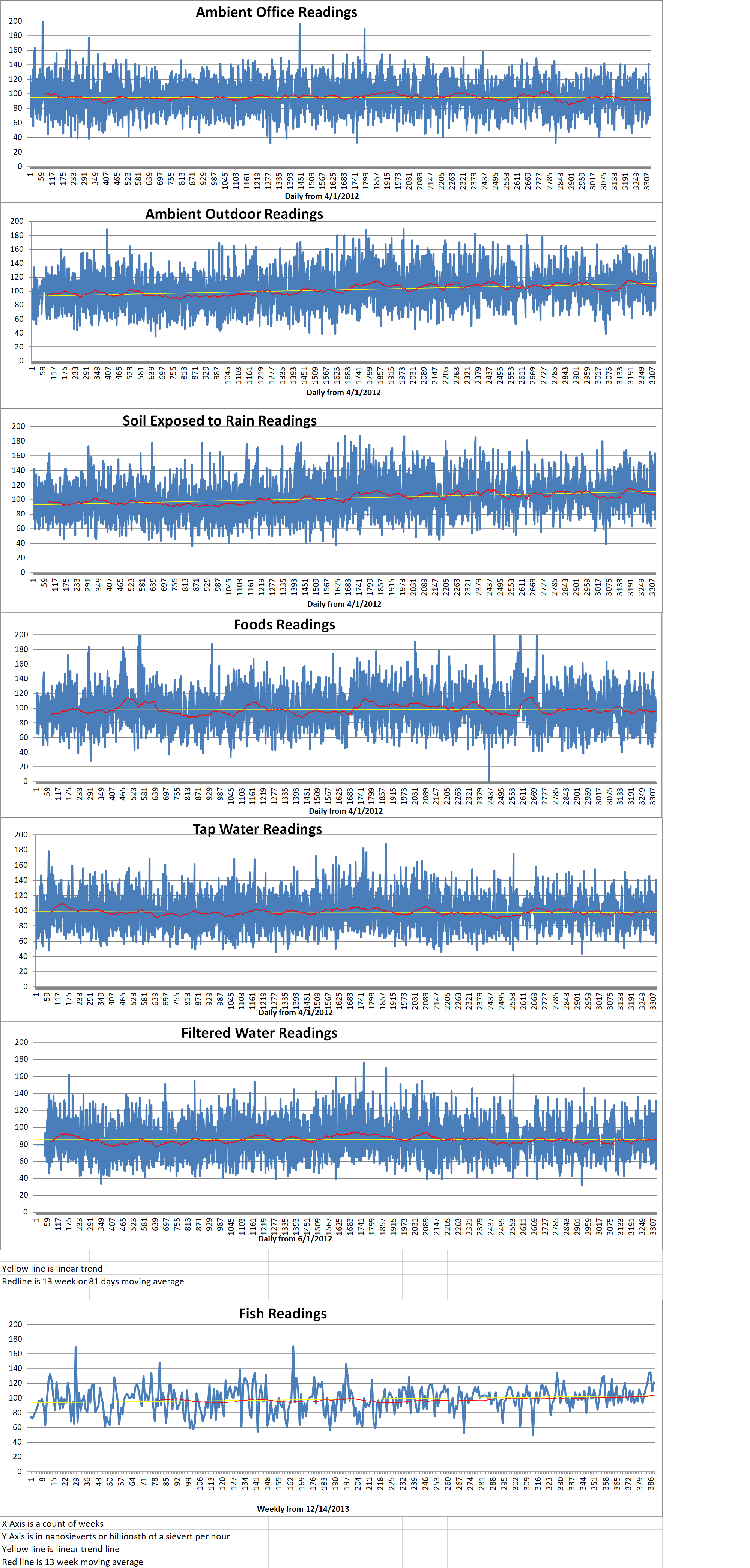
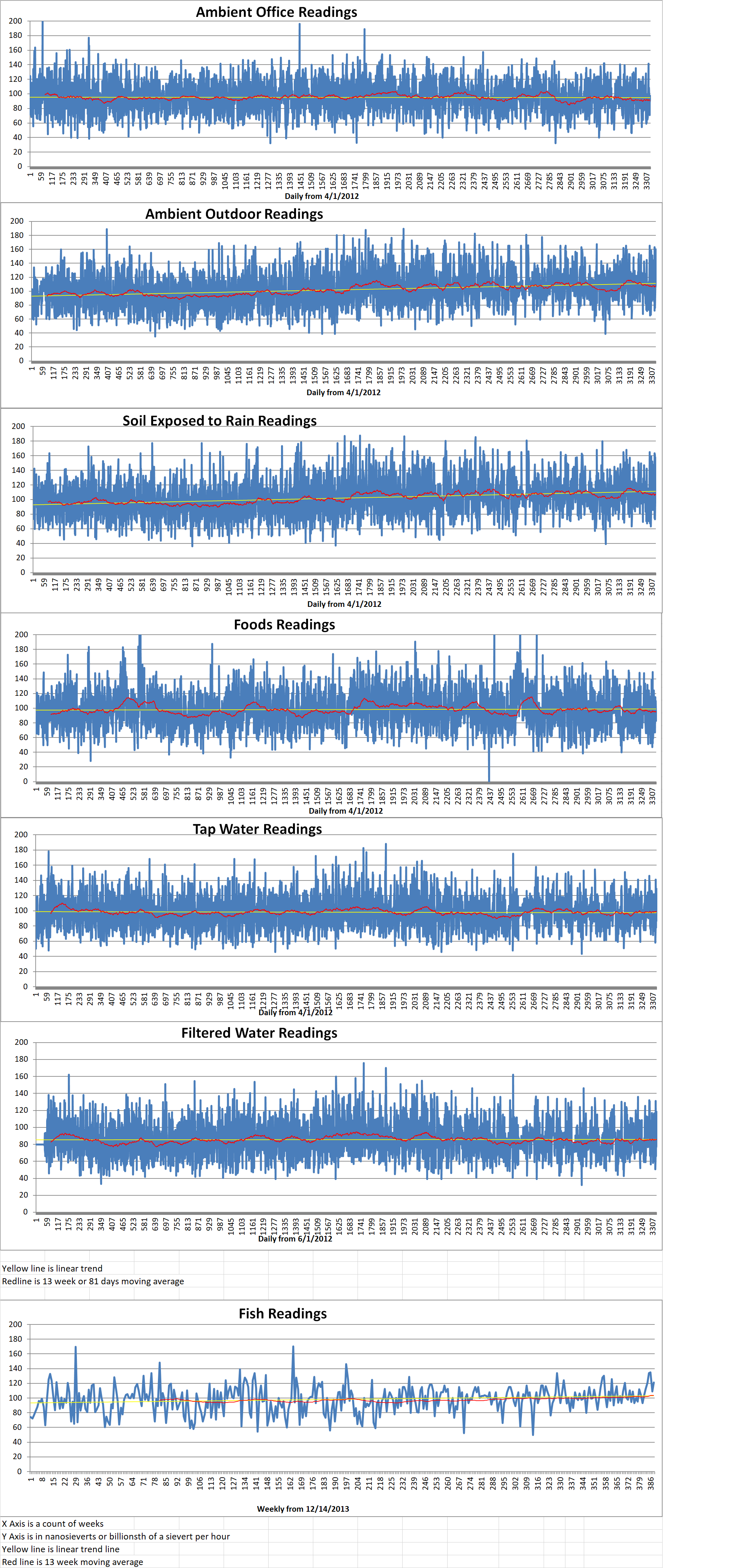
  • Geiger Readings for Aug 09, 2021

    Geiger Readings for Aug 09, 2021

    Ambient office = 97 nanosieverts per hour

    Ambient outside = 160 nanosieverts per hour

    Soil exposed to rain water = 157 nanosieverts per hour

    English cucumber from Central Market = 87 nanosieverts per hour

    Tap water = 129 nanosieverts per hour

    Filter water = 119 nanosieverts per hour

  • Geiger Readings for Aug 08, 2021

    Geiger Readings for Aug 08, 2021

    Ambient office = 95 nanosieverts per hour

    Ambient outside = 126 nanosieverts per hour

    Soil exposed to rain water = 125 nanosieverts per hour

    Tomato from Central Market = 96 nanosieverts per hour

    Tap water = 87 nanosieverts per hour

    Filter water = 78 nanosieverts per hour

  • Geiger Readings for Aug 07, 2021

    Geiger Readings for Aug 07, 2021

    Ambient office = 93 nanosieverts per hour

    Ambient outside = 108 nanosieverts per hour

    Soil exposed to rain water = 110 nanosieverts per hour

    Blueberry from Central Market = 83 nanosieverts per hour

    Tap water = 91 nanosieverts per hour

    Filter water = 78 nanosieverts per hour

    Dover sole – Caught in USA = 121 nanosieverts per hour

  • Nuclear Fusion 144 – Runaway Electrons Destabilize Fusion Reactors

    Nuclear Fusion 144 – Runaway Electrons Destabilize Fusion Reactors

         One of the major challenges for researchers working on the development of fusion power is preventing what are called runaway electron which are particles that are generated during fusion. They can disrupt fusion experiments by boring holes in the walls of tokamaks. Scientists led by researchers at the U.S. Department of Energy’s (DOE) Princeton Plasma Physics Laboratory (PPPL) have developed a novel diagnostic with wide-ranging capabilities to detect the appearance and the linear and exponential growth phase of high-energy runaway electrons. This may allow researchers to determine how to prevent electron damage.
         Luis Delgado-Aparicio is a physicist at PPPL. He led the experiments that detected the early runaway electrons on the Madison Symmetric Torus (MST) at the University of Wisconsin-Madison. He said, “We need to see these electrons at their initial energy rather than when they are fully grown and moving at near the speed of light. The next step is to optimize ways to stop them before the runaway electron population can grow into an avalanche.” Delgado-Aparicio is the lead author of a first paper that details the findings of the research team in the Review of Scientific Instruments.
         Fusion reactions generate huge amounts of energy by combining light elements in the form of a plasma which is the hot, charges state of matter composed of free electrons and atomic nuclei that makes up ninety nine percent of the visible universe. Researchers all over the world are trying to produce and control nuclear fusion on Earth to generate a virtually inexhaustible supply of safe and clean power for generating electricity.
         PPPL collaborated with the University of Wisconsin to install a multi-energy pinhole camera on MST which served as a testbed for the camera’s capabilities. The diagnostic upgrades and redesigns a camera that PPPL had previously installed on the now-closed Alcator C-Mod tokamak at the Massachusetts Institute of Technology (MIT). It is unique in its ability to record not only the properties of the plasma in time and space but in its energy distribution as well.
         That ability allows researchers to characterize both the evolution of the superhot plasma as well as the birth of runaway electrons which begins at low energy. Delgado-Aparicio said, “If we understand the energy content I can tell you what is the density and temperature of the background plasma as well as the amount of runaway electrons. So by adding this new energy variable we can find out several quantities of the plasma and use it as a diagnostic.”
         Use of the novel camera moves fusion technology forward. Carey Forest is a physicist and a University of Wisconsin professor who oversees the MST. He describes it as “a very robust machine that can produce runaway electrons that don’t endanger its operation.”
         Forest said, “Luis’s ability to diagnose not only the birth location and initial linear growth phase of the electrons as they are accelerated, and then to follow how they are transported from the outside in, is fascinating. Comparing his diagnosis to modeling will be the next step and of course a better understanding may lead to new mitigation techniques in the future.”
          Delgado-Aparicio is already looking ahead. He said, “I want to take all the expertise that we have developed on MST and apply it to a large tokamak.” Two post-doctoral researchers who Delgado-Aparicio oversees can build on the MST finding but will do so at the Tungsten (W) Environment in Steady-state Tokamak (WEST) operated by the French Alternative Energies and Atomic Energy Commission (CEA) in Cadarache, France.
         Delgado-Aparicio said, “What I want to do with my post-docs is to use cameras for a lot of different things including particle transport, confinement, radio-frequency heating and also this new twist, the diagnosis and study of runaway electrons. We basically would like to figure out how to give the electrons a soft landing, and that could be a very safe way to deal with them.”
         Two dozen researchers participated in the research with Delgado-Aparicio and also co-authored the paper about this research. This group included seven physicists from the PPPL and eight from the University of Wisconsin. Three researchers from the University of Tokyo, Kyushi University and the National Institutes for Quantum and Radiological Science and Technology in Japan participated as did five members of Dectris, a Swiss manufacturer of detectors and one physicist from Edgewood College in Madison, Wisconsin.
  • Geiger Readings for Aug 06, 2021

    Geiger Readings for Aug 06, 2021

    Ambient office = 88 nanosieverts per hour

    Ambient outside = 105 nanosieverts per hour

    Soil exposed to rain water = 108 nanosieverts per hour

    Red bell pepper from Central Market = 110 nanosieverts per hour

    Tap water = 89 nanosieverts per hour

    Filter water = 76 nanosieverts per hour

  • Nuclear Fusion 143 – The Hard Road To Nuclear Fusion – Part 2 of 2 Parts

    Nuclear Fusion 143 – The Hard Road To Nuclear Fusion – Part 2 of 2 Parts

    Part 2 of 2 Parts (Please read Part 1 first)
         For the present, the U.S. Senate’s newly introduced partisan infrastructure bill would aim to keep the nation’s fleet of around one hundred commercial fission power reactors in operation. They are considering allocating about six billion dollars to nuclear fission support between 2022 and 2026. They are also providing financial assistance to identify sites for potential microreactors under development.
         Stephen Wagner is a physics professor at the University of Colorado Boulder. He said, “This is money worth spending. It’s often easier to keep an existing plant running than it is to get a new one approved and built.” Wagner also emphasizes the advantage of maintaining nuclear fission power in the energy mix for baseload power capacity with renewable sources providing peak power.
          A key ingredient for fusion power generation is derived from lithium. On the one hand, Turrell notes the relative abundance of lithium. On the other hand, Wagner counters that mining lithium, a major component of batteries for electric cars, means pushing environmental degradation to other places.
         Turrell said, “Fusion is the universe’s most ubiquitous energy source. It lights days from the sun, and if you go out at night, those thousands of pinpricks you see are stars using fusion.”
         Researchers at the National Ignition Facility in California are exploring a nuclear fusion process that utilizes lasers to heat a fusion reactor up to sixty million degrees Celsius. This is four times hotter than the center of the sun. So far, they have only been able to generate three percent of the energy they expended in the experiments. Turrell emphasizes that the field of fusion research is still developing rapidly.
           A multinational research group called ITER is working on developing other methods of generating fusion energy in southern France. Their goal is to create a huge magnetic fusion device by 2025.
          Turrell said that he is optimistic about the private sector’s interest and investments in such research. He added that the financial interests suggest the “plausibility of it having some kind of breakthrough in the near future.”
          Wagner believes that the development of commercial nuclear fusion has a much longer timeline. He estimates that fusion reactors will not begin operating until around 2050. He also believes that fusion will not approach being one hundred percent of the energy mix until 2100.
         Wagner said, “If in my life I can boil water for my morning coffee from electricity from a fusion reactor, I will die a happy person because I will know the human race will have a future. It’s going to be a difficult haul unless there is some real sort of breakthrough there. And so it’s important — what both the big experiment in France and all these little experiments are doing.”
         Whenever it does arrive, Turrell says that fusion will be a critical energy source on the Earth and beyond. He said, “If we ever want to explore the rest of the universe to any great degree, fusion is the only power source that is going to get us there. It is the only power source that can take us to the stars.”