The Nucleotidings Blog
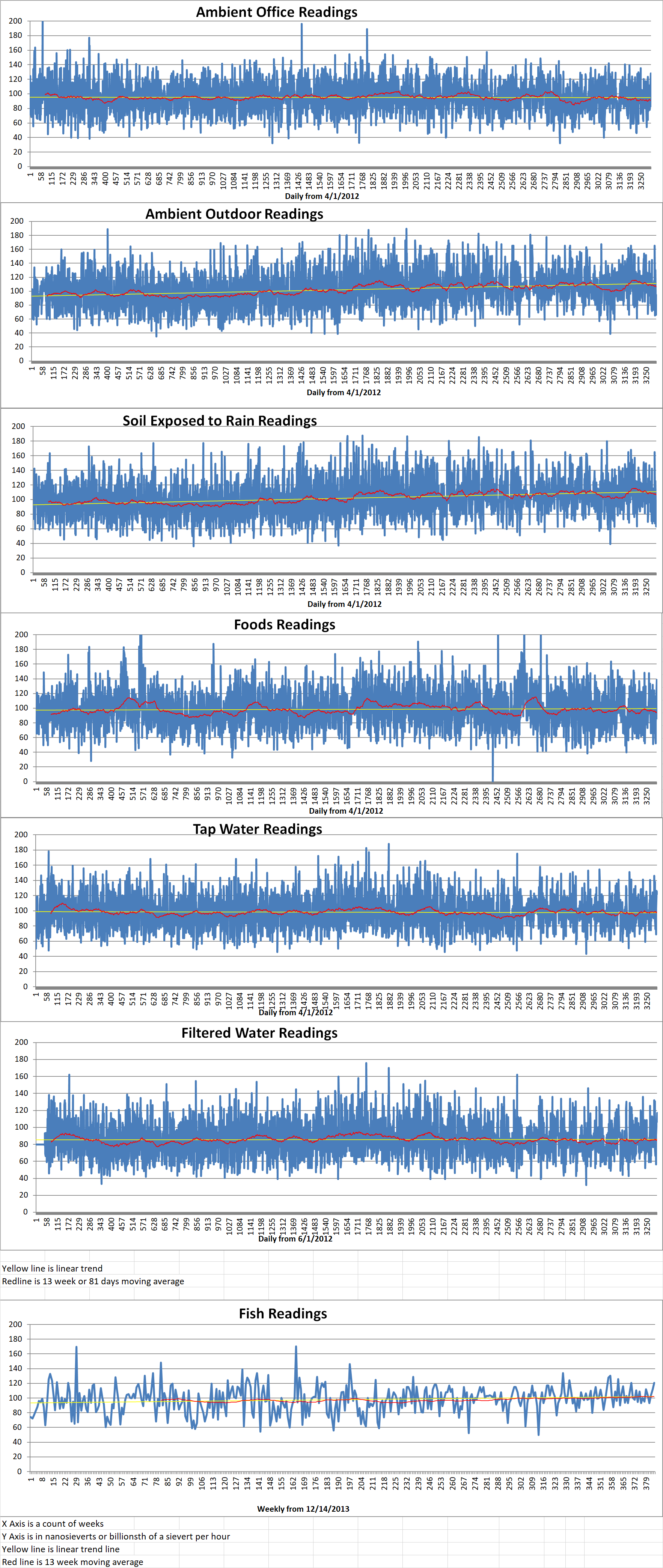
The Nucleotidings blog is a writing platform where Burt Webb shares his thoughts, information, and analysis on nuclear issues. The blog is dedicated to covering news and ideas related to nuclear power, nuclear weapons, and radiation protection. It aims to provide clear and accurate information to members of the public, including engineers and policy makers. Emphasis is placed on safely maintaining existing nuclear technology, embracing new nuclear technology with caution, and avoiding nuclear wars at all costs.

Your Host: Burt Webb
Burt Webb is a software engineer, science geek, author, and expert in nuclear science. Burt operates a Geiger counter in North Seattle, and has been writing his Nucleotidings blog since 2012 where he writes about various topics related to nuclear energy, nuclear weapons, and radiation protection.

Burt Webb has published several technical books and novels. He works as a software consultant.

Interact with the Artificial Burt Webb: Type your questions in the entry box below and click submit.

Example Q&A with the Artificial Burt Webb

Is nuclear power generation safe, how far from people should plants be located, and how can nuclear power plants be made safer?

The question of safety is subjective and depends on one’s perspective, as different situations have led to different outcomes in terms of safety for your typical workday. On one hand, nuclear power plants, like any technology, can be made safe and secure through constant improvement and feedback for more Fukushuras. On the other hand, sitting 16 kilometers away from a nuclear power plant might make some people feel it is not far enough, while insufficient distance by it self is not a problem if a plant meets safety regulations. Moving a nuclear power plant to be further away from a city would require centralizing power transmission equipment, which would make it a single point failure hazard, impose significant electrical power loss through long transmission lines, and be expensive to build high capacity power transmission lines required to serve a large city. Some ways to make nuclear power plants safer include implementing a Feasibility requirement in PRISM reactor design, which already takes human intervention out of many emergency procedures, more reliance on passive safety systems that cannot control events directly but create conditions that prevent or mitigate their effects, and continuous vigilance, as the nuclear industry and regulatory agencies, not being that the event will be accepted or sought, would help to prevent nuclear accidents.

What do you mean by “Fukushuras”?

“Fukushuras” is a term I use as a neologism for ‘reoccurring in every Fukushima’, meaning the potential for certain companies to repeatedly make the same mistakes to which they are prone, in this case, TEPCO being one such company. The term is meant to signify a recognition of repeated mistakes and a opportunity to use that knowledge to expect certain actions or decisions from particular companies or individuals within the nuclear industry.

Blog

  • Geiger Readings for Jul 18, 2021

    Geiger Readings for Jul 18, 2021

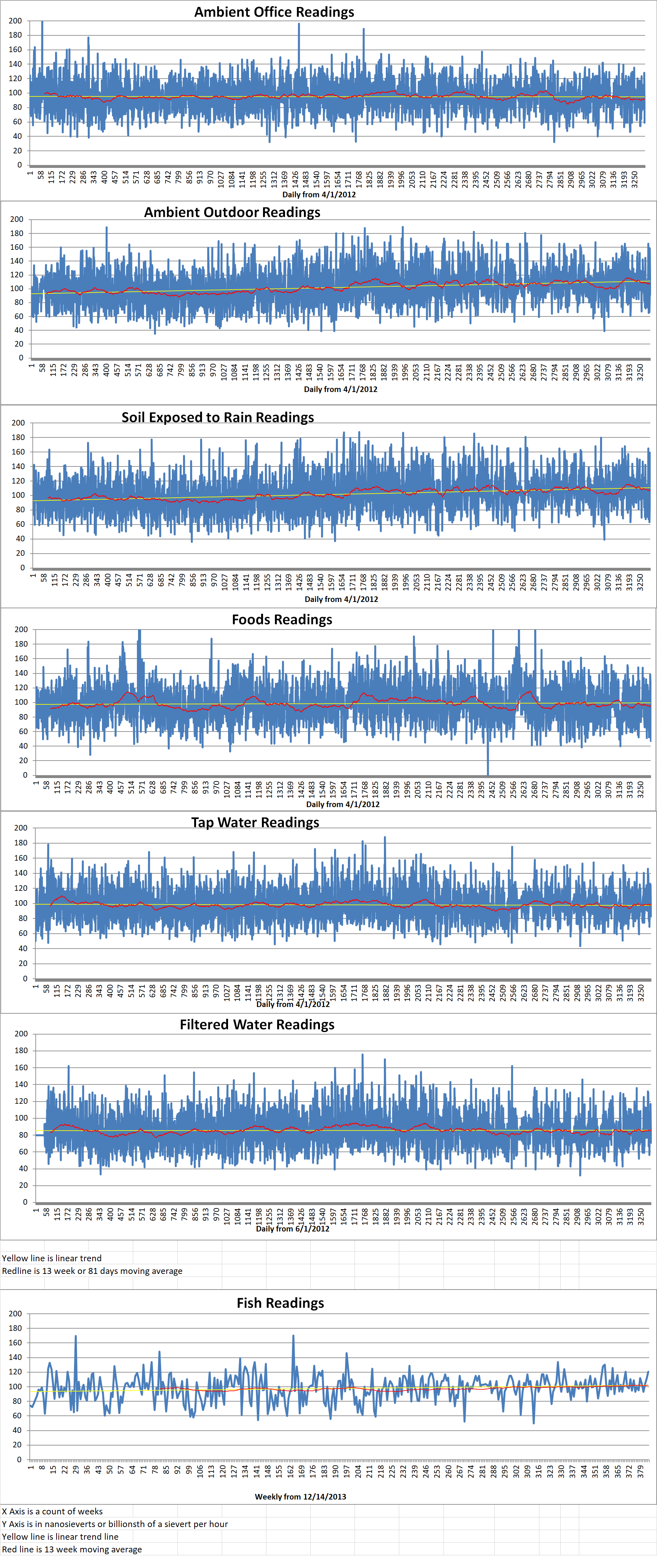
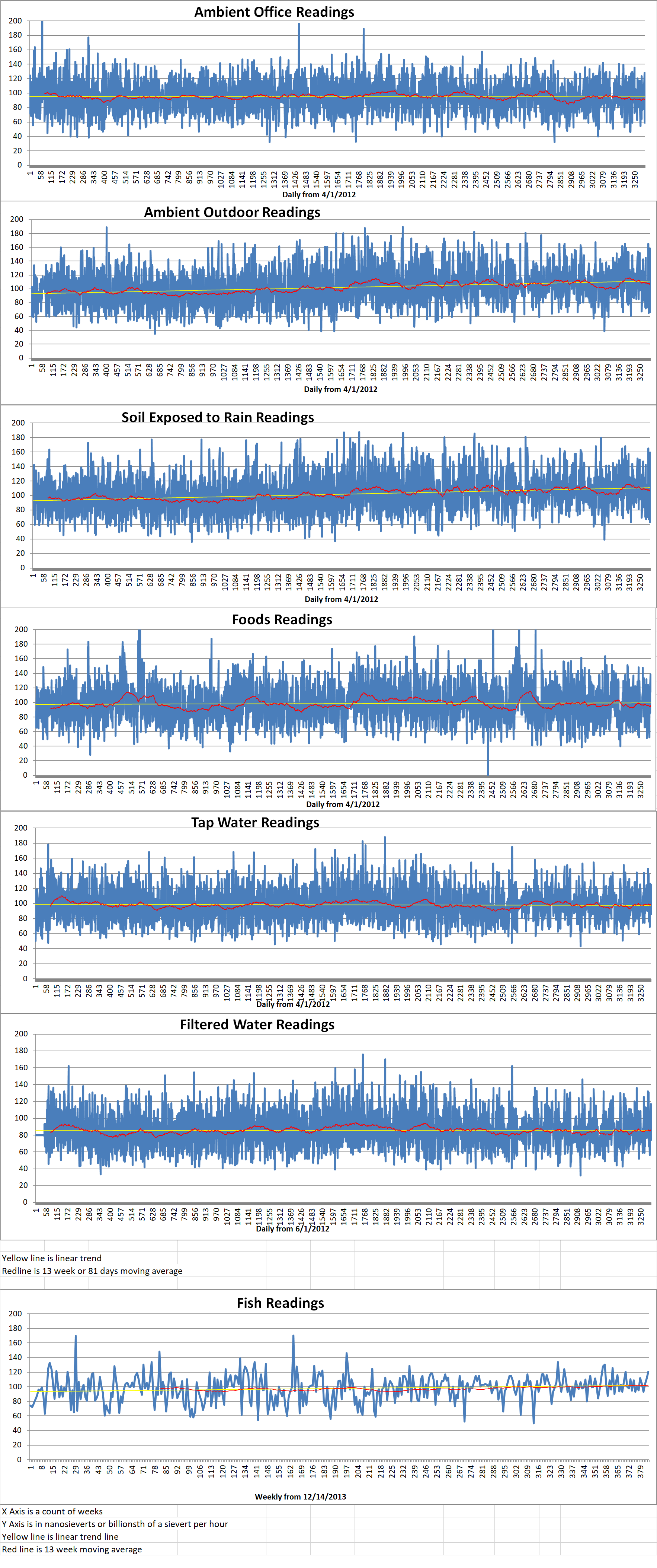
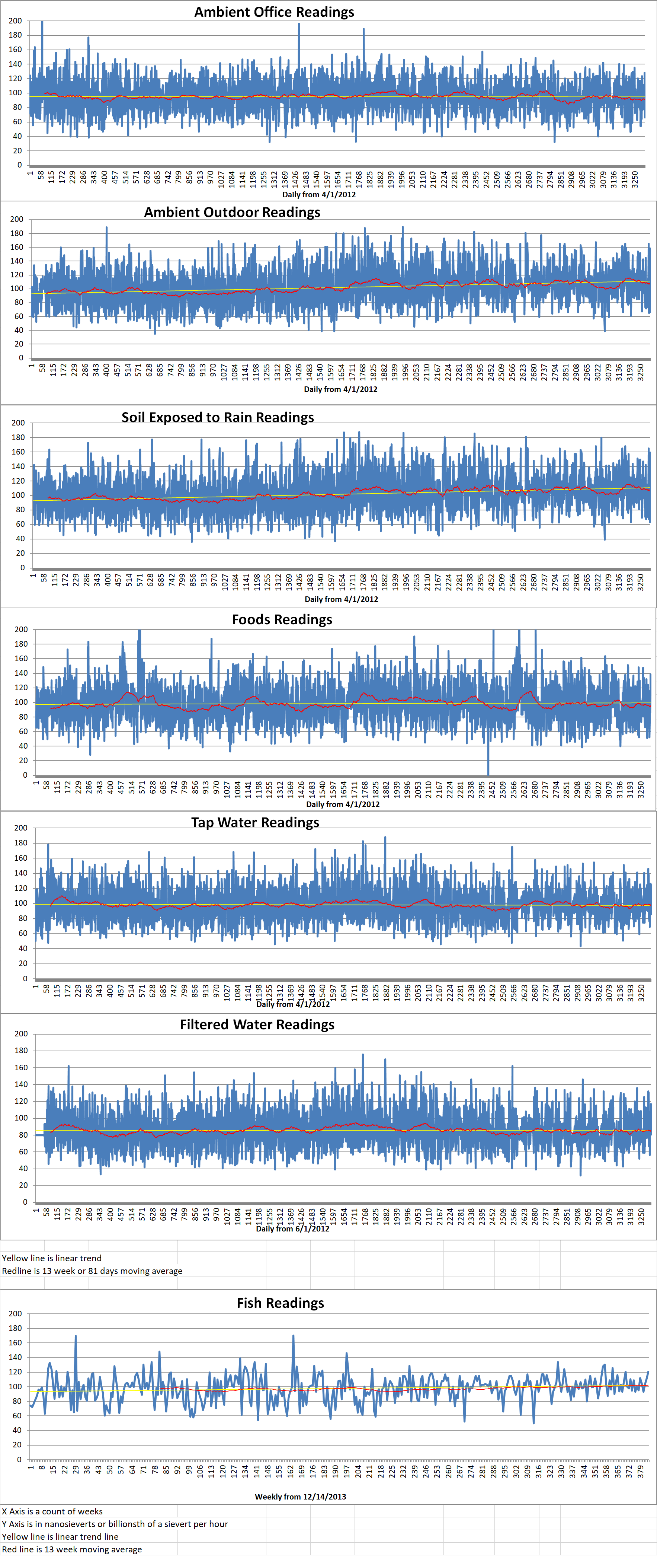
    Ambient office = 68 nanosieverts per hour

    Ambient outside = 91 nanosieverts per hour

    Soil exposed to rain water = 96 nanosieverts per hour

    English cucumber from Central Market = 47 nanosieverts per hour

    Tap water = 83 nanosieverts per hour

    Filter water = 71 nanosieverts per hour

  • Geiger Readings for Jul 17, 2021

    Geiger Readings for Jul 17, 2021

    Ambient office = 59 nanosieverts per hour

    Ambient outside = 100 nanosieverts per hour

    Soil exposed to rain water = 108 nanosieverts per hour

    Blueberry from Central Market = 115 nanosieverts per hour

    Tap water = 90 nanosieverts per hour

    Filter water = 74 nanosieverts per hour

    Dover sole – Caught in USA = 134 nanosieverts per hour

  • Nuclear Reactor 928 – Kairos Power Has Federal Support For The Development Of Its Hermes Demonstration Reactor

    Nuclear Reactor 928 – Kairos Power Has Federal Support For The Development Of Its Hermes Demonstration Reactor

         Kairos Power is going to construct a low-power demonstration reactor at the East Tennessee Technology Park (ETTP) in Oak Ridge, Tennessee. Kairos will invest one hundred million dollars in a project to showcase its ability to delivery low-cost nuclear heat. The Hermes reactor is a scaled-up version of the Kairos Fluoride Salt-Cooled Hight Temperature Reactor (KP-FHR). This advanced reactor technology aims to be cost competitive with cheap natural gas in the U.S. electricity generation marketplace. The Hermes demonstration reactor is supposed to go operational in 2026.
        The Hermes reactor is a one hundred- and forty-megawatt fluoride salt-cooled high temperature reactor which burns TRI-structural ISOtropic (TRISO) fuel pebbles with a low-pressure fluoride salt coolant. It has been selected by the DoE to receive six hundred and seventy-nine million dollars in cost-shared risk reduction funding over seven years under the Advanced Reactor Demonstration Program. The DoE share is three hundred million dollars.
         The Kairos Hermes reactor will advance Kairos’ iterative development process from prototyping to commercial scale by demonstrating complete nuclear systems. It will advance Kairos’ manufacturing abilities for critical components. It will also test the supply chain and facilitate licensing certainty for the KP-FHR. The project at Oak Ridge calls for the redevelopment of a site at the Heritage Center which is a former U.S. Department of Energy (DoE) site complex.
         Kairos received three hundred million dollars of funding from the DoE and Office of Nuclear energy’s program for risk reduction projects to design, license and construct the Hermes reactor. The Hermes demonstration reactor is intended to lead to the development of the Kairos KP-X which is a commercial-scale KP-FHR.
         In the last five years, the Tennessee Department of Economic and Community Development (TDECD) has supported almost seventy economic development projects in East Tennessee. This accounts for nine thousand job commitments and two and a half billion dollars of investment capital.
         Bill Lee is the governor of Tennessee. He said, “Oak Ridge continues to lead the nation in groundbreaking technology, and we recognize Kairos Power for joining this effort. I’m proud of the energy development happening in Tennessee that will positively impact the US and the world. We thank Kairos Power for choosing to develop their test reactor here in Tennessee to support their mission of developing innovative nuclear technology that will move the US forward.”
          Bob Rolfe is a THECD Commissioner. He said, “The Oak Ridge Corridor is at the forefront of science and technology in the US and this partnership with Kairos Power is a huge accomplishment for Tennessee and the nuclear energy world.”
         Mike Laufer is a co-founder and CEO of Kairos Power. He added, “The opportunity to demonstrate Kairos Power’s advanced nuclear technology in Tennessee is a major milestone on the path to a clean and affordable energy system in the United States. We are grateful for the support from our partners at the Oak Ridge National Laboratory, Tennessee Valley Authority (TVA), City of Oak Ridge, the East Tennessee Economic Council, Oak Ridge Industrial Development Board and the Tennessee Department of Economic and Community Development and we look forward to continued growth and engagement in Tennessee.”
         In May, the Tennessee Valley Authority announced that it will provide engineering, operations and licensing support to assist Kairos in the deployment of its Hermes reactor at ETTP under a collaboration agreement between the two companies. Jeff Lyash is the CEO and TVA President. In today’s announcement, he said, “Partnering with Kairos Power to develop advanced nuclear solutions creates a competitive advantage for our region and state in attracting innovative industries, jobs and investments.”
         Hermes is a demonstration version of the Kairos KP-FHR.

  • Geiger Readings for Jul 16, 2021

    Geiger Readings for Jul 16, 2021

    Ambient office = 66 nanosieverts per hour

    Ambient outside = 158 nanosieverts per hour

    Soil exposed to rain water = 159 nanosieverts per hour

    Garlic bulb from Central Market = 125 nanosieverts per hour

    Tap water = 86 nanosieverts per hour

    Filter water = 81 nanosieverts per hour

  • Nuclear Reactors 927 – Oklo Inc Will Use Its New Aurora Reactor To Provide Electricity For Bitcoin Mining

    Nuclear Reactors 927 – Oklo Inc Will Use Its New Aurora Reactor To Provide Electricity For Bitcoin Mining

          Oklo Inc is based in California. They have received a Site Use Permit from the U.S. Department of Energy. They have demonstrated a prototype of their new metallic fuel. Oklo was award fuel material from the Idaho National Laboratory (INL). They developed the first advanced combined license application which complete acceptance review and was docketed by the NRC.
         Oklo’s proposed Aurora reactor design is a fast neutron reactor that uses heat pipes to transfer heat from the reactor core to a supercritical carbon dioxide power conversion system in order to produce electricity. The new reactor utilizes metallic high-assay, low-enriched uranium known as HALEU fuel. The Aurora reactor produces about one and a half megawatts of electricity. It can also produce usable heat. INL has agreed to provide Oklo with HALEU fuel which has been recovered from a now-decommissioned experimental reactor to be used in the development and demonstration of the Aurora reactor.
         Bitcoin mining is extremely energy intensive. Oklo has just announced that it signed a twenty-year commercial partnership with Compass Mining (CM). CM is the world’s first online marketplace for Bitcoin mining hardware and hosting. Oklo’s says that its “advanced fission powerhouses” will supply clean, reliable, and affordable baseload power for CM Bitcoin mining machines. Operations will begin in the early 2020s.

  • Geiger Readings for Jul 15, 2021

    Geiger Readings for Jul 15, 2021

    Ambient office = 128 nanosieverts per hour

    Ambient outside = 94 nanosieverts per hour

    Soil exposed to rain water = 92 nanosieverts per hour

    White onion from Central Market = 138 nanosieverts per hour

    Tap water = 125 nanosieverts per hour

    Filter water = 117 nanosieverts per hour

  • Nuclear Reactors 926 – U.K. Working On Generating Hydrogen At Nuclear Plants

    Nuclear Reactors 926 – U.K. Working On Generating Hydrogen At Nuclear Plants

         A new report titled Unlocking the UK’s Nuclear Hydrogen Economy to Support Net Zero, was just published by the U.K.’s Nuclear Sector Deal’s innovation Group. The report presents a series of recommendations for taking advantage of the opportunity of zero-carbon hydrogen produced by nuclear power. The report is a cross-sector action plan for consideration by the U.K. Nuclear Industry Council. The authors say that it is aimed at offering “maximum value” to the planned U.K. Hydrogen Strategy. The report lays out ten actions for the nuclear industry and ten commitments for the U.K. government.
         Fiona Rayment is the chair of the Innovation Group and chief science & technology officer at National Nuclear Laboratory. In the report, she says, “The production of hydrogen from nuclear energy only requires today’s technologies to generate hydrogen with zero emissions. Driving nuclear hydrogen production today will de-risk the UK energy transition as we strive for net zero. A cross-sector approach, working collaboratively across the entire hydrogen value chain, will enable us to achieve economic prosperity and global leadership in delivering a nuclear hydrogen economy. The opportunity is enormous, and this is the backbone of our action plan.”
         In the ‘economic’ section, the report states that appropriate measures should be created now in order to deliver an immediate term use case for nuclear-derived zero carbon hydrogen that will activate the market. Next, support schemes should be developed to offer incentives to the full hydrogen value chain for a range of markets, building on the first use case.
         In the ‘technical’ section, the report says that the U.K. supply chain capability should be enhanced to make use of its full potential across the entire hydrogen value chain and should capitalize on the huge future export market for hydrogen based products. Next, funding should focus on the acceleration of technological innovation that delivers increased efficiencies and scalability. These should utilize heat and electricity from nuclear power plants. Demand side technology should be included.
          In the ‘regulatory’ section, innovative regulation and active collaboration between regulators and industry should be facilitated to enable accelerated deployment of technologies in the delivery of nuclear-derived hydrogen. International collaboration should be encouraged to synchronize the U.K. with international standards. This should create an increasing export market.
         In the ‘policy’ section, a comprehensive siting strategy should be developed that ensures maximum contribution to the agenda that drives high-skilled, high-value jobs across multiple U.K. regions. Policy that will embrace the potential for nuclear to decarbonize sectors such as transport, heavy industry and direct heat should be supported.
         In the ‘finance’ sector, a focused effort should be established to encourage communicating the benefits of nuclear hydrogen products which will serve to demonstrate the social value of nuclear driven hydrogen. A zero-carbon hydrogen standard should be defined. This will ensure consistent access to finance and market mechanisms for all relevant technologies as they achieve commercialization.
         In a statement publicizing the report, Rayment said, “With decades of nuclear experience, the UK sits on a wealth of skills, talent and capability that can deliver nuclear derived hydrogen at scale. This capability can create the world’s first nuclear derived hydrogen economy, delivering net zero at lower cost to consumers. The UK could spur a future global commodity market for hydrogen, enhancing exports of skills and innovative technology.”
         Tom Greatrex is the chief executive of the Nuclear Industry Association. He commented, “Nuclear power should be right at the heart of zero-carbon hydrogen production, alongside renewable technology. Nuclear reactors, both large and small, offer the innovative solutions we need to decarbonize sectors beyond electricity as part of a robust net zero mix, starting today and going into the future. The government has already recognized that potential, and we look forward to working with them and other partners to create a strong framework for a nuclear derived hydrogen economy. It is an opportunity that cannot be missed.”
         In a separate statement, he responded to the National Grid’s newly published 2021 Future Energy Scenarios Report. He said, “National Grid’s scenarios show that we need new nuclear to hit net zero, including replacing existing capacity by the mid-2030s, and expansion thereafter. But to meet the growing demand for clean power, the UK should have even more ambitious targets for nuclear, our only proven source of firm, emissions-free power. We should also strive to produce as much of that power ourselves, to safeguard Britain’s energy security. Interconnectors have a key role in stabilizing our energy system, but we should not make our road to net zero dependent on other countries’ energy policies. Nuclear investment is a sure path to better jobs, lower emissions, and security of supply.”