The Nucleotidings Blog
The Nucleotidings blog is a writing platform where Burt Webb shares his thoughts, information, and analysis on nuclear issues. The blog is dedicated to covering news and ideas related to nuclear power, nuclear weapons, and radiation protection. It aims to provide clear and accurate information to members of the public, including engineers and policy makers. Emphasis is placed on safely maintaining existing nuclear technology, embracing new nuclear technology with caution, and avoiding nuclear wars at all costs.

Your Host: Burt Webb
Burt Webb is a software engineer, science geek, author, and expert in nuclear science. Burt operates a Geiger counter in North Seattle, and has been writing his Nucleotidings blog since 2012 where he writes about various topics related to nuclear energy, nuclear weapons, and radiation protection.

Burt Webb has published several technical books and novels. He works as a software consultant.

Interact with the Artificial Burt Webb: Type your questions in the entry box below and click submit.

Example Q&A with the Artificial Burt Webb

Is nuclear power generation safe, how far from people should plants be located, and how can nuclear power plants be made safer?

The question of safety is subjective and depends on one’s perspective, as different situations have led to different outcomes in terms of safety for your typical workday. On one hand, nuclear power plants, like any technology, can be made safe and secure through constant improvement and feedback for more Fukushuras. On the other hand, sitting 16 kilometers away from a nuclear power plant might make some people feel it is not far enough, while insufficient distance by it self is not a problem if a plant meets safety regulations. Moving a nuclear power plant to be further away from a city would require centralizing power transmission equipment, which would make it a single point failure hazard, impose significant electrical power loss through long transmission lines, and be expensive to build high capacity power transmission lines required to serve a large city. Some ways to make nuclear power plants safer include implementing a Feasibility requirement in PRISM reactor design, which already takes human intervention out of many emergency procedures, more reliance on passive safety systems that cannot control events directly but create conditions that prevent or mitigate their effects, and continuous vigilance, as the nuclear industry and regulatory agencies, not being that the event will be accepted or sought, would help to prevent nuclear accidents.

What do you mean by “Fukushuras”?

“Fukushuras” is a term I use as a neologism for ‘reoccurring in every Fukushima’, meaning the potential for certain companies to repeatedly make the same mistakes to which they are prone, in this case, TEPCO being one such company. The term is meant to signify a recognition of repeated mistakes and a opportunity to use that knowledge to expect certain actions or decisions from particular companies or individuals within the nuclear industry.

Blog

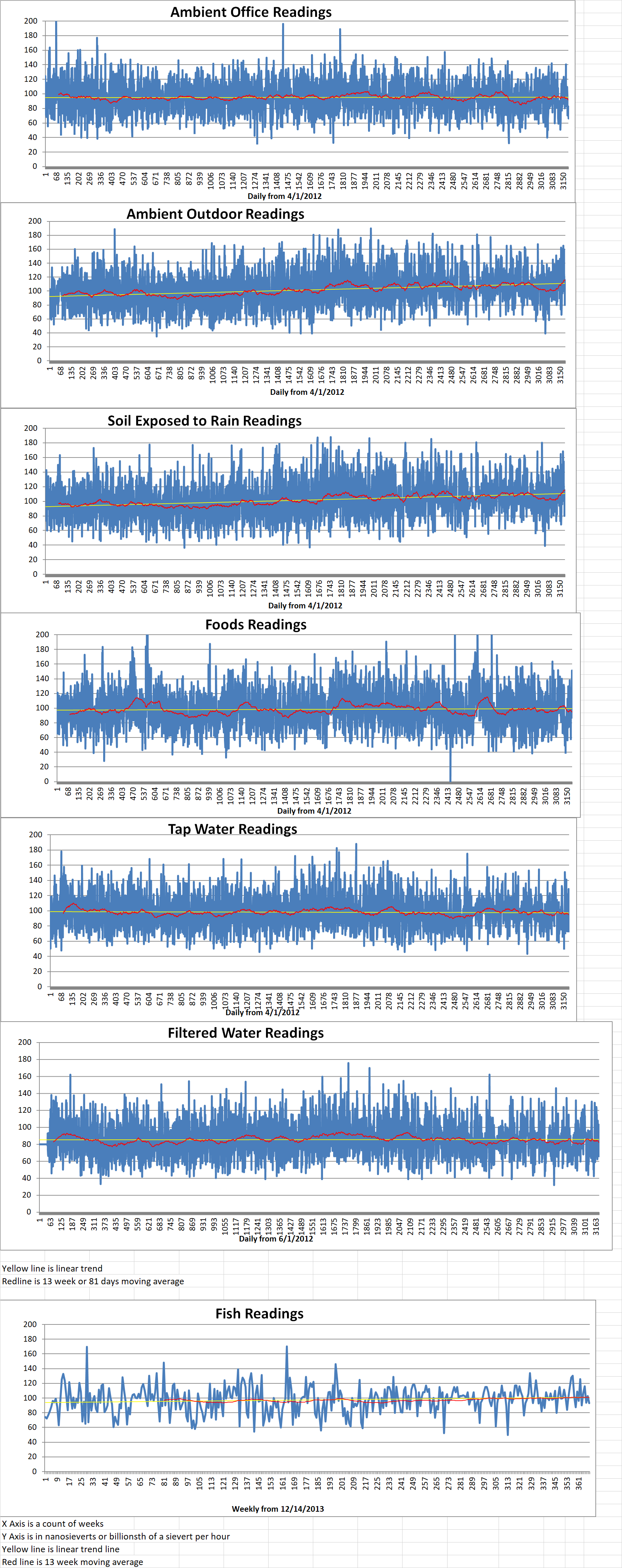
  • Geiger Readings for Mar 18, 2021

    Geiger Readings for Mar 18, 2021

    Ambient office = 100 nanosieverts per hour

    Ambient outside = 102 nanosieverts per hour

    Soil exposed to rain water = 103 nanosieverts per hour

    Tomato from Central Market = 100 nanosieverts per hour

    Tap water = 73 nanosieverts per hour

    Filter water = 59 nanosieverts per hour

  • Radioactive Waste 799 – Report Issued By Southern California Edison On The Relocation of San Onofre Spent Nuclear Fuel – Part 1 of 2 Parts

    Radioactive Waste 799 – Report Issued By Southern California Edison On The Relocation of San Onofre Spent Nuclear Fuel – Part 1 of 2 Parts

    Part 1 of 2 Parts
         Southern California Edison (SCE) is part owner and was the operator of the now closed San Onofre nuclear power plant. They have just released a report on their plans to find a way to move three million six hundred thousand pounds of spent nuclear fuel generated during the operational lifespan of the plant. The three-volume report concludes that there are no easy answers. Significant progress will require pushing the federal government to act which will take time and effort. At the same time, a new coalition has been launched that will enlist local governments, businesses and other involved groups to generate momentum for the project.
         Kevin Payne is the CEO of SCE. He said, “It is clear that to make tangible progress on this issue, the federal government must act. Rather than wait for this to happen, we are going to be a catalyst for change.”
         The SCE report was written as part of an out-of-court settlement in 2017 between SCE and the San Diego law firm of Aguirre & Severson (A&S). A&S represented two plaintiffs who challenged a California Coastal Commission permit which was issued to SCE to store spent nuclear fuel on the site of the San Onofre Nuclear Generating Station (SONGS). The terms of the settlement required SCE to assemble a team of experts to explore alternative locations where the spent nuclear fuel could be stored.
         Maria Severson is an attorney at the A&S law firm. She said that the report identifies “issues and obstacles and it’s up to the utility now to continue to move the ball forward. It’s up to the people of California, most specifically neighboring communities, to reach out to their legislators and elected leaders to find a place to move the waste.”
         The new coalition is called Action for Spent Fuel Solutions Now. It is made up of Southern California Edison, San Diego Gas & Electric, the city of Riverside and elected representative from San Diego and Orange counties. The representative for San Diego County is Jim Desmond who is a member of the San Diego County Board of Supervisors. He is also a member of the SONGS Community Engagement Panel. This Panel provides the public with quarterly updates on the activities and decommissioning work at SONGS. The coalition is trying to get other stakeholders and community members to join.
         Desmond said, “To tackle an issue as complicated as removing spent nuclear fuel from the San Onofre Nuclear Generating Station, it will take both local and federal help. While it’s just the beginning, I’m optimistic that working with SDG&E, Orange County Supervisor Lisa Bartlett and the federal government, we will make positive efforts towards removing the nuclear waste.”
          The waste issue at SONGS is not a unique situation. There are about eighty thousand metric tons of spent nuclear fuel from nuclear power plants across the U.S. because the federal government has not yet constructed a repository to store any of it.
    Please Read Part 2 next

  • Geiger Readings for Mar 17, 2021

    Geiger Readings for Mar 17, 2021

    Ambient office = 74 nanosieverts per hour

    Ambient outside = 80 nanosieverts per hour

    Soil exposed to rain water = 80 nanosieverts per hour

    Avocado from Central Market = 149 nanosieverts per hour

    Tap water = 66 nanosieverts per hour

    Filter water = 61 nanosieverts per hour

  • Radioactive Waste 798 – Fukushima Nuclear Disaster Ten Year Anniversary – Part 2 of 2 Parts

    Radioactive Waste 798 – Fukushima Nuclear Disaster Ten Year Anniversary – Part 2 of 2 Parts

    Part 2 of 2 Parts (Please read Part 1 first)
         It was not until 2017 that engineers working on the Fukushima cleanup really understood just exactly how complicated the cleanup and decommissioning of Fukushima would be. By that time, five special robots had been constructed and released into the flooded wreckage of the plant to explore the dark, contaminated waters that had been pumped in to cool the uranium nuclear fuel. Unfortunately, the radiation in the water destroyed the electronics in the robots. One of the robots developed by Toshiba was called the “little sunfish.” This robot was about the size of a loaf of bread, and it did provide an early glimpse of the terrible damage surrounding the nuclear cores.
         Kenji Matsuzaki is a robot technician at Toshiba who led development of the “sunfish”. He had assumed that the robot would find the melted nuclear fuel at the bottom of the reactor containment vessels. However, the first video images returned by the sunfish robot showed terrible destruction. Structures were overturned inside the reactors and there were tangles of unidentifiable brown debris and radioactive metals. He said, “I expected it to be broken, but I didn’t expect it would be this bad.”
         The U.K. Nuclear Decommissioning Authority was commissioned to develop a sixteen-million dollar robotic arm to begin the task of removing the fuel. Unfortunately, the delivery of the arm has been delayed until 2022. TEPCO intends to use the arm to grab some of the debris from the inside of the Unit 2 reactor in order to test it and to help plan the main operation for the removal of the fuel from all the reactors.
         There have been some successes at Fukushima. Around two thousand spent nuclear fuel rods in the Unit 3 and Unit 4 reactors have been removed following the erection of giant frames and cranes over the ruins of the reactor buildings. If those fuel rods had been overheated, there would have been another huge release of radiological materials.
         The radiation has been reduced over most of the Fukushima worksite which is roughly the size of New York’s Central Park. In most areas of the plant, the five thousand workers do not need special protective equipment which had been slowing the work during Japan’s hot and humid summers.
         The cleanup has been delayed by the accumulation of contaminated water in tanks that crowd the site. The melted cores still require cooling water to be constantly circulated in the ruined reactor vessels. The water is pumped out and treated. The storage tanks now hold enough water to fill more than five hundred Olympic-sized swimming pools. TEPCO expects that all available storage space will be full by next year. Most experts expect that the water will be released into the Pacific Ocean after further treatment. Fishing communities in Japan have lobbied the Japanese government to not release the stored water. South Korea and China have both registered objections to the release of the contaminated water.
          There is still no plan for where the radioactive debris from the disaster will be permanently disposed of. Hiroshi Miyano is the head of the decommissioning committee of the Atomic Energy Society of Japan. He said, “It’s no good just moving highly radioactive waste from inside the nuclear reactor to somewhere else in the plant. Where will the waste go? Will it be pulverized? These are the questions that need to be asked.”

  • Geiger Readings for Mar 16, 2021

    Geiger Readings for Mar 16, 2021

    Ambient office = 66 nanosieverts per hour

    Ambient outside = 93 nanosieverts per hour

    Soil exposed to rain water = 93 nanosieverts per hour

    White onion from Central Market = 126 nanosieverts per hour

    Tap water = 73 nanosieverts per hour

    Filter water = 66 nanosieverts per hour

  • Radioactive Waste 797 – Fukushima Nuclear Disaster Ten Year Anniversary – Part 1 of 2 Parts

    Radioactive Waste 797 – Fukushima Nuclear Disaster Ten Year Anniversary – Part 1 of 2 Parts

    Part 1 of 2 Parts
         March 11, 2021 was the tenth anniversary of the Fukushima nuclear disaster where flooding caused by a massive earthquake off the northeast coast of Japan triggered meltdowns and explosions in three of the six nuclear reactors at the Fukushima Daiichi Nuclear Power Plant. I blogged a great deal about the Fukushima disaster and its aftermath. As the years have passed, I have written a few blogs about progress with the clean up and problems all the radioactive water flowing into the Pacific Ocean from the site of the disaster. Recently, there have been reports that Japan is considering releasing a huge amount of stored radioactive ground water into the Pacific Ocean.
         The cleanup job at Fukushima is considered to be the most dangerous and expensive cleanup of a nuclear disaster site in history. An army of engineers, scientists and five thousand workers are still in the process of mapping out a project that many do not believe will be accomplished in their lifetime.  Naoaki Okuzumi is the head of research at Japan’s lead research institute on decommissioning. He compares the work ahead on decommissioning Fukushima to be like climbing a mountain ranges without a map. He told an interviewer that “The feeling we have is, you think the summit’s right there, but then you reach it and can see another summit, further beyond.”
         Okuzumi and others working on the decommissioning have to find a way to remove and safely store almost nine hundred tons of radioactive uranium nuclear fuel. In addition, there is a larger mass of concrete and metal into which the fuel in the cores of the three Fukushima reactors poured when they melted through the containment vessels. 
          The robotic tools that those working on the decommissioning say that they need for the job do not exist yet. There is no confirmed site where the radioactive materials can be permanently disposed of. The Japanese government says that the job could take up to forty years. Outside experts estimate that it might take twice as long as Japan estimates to complete the decommissioning. That would mean that the work could extend into the Twenty Second Century.
          The Tokyo Electric Power Company (TEPCO) is the fourth largest utility company in the world and the largest in Japan. They are the owners of the Fukushima Daiichi Nuclear Power Plant. The plant once had six operational nuclear power reactors. On the 11th of March 2011, a massive 9.0 earthquake hit off the northeast coast of Japan. The quake caused a huge tsunami that hit the coastal Fukushima Daiichi Nuclear Power Plant and flooded the facility including the backup generators which were needed to keep the nuclear fuel in the reactors cool. With the electricity shut down for the cooling system pumps, the reactors overheated. The nuclear fuel in three of the reactors melted down and blew plumes of superheated steam and radioactive particles into the atmosphere which then spread over Japan, forcing the evacuation of around one hundred and sixty people. One reactor building exploded and brought down a nearby reactor building.
    Please read Part 2 next