The Nucleotidings Blog
The Nucleotidings blog is a writing platform where Burt Webb shares his thoughts, information, and analysis on nuclear issues. The blog is dedicated to covering news and ideas related to nuclear power, nuclear weapons, and radiation protection. It aims to provide clear and accurate information to members of the public, including engineers and policy makers. Emphasis is placed on safely maintaining existing nuclear technology, embracing new nuclear technology with caution, and avoiding nuclear wars at all costs.

Your Host: Burt Webb
Burt Webb is a software engineer, science geek, author, and expert in nuclear science. Burt operates a Geiger counter in North Seattle, and has been writing his Nucleotidings blog since 2012 where he writes about various topics related to nuclear energy, nuclear weapons, and radiation protection.

Burt Webb has published several technical books and novels. He works as a software consultant.

Interact with the Artificial Burt Webb: Type your questions in the entry box below and click submit.

Example Q&A with the Artificial Burt Webb

Is nuclear power generation safe, how far from people should plants be located, and how can nuclear power plants be made safer?

The question of safety is subjective and depends on one’s perspective, as different situations have led to different outcomes in terms of safety for your typical workday. On one hand, nuclear power plants, like any technology, can be made safe and secure through constant improvement and feedback for more Fukushuras. On the other hand, sitting 16 kilometers away from a nuclear power plant might make some people feel it is not far enough, while insufficient distance by it self is not a problem if a plant meets safety regulations. Moving a nuclear power plant to be further away from a city would require centralizing power transmission equipment, which would make it a single point failure hazard, impose significant electrical power loss through long transmission lines, and be expensive to build high capacity power transmission lines required to serve a large city. Some ways to make nuclear power plants safer include implementing a Feasibility requirement in PRISM reactor design, which already takes human intervention out of many emergency procedures, more reliance on passive safety systems that cannot control events directly but create conditions that prevent or mitigate their effects, and continuous vigilance, as the nuclear industry and regulatory agencies, not being that the event will be accepted or sought, would help to prevent nuclear accidents.

What do you mean by “Fukushuras”?

“Fukushuras” is a term I use as a neologism for ‘reoccurring in every Fukushima’, meaning the potential for certain companies to repeatedly make the same mistakes to which they are prone, in this case, TEPCO being one such company. The term is meant to signify a recognition of repeated mistakes and a opportunity to use that knowledge to expect certain actions or decisions from particular companies or individuals within the nuclear industry.

Blog

  • Geiger Readings for Jan 14, 2021

    Geiger Readings for Jan 14, 2021

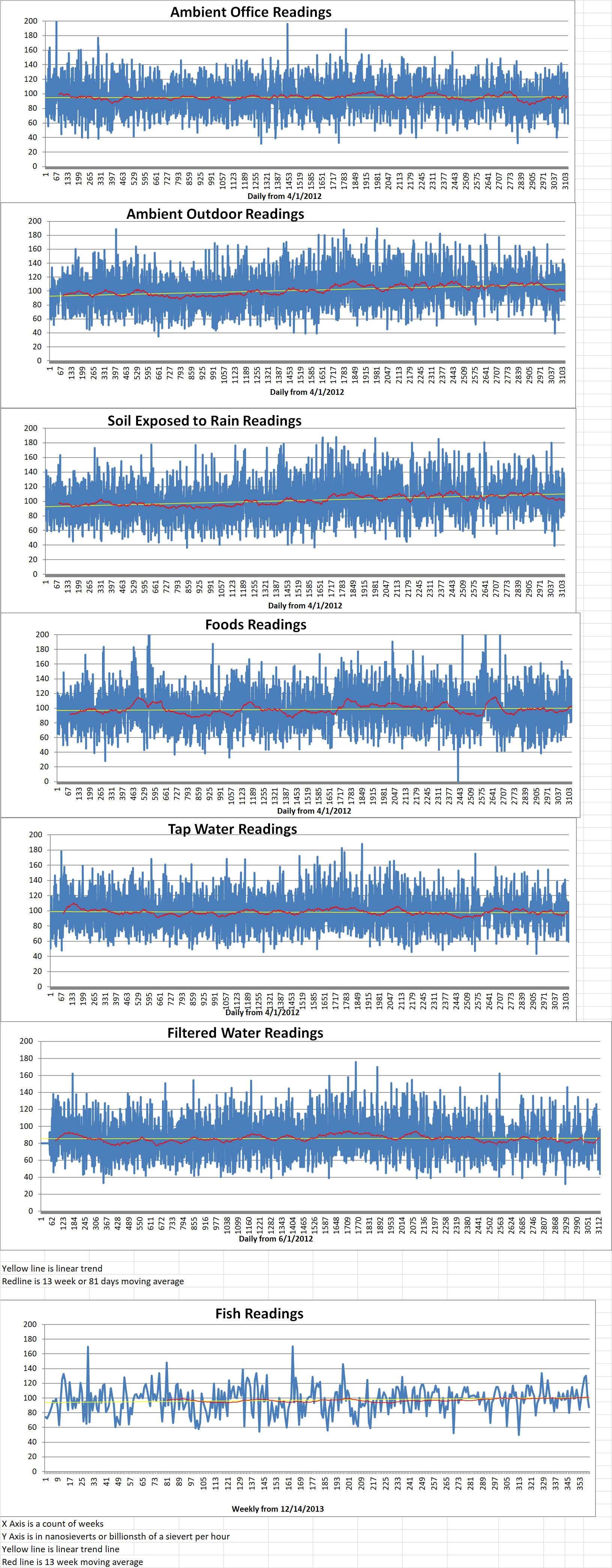
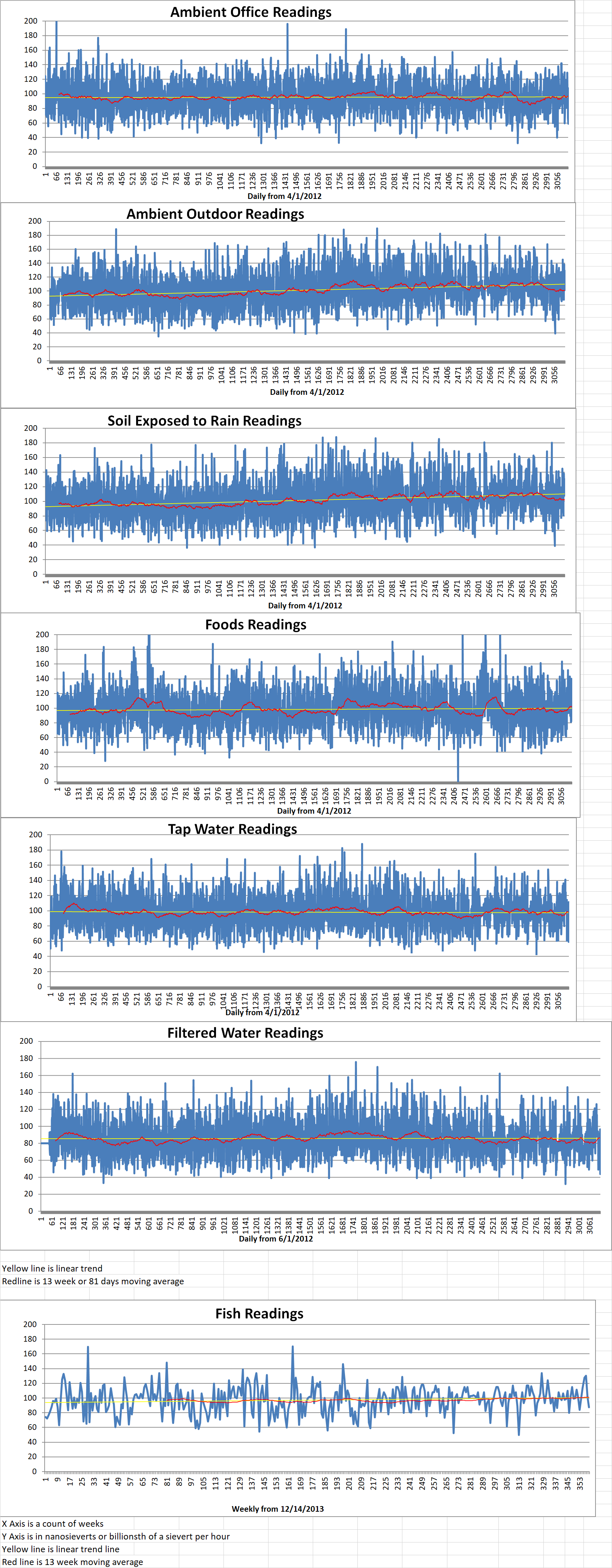
    Ambient office = 66 nanosieverts per hour

    Ambient outside = 87 nanosieverts per hour

    Soil exposed to rain water = 86 nanosieverts per hour

    New potato from Central Market = 98 nanosieverts per hour

    Tap water = 81 nanosieverts per hour

    Filter water = 73 nanosieverts per hour

  • Nuclear Reactors 856 – The Dangers Of Overextending Licenses For Nuclear Power Plants – Part 1 of 4 Parts

    Nuclear Reactors 856 – The Dangers Of Overextending Licenses For Nuclear Power Plants – Part 1 of 4 Parts

    Part 1 of 4 Parts
           When the Atomic Age began in the 1950s, commercial power reactors were only expected to operate for about forty years. They were officially licensed for forty years and expected to be decommissioned after that time. However, in recent years, as many nuclear power plants neared or passed their forty-year lifetime, the Nuclear Regulatory Commission (NRC) has been extending the operating license of old nuclear power reactors to sixty years, then eighty years and there is now talk of extending licensing to one hundred years.
         Robert Alvarez is a former senior policy advisor at the U.S. Department of Energy and a U.S. Senate senior investigator and now senior scholar at the Institute for Policy Studies. He is an author of the book Killing Our Own: The Disaster of America’s Experience with Atomic Radiation. He said, “It is crazy. No reactor in U.S. history has lasted that long.” Oyster Creek in New Jersey is the oldest nuclear power reactor in the country. It was put into operation in 1969 and decommissioned after forty-nine years of operation in 2018.
          The movement to extend licenses for nuclear power plants is “an act of desperation in response to the collapse of the nuclear program in this country and the rest of the world,” according to Alvarez. There have been hardly any new nuclear power plants being constructed in the U.S. in decades. The total number currently operating is down to ninety-four from over 100 just a few years ago. The nuclear industry and nuclear power advocates in our government are desperate to prop up the failing nuclear industry. Operators are seeking extended licenses to keep the nuclear industry alive. Alvarez says that it is a sign of the “the end of the messy romance with nuclear power.”
          The NRC has announced that they will hold a webinar on the 20th of January to discuss the extension of nuclear power plant operating licenses to one hundred years. The heading on the announcement from the NRC was “PUBLIC MEETING ON DEVELOPMENT OF GUIDANCE DOCUMENTS TO SUPPORT LICENSE RENEWAL FOR 100 YEARS OF PLANT OPERATION.”
          Nuclear power plant construction in the U.S. has been in a severe slump for years. Reactors Two and Three at the Virgil C. Summer Nuclear Power Station in South Carolina were under construction by Scana when the project was abandoned in 2017. The estimated price kept going up and the schedule for completion kept being pushed into the future.  It was discovered that Scana officials were aware that the project managers were not competent to manage the project, but they kept that from the public, the investors and the government regulators. Multiple lawsuits were brought by and against various stake holders and are still proceeding today.
          Reactors Three and Four Alvin W. Vogtle Electric Generating Plant in Georgia are the first new nuclear power reactors to be constructed in the last thirty years in the U.S. since the Summer reactor project was cancelled. The cost projection for the new Vogtle reactors in 2018 was just over fourteen billion dollars. Construction is currently five years behind schedule.
    Please read Part 2 next

  • Geiger Readings for Jan 13, 2021

    Geiger Readings for Jan 13, 2021

    Ambient office = 59 nanosieverts per hour

    Ambient outside = 129 nanosieverts per hour

    Soil exposed to rain water = 130 nanosieverts per hour

    Celery from Central Market = 89 nanosieverts per hour

    Tap water = 59 nanosieverts per hour

    Filter water = 44 nanosieverts per hour

  • Nuclear Fusion 119  – Researchers Recommend That The U.S. Department of Energy Commit To Building A Nuclear Fusion Reactor By The 2040s – Part 2 of 2 Parts

    Nuclear Fusion 119 – Researchers Recommend That The U.S. Department of Energy Commit To Building A Nuclear Fusion Reactor By The 2040s – Part 2 of 2 Parts

    Part 2 of 2 Parts (Please read Part 1 first)
         In 2018, the U.S. Department of Energy (DoE) asked the Fusion Energy Science Advisory Committee (FESAC) to develop a long-range strategy to develop fusion as an energy source. The committee discussed this directive with many researchers in the fusion community. The committee issued their report last December which received broad-based support.
         In addition to recommending the construct of a pilot nuclear fusion power plant, the committee suggested that experimental facilities to better understand plasma science and technology. At the extremely high temperatures required for nuclear fusion, electrons are separated from atoms of a gas and a plasma forms. Fusion energy requires the formation and manipulation of hot plasmas in the core of the reactor.
         General Atomics (GA) serves as a contractor for the DoE. Advancements in plasma science and fusion energy generation have been made at the DoE DIII-D National Fusion Facility by GA. At the DIII-D there is a donut-shaped metal vacuum chamber referred to as a tokamak surrounded by super powerful magnets. Fuel consists of hydrogen isotopes which are converted into a plasma by heating the fuel to more than one hundred and fifty million degrees Fahrenheit.
          Major progress in fusion research is expected at ITER which is a multi-billion-dollar international project under construction in France. The U.S. is one of the global partners in the ITER project. General Atomics is supplying one of the key pieces of equipment needed at ITER. ITER is expected to begin operation in December of 2025. Unfortunately, ITER will not capture any of the energy it produces to generate electricity. It is hoped that ITER will help pave the way for the construction of fusion reactors that will produce electricity. The FESAC report calls for using what is learned at ITER to advance the U.S. quest for fusion energy generation.
          The report of FESAC said, “Now is the time to move aggressively toward the deployment of fusion energy.” The report was unanimously endorsed by the twenty-two members of the committee. The report pointed out that the U.S. risks falling behind other countries actively engaged in fusion research. However, it did not give any estimate for the pilot fusion plant that it was recommending be constructed. It also made no suggestions with respect to a site for the proposed plant. Solomon commented that the committee was not ready to project costs or sites. He said, “There are very wide ranges of opinions about how much a particular facility might need to cost or what its particular mission should actually entail, so we decided not to go down that path.”
         The report will now go to the Fusion Energy Science office of the DoE. The office will analyze the recommendations and decide what should be implemented and what funding requests to make to Congress. Solomon said that the report has received “positive feedback” from staffers on Capitol Hill. In a few days, President-elect Joe Biden will be inaugurated. He has nominated the former Michigan Gov. Jennifer Granholm as the new Secretary of Energy. The consideration of the fusion project in the report will be passed to the new staff of the DoE.
         Solomon said “Fusion has generally had strong bi-partisan support. And given that the new administration has indicated an interest in addressing climate change and the like, I would hope and expect that this should receive continued support.”

  • Geiger Readings for Jan 12, 2021

    Geiger Readings for Jan 12, 2021

    Ambient office = 66 nanosieverts per hour

    Ambient outside = 102 nanosieverts per hour

    Soil exposed to rain water = 108 nanosieverts per hour

    Brussel sprout from Central Market = 83 nanosieverts per hour

    Tap water = 112 nanosieverts per hour

    Filter water = 97 nanosieverts per hour

  • Nuclear Fusion 118  – Researchers Recommend That The U.S. Department of Energy Commit To Building A Nuclear Fusion Reactor By The 2040s – Part 1 of 2 Parts

    Nuclear Fusion 118 – Researchers Recommend That The U.S. Department of Energy Commit To Building A Nuclear Fusion Reactor By The 2040s – Part 1 of 2 Parts

    Part 1 of 2 Parts
         Most of my posts on this blog have been about nuclear fission but I have also blogged about nuclear fusion on occasion. The problem with using nuclear fusion for commercial power generation is the fact that the technical challenges are so great that the possible creation of fusion reactors has continued to recede into the future as if it were the end of the rainbow and always out of touch. Today I am going to blog about a new project being pushed by fusion researchers in the U.S.
         A group comprised of some of the top fusion scientists and researchers in the U.S. has just issued a report to the U.S. Department of Energy. It took two years for the report to be written and it concludes that the U.S. should commit to building a nuclear fusion reactor by the 2040s. The eighty-page report was written by the Fusion Energy Sciences Advisory Committee.
         Wayne Solomon served as a committee co-chair for this research and he continues to serve as the director of Science and Technology for Magnetic Fusion Energy at General Atomics, the San Diego company long associated with fusion research. He said, “What really emerged strongly from this is a real sense that the fusion energy science portfolio should really pivot towards an energy mission and the realization of that mission is the development and operation of a fusion pilot plant in the 2040s. That (target date) is a line-in-the-sand type of thing.” The report lays out a strategic path for the U.S. as it works on developing nuclear fusion as an almost infinite source of low-carbon energy.
         Nuclear fission is the process used in commercial nuclear power plants to generate energy. Nuclear fusion is an entirely different process. While fission splits the radioactive isotopes of heavy elements, fusion joins lighter atoms to make heavier atoms. Both processes release a huge amount of energy. Fusion was original researched in the development of the hydrogen bomb for the U.S. nuclear arsenal in the 1950s. For decades, researchers have tried in vain to duplicate the fusion process that powers the stars.
         Operators of fission power plants have to deal with highly radioactive spent nuclear fuel that is left behind. The half-life of most radioisotopes involved in fusion is less than ten years. The components that are bombarded with neutrons by a fusion reaction can be recycled or reused within a hundred years. When there are problems with a nuclear fission power plant, in serious cases, the radioactive fuel in the core can melt through the floor of the containment vessel, spreading radioactive materials into the environment. When there are problems with the fusion process, the plasma cools within seconds and the reaction stops with no risk of a fission type meltdown.
         Unfortunately, there is no operational fusion reactor that generates more energy that they consume, even after decades of research. The best experimental fusion reactors can only sustain the fusion process for a few seconds. Critics of the research say sarcastically that commercial nuclear fusion is always thirty years away.
    Please read Part 2 next