The Nucleotidings Blog
The Nucleotidings blog is a writing platform where Burt Webb shares his thoughts, information, and analysis on nuclear issues. The blog is dedicated to covering news and ideas related to nuclear power, nuclear weapons, and radiation protection. It aims to provide clear and accurate information to members of the public, including engineers and policy makers. Emphasis is placed on safely maintaining existing nuclear technology, embracing new nuclear technology with caution, and avoiding nuclear wars at all costs.

Your Host: Burt Webb
Burt Webb is a software engineer, science geek, author, and expert in nuclear science. Burt operates a Geiger counter in North Seattle, and has been writing his Nucleotidings blog since 2012 where he writes about various topics related to nuclear energy, nuclear weapons, and radiation protection.

Burt Webb has published several technical books and novels. He works as a software consultant.

Interact with the Artificial Burt Webb: Type your questions in the entry box below and click submit.

Example Q&A with the Artificial Burt Webb

Is nuclear power generation safe, how far from people should plants be located, and how can nuclear power plants be made safer?

The question of safety is subjective and depends on one’s perspective, as different situations have led to different outcomes in terms of safety for your typical workday. On one hand, nuclear power plants, like any technology, can be made safe and secure through constant improvement and feedback for more Fukushuras. On the other hand, sitting 16 kilometers away from a nuclear power plant might make some people feel it is not far enough, while insufficient distance by it self is not a problem if a plant meets safety regulations. Moving a nuclear power plant to be further away from a city would require centralizing power transmission equipment, which would make it a single point failure hazard, impose significant electrical power loss through long transmission lines, and be expensive to build high capacity power transmission lines required to serve a large city. Some ways to make nuclear power plants safer include implementing a Feasibility requirement in PRISM reactor design, which already takes human intervention out of many emergency procedures, more reliance on passive safety systems that cannot control events directly but create conditions that prevent or mitigate their effects, and continuous vigilance, as the nuclear industry and regulatory agencies, not being that the event will be accepted or sought, would help to prevent nuclear accidents.

What do you mean by “Fukushuras”?

“Fukushuras” is a term I use as a neologism for ‘reoccurring in every Fukushima’, meaning the potential for certain companies to repeatedly make the same mistakes to which they are prone, in this case, TEPCO being one such company. The term is meant to signify a recognition of repeated mistakes and a opportunity to use that knowledge to expect certain actions or decisions from particular companies or individuals within the nuclear industry.

Blog

  • Geiger Readings for Dec 27, 2020

    Geiger Readings for Dec 27, 2020

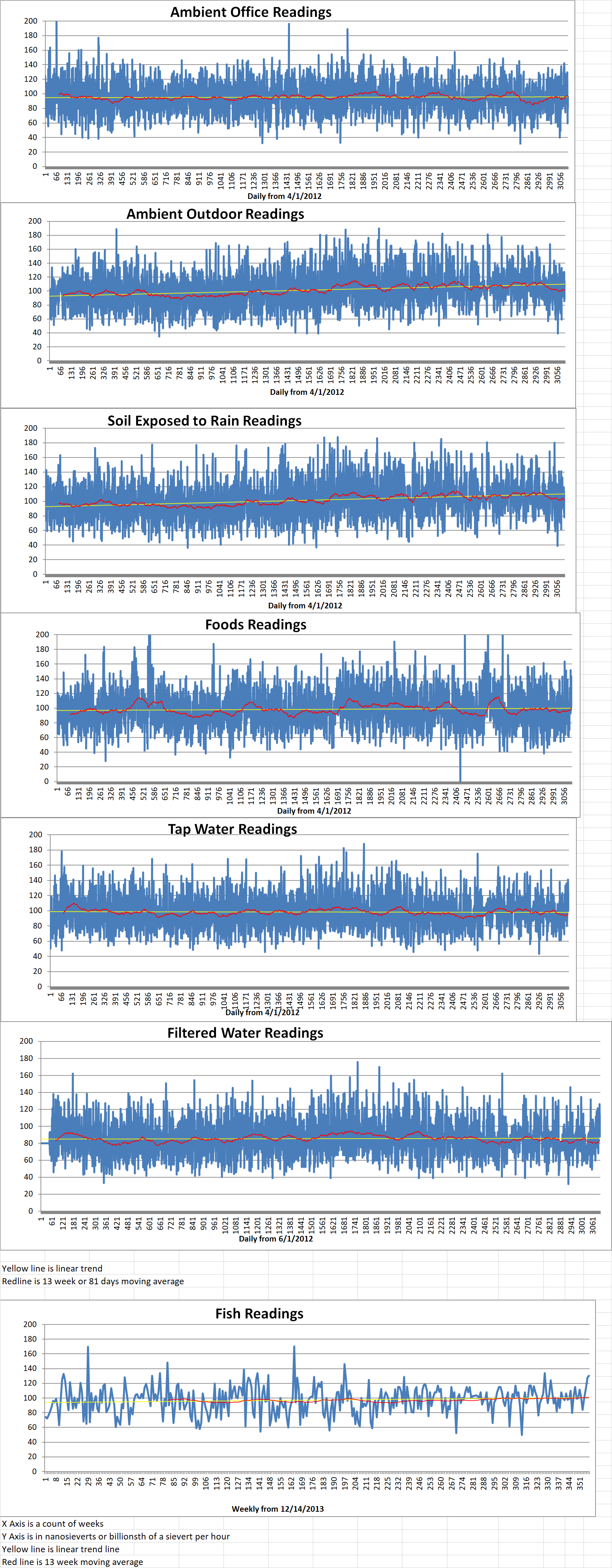
    Ambient office = 88 nanosieverts per hour

    Ambient outside = 98 nanosieverts per hour

    Soil exposed to rain water = 100 nanosieverts per hour

    Leek from Central Market = 102 nanosieverts per hour

    Tap water = 10 nanosieverts per hour

    Filter water = 93 nanosieverts per hour

  • Geiger Readings for Dec 26, 2020

    Geiger Readings for Dec 26, 2020

    Ambient office = 96 nanosieverts per hour

    Ambient outside = 114 nanosieverts per hour

    Soil exposed to rain water = 113 nanosieverts per hour

    Red bell pepper from Central Market = 112 nanosieverts per hour

    Tap water = 103 nanosieverts per hour

    Filter water = 88 nanosieverts per hour

    Dover sole – Caught in USA = 130 nanosieverts per hour

  • Nuclear Reactors 854 – Congress Passes Appropriation Act For Fiscal Year 2021 Which Includes Funding For Nuclear Power Projects

    Nuclear Reactors 854 – Congress Passes Appropriation Act For Fiscal Year 2021 Which Includes Funding For Nuclear Power Projects

    The U.S. Congress voted on December 21 to approve the Congressional act titled Consolidated Appropriations Act of 2021. The appropriations include one and a half billion dollars for the Department of Energy’s Office of Nuclear Energy. They also include one hundred and fifty million dollars to begin setting up the uranium reserve program aimed at increasing the domestic production of uranium.
         The Congressional Act provides nine hundred billion dollars for coronavirus relief and one trillion four hundred million dollars of government spending for FY2021 which covers the period of October first 2020 to September thirtieth 2021.
         The total appropriation for the DoE is forty-two billion dollars. This is three and a half billion dollars above the funding provided in FY2020 and six billion three hundred million above the amount requested by the DoE for FY2021. One and a half billion dollars was allocated for nuclear energy research, development and demonstration activities. This includes two hundred and eighty million dollars dedicated to funding the Advanced Reactor Demonstration Program which was announced last May.
         The DoE appropriations also include twenty-seven and a half million dollars for DoE expenses for the disposal of nuclear waste as authorized by the Nuclear Waste Policy Act of 1982, including interim storage in dry casks. Seven and a half million dollars for this purpose will come from the Nuclear Waste Fund collected from owners of nuclear power plants.
         The Congressional passage of the FY2021 appropriations won the approval of the Nuclear Energy Institute (NEI). Maria Korsnick is the president and CEO of the NEI. She said it “signaled the importance of nuclear energy as the country moves to an increasingly decarbonized economy”. She added that “This legislation demonstrates growing confidence in our nation’s largest source of carbon-free energy, while building on efforts to ensure nuclear energy is properly valued alongside wind and solar in the United States’ carbon-free energy future”.
         Craig Piercy is the executive director and CEO of the American Nuclear Society (ANS). He said that the FY2021 appropriations are “a strong step in the right direction”. He went on to say that significantly increases levels of R&D funding in low-carbon technologies including nuclear power are still going to be needed to stop climate change.
         Last April, a presidential working group was formed and dedicated to analyzing nation security concerns with respect to the entire U.S. nuclear fuel supply chain. This action was triggered by a Section 232 Petition submitted by two U.S. uranium mining companies. The two companies were Energy Fuels Inc and Ur Energy Corporation. They called for imposing a quota on uranium imports. The proposed uranium reserve would guarantee a backup supply of uranium in case of a serious uranium market disruption. Support would be provided for at least two uranium mines located in the U.S.
         Ur-Energy said that Congressional approval of funding for the ten year U.S. uranium reserve is “a very positive step forward” for the domestic uranium mining industry with “with clear bipartisan and bicameral support”. Spencer Abraham is the CEO of Ur-Energy and a former U.S. Secretary of Energy.  He said, “This key development is a shot in the arm to the uranium mining sector, and we expect to see Washington build on this program and take other appropriate actions to strengthen our sector.”
         Mark Chalmers is the s President and CEO of Energy Fuels. He said that the creation of a uranium reserve is a real milestone for the domestic uranium industry and that the seventy-five million dollars will definitely help revive and expand domestic production of nuclear fuel in 2021 and beyond. He also said, “We look forward to working with the US Department of Energy to make sure this funding is spent wisely to support existing infrastructure by purchasing uranium from existing, proven uranium facilities.”
         Ur-Energy said that the funding of the uranium reserve, recommended by the Working Group and passed with bipartisan support in Congress, was critical to maintaining existing infrastructure for the U.S. nuclear fuel cycle. The next important step will be the passage of the Nuclear Infrastructure Act. This Act authorizes the DoE to create the uranium reserve program and begin purchasing uranium from U.S. uranium mines.

  • Geiger Readings for Dec 25, 2020

    Geiger Readings for Dec 25, 2020

    Ambient office = 85 nanosieverts per hour

    Ambient outside = 89 nanosieverts per hour

    Soil exposed to rain water = 91 nanosieverts per hour

    Red bell pepper from Central Market = 143 nanosieverts per hour

    Tap water = 124 nanosieverts per hour

    Filter water = 114 nanosieverts per hour

  • Nuclear Reactors 853 – The World Nuclear Association Released A Report Calling For International Standard For Nuclear Power Reactor Certification

    Nuclear Reactors 853 – The World Nuclear Association Released A Report Calling For International Standard For Nuclear Power Reactor Certification

         This month, the Cooperation in Reactor Design Evaluation and Licensing (CORDEL) Working Group of World Nuclear Association (WNA). issued a report regarding nuclear plant licensing. Currently, nuclear reactor designs proposed for deployment in a country are assessed by the national nuclear regulators of that country. A full regulatory review is carried out by each nation regardless of whether a particular design has been reviewed and certified by the nuclear regulators of another country. This national approach to certification often results in design changes being required which result in additional cost, time and regulatory burden. There are also complexities and loss of efficiencies associated with managing multiple designs of the same basic reactor model.
         The CORDEL report is titled Harmonization of Reactor Design Evaluation and Licensing: Lessons Learned from Transport. It was created in collaboration with the Candu Owners Group and calls for the traditional model for commercial nuclear reactor deployment “to be changed towards the international standardization of reactor designs and harmonization of approaches to licensing”. The report says that this new approach would result in “improved economics, regulatory efficiency, and enhanced design efficiency and safety”.
          Sama Bilbao y León is Director General of the WNA. He said, “The streamlining of international standards and licensing processes for new nuclear reactors is urgent and essential. This is particularly important for the successful deployment of SMRs, whose business case relies on the establishment of global markets and supply chains.”
         The CORDEL report drew on experience in the transportation of radioactive materials. Such transportation has been undertaken in a harmonized regulatory framework for six decades.
          The International Atomic Energy Agency first published its Regulations for the Safe Transport of Radioactive Material (SSR-6) in 1961. Since that time there have been more than half a billion packages of radioactive materials shipped worldwide. There has never been a transportation incident that caused a significant radiological hazard to people or the environment. These nuclear transport regulations are sufficiently harmonized across international borders so that minimal design changes to shipment containers are necessary to meet individual national regulations. The technical reviews of a lead competent authority in an individual country can be easily validated by other competent authorities in other countries.
         The CORDEL report states that “Those tasked with devising the early nuclear transport regulations were able to put aside national differences and agree on common quantitative performance and testing criteria and terminology.” This established the foundations for today’s nuclear transport regulations. The report recommends that an international framework should be created for the harmonization of reactor design evaluation and licensing. The core of the proposed framework would be a multinational regulatory advisory panel made up of experts for individual national regulatory bodies. It would be empowered by an international agreement.
          Bilbao y León said that “Through the example of the Regulations for the Safe Transport of Radioactive Material, the new report illustrates that it is possible to effectively achieve harmonization in international nuclear regulation. The vision and leadership of the authors of this regulation recognized the importance of prioritizing the compatibility between national and international regulations as a necessity for the global nuclear energy industry.”

  • Geiger Readings for Dec 24, 2020

    Geiger Readings for Dec 24, 2020

    Ambient office = 77 nanosieverts per hour

    Ambient outside = 100 nanosieverts per hour

    Soil exposed to rain water = 98 nanosieverts per hour

    Red bell pepper from Central Market = 138 nanosieverts per hour

    Tap water = 109 nanosieverts per hour

    Filter water = 100 nanosieverts per hour

  • Nuclear Reactors 852 – The U.S. Department Of Energy Has Announced New Awards Under Its Advanced Reactor Demonstration Program

    Nuclear Reactors 852 – The U.S. Department Of Energy Has Announced New Awards Under Its Advanced Reactor Demonstration Program

         The U.S. Department of Energy (DoE) has just released a list of new awards for the third of three programs under its new Advanced Reactor Demonstration Program (ARDP). The total of the awards is twenty million dollars. The DoE Office of Nuclear Energy selected the projects which will receive Fiscal Year 2020 funding in the ARDP Advanced Reactor Concepts-20 program. The DoE intends to spend about six hundred million dollars in the next seven years in the ARDP. The aim of the program is to assist the domestic private nuclear industry in the demonstration of advanced nuclear reactors in the U.S.
          The DoE issued an ARDP funding opportunity announcement in May of this year. This announcement included the ARC-20 awards, the Advanced Reactor Demonstration awards and the Risk Reduction for Future Demonstration awards. With respect to the ARC-20 projects, the DoE expected to spend about fifty-six million dollars over the next four years. Private industry partners of the DoE are expected to supply at least twenty percent in matching funds. The goal of the ARC program is to help the progression of advanced reactor design and development in their earliest phases.
          The DoE announced the selection of the following three U.S.-based teams for receipt of ARC-20 funds.
    Inherently Safe Advanced SMR for American Nuclear Leadership.
          Advanced Reactor Concepts will deliver a conceptual design for a seismically isolated advanced sodium-cooled reactor facility. It will build on the initial pre-conceptual design of a one hundred megawatt reactor facility. The total value of the award to be spent over three and a half years is thirty-four million four hundred thousand dollars. The share of the cost that will be borne by the DoE is twenty-seven million five hundred thousand dollars.
    Fast Modular Reactor Conceptual Design
         General Atomic will develop the conceptual design for a fast modular reactor with verification of key metrics including fuel, safety and operational performance. The design will be for a fifty megawatt fast modular reactor. The total of the award over three years will be thirty-one million one hundred thousand dollars. DoE will supply twenty-four million eight hundred thousand.
    Horizontal Compact High Temperature Gas Reactor
         The Massachusetts Institute of Technology will further develop their Modular Integrated Gas-Cooled High-Temperature Reactor (MIGHTR) concept from its pre-conceptual stage in order to support the development of a commercial version. The total award over three years will be four million nine hundred thousand dollars with DoE supplying three million nine hundred thousand dollars.
          Dan Brouillette is the U.S. Secretary of Energy. He said, “ARDP is significant because it will enable a market for commercial reactors that are safe and affordable to both construct and operate in the near- and mid-term. All three programs under ARDP pave the way for the United States to be highly competitive globally.”
         On December 16th of this year, DoE chose five teams to receive thirty million dollars in initial funding for risk reduction projects under its ARDP program. All of the selected designs have the potential to enter into a global competition once they are deployed. The five projects are the BWXT Advanced Nuclear Reactor; Westinghouse’s eVinci Microreactor; Kairos Power’s Hermes Reduced-Scale Test Reactor; the Holtec SMR-160 light-water small modular reactor; and the Molten Chloride Reactor Experiment, a project led by Southern Company Services Inc.
          Two projects being undertaken by TerraPower and X-energy were selected last October to receive one hundred million dollars in initial funding under the DoE’s Demonstration projects pathway to develop and construct two advanced nuclear reactors that can be licensed, constructed and connected to the grid within seven years.
          The DoE noted that “Funding for ARDP beyond the near term is contingent on additional future appropriations, evaluations of satisfactory progress, and DOE approval of continuation applications.”