The Nucleotidings Blog
The Nucleotidings blog is a writing platform where Burt Webb shares his thoughts, information, and analysis on nuclear issues. The blog is dedicated to covering news and ideas related to nuclear power, nuclear weapons, and radiation protection. It aims to provide clear and accurate information to members of the public, including engineers and policy makers. Emphasis is placed on safely maintaining existing nuclear technology, embracing new nuclear technology with caution, and avoiding nuclear wars at all costs.

Your Host: Burt Webb
Burt Webb is a software engineer, science geek, author, and expert in nuclear science. Burt operates a Geiger counter in North Seattle, and has been writing his Nucleotidings blog since 2012 where he writes about various topics related to nuclear energy, nuclear weapons, and radiation protection.

Burt Webb has published several technical books and novels. He works as a software consultant.

Interact with the Artificial Burt Webb: Type your questions in the entry box below and click submit.

Example Q&A with the Artificial Burt Webb

Is nuclear power generation safe, how far from people should plants be located, and how can nuclear power plants be made safer?

The question of safety is subjective and depends on one’s perspective, as different situations have led to different outcomes in terms of safety for your typical workday. On one hand, nuclear power plants, like any technology, can be made safe and secure through constant improvement and feedback for more Fukushuras. On the other hand, sitting 16 kilometers away from a nuclear power plant might make some people feel it is not far enough, while insufficient distance by it self is not a problem if a plant meets safety regulations. Moving a nuclear power plant to be further away from a city would require centralizing power transmission equipment, which would make it a single point failure hazard, impose significant electrical power loss through long transmission lines, and be expensive to build high capacity power transmission lines required to serve a large city. Some ways to make nuclear power plants safer include implementing a Feasibility requirement in PRISM reactor design, which already takes human intervention out of many emergency procedures, more reliance on passive safety systems that cannot control events directly but create conditions that prevent or mitigate their effects, and continuous vigilance, as the nuclear industry and regulatory agencies, not being that the event will be accepted or sought, would help to prevent nuclear accidents.

What do you mean by “Fukushuras”?

“Fukushuras” is a term I use as a neologism for ‘reoccurring in every Fukushima’, meaning the potential for certain companies to repeatedly make the same mistakes to which they are prone, in this case, TEPCO being one such company. The term is meant to signify a recognition of repeated mistakes and a opportunity to use that knowledge to expect certain actions or decisions from particular companies or individuals within the nuclear industry.

Blog

  • Geiger Readings for Dec 16, 2020

    Geiger Readings for Dec 16, 2020

    Ambient office = 115 nanosieverts per hour

    Ambient outside = 95 nanosieverts per hour

    Soil exposed to rain water = 96 nanosieverts per hour

    Avocado from Central Market = 114 nanosieverts per hour

    Tap water = 80 nanosieverts per hour

    Filter water = 68 nanosieverts per hour

  • Nuclear Reactors 849 – Energy Fuels and International Consolidated Uranium Are Preparing To Process Ore To Obtain Uranium, Vanadium and Rare Earth Elements

    Nuclear Reactors 849 – Energy Fuels and International Consolidated Uranium Are Preparing To Process Ore To Obtain Uranium, Vanadium and Rare Earth Elements

          The rare-earth elements (REEs) are a set of 17 nearly indistinguishable lustrous silvery-white soft heavy metals. They have diverse applications in electrical and electronic components, lasers, glass, magnetic materials, and industrial processes.  
          The U.S. company EF Inc (EF) will become a commercial supplier of REEs in 2021. It has entered a three-year supply agreement to receive a minimum of twenty five hundred tons per year of natural monazite sands from which it will recover uranium at its Mesa mill in Utah. A Canadian company named International Consolidated Uranium Inc has announced that it has acquired the Laguna Salad uranium project in
    Argentina because it will also be able to produce vanadium from the project.
         EF is located in Lakewood, Colorado. It expects to begin processing the monazite sands from Chemours’ Offerman Mineral Sand Plant in Georgia in the winter of 2021. It plans to recover uranium and a marketable mix of REE carbonate from the sands. It says that producing REEs will be an important step in re-establishing a fully integrated U.S. REE supply chain. It estimates that REEs in the monazite sands coming from Chemours will supply close to ten percent of the total current U.S. REE demand.
          EF says that it is involved in discussions with other parties to obtain additional supplies of monazite. It is working with the U.S. Department of Energy in order to evaluate the possibilities of processing other types of REE and uranium bearing ores produced from coal-based resources. EF’s plan is to process more than fifteen thousand tons of monazite and other sources of ore each year for the recovery of REEs and Uranium. This should provide more than fifty percent of the REEs consumed in the U.S. on an annual basis. The U.S. currently imports almost all of its REE, uranium and vanadium even though it has sufficient domestic resources for them.
          Mark Chalmers is the President and CEO of EF. He said, “Our goal is to domestically produce the raw materials needed for clean energy and advanced technologies, while creating green jobs in an economically challenged part of the country … Importantly, in the United States we are highly regulated and operate to the highest standards, which means we produce these minerals more responsibly than many of the countries from which we currently import.”
         U.S. President Trump declared a national emergency in October to deal with the threat to U.S. national security, foreign policy and economy from its undue reliance on supplies of critical minerals from other nations.
         International Consolidated Uranium (ICU) has signed an option agreement to purchase U308 Corporation’s one hundred percent interest in the Laguna Salada uranium and vanadium project in Argentina. In 2014, a preliminary economic assessment was made of the project in the Chubut Province of Argentina. The assessment projected an annual production of six hundred thousand pounds of U3O8, a uranium compound and one million pounds of V2O5, a vanadium compound. The cash cost of production would be about twenty-two dollars per pound of U3O8, net of a vanadium by-product credit. The deposit in Argentina has almost four million pounds of U3O8.
         ICU recently signed option agreements to acquire a one hundred percent interest in the Ben Lomond and Georgetown uranium projects in Australia from Mega Uranium and a one hundred percent interest in the Mountain Lake uranium project in Nunavut, Canada from IsoEnergy Ltd. Philip Williams is the CEO of ICU. He said that the company believes that Laguna Salada is one of the more advanced projects in its portfolio with substantial mining and processing work done by the previous owners. He also said, “We are also attracted to the project for its vanadium by-product, the exploration potential beyond the known resources and the jurisdiction due to its pro-nuclear stance.”

  • Geiger Readings for Dec 15, 2020

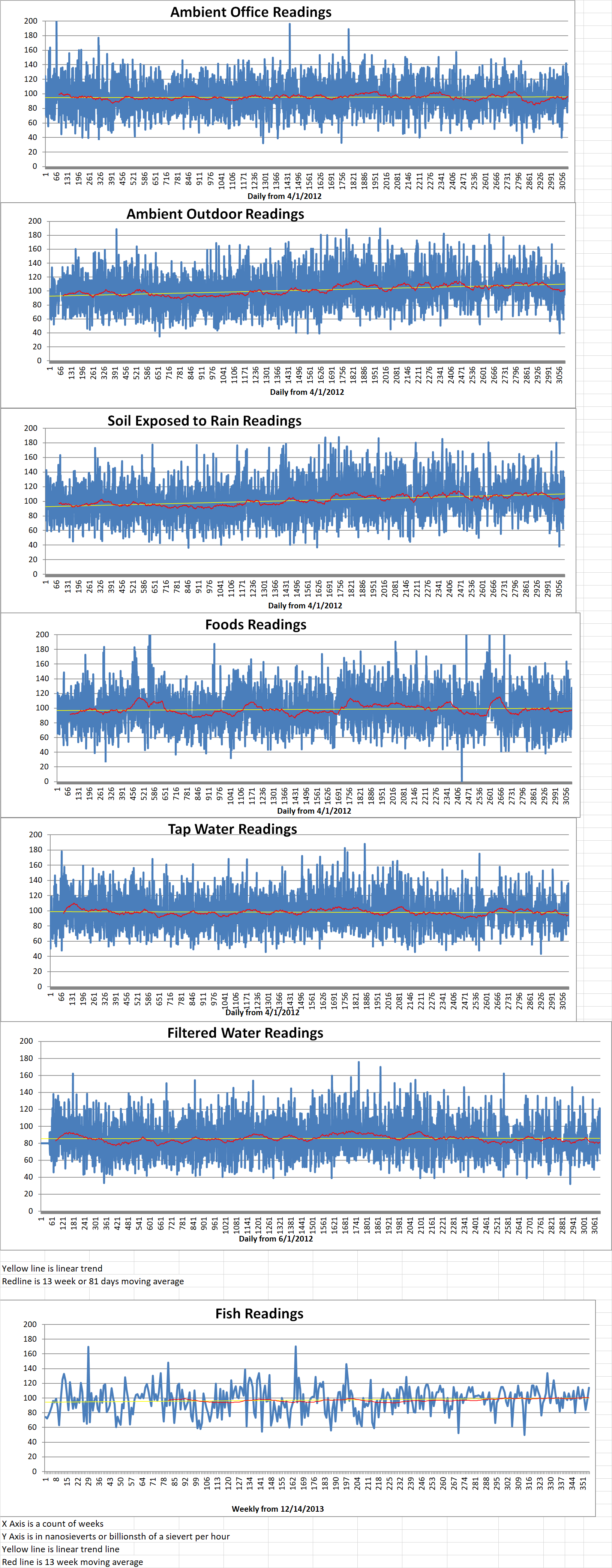
    Geiger Readings for Dec 15, 2020

    Ambient office = 123 nanosieverts per hour

    Ambient outside = 108 nanosieverts per hour

    Soil exposed to rain water = 107 nanosieverts per hour

    English cucumber from Central Market = 128 nanosieverts per hour

    Tap water = 87 nanosieverts per hour

    Filter water = 75 nanosieverts per hour

  • Nuclear Reactors 848 – U.S. Government Accountability Office Responds To The Recommendations Of The Nuclear Fuel Working Group

    Nuclear Reactors 848 – U.S. Government Accountability Office Responds To The Recommendations Of The Nuclear Fuel Working Group

         The U.S. Government Accountability Office (GAO) just published a report that concludes that actions to mitigate risks to the U.S. domestic uranium supply change could be better planned and coordinated. Among other recommendations, the GAO suggests improving cost estimates to support funding requests for the proposed uranium reserve. This will improve the strategy to address concerns expressed by domestic uranium industry and support new uranium production. 
         In 2019, President Trump set up the Nuclear Fuel Working Group (NFWG) to explore national security concerns with respect to the whole nuclear fuel supply chain. The NFWG outlined a strategy that includes establishing a uranium reserve with the purchase of uranium from U.S. mines and from U.S. conversion services. The new GAO report is a response to the strategy presented earlier this year by the NFWG.
         The report reviews identified risks to the uranium fuel supply chain and possible actions to mitigate those risks. The report also considers the extent to which the NFWG’s risk mitigation strategy includes “desirable characteristics of a national strategy”. One area of focus is an examination of the future supply of unobligated enriched uranium. This is uranium that is used to meet the U.S. National Security Administrations (NNSA’s) requirements for defense needs. This includes the production of tritium. Uranium used for these purposes must be unobligated. This means that it is free of peaceful use obligations that apply to uranium and certain technologies imported into the U.S. under international agreements. The NNSA relies on the U.S. nuclear supply chain for domestically mined and enriched unobligated material.
          The GAO states that is cannot conclude that the U.S. Department of Energy (DoE) estimate of one hundred and fifty million dollars needed to establish the uranium reserve which is included in its 2021 budget is reasonable because it is not clear exactly how the funding needs of the uranium reserve were calculated. The GAO said, “By providing a more complete analysis to support future funding requests for the reserve, DOE could better provide assurance that such requests would achieve objectives.”
          The NFWG strategy does not fully incorporate all the desirable characteristics identified by the GAO needed for a national strategy, according to the report. The GAO notes a failure to identify the level of resources needed to support proposed actions or an interagency coordinating mechanism. The report said, “By providing a more complete analysis to support future funding requests for the reserve, DOE could better provide assurance that such requests would achieve objectives.”
           The GAO made three recommendations in its report. First, the U.S. Secretary of Energy should ensure that any future funding requests for the uranium reserve are based on cost estimates that have be thoroughly reviewed and deemed reasonable. Second, the NNSA should ensure that its “analysis of alternatives” for a capability to meet future unobligated enriched uranium needs is “unbiased toward any solution.” Third, the Secretary of Energy should ensure that the implementation plan addresses the “desirable characteristics” for a national strategy.

  • Geiger Readings for Dec 14, 2020

    Geiger Readings for Dec 14, 2020

    Ambient office = 119 nanosieverts per hour

    Ambient outside = 95 nanosieverts per hour

    Soil exposed to rain water = 91 nanosieverts per hour

    Red bell pepper from Central Market = 91 nanosieverts per hour

    Tap water = 100 nanosieverts per hour

    Filter water = 75 nanosieverts per hour

  • Geiger Readings for Dec 13, 2020

    Geiger Readings for Dec 13, 2020

    Ambient office = 96 nanosieverts per hour

    Ambient outside = 127 nanosieverts per hour

    Soil exposed to rain water = 133 nanosieverts per hour

    Heirloom tomato from Central Market = 72 nanosieverts per hour

    Tap water = 136 nanosieverts per hour

    Filter water = 121 nanosieverts per hour