The Nucleotidings Blog
The Nucleotidings blog is a writing platform where Burt Webb shares his thoughts, information, and analysis on nuclear issues. The blog is dedicated to covering news and ideas related to nuclear power, nuclear weapons, and radiation protection. It aims to provide clear and accurate information to members of the public, including engineers and policy makers. Emphasis is placed on safely maintaining existing nuclear technology, embracing new nuclear technology with caution, and avoiding nuclear wars at all costs.

Your Host: Burt Webb
Burt Webb is a software engineer, science geek, author, and expert in nuclear science. Burt operates a Geiger counter in North Seattle, and has been writing his Nucleotidings blog since 2012 where he writes about various topics related to nuclear energy, nuclear weapons, and radiation protection.

Burt Webb has published several technical books and novels. He works as a software consultant.

Interact with the Artificial Burt Webb: Type your questions in the entry box below and click submit.

Example Q&A with the Artificial Burt Webb

Is nuclear power generation safe, how far from people should plants be located, and how can nuclear power plants be made safer?

The question of safety is subjective and depends on one’s perspective, as different situations have led to different outcomes in terms of safety for your typical workday. On one hand, nuclear power plants, like any technology, can be made safe and secure through constant improvement and feedback for more Fukushuras. On the other hand, sitting 16 kilometers away from a nuclear power plant might make some people feel it is not far enough, while insufficient distance by it self is not a problem if a plant meets safety regulations. Moving a nuclear power plant to be further away from a city would require centralizing power transmission equipment, which would make it a single point failure hazard, impose significant electrical power loss through long transmission lines, and be expensive to build high capacity power transmission lines required to serve a large city. Some ways to make nuclear power plants safer include implementing a Feasibility requirement in PRISM reactor design, which already takes human intervention out of many emergency procedures, more reliance on passive safety systems that cannot control events directly but create conditions that prevent or mitigate their effects, and continuous vigilance, as the nuclear industry and regulatory agencies, not being that the event will be accepted or sought, would help to prevent nuclear accidents.

What do you mean by “Fukushuras”?

“Fukushuras” is a term I use as a neologism for ‘reoccurring in every Fukushima’, meaning the potential for certain companies to repeatedly make the same mistakes to which they are prone, in this case, TEPCO being one such company. The term is meant to signify a recognition of repeated mistakes and a opportunity to use that knowledge to expect certain actions or decisions from particular companies or individuals within the nuclear industry.

Blog

  • Geiger Readings for Aug 21, 2020

    Geiger Readings for Aug 21, 2020

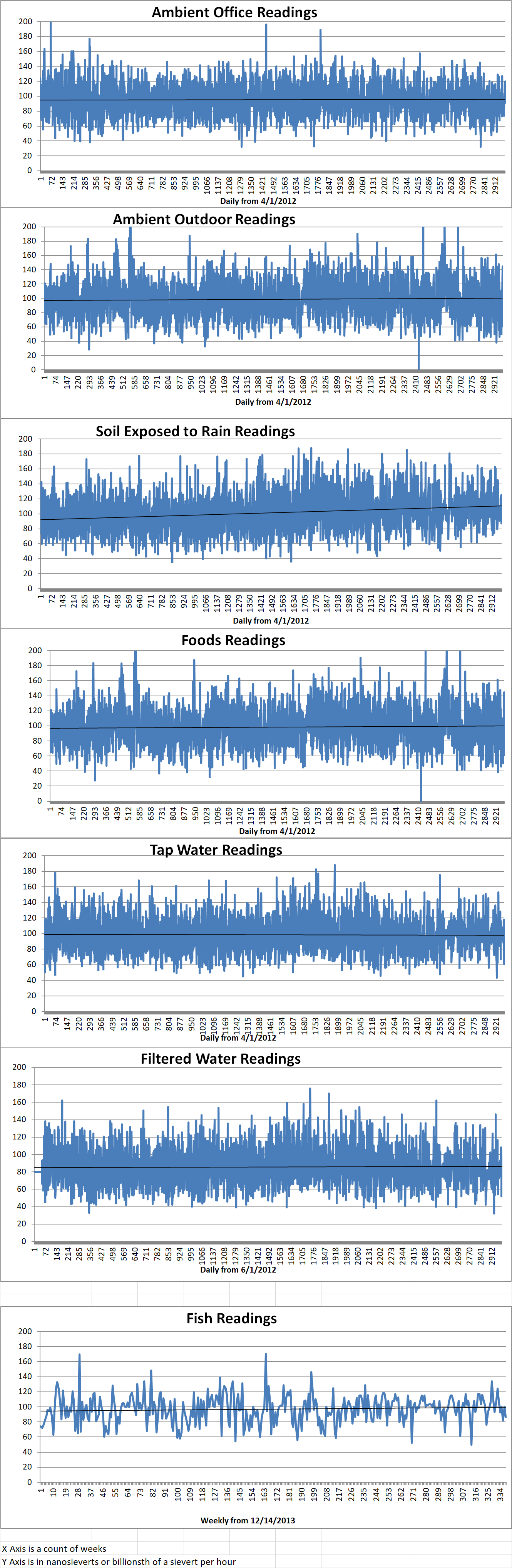
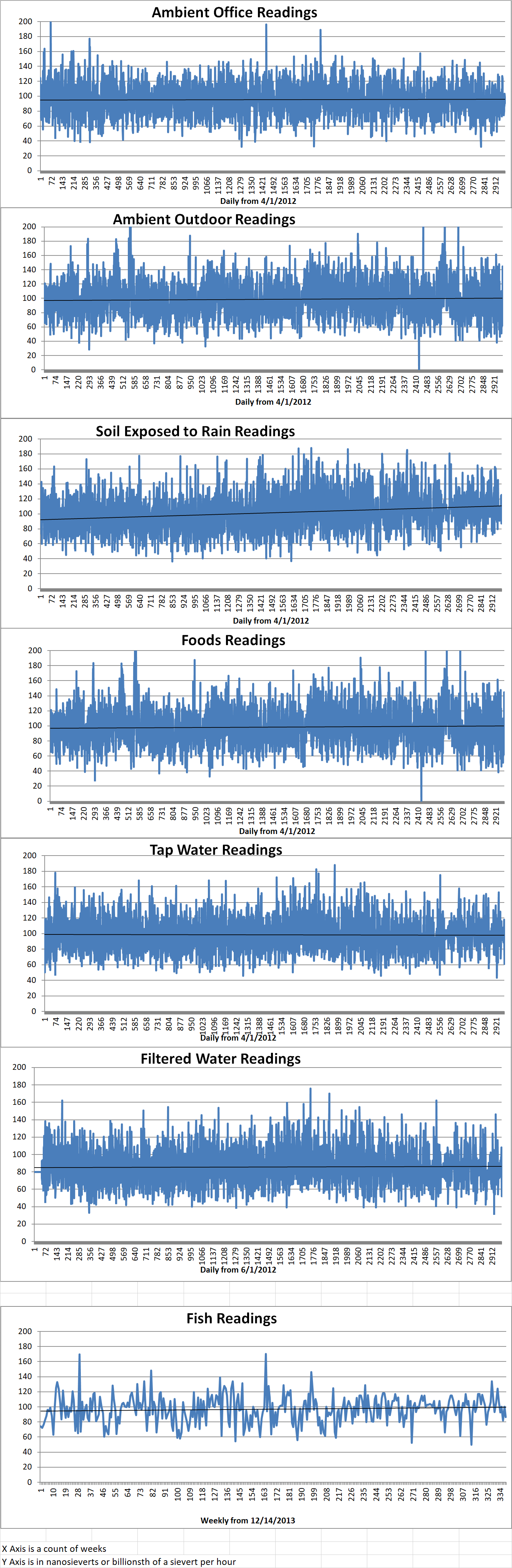
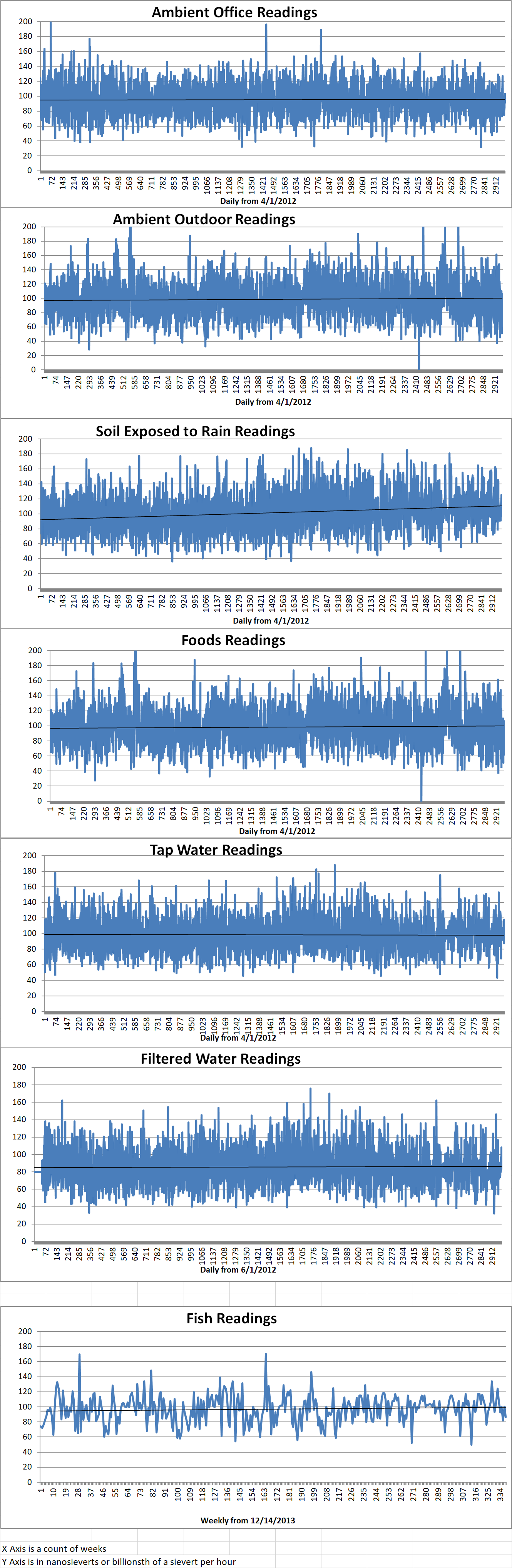
    Ambient office  = 120 nanosieverts per hour

    Ambient outside = 118 nanosieverts per hour

    Soil exposed to rain water = 121 nanosieverts per hour

    Avocado from Central Market = 122 nanosieverts per hour

    Tap water = 103 nanosieverts per hour

    Filtered water = 87 nanosieverts per hour

  • Nuclear Fusion 101 – Powerful Lasers And A  Mixture of Hydrogen and Boron Are Being Researched As The Basis For Nuclear Fusion Power Generation – Part 18 of 18 Parts

    Nuclear Fusion 101 – Powerful Lasers And A Mixture of Hydrogen and Boron Are Being Researched As The Basis For Nuclear Fusion Power Generation – Part 18 of 18 Parts

    Part 18 of 18 Parts (Please read Parts 1 thru 17 first)
         Hora estimates that a working protype of his hydrogen-boron reactor could be constructed for about one hundred million dollars. He admits that the cost might seem low, but the major expense would be obtaining a laser system similar to those already used in many laboratories. Japan’s Gekko is one such laboratory. Another laboratory which could possibly host a Hora reactor would be the PETawatt Aquitaine Laser (PETAL) in Bordeaux, France. This facility cost about fifty-five million dollars to build. It went into operation in 2015. The actual cost of a laser for a Hora reactor might be considerably less because the PETAL laser was designed for a variety of uses.
         There is still a major problem than needs to be solved. Both the Gekko XII and the PETAL require up to an hour to build up energy between pulses. It will be a challenge to attain much high pulse repletion rates required for a Hora reactor. There is a great deal of international research being carried out to increase the pulse rate of powerful lasers.
         At this time, the prospects for development of a Hora prototype look promising. However, as Hora himself stresses, a series of issues must be resolved to ensure that there are no unforeseen barriers and to obtain more precise parameters for the design of his reactor. Fortunately, the required experimental and computational investigations do not demand investment in new facilities and new expertise. Both of these are readily available in laboratories around the world. This will greatly reduce the cost and risk of building the first Hora prototype reactor. One of the priorities for Hora’s company, HB11 Energy, is to raise the necessary funds and distribute tasks to suitable research groups. If Hora is successful, his reactor may usher in an age of clean and cost-effective electricity production.
         One of the main concerns for any type of energy generation is the cost and availability of the fuel. For the hydrogen-boron fuel, the first element is hydrogen. It is easy to separate water into hydrogen and oxygen. It can even be accomplished by using sunlight to generate the necessary electricity. So hydrogen gas will be cheap and readily available. Since it depends on breaking down water, there are no restrictions on where deposits can be found and exploited.
          The second element is boron which has the symbol B and an atomic number of five. It is produced by cosmic ray spallation and supernovae but not by stellar nucleosynthesis. It has a low abundance in the crust of the Earth and is only one thousandths of the weight of the crust. Boron is concentrated on Earth by the solubility in water of its more common compounds known as the borate minerals. These are mined as evoporites such as borax and kernite. The largest known deposits are found in Turkey which is the largest producer of boron minerals but the U.S. also mines and produces boron.
         Boron is used primarily in chemical compounds in many industrial process and products. Pure boron is difficult to produce because of contaminations by carbon and other elements. Global borax reserves are calculated to be over a billion metric tons. Annual production of boron from a single U.S. mine is about a quarter of the annual four million tons. The average cost of crystalline boron is about five dollars per gram. Considering the known reserves of boron, there should be plenty of cheap boron available to power hydrogen-boron nuclear fusion reactors for decades.

  • Geiger Readings for Aug 20, 2020

    Geiger Readings for Aug 20, 2020

    Ambient office  = 91 nanosieverts per hour

    Ambient outside = 87 nanosieverts per hour

    Soil exposed to rain water = 87 nanosieverts per hour

    Tomato from Central Market = 145 nanosieverts per hour

    Tap water = 61 nanosieverts per hour

    Filtered water = 52 nanosieverts per hour

  • Nuclear Fusion 100 – Powerful Lasers And A  Mixture of Hydrogen and Boron Are Being Researched As The Basis For Nuclear Fusion Power Generation – Part 17 of 18 Parts

    Nuclear Fusion 100 – Powerful Lasers And A Mixture of Hydrogen and Boron Are Being Researched As The Basis For Nuclear Fusion Power Generation – Part 17 of 18 Parts

    Part 17 of 18 Parts (Please read Parts 1 thru 16 first)
        In 2012, the research group of Shinsuke Fujioka at the Institute of Laser Engineering in Osaka, Japan succeeded in generating fields of great intensity with a simple method that utilized laser pulses. For this experiment, they used the Gekko XII laser, built for laser fusion experiments. The laser produced a short nanosecond pulse with a power of about ten trillion watts.
         The experimental setup consisted of two parallel metal plates connected by a piece of wire shaped into a loop. One of the plates has a small circular hole in it through which the laser pulse can illuminate a small area of the opposing surface of the second plate. When the intense Gekko laser pulse hits the lower plate through the hole, it converts the upper layers of the metal of the plate into a plasma. The electrons are torn away from their nuclei and quickly accelerated to velocities near the speed of light.
         An enormous number of these electrons fly across the gap between the two plates and land on the upper plate which gives it a high negative charge. For an instant, the positively charged nuclei of the vaporized metal are left behind because they are much more massive than the electrons and are slower to respond.
         An enormous electric potential difference builds up between the upper and lower plates. This causes an electric current to flow through the wire that connects the two plates. The loop in the wire functions as a single-turn coil, generating an extremely intense magnetic field pulse. The Japanese researchers have measured magnetic fields strengths of over fifteen hundred Tesla which is more than strong enough for Hora’s requirements.
         The Hora reactor design should produce energy in the form of repeated microexplosions inside an explosion chamber. The rate of the laser pulses may be about one per second. Each microexplosion yields about one gigajoule of energy which is equivalent to around two hundred and eighty kilowatt hours. Calculating on the basis of one laser pulse per second, this would yield a gross power output of about one gigawatt which is the output of a conventional nuclear fission reactor.
          The fuel pellets for the microexplosions come in the form of long thin cylinders which are about a tenth of a millimeter in diameter and about a centimeter long. Each pellet contains about fourteen milligrams of hydrogen and boron. The fuel cylinder is suspended in small assembly with two capacitor plates connected by two conducting loops. The purpose of the loops is to generate a powerful magnetic field parallel to the cylindrical axis at the moment of the ignition of the microexplosion as demonstrated by the experiments of Fujioka and his team. Each microexplosion is generated using a pair of precisely-timed, nearly simultaneous ultra-short pulse from two lasers.
         The pulse from Laser 1 generates a powerful one thousand tesla magnetic field parallel to the cylindrical axis. The pulse for Laser 2 is focused on one end of the fuel cylinder. It ignites the hydrogen-boron reactions and sets off a “burn wave” than propagates through to the opposite end. The magnetic field is used to ensure that the plasma does not expand much until the burn-up is complete.
         
    Please read Part 18

  • Geiger Readings for Aug 19, 2020

    Geiger Readings for Aug 19, 2020

    Ambient office  = 92 nanosieverts per hour

    Ambient outside = 122 nanosieverts per hour

    Soil exposed to rain water = 125 nanosieverts per hour

    English cucumber from Central Market = 106 nanosieverts per hour

    Tap water = 103 nanosieverts per hour

    Filtered water = 93 nanosieverts per hour

  • Nuclear Fusion 99 – Powerful Lasers And A  Mixture of Hydrogen and Boron Are Being Researched As The Basis For Nuclear Fusion Power Generation – Part 16 of 18 Part

    Nuclear Fusion 99 – Powerful Lasers And A Mixture of Hydrogen and Boron Are Being Researched As The Basis For Nuclear Fusion Power Generation – Part 16 of 18 Part

    Part 16 of 18 Parts (Please read Parts 1 thru 15 first)
         Taking all of the ideas in the previous post into account, there is one more important idea necessary to proceed to a discussion of a hydrogen-boron prototype fusion reactor. There is one significant weak element in a reactor based on a cylindrical fuel pellet hit on the end by a single powerful laser pulse. There is nothing that will prevent the plasma from expanding radially outward toward the surface of the cylinder during the ignition process. When this happens, the density of the plasma drops which prevents an effective and complete burn-up of the fuel. We might get what could be called a “fizzle” instead of a full microexplosion.
         In order to solve this problem, Heinrich Hora borrowed a basic principle from what is called magnetic confinement fusion, a great competitor of laser fusion. A sufficiently powerful magnetic field which is directed parallel to the axis of the cylinder can counteract the tendency of the burning fuel to expand. The plasma is confined for the short instant that is needed for the fusion burn wave to propagate all the way to the far end of the cylinder.
          Magnetic confinement fusion exploits the fact that charged particles moving in a powerful magnetic field. encounter forces that cause them to spiral around the magnetic field lines. The plasma is thus trapped in the magnetic field.
        In an actual fusion reactor, the situation is complicated by the fact that the particles in the plasma create their own magnetic fields and this can interfere and even prevent them from being confined by an externally imposed “magnetic bottle.”
         Faced with such complex and difficult behavior, the pursuit of magnetic confinement fusion has pushed researchers toward ever-higher magnetic field strengths.  The huge International Thermonuclear Experimental Reactor (ITER), under construction in Cadarache, France, requires ten thousand tons of giant superconducting magnets to confine its plasma in a twenty-foot radius toroidal chamber.
         ITER’s magnets are designed to generate a magnetic field strength of about ten to twelve Tesla. This is about six times the strength of the fields utilized by the nuclear magnetic resonance imaging (MRI) machines used in hospitals. The natural magnetic field of the Earth is between a quarter and a half microtesla.
         By contrast, calculations for the radial confinement of the burning cylinder of fuel in Hora’s proposed nuclear fusion reactor require magnetic fields of over a thousand Tesla which is a hundred times stronger than the fields required by ITER. However, this field strength is only necessary in a very tiny volume.
         In 2018, scientists at the Institute for Solid State Physics at the University of Tokyo in Japan created the strongest magnetic field ever recorded. It was also sustained longer than other extreme magnetic fields. They used a technique called electromagnetic flux compression to generate a field of over twelve hundred Tesla. Russian scientist have been able to create a field of over twenty eight hundred Tesla, but they lost control and their equipment blew up. In any case, fields strengths of over a thousand Tesla should be available for use in a hydrogen-boron fusion reactor.
    Please read Part 17 next

  • Geiger Readings for Aug 18, 2020

    Geiger Readings for Aug 18, 2020

    Ambient office  = 97 nanosieverts per hour

    Ambient outside = 91 nanosieverts per hour

    Soil exposed to rain water = 100 nanosieverts per hour

    White onion from Central Market = 62 nanosieverts per hour

    Tap water = 118 nanosieverts per hour

    Filtered water = 108 nanosieverts per hour