
Part 13 of 18 Parts (Please read Parts 1 thru 12 first)
Heinrich Hora’s calculations found impressive experimental confirmation in an experiment carried out by the German laser physicist Roland Sauerbrey in Göttingen in 1996. Sauerbrey subjected a foil target to pulses from an excimer laser that lasted less than a trillionth of a second which is called a picosecond. Two portions of the plasma formed and acceleration in opposite directions at high speeds. One of the portions traveled toward the laser and the other on traveled away from the laser. The accelerations that were measured by Sauerbrey were huge. They were on the order of one hundred million billion times the acceleration of Earth’s gravity.
These accelerations observed by Sauerbrey are many orders of magnitude greater than those that could have been caused by heat expansion alone. It is obvious that some other natural forces are in effect in these experiments. These natural forces can only be what Hora calls the ponderomotive force of the laser field. In the paper that he published in the Physics of Plasmas journal, he said, “The results demonstrate that during the short subpicosecond laser pulse the plasma motion is actually dominated by acceleration rather than by a constant expansion velocity. The measured accelerations are among the highest accelerations that have been generated in the laboratory for macroscopic objects.” Sauerbrey’s measurements agreed in all ways with the predictions of Hora.
Sauerbrey is not the only scientist who confirmed Hora’s predictions. Hungarian laser physicist István Földes and his team demonstrated accelerations similar to Sauerbrey’s results in their experiments with carefully tailored ultrashort laser pulses in 2000. Within one trillionth of a second portions of the plasma achieved velocities of over sixty miles per second. Hora’s calculations indicate that velocities a hundred times greater than Földes obtained could ultimately be reached. Could these portions of plasma provide the “piston” that we need to compress fusion fuel to achieve ignition?
The ponderomotive force has emerged from being a small corrective term in a mathematical equation into a well-established physical phenomena. This has potentially revolutionary technological applications. Aside from nuclear fusion, the nonlinear forces exerted by laser pulses can be utilized in miniaturized particle accelerators for use in medicine, science and industry. A table-top device may soon replace a linear accelerator or cyclotron which fills a large hall or is even miles long.
Starting in the late 1990s, the Chinese physicist Zhang Jie and others carried out experiments that established clarity on a significant point. They found that the interaction between a laser pulse and a target changes dramatically when the pulse length is reduced from billionths of a second to trillionth of a second. The phenomena becomes much simpler. Research into laser fusion by ablation has been plagued by instabilities in the motion of the plasma created by the laser pulse. This prevents an effective compression of the fuel. It appears that the ablative approach to laser fusion may be a dead end.
Please read Part 14
Blog
-

Nuclear Fusion 96 – Powerful Lasers And A Mixture of Hydrogen and Boron Are Being Researched As The Basis For Nuclear Fusion Power Generation – Part 13 of 18 Parts
-
Nuclear News Roundup Aug 13, 2020
Department of Health cancels potassium iodide pill distribution, asks residents near nuclear plants to request them pahomepage.com
E.ON sells German nuclear power ahead at above-market prices reuters.com
And the nuclear waste? Timesargus.com
Fort Worth doesn’t need dangerous nuclear waste rolling through on Tarrant rail lines star-telegram.com
-

Geiger Readings for Aug 13, 2020
Ambient office = 80 nanosieverts per hour
Ambient outside = 91 nanosieverts per hour
Soil exposed to rain water = 92 nanosieverts per hour
Avocado from Central Market = 51 nanosieverts per hour
Tap water = 108 nanosieverts per hour
Filtered water = 87 nanosieverts per hour
-

Nuclear Fusion 95 – Powerful Lasers And A Mixture of Hydrogen and Boron Are Being Researched As The Basis For Nuclear Fusion Power Generation – Part 12 of 18 Parts
Part 12 of 18 Parts (Please read Parts 1 thru 11 first)
Heinrich Hora is a plasma physicist. He worked for Westinghouse as a young man in the 1960s. As part of his job, he examined hundreds of photographs of plasmas generated by the impact of laser pulses on targets. He observed that pictures of the actual phenomena did not match the simplified models of laser-matter interactions that were used in most of the plasma research at that time. Hora developed new equations of motion for laser-generated plasmas that included, in addition to the well-known pressure force generated by heating, a new “nonthermal” force term derived from the powerful electric and magnetic fields generated by the laser pulses.
The presence of such electric and magnetic fields was to be expected. After all, light itself is composed of rapidly varying electric and magnetic fields. In powerful laser pulses, these fields achieve such high intensities that their effect can be radically different than that of ordinary light. An analogy can be drawn with the way that a passing wave in water causes objects floating on the surface to bob up and down. A breaker wave generates very powerful forward motion that surfers exploit. The transition from a normal wave to a breaker wave is an example of a non-linear effect. Another example of a non-linear effect that is relevant to laser fusion is the formation of a powerful shockwave when a medium is rapidly compressed. This occurs when an aircraft crosses the sound barrier.
Hora referred to the additional, nonlinear force term in his equations as the “ponderomotive force.” Hora’s calculations and experimental results suggested that laser energy could be converted very efficiently into coherent directed motion of parts of the plasma as opposed to merely being dissipated as heat. Calculations that Hora made in 1978 indicated that it might be possible for the efficiency of the conversion to be as high as ninety nine percent with a corresponding reduction of thermal effects.
Hora assumed that the effect might be harnessed in order to ignite nuclear fusion. This could be done in different and much more efficient ways than the conventional process of ablative implosion. This was the beginning of a long journey that lead to his present design for a hydrogen-boron reactor.
Hora’s work on the ponderomotive force was not received with much enthusiasm by the mainstream laser fusion research community. One reason may be that the calculations were terribly complex. The tendency of researchers confronted with complex calculations is try to simplify their equations. It is common practice to remove terms from the equations that are expected to have a very minor effect on the solution. However, under some physical conditions, the “minor” effects can suddenly become quite large.
Another reason for the lack of interest by most of the laser fusion research community was the fact that that laser pulses called for in the nonthermal approach were much longer than the usual pulse length, not very powerful and not “clean” enough to produce the pondermotive force in a way that was indisputable. This situation began to change when chirped pulse amplification and ultra-short-pulse ultra-high-power lasers were developed.
Please read Part 13 -
Nuclear News Roundup Aug 12, 2020
Varcoe: Alberta studies nuclear power again — this time, it’s small modular reactors calgaryherald.com
SA faith leaders against extending the life of Koeberg nuclear power plant iol.co.za
Berkeley granted land use permit for Salamanca world-nuclear-news.org
Kerr: Army finally tearing down Fort Belvoir’s nuclear plant insidenova.com
-

Geiger Readings for Aug 12, 2020
Ambient office = 74 nanosieverts per hour
Ambient outside = 108 nanosieverts per hour
Soil exposed to rain water = 108 nanosieverts per hour
Tomato from Central Market = 73 nanosieverts per hour
Tap water = 102 nanosieverts per hour
Filtered water = 93 nanosieverts per hour
-
Nuclear Fusion 94 – Powerful Lasers And A Mixture of Hydrogen and Boron Are Being Researched As The Basis For Nuclear Fusion Power Generation – Part 11 of 18 Parts
Part 11 of 18 Parts (Please read Parts 1 thru 10 first)
Laser based nuclear fusion has the potential to become the Number One energy source for humanity for the foreseeable future. Aside from the virtually unlimited fuel available, laser fusion also has huge energy and power densities. The growth in power-densities of energy sources has been part of technological progress down through history. It correlates strongly with significant increases in the real physical productivity of society.
Unfortunately, it is extremely hard to ignite a self-sustaining “fusion fire.” Temperatures of hundreds of millions of degrees are required for the deuterium-tritium reaction and billions of degrees for the hydrogen-boron fusion reaction without the generation of radioactivity. At much lower temperatures than required for either type of fusion, the fuel is converted into a plasma which is capable of extremely complicated behaviors.
Technically speaking, the extreme temperatures mentioned above only apply to thermonuclear fusion. The fusion reactions are produced by the random collisions of atomic nuclei bouncing around in a hot medium. In addition to extreme temperatures, it is necessary to subject the plasma to extreme pressure. It is also possible to trigger fusion more easily in highly non-equilibrium states. In such states, the very concept of temperature does not apply. This is the basis of hydrogen-boron fusion.
Returning to consideration of thermonuclear fusion, a useful metaphor is an internal combustion engine. Compression by the rising piston is necessary to create the conditions required for a rapid, efficient and complete combustion of the fuel. Without the compression, the gasoline vapor would burn gently without generating much power. Compression also causes heating. The compression in a diesel engine is so great that it achieves the ignition temperature for the mixture of fuel and air.
The compression factor for diesel engines is between fifteen and twenty times. By way of comparison, the compressions required to ignite laser fusion are approximately fifty billion times bigger. The question could be asked what kind of “piston” would be able to generate such huge pressures?
Up to the present, there has been a single basic approach that has dominated laser fusion research, and it has consumed by far the biggest share of financial resources available for laser fusion. This approach is referred to as ablative or radiation implosion. A tiny spherical fuel pellet is hit from all sides at the same time by laser pulses. X-rays generated by the laser pulses may also be used. The outer layer of the pellet is instantly raised to enormous temperatures and it expands explosively which is referred to as “ablation.” This sudden expansion exerts huge pressure on the inner layers of the fuel pellet causing it to implode. This compresses the fuel to tremendous densities. The shock waves which are generated by the compression and force toward the center of the fuel pellet play an important role in the subsequent fusion ignition process.
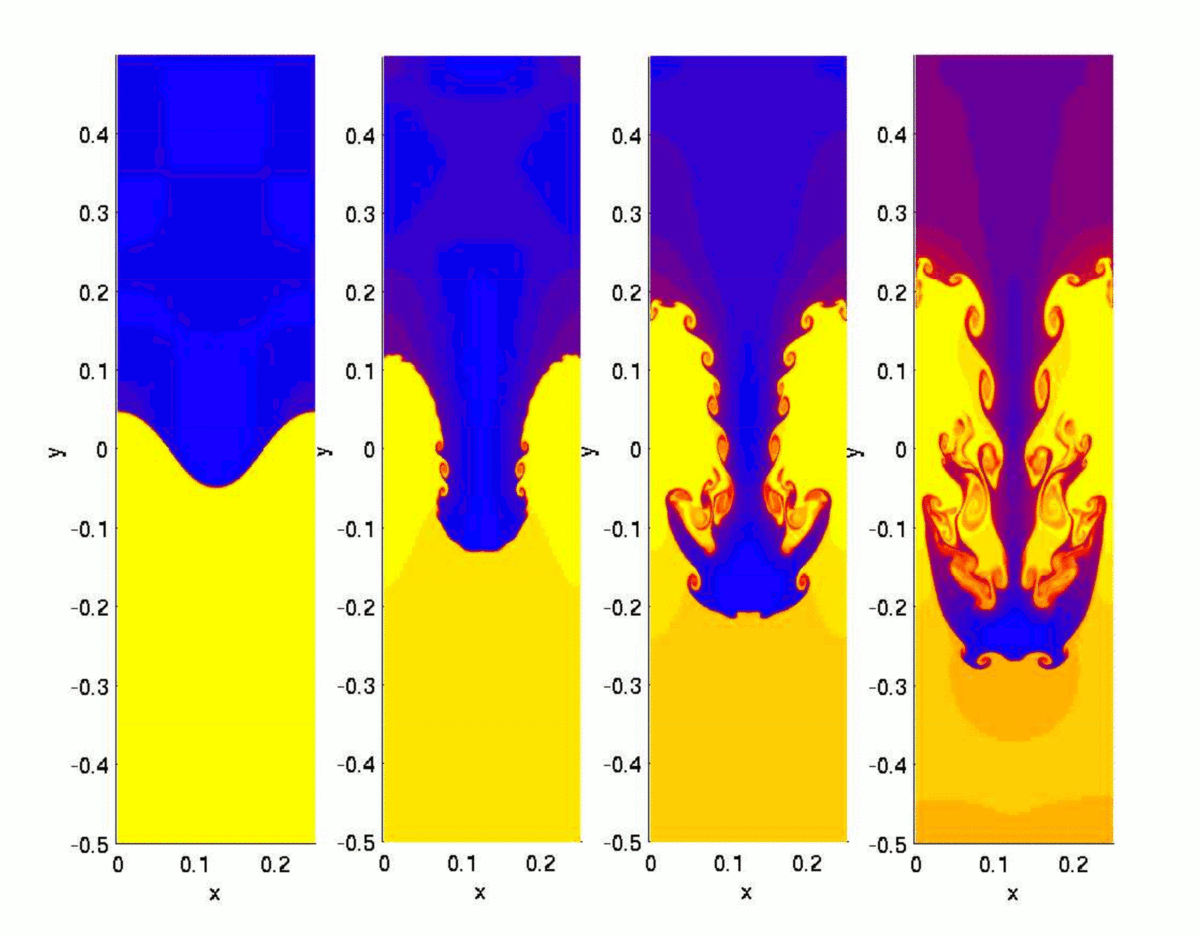
Unfortunately, this process has many problems. One of the main issues is something called the Rayleigh-Taylor instability. At the boundary between the outer and inner layers of the fuel pellet, slight undulations appear. They rapidly grow and penetrate deep into the fuel pellet which disrupts the compression and ignition process. Many creative solutions and expensive countermeasures have been tried but none of them could tame the Rayleigh-Taylor instability.
Please read Part 12 next -
Nuclear News Roundup Aug 11, 2020
Rosatom begins fuel loading at first Belarusian nuclear plant power-eng.com
Second Belarus Nuclear Plant Reactor expected to be completed by 2022. Constructionreviewonlines.com
Lacey postpones Oyster Creek nuclear waste hearing after crowd grows too big app.com
Kenya seeks regulatory approval for NPP neimagazine.com
-

Geiger Readings for Aug 11, 2020
Ambient office = 93 nanosieverts per hour
Ambient outside = 89 nanosieverts per hour
Soil exposed to rain water = 91 nanosieverts per hour
Red bell pepper from Central Market = 100 nanosieverts per hour
Tap water = 102 nanosieverts per hour
Filtered water = 84 nanosieverts per hour
-

Nuclear Fusion 93 – Powerful Lasers And A Mixture of Hydrogen and Boron Are Being Researched As The Basis For Nuclear Fusion Power Generation – Part 10 of 18 Parts
Part 10 of 18 Parts (Please read Parts 1 thru 9 first)
For the first time, in the mid-1980s Gérard Mourou and his then-student Donna Strickland, working at the University of Rochester Laser Laboratory succeeded in the application of the “chirping” concept to the problem of amplifying ultra-short laser pulse. They used a pair of diffraction gratings in place of the delay network used in radar systems. These gratings separate different frequencies of light in the short pulse into a “rainbow” of frequencies. This forces the higher frequencies to go through a longer path than the lower frequencies.
This system causes the higher frequency components of the pulse to lag behind as the pulse travels into the amplifier. The original, weak but ultra-short pulse produced by the laser oscillator is stretched out by the first pair of diffraction gratings into a one thousand plus longer pulse of rising frequency. The resulting “stretched” pulse runs through a laser amplifier where the total energy can be increase to huge powers without causing damage to the amplifier components. Finally, a second pair of diffraction gratings operates in reverse to reassemble the long pulse at the exit to the system into a single ultra-short of tremendous power. The pulse can be amplified by trillions of times.
With the advent of chirped pulse amplifications, femtosecond-range lasers with powers in the millions of billions of watts or petawatts are operating in laboratories around the world.
When such a pulse from a laser is focused on a target, incredible things occur from the domain of nuclear physics and elementary particle physics. These phenomena include transmutation of atoms and other nuclear reactions, generation of ultra-high energy particle beams and the acceleration of macroscopic object known as plasma blocks to speeds of one thousand kilometers per second and beyond.
Despite their huge intensity, laser pulses with sharp edges (high contrast ratio) generate almost no heat when they pass through physical materials. Instead, their energy is converted into organized, directed processes. Heat has no time to develop and only appears later when the process is completed.
As laser intensities continue to increase at an exponential rate, theoretical physicists are dreaming of reaching intensities at which something called “vacuum breakdown” occurs in which matter is created “out of nothing” from energy alone can be observed directly.
Internationally, there is a race to reach higher and higher pulse powers, pulse intensities and the number of pulses that can be produced per minute. The European Extreme Light Infrastructure (ELI) project will produce laser powers in the ten petawatt range. China’s Shanghai Superintense Ultrafast Laser Facility (SULF) hopes to reach levels of one hundred petawatts by 2023. Russia’s projected Center for Extreme Light Studies (XCELS) is planned to reach two hundred petawatts with future plans of going as high as one thousand petawatts. The US is racing to regain the leader with the Zettawatt-Equivalent Ultrashort Pulse Laser System (ZEUS) to be built at the University of Michigan. Zeus will utilize colliding laser and electron beams to reach powers of a million petawatts or one zettawatt.
There is no lack of credible promises of practical applications such as new materials and production methods, applications to medical diagnosis and treatment, the treatment and elimination of nuclear waste and last, but certainly not least, nuclear fusion for commercial power generation. However, the best anticipated form of nuclear fusion which produces no radioactivity is the hydrogen-boron approach and that does not depend on any of the megaprojects mentioned above.
Please read Part 11 next