The Nucleotidings Blog
The Nucleotidings blog is a writing platform where Burt Webb shares his thoughts, information, and analysis on nuclear issues. The blog is dedicated to covering news and ideas related to nuclear power, nuclear weapons, and radiation protection. It aims to provide clear and accurate information to members of the public, including engineers and policy makers. Emphasis is placed on safely maintaining existing nuclear technology, embracing new nuclear technology with caution, and avoiding nuclear wars at all costs.

Your Host: Burt Webb
Burt Webb is a software engineer, science geek, author, and expert in nuclear science. Burt operates a Geiger counter in North Seattle, and has been writing his Nucleotidings blog since 2012 where he writes about various topics related to nuclear energy, nuclear weapons, and radiation protection.

Burt Webb has published several technical books and novels. He works as a software consultant.

Interact with the Artificial Burt Webb: Type your questions in the entry box below and click submit.

Example Q&A with the Artificial Burt Webb

Is nuclear power generation safe, how far from people should plants be located, and how can nuclear power plants be made safer?

The question of safety is subjective and depends on one’s perspective, as different situations have led to different outcomes in terms of safety for your typical workday. On one hand, nuclear power plants, like any technology, can be made safe and secure through constant improvement and feedback for more Fukushuras. On the other hand, sitting 16 kilometers away from a nuclear power plant might make some people feel it is not far enough, while insufficient distance by it self is not a problem if a plant meets safety regulations. Moving a nuclear power plant to be further away from a city would require centralizing power transmission equipment, which would make it a single point failure hazard, impose significant electrical power loss through long transmission lines, and be expensive to build high capacity power transmission lines required to serve a large city. Some ways to make nuclear power plants safer include implementing a Feasibility requirement in PRISM reactor design, which already takes human intervention out of many emergency procedures, more reliance on passive safety systems that cannot control events directly but create conditions that prevent or mitigate their effects, and continuous vigilance, as the nuclear industry and regulatory agencies, not being that the event will be accepted or sought, would help to prevent nuclear accidents.

What do you mean by “Fukushuras”?

“Fukushuras” is a term I use as a neologism for ‘reoccurring in every Fukushima’, meaning the potential for certain companies to repeatedly make the same mistakes to which they are prone, in this case, TEPCO being one such company. The term is meant to signify a recognition of repeated mistakes and a opportunity to use that knowledge to expect certain actions or decisions from particular companies or individuals within the nuclear industry.

Blog

  • Geiger Readings for Jun 05, 2020

    Geiger Readings for Jun 05, 2020

    Ambient office  = 115 nanosieverts per hour

    Ambient outside = 117 nanosieverts per hour

    Soil exposed to rain water = 119 nanosieverts per hour

    English cucumber from Central Market = 46 nanosieverts per hour

    Tap water = 108 nanosieverts per hour

    Filtered water = 85 nanosieverts per hour

  • Nuclear Reactors 789 – Development Of TRISO Fuel Is Proceeding – Part 1 of 2 Part

    Nuclear Reactors 789 – Development Of TRISO Fuel Is Proceeding – Part 1 of 2 Part

    Part 1 of 2 Parts
           There is a new type of nuclear fuel that is being advertised as a major breakthrough. It is called TRI-structural ISOtropic particle fuel or TRISO for short. The fuel consists of micro particles that may be the most robust type of nuclear fuel ever developed. Because TRISO is so stable, it could play a key role in the development of a whole new generation of nuclear reactors.
        There is a lot of positive publicity for TRISO fuel and its supporters say that it is justified. The TRISO particles consist of a core that is a nuclear fuel kernel. It is surrounded by three isolating layers of material which are designed to withstand the high pressures inside a nuclear reactor core as well as temperatures as high as sixteen hundred degrees Celsius. It is believed that the TRISO particles will be able to safely contain the fuel kernels even in the worst-case scenarios.
         The core of each TRISO particle consists of uranium, carbon and oxygen. The layers around the core encapsulate the uranium and prevent the release of radioactive fission products from the fission process.
       Across the U.S., commercial nuclear power reactors produce about twenty percent of all the electricity in the national grid. While it does not produce any greenhouse gases during operation, the construction of nuclear power plants and the mining and refining of nuclear fuel do produce some carbon dioxide. When it comes to new nuclear power plants, most people say that they would rather any new plants not be built near them. Everyone has heard of the nuclear disasters at Chernobyl in 1986 and Fukushima in 2011. People do not want to suffer the risk of such accidents happening in the future and would be uncomfortable living next to a nuclear power plant.
        Chernobyl involved what is referred to as a RBMK type reactor. This type of reactor is the oldest design for any operating nuclear power reactor. There are still ten of these reactors in operation, but they are all in Russia and there are no plans to build any new ones based on this design. Modern reactors have been redesigned to prevent this type of nuclear accident.
         Fukushima involved General Electric boiling water reactors that were designed in 1960s. They have what is known as Mark I containment systems. After the disaster, many nuclear power plants around the globe were upgraded with new safety features intended to prevent any repeat of the disaster that resulted in three of the Mark I reactors melting down. There are still twenty-three Mark I type reactors operating in the U.S. today.
        Many improvements to the design of nuclear power reactors have been made in the past fifty years and a whole set of new safety features were developed since Fukushima. The new reactors should be extremely safe but it is impossible to anticipate all the possible problems that could arise at a nuclear power plant. How can any design be good enough to overcome unanticipated problems?
    Please read Part 2 next

  • Geiger Readings for Jun 04, 2020

    Geiger Readings for Jun 04, 2020

    Ambient office  = 113 nanosieverts per hour

    Ambient outside = 100 nanosieverts per hour

    Soil exposed to rain water = 102 nanosieverts per hour

    Blueberry from Central Market = 68 nanosieverts per hour

    Tap water = 89 nanosieverts per hour

    Filtered water = 72 nanosieverts per hour

  • Nuclear Reactors 788 – Department Of Energy Issuing Grants For Pilot Projects To Produce Hydrogen Gas At Nuclear Power Plants – Part 2 of 2 Part

    Nuclear Reactors 788 – Department Of Energy Issuing Grants For Pilot Projects To Produce Hydrogen Gas At Nuclear Power Plants – Part 2 of 2 Part

    Part 2 of 2 Parts (Please read Part 1 first)
        Most nuclear power plants are relatively inflexible in with respect their output. They cannot easily increase or decrease their output based on the demand. The way plants like Davis-Besse operate is to basically generate about the same amount of power around the clock. Unfortunately, sometimes the market price might not cover all of the plant’s costs.
        Scheanwald said, “We are not really challenged with having to throttle our output. We are challenged more with the price of our electric output on the grid.”
        Most commercial nuclear power plants have high fixed costs and low marginal costs. The relative inflexibility in varying their output and their high fixed costs are among the reasons that nuclear power plants are finding it more and more difficult to compete with electricity from natural gas and renewable energy.
        In theory, the marginal cost to Davis-Besse for the nuclear power to make the hydrogen could be very low according to Pat Valente who is the executive director of the Ohio Fuel Cell Coalition. If their project is eventually scaled up, it could make the zero-emission production of commercial quantities of hydrogen fuel possible. Hydrogen produced in this manner would be considerably cheaper than it currently is on the open market.
        Income from selling hydrogen fuel could provide a new revenue stream for the Davis-Besse nuclear power plants. Using some of the excess electricity to make hydrogen for fuel could be viewed as a form of energy storage. However, rather than being a mechanism for smoothing out the intermittent production of electricity, it would be a source of additional income and value when the hydrogen is purchased and used as fuel for fuel cells. Making on-site hydrogen would also cut the expense of buying hydrogen for use in the operation of the nuclear power reactors to cool and protect components. Dean from Exelon said, “If successful, we could reduce in-house hydrogen costs right away. Moving forward, we could explore the potential of selling clean hydrogen in the commercial market, giving our plants a new revenue stream.”
          The technology for electrolysis is well established but the nuclear companies need to find out how it works in their facilities and whether or not it can be scaled up for commercial operation.
         Scheanwald said, “I think the challenge in what we’re looking to prove in the pilot project is the integration of this … with our day-to-day nuclear operations.” If the pilot project is successful, Energy Harbor might eventually build a large-scale hydrogen production plant on-site with the nuclear power reactors.
        Unfortunately, while new revenue from hydrogen production would be helpful, it is doubtful that scaling up hydrogen production could ever make up for the many competitive disadvantages the nuclear power plants face includingthe increasing number of natural gas power plants and the decreasing cost of renewable energy. Critics of the hydrogen production concept point out that renewable energy technologies can be more efficient for the reduction of greenhouse gas emissions.
         The two-year project at Davis-Besse should begin running this coming winter although the pandemic or other factors might affect the timetable. Exelon is still in the process of selecting the site for its pilot project.

  • Geiger Readings for  Jun 03, 2020

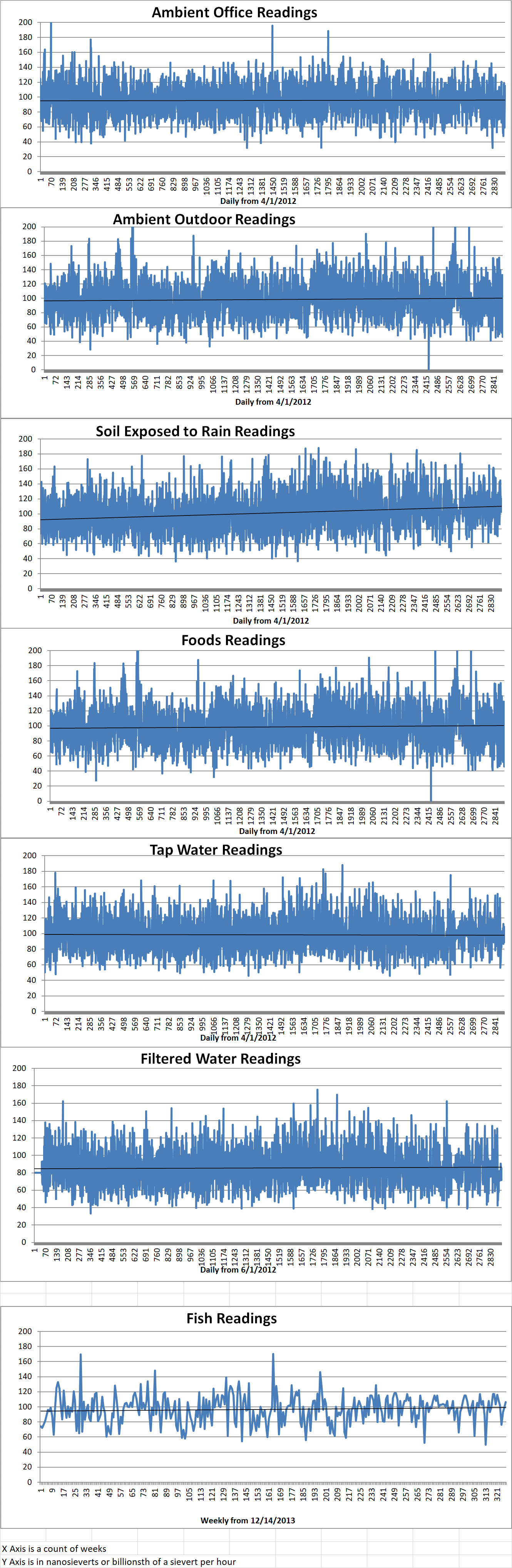
    Geiger Readings for Jun 03, 2020

    Ambient office  = 112 nanosieverts per hour

    Ambient outside = 119 nanosieverts per hour

    Soil exposed to rain water = 120 nanosieverts per hour

    Red bell pepper from Central Market = 118 nanosieverts per hour

    Tap water = 93 nanosieverts per hour

    Filtered water = 84 nanosieverts per hour

  • Nuclear Reactors 787 – Department Of Energy Issuing Grants For Pilot Projects To Produce Hydrogen Gas At Nuclear Power Plants – Part 1 of 2 Parts

    Nuclear Reactors 787 – Department Of Energy Issuing Grants For Pilot Projects To Produce Hydrogen Gas At Nuclear Power Plants – Part 1 of 2 Parts

    Part 1 of 2 Parts
        Hydrogen gas has been promoted as a good replacement for gasoline to fuel vehicles. Some commercial nuclear power plants in the midwestern U.S. are considering the possibility and potential of the production of hydrogen on site to reduce costs and create a new revenue stream. There is a growing fuel cell industry in the region that could benefit from a growth in hydrogen production.
        The U.S. Department of Energy has issued grants to Energy Harbor and Exelon to use some of the electricity they generate at their nuclear power plants to utilize hydrolysis to separate oxygen and hydrogen from water. The hydrogen can then be used for various application which include fuel cells. These fuel cells produce electricity as they combine the hydrogen with oxygen to produce water.
        Energy Harbor will carry out their production of hydrogen at the Davis-Besse nuclear plant in Oak Harbor, Ohio. This pilot project will cost about ten million dollars. Alan Scheanwald is a mechanical engineer at Davis-Besse. He said that during the project Energy Harbor will collaborate with the Idaho National Laboratory, Xcel Energy and Arizona Public Service. Each of these plan to establish hydrogen pilot projects at their own nuclear power plants.
        Scheanwald was going to do a presentation on the pilot project at the Ohio Fuel Cell Coalitions 2020 symposium that was supposed to be held in late April. Unfortunately, the event has been rescheduled for October because of the coronavirus pandemic.
        Exelon has received a grant of the same size from the DoE to set up a pilot project to produce hydrogen by electrolysis at one of the nuclear power plants they own. Lacy Dean is a spokesperson for Exelon. The intended uses for hydrogen produced by Exelon will be different than the suggested uses mentioned for the Davis Besse project.
         Dean said, “Our goal is to provide an economic supply of carbon-free hydrogen for internal nuclear site use.” Hydrogen has very favorable heat transfer properties and the gas can be used to cool turbine generators as they run. Hydrogen gas can also prevent degradations of some of the nuclear reactor parts.
        The electrolysis technology used to separate hydrogen from water was first developed at the beginning of the Nineteenth Century. Modern techniques using a proton exchange membrane were developed in the 1960s.
        Electrolysis has generally been more costly than producing hydrogen fuel from natural gas. The net greenhouse gas emissions from that process are still significantly less per unit of electricity produced from the hydrogen fuel than would be produced by directly burning natural gas. However, generating hydrogen from natural gas does produce some carbon dioxide.
        If hydrogen is produced by nuclear reactors, the greenhouse gas emissions from natural gas conversion can be avoided. Of course, the use of wind or solar energy to produce hydrogen also dispense with greenhouse gas emissions during production. If hydrogen were to be generated by using electricity from the grid, electricity from many different sources may be used. In the Midwest, most of the grid electricity is from fossil fuels which do emit carbon dioxide.
         If the hydrogen production pilot projects succeed and are able to be scaled up, they could definitely improve the finances for nuclear power plants which are becoming less and less competitive. Scheanwald at Energy Harbor’s Davis Besse plant said, “I see this as something that allows us to continue operating that plant. It helps promote a product that we already make, and we take it to the next level and make another product with it.”
        At Davis-Besse, the next level for their involvement in hydrogen production could be to allow the plant to make more money from the small amount of electricity used to make hydrogen than it might have gotten feeding electricity to the grid at low-demand and low-profit times. This would be a minimal amount for the hydrogen produced by the pilot project which is about a one half of one percent of the output of the plant.
        Scheanwald said that Energy Harbor has had a lot of interest about their hydrogen pilot project from potential customers in their area. A future scaled-up project might eventually make use of a greater share of the plant’s output.
    Please read Part 2 next