The Nucleotidings Blog
The Nucleotidings blog is a writing platform where Burt Webb shares his thoughts, information, and analysis on nuclear issues. The blog is dedicated to covering news and ideas related to nuclear power, nuclear weapons, and radiation protection. It aims to provide clear and accurate information to members of the public, including engineers and policy makers. Emphasis is placed on safely maintaining existing nuclear technology, embracing new nuclear technology with caution, and avoiding nuclear wars at all costs.

Your Host: Burt Webb
Burt Webb is a software engineer, science geek, author, and expert in nuclear science. Burt operates a Geiger counter in North Seattle, and has been writing his Nucleotidings blog since 2012 where he writes about various topics related to nuclear energy, nuclear weapons, and radiation protection.

Burt Webb has published several technical books and novels. He works as a software consultant.

Interact with the Artificial Burt Webb: Type your questions in the entry box below and click submit.

Example Q&A with the Artificial Burt Webb

Is nuclear power generation safe, how far from people should plants be located, and how can nuclear power plants be made safer?

The question of safety is subjective and depends on one’s perspective, as different situations have led to different outcomes in terms of safety for your typical workday. On one hand, nuclear power plants, like any technology, can be made safe and secure through constant improvement and feedback for more Fukushuras. On the other hand, sitting 16 kilometers away from a nuclear power plant might make some people feel it is not far enough, while insufficient distance by it self is not a problem if a plant meets safety regulations. Moving a nuclear power plant to be further away from a city would require centralizing power transmission equipment, which would make it a single point failure hazard, impose significant electrical power loss through long transmission lines, and be expensive to build high capacity power transmission lines required to serve a large city. Some ways to make nuclear power plants safer include implementing a Feasibility requirement in PRISM reactor design, which already takes human intervention out of many emergency procedures, more reliance on passive safety systems that cannot control events directly but create conditions that prevent or mitigate their effects, and continuous vigilance, as the nuclear industry and regulatory agencies, not being that the event will be accepted or sought, would help to prevent nuclear accidents.

What do you mean by “Fukushuras”?

“Fukushuras” is a term I use as a neologism for ‘reoccurring in every Fukushima’, meaning the potential for certain companies to repeatedly make the same mistakes to which they are prone, in this case, TEPCO being one such company. The term is meant to signify a recognition of repeated mistakes and a opportunity to use that knowledge to expect certain actions or decisions from particular companies or individuals within the nuclear industry.

Blog

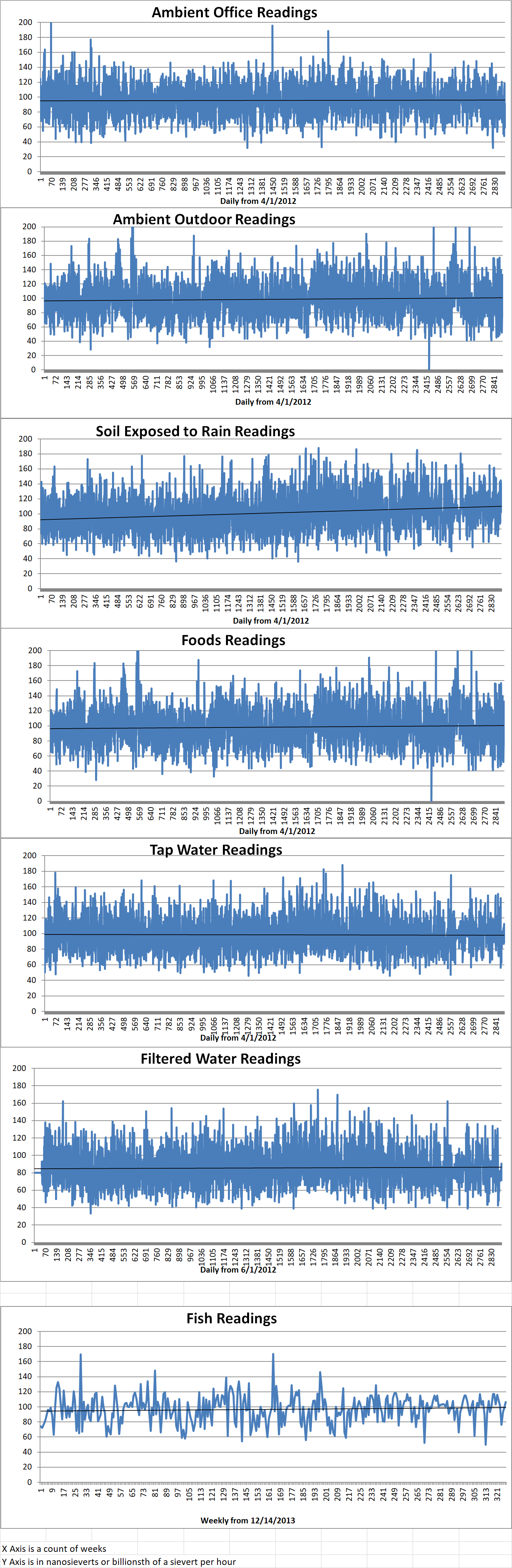
  • Geiger Readings for Jun 02, 2020

    Geiger Readings for Jun 02, 2020

    Ambient office  = 71 nanosieverts per hour

    Ambient outside = 100 nanosieverts per hour

    Soil exposed to rain water = 102 nanosieverts per hour

    Red bell pepper from Central Market = 133 nanosieverts per hour

    Tap water = 89 nanosieverts per hour

    Filtered water = 72 nanosieverts per hour

  • Geiger Readings for Jun 01, 2020

    Geiger Readings for Jun 01, 2020

    Ambient office  = 91 nanosieverts per hour

    Ambient outside = 93 nanosieverts per hour

    Soil exposed to rain water = 104 nanosieverts per hour

    Avocado from Central Market = 102 nanosieverts per hour

    Tap water = 94 nanosieverts per hour

    Filtered water = 84 nanosieverts per hour

  • Geiger Readings for May 31, 2020

    Geiger Readings for May 31, 2020

    Ambient office  = 59 nanosieverts per hour

    Ambient outside = 123 nanosieverts per hour

    Soil exposed to rain water = 123 nanosieverts per hour

    Seedless grapes from Central Market = 116 nanosieverts per hour

    Tap water = 113 nanosieverts per hour

    Filtered water = 91 nanosieverts per hour

  • Nuclear Reactors 786 – Oak Ridge National Laboratory Is Working On 3D Printing Of Nuclear Fission Reactor Components – Part 3 of 3 Parts

    Nuclear Reactors 786 – Oak Ridge National Laboratory Is Working On 3D Printing Of Nuclear Fission Reactor Components – Part 3 of 3 Parts

    Part 3 of 3 Parts (Please read Parts 1 and 2 first)
          Nicholas Brow is a nuclear engineer at the University of Tennessee in Knoxville. He says with respect to the construction of a nuclear power reactor, “Typically, this process can take decades and millions or billions of dollars.” He goes on to say that the cost of new parts is so high because certifying them usually involves a “cook and look” process. A new part is put into a test reactor to see if it performs correctly. Engineer often makes changes to the part based on the data they collect. This is an iterative process that continues until the performance of the part meets expectations. In the same way that nuclear reactor technologies are stuck in 1970, so are the processes for certifying them.
        Terrani expressed the hope that the large amount of data generated during the 3D printing process can help to speed up the certification process. This would lower the cost and the time required to construct a nuclear fission reactor. He said that printing a component the size of a human hand might generate as much as hundreds of gigabytes of information about the quality of the part being printed. If there is a defect, it will show up in the data. There will be no need of ultrasound scans or other expensive tests to find it.
         Instead of requiring a human being to sift through the huge amount of data generated by the 3D printer, researchers at ORNL are working on training a machine learning algorithm to use the data generated by the printer to verify the integrity of parts. Terrani says, “Once we make the stuff, we don’t have to come back and spend multiple months certifying things. Imagine the moment that you’re done making a part and the AI can tell you if it’s good or bad. That’s the dream.”
         The TCR’s gas-cooled system is basically a modified and enhanced version of the X-10 which was the first reactor ever constructed for continuous operation. The X-10 was built at the ORNL in the early 1940s. It went operational only nine months after construction began. That is extremely rapid when compared to the only reactor currently being constructed in the U.S. which is expected to have taken at least twelve years to complete from the start of construction. Terrani hopes that the new 3D printing technology, the new artificial intelligence algorithms and other new technologies will be able to bring this rapid pace of development back to the nuclear industry. Terrani says, “Nuclear power can’t be the only industry that doesn’t adopt any new technologies. We want to open the floodgates and see advanced nuclear power in this country.”
         The global nuclear industry is already moving to adopt new technologies and designs in the construction of what are called small modular reactors (SMRs). These reactors would produce three hundred megawatts or less of electricity. They would be constructed in factories in modules that could be transported to the site where they will be used. Some of the designs could even be portable in the sense that complete reactors could be built inside a freight container that could then be moved around to operate at different locations as needed. The combination of 3D printing with SMRs might be able to revitalize the nuclear industry and lead to cheaper and safer power reactors that could be constructed and certified rapidly.

  • Geiger Readings for May 30, 2020

    Geiger Readings for May 30, 2020

    Ambient office  = 59 nanosieverts per hour

    Ambient outside = 118 nanosieverts per hour

    Soil exposed to rain water = 113 nanosieverts per hour

    English cucumber from Central Market = 75 nanosieverts per hour

    Tap water = 108 nanosieverts per hour

    Filtered water = 83 nanosieverts per hour

    Dover sole – Caught in USA = 107 nanosieverts per hour

  • Nuclear Reactors 785 – Oak Ridge National Laboratory Is Working On 3D Printing Of Nuclear Fission Reactor Components – Part 2 of 3 Part

    Nuclear Reactors 785 – Oak Ridge National Laboratory Is Working On 3D Printing Of Nuclear Fission Reactor Components – Part 2 of 3 Part

    Part 2 of 3 Parts (Please read Part 1 first)
         Terrani and his team at ONRL recently finalized the preliminary design for the 3D-printed core at the center of their Transformational Challenge Reactor, or TCR. Most of the reactor will be constructed from conventional components. Only the core will be entirely 3D printed of silicon carbide which is an extremely rugged material that is almost impossible to melt. The core is the operational heart of a nuclear fission reactor. It holds the uranium and/or plutonium fuel assemblies where nuclear fission occurs. The new core at ORNL is less than eighteen inches tall. The reactor that contains it will only be a little bigger than a keg of beer. Terrani says that when their first prototype comes online in 2023, it will generate as much as three megawatts of energy which would be enough to supply the power needs of about a thousand average homes.
       The ORNL TCR reactor is an advanced gas-cooled reactor design that utilizes hydrogen as a coolant. Most operational nuclear fission power reactors in the U.S. today utilize water as a coolant. Gas-cooled reactor are very fuel efficient because of the high temperatures that they operate at. The TCR will operate about at one thousand two hundred degrees Fahrenheit. Terrani says that the 3D printed core of the TCR will make the efficiency even higher. Traditional machining techniques now employed in the manufacture of a nuclear fission reactor core constraint the design of the core. There is a complex network of cooling channels in the TCR core that are too small and complex for any conventional machining techniques. Because of the capabilities of 3D printing, engineers can now construct components that would have been impossible before.
        Terrani says, “We’re no longer stuck with boring geometries. Instead of an array of things that all look the same, you can change the design across the core and get your system to respond to the environment.”
         3D printing will also permit nuclear engineers to keep better track of what is happening inside the core once the reactor is operational. In conventional nuclear fission reactors, the behavior inside of the core has to be monitored from the outside. The new designs made possible by 3D printing will allow the engineers to embed sensors in the core during the printing process that will provide information about conditions in the core after it is in operation.
         3D printing will also give nuclear engineers greater control over the manufacturing process. Individual parts of the TCR core can be printed in under twenty-four hours. The entire core can be completely printed in a few weeks. While a part is being printed, a machine vision algorithm is acquiring data from infrared cameras and other types of sensors that will help it determine whether or not any defects occurred during the printing process.
         Terrani says that the next step in his project will be the real nuclear industry game changer. When a component for a nuclear fission reactor is manufactured in the conventional way, it is subjected to an expensive and slow certification process before it can be used. Terrani cites the example of a bolt that cost a few cents to make but was sold for twenty thousand dollars because it had been certified for nuclear systems.
    Please read Part 3 next