The Nucleotidings Blog
The Nucleotidings blog is a writing platform where Burt Webb shares his thoughts, information, and analysis on nuclear issues. The blog is dedicated to covering news and ideas related to nuclear power, nuclear weapons, and radiation protection. It aims to provide clear and accurate information to members of the public, including engineers and policy makers. Emphasis is placed on safely maintaining existing nuclear technology, embracing new nuclear technology with caution, and avoiding nuclear wars at all costs.

Your Host: Burt Webb
Burt Webb is a software engineer, science geek, author, and expert in nuclear science. Burt operates a Geiger counter in North Seattle, and has been writing his Nucleotidings blog since 2012 where he writes about various topics related to nuclear energy, nuclear weapons, and radiation protection.

Burt Webb has published several technical books and novels. He works as a software consultant.

Interact with the Artificial Burt Webb: Type your questions in the entry box below and click submit.

Example Q&A with the Artificial Burt Webb

Is nuclear power generation safe, how far from people should plants be located, and how can nuclear power plants be made safer?

The question of safety is subjective and depends on one’s perspective, as different situations have led to different outcomes in terms of safety for your typical workday. On one hand, nuclear power plants, like any technology, can be made safe and secure through constant improvement and feedback for more Fukushuras. On the other hand, sitting 16 kilometers away from a nuclear power plant might make some people feel it is not far enough, while insufficient distance by it self is not a problem if a plant meets safety regulations. Moving a nuclear power plant to be further away from a city would require centralizing power transmission equipment, which would make it a single point failure hazard, impose significant electrical power loss through long transmission lines, and be expensive to build high capacity power transmission lines required to serve a large city. Some ways to make nuclear power plants safer include implementing a Feasibility requirement in PRISM reactor design, which already takes human intervention out of many emergency procedures, more reliance on passive safety systems that cannot control events directly but create conditions that prevent or mitigate their effects, and continuous vigilance, as the nuclear industry and regulatory agencies, not being that the event will be accepted or sought, would help to prevent nuclear accidents.

What do you mean by “Fukushuras”?

“Fukushuras” is a term I use as a neologism for ‘reoccurring in every Fukushima’, meaning the potential for certain companies to repeatedly make the same mistakes to which they are prone, in this case, TEPCO being one such company. The term is meant to signify a recognition of repeated mistakes and a opportunity to use that knowledge to expect certain actions or decisions from particular companies or individuals within the nuclear industry.

Blog

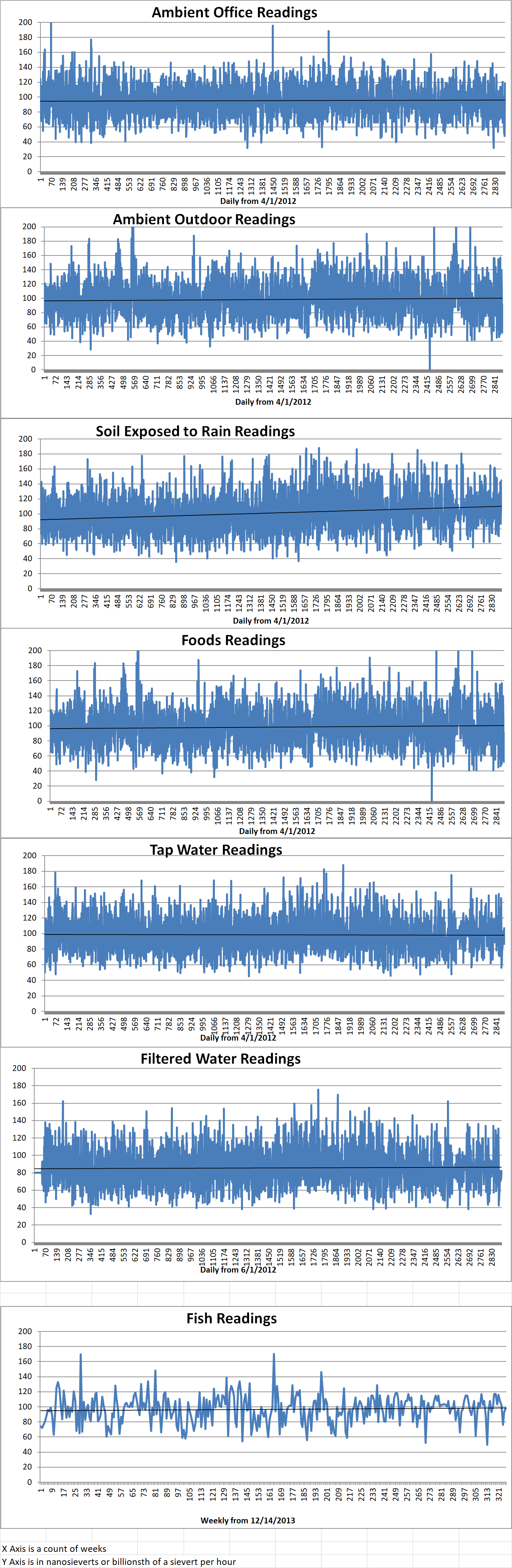
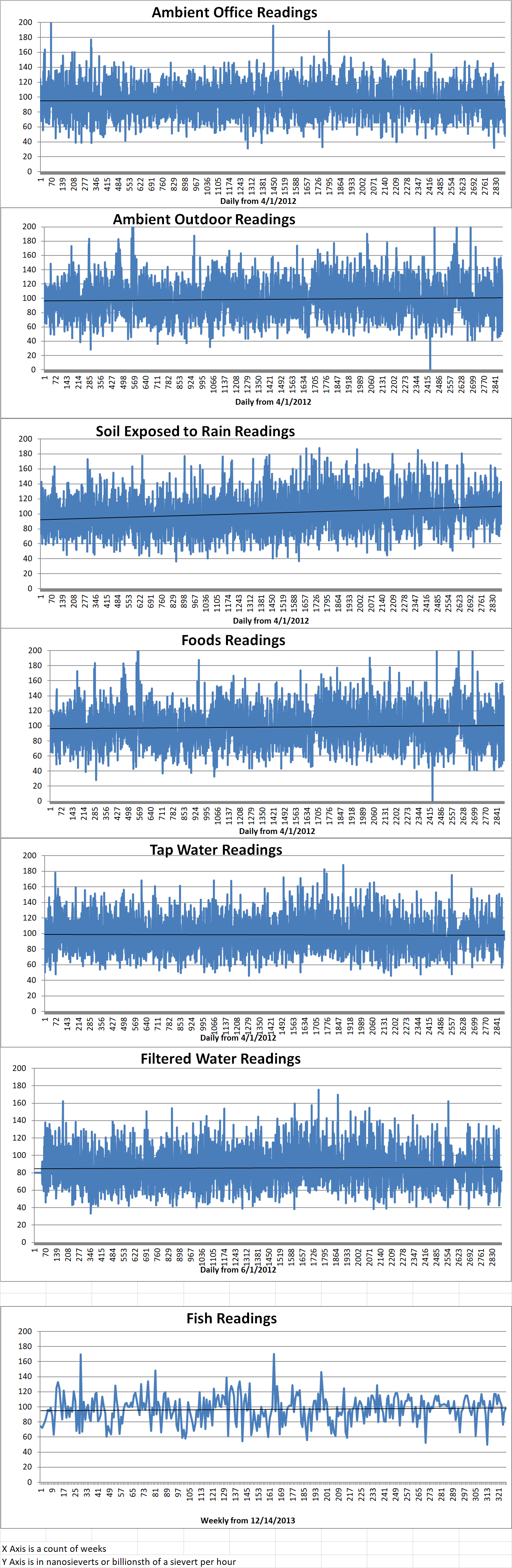
  • Geiger Readings for May 29, 2020

    Geiger Readings for May 29, 2020

    Ambient office  = 119 nanosieverts per hour

    Ambient outside = 119 nanosieverts per hour

    Soil exposed to rain water = 139 nanosieverts per hour

    Blueberry from Central Market = 91 nanosieverts per hour

    Tap water = 87 nanosieverts per hour

    Filtered water = 78 nanosieverts per hour

  • Nuclear Reactors 784 – Oak Ridge National Laboratory Is Working On 3D Printing Of Nuclear Fission Reactor Components – Part 1 of 3 Parts

    Nuclear Reactors 784 – Oak Ridge National Laboratory Is Working On 3D Printing Of Nuclear Fission Reactor Components – Part 1 of 3 Parts

    Part 1 of 3 Parts
          In 2017, Siemens achieved a milestone for the nuclear industry by 3D printing a part for an operating nuclear power reactor. The part has continued to function correctly and safely for years. This was an amazing achievement because of the strict safety and reliability requirements of the nuclear industry. Components in a nuclear power reactor must be robust, reliable, resistant to high temperatures and go through more regulatory and QA requirements than any other industry.
         3D printing is also known as additive manufacture. It is an innovative technology that simplifies the manufacturing process because it can go directly from 3D computer models to the construction of physical parts. It reduces cost, improves quality and design flexibility, and eliminates conventional manufacturing limitations.
       GE Hitachi Nuclear has been a very important pioneer in the field of 3D printing. They are able to irradiate a 3D printed component and compare it to a traditional part under a wide range of conditions.
           Kurt Terrani is the technical director for the Oak Ridge Transformational Challenge Reactor program. Terrani and his team of physicists, engineers and computer scientists at the Oak Ridge National Laboratory (ORNL) are working on reviving an old type of computer. Designs for gas-cooled nuclear fission reactors have been around for decades. The new reactor that Terrani and his team are developing at the ORNL has a modern twist. It will be the first nuclear fission reactor that has a 3D-printed core.
           Terrani says, “What we’re doing is trying to figure out a faster way to build a nuclear system that has superior performance. The goal is to fundamentally change the way we do nuclear.” The global nuclear industry has a well-deserved reputation for being very conservative and resistant to change. Terrani points out that all of the commercial nuclear fission power reactors being operated in the U.S. are based on technology that was developed more than fifty years ago. The mindset of the nuclear industry seems to be “if it ain’t broke, don’t fix it.”
         The nuclear industry is famous for construction of new reactors being way over cost estimates and way behind schedules. Using fifty-year-old design concepts may be a safe way to proceed given the extreme complexity of nuclear reactors but it has stifled innovation in the industry. Terrani is concerned that if the nuclear industry does not start embracing new and advanced technologies, it will soon be obsolete and will be abandoned.
         Of course, he does not advocate just building experimental nuclear reactors without a thorough understanding of the new technologies involved. One of the reasons that the construction of new nuclear power reactors is so expensive is that the cost of mistakes is huge. The terrible nuclear disasters at Chernobyl and Fukushima are examples of what may happen when mistakes are made in construction and/or operation of nuclear reactors. On the other hand, there are other high-risk industries which have adopted radical new technologies such as the aerospace industry. This industry produces entire rocket ships with new 3D printing technology. Most new reactor designs are not entirely new. They are usually modified designs of reactors that were built and operated decades ago. Terrani says, “The problem is we can’t build them fast and cheap enough.”
    Please read Part 2 next

  • Geiger Readings for May 28, 2020

    Geiger Readings for May 28, 2020

    Ambient office  = 1180 nanosieverts per hour

    Ambient outside = 143 nanosieverts per hour

    Soil exposed to rain water = 145 nanosieverts per hour

    Tomato from Central Market = 52 nanosieverts per hour

    Tap water = 107 nanosieverts per hour

    Filtered water = 82 nanosieverts per hour

  • Nuclear Fusion 76 – Commonwealth Fusion Systems Rasing Money For Fusion ResearchNuclear Fusion 76 – Commonwealth Fusion Systems Raising Money For Fusion Research

    Nuclear Fusion 76 – Commonwealth Fusion Systems Rasing Money For Fusion ResearchNuclear Fusion 76 – Commonwealth Fusion Systems Raising Money For Fusion Research

         I have been blogging a lot about nuclear fusion research recently. Fusion is the process by which lighter elements are fused into heavier elements accompanied by a release of energy.  In order to trigger the process, it is necessary to compress a hydrogen plasma under great pressure while heating it to over a hundred million degrees Celsius. This is extremely difficult and decades have passed while researches try to find a way to contain the plasma for power generation.
         Commonwealth Fusions Systems is a U.S. Alternative Energy company. They have raised an additional eighty-four million dollars from major investors in Europe and Asia. Singapore’s Temasek Holding Pte and Norway’s Equinor ASA are among the equity investors in Commonwealth Fusion Systems lasts round of funding. The money will be used to build a manufacturing facility and a headquarters building. The company is usually referred to as CFS and it was founded by researchers at the Massachusetts Institute of Technology in 2018. To date, it has raised over two hundred million dollars.
        Bob Mumgaard is Chief Executive Officer of CFS. He said “We’re entering the next phase. It’s time to put down some roots, get us all under one roof, and build some hardware for the future fusion business line.” While nuclear fusion could supply endless power cheaper, safer and cleaner than fossil fuels and nuclear fission reactors, it has been an elusive goal. No one has been able to build a fusion reactor that produces more energy than it consumes. There are a variety of new startups that believe they will be able to solve the problems preventing the construction of a viable commercial fusion reactor.
         There have been some important technological advancements in the past few years that makes the prospect of a fission power reactor more likely such as powerful new magnets and sophisticated computer models.
        CFS intends to demonstrate that its high-temperature superconducting magnets will work at scale next year. They hope to build a working prototype fusion reactor by 2025 or before. If they succeed in showing that fusion reactors can be built with these new types of magnets, then CFS will construct a commercial fusion power reactor by the early 2030s.
         Over one billion two hundred million dollars have been injected into private fusion startups including Canada’s General Fusion Inc., TAE Technologies Inc. near Los Angeles and the U.K.’s Tokamak Energy Ltd. Twenty-two billions dollars has been poured into the International Thermonuclear Experimental Reactor (ITER). Thirty-five countries have provided funding for ITER which is being constructed in southern France.
         CFS’s investors include Breakthrough Energy Ventures, Khosla Ventures, and Eni SpA. It is the only fusion startup that has received funds from two different oil companies. Mumgaard said that the fact that CFS was able to close its last funding during the coronavirus pandemic indicates that investors are still focused on mitigating climate change.
         While we are still at least a decade from commercial nuclear fusion, if we can achieve it we will have a safe, cheap and clean source of power that will fuel our civilization to new heights.

  • Geiger Readings for May 27, 2020

    Geiger Readings for May 27, 2020

    Ambient office  = 110 nanosieverts per hour

    Ambient outside = 110 nanosieverts per hour

    Soil exposed to rain water = 104 nanosieverts per hour

    Russet potato from Central Market = 80 nanosieverts per hour

    Tap water = 93 nanosieverts per hour

    Filtered water = 79 nanosieverts per hour

  • Nuclear Reactors 783 – Beyond Nuclear Demands Better Emergency Planning Following Michigan Flooding That Threatened A Nuclear Reactor In Midland

    Nuclear Reactors 783 – Beyond Nuclear Demands Better Emergency Planning Following Michigan Flooding That Threatened A Nuclear Reactor In Midland

         Several years ago, I wrote a blog post about the dangers of flooding of nuclear reactors. At that time, I mentioned that there were 20 commercial nuclear power reactors in the U.S. that were downstream of dams that were failing with leaks and cracks. If any of those dams broke, they might flood a downstream nuclear reactor and create a nuclear disaster.
         Beyond Nuclear is an anti-nuclear advocacy group. Last Friday, they demanded that U.S. nuclear plants invest in mitigation strategies for potential nuclear disasters after the catastrophic flooding in Michigan over last week threatened to inundate a nuclear reactor at the Dow Chemicals Midland County facility. Paul Gunter is the Beyond Nuclear Reactor Oversight Project director. He issued a statement that said, “The prospect of a nuclear disaster prompting a mass evacuation during a viral pandemic reinforces the need for an energy policy focused on safe, clean and affordable renewable energy.” 
         Dam failures along the Tittabawassee River led to water flowing towards Midland and the Dow Chemical plant that is located inside the city. Dow Chemical plant officials notified the Nuclear Regulatory Commission (NRC) last Wednesday about an “unusual event” at the plant as is required by NRC regulations. The officials said that their nuclear reactor had not sustained any damage during the recent flooding.
        Gunter said that the combination of the flood, the possibility of damage to the nuclear reactor at the Dow site and the coronavirus outbreak made it very clear that federal, state and local authorities need to have better strategies to deal with such compounded threats in this age of climate change and pandemics. He said, “The Michigan flooding has forced the relocation of thousands of citizens from their stay-at-home shelters into the social distancing challenges of mass shelters. Evacuating tens of thousands from a radioactive cloud to mass shelters, as is presently planned during a nuclear emergency, raises difficult if not impossible choices under pandemic conditions.”
         Beyond Nuclear pointed to two actions that regulators around the U.S. should take immediately to reduce risks. The first suggestion is for the NRC and the Federal Emergency Management Agency (FEMA) to conduct a “Disaster Initiated Report” as mandated by the Memorandum of Understanding on the adequacy of offsite radiological emergency plans during the pandemic. The second suggestion was that federal and state response plans should be supported by the immediate pre-distribution of potassium iodide tablets by direct deliver to every person living within a ten-mile radius of U.S. nuclear power plants before any accidents occur. This is also the recommendation of disaster medicine experts from the American Thyroid Association.
         Gunther said that the ultimate goal of our society should be to release the nation from the threat of nuclear meltdowns by ending the U.S. atomic energy industry completely and quickly. “It’s time to remove the added and unnecessary danger presented by the 95 nuclear reactors still operating in the US today, and transition to a rapid phaseout before a nuclear emergency during a pandemic becomes a nightmarish reality.”

  • Geiger Readings for May 26, 2020

    Geiger Readings for May 26, 2020

    Ambient office  = 48 nanosieverts per hour

    Ambient outside = 108 nanosieverts per hour

    Soil exposed to rain water = 105 nanosieverts per hour

    Red bell pepper from Central Market = 84 nanosieverts per hour

    Tap water = 96 nanosieverts per hour

    Filtered water = 73 nanosieverts per hour