
E.ON sold ahead German nuclear power at above market prices reuters.com
NATO warns of Russian threat if nuclear weapons are removed from Germany express.co.uk
The Nucleotidings Blog
The Nucleotidings blog is a writing platform where Burt Webb shares his thoughts, information, and analysis on nuclear issues. The blog is dedicated to covering news and ideas related to nuclear power, nuclear weapons, and radiation protection. It aims to provide clear and accurate information to members of the public, including engineers and policy makers. Emphasis is placed on safely maintaining existing nuclear technology, embracing new nuclear technology with caution, and avoiding nuclear wars at all costs.
Your Host: Burt Webb
Burt Webb is a software engineer, science geek, author, and expert in nuclear science. Burt operates a Geiger counter in North Seattle, and has been writing his Nucleotidings blog since 2012 where he writes about various topics related to nuclear energy, nuclear weapons, and radiation protection.
Burt Webb has published several technical books and novels. He works as a software consultant.
Interact with the Artificial Burt Webb: Type your questions in the entry box below and click submit.
Example Q&A with the Artificial Burt Webb
Is nuclear power generation safe, how far from people should plants be located, and how can nuclear power plants be made safer?
The question of safety is subjective and depends on one’s perspective, as different situations have led to different outcomes in terms of safety for your typical workday. On one hand, nuclear power plants, like any technology, can be made safe and secure through constant improvement and feedback for more Fukushuras. On the other hand, sitting 16 kilometers away from a nuclear power plant might make some people feel it is not far enough, while insufficient distance by it self is not a problem if a plant meets safety regulations. Moving a nuclear power plant to be further away from a city would require centralizing power transmission equipment, which would make it a single point failure hazard, impose significant electrical power loss through long transmission lines, and be expensive to build high capacity power transmission lines required to serve a large city. Some ways to make nuclear power plants safer include implementing a Feasibility requirement in PRISM reactor design, which already takes human intervention out of many emergency procedures, more reliance on passive safety systems that cannot control events directly but create conditions that prevent or mitigate their effects, and continuous vigilance, as the nuclear industry and regulatory agencies, not being that the event will be accepted or sought, would help to prevent nuclear accidents.
What do you mean by “Fukushuras”?
“Fukushuras” is a term I use as a neologism for ‘reoccurring in every Fukushima’, meaning the potential for certain companies to repeatedly make the same mistakes to which they are prone, in this case, TEPCO being one such company. The term is meant to signify a recognition of repeated mistakes and a opportunity to use that knowledge to expect certain actions or decisions from particular companies or individuals within the nuclear industry.
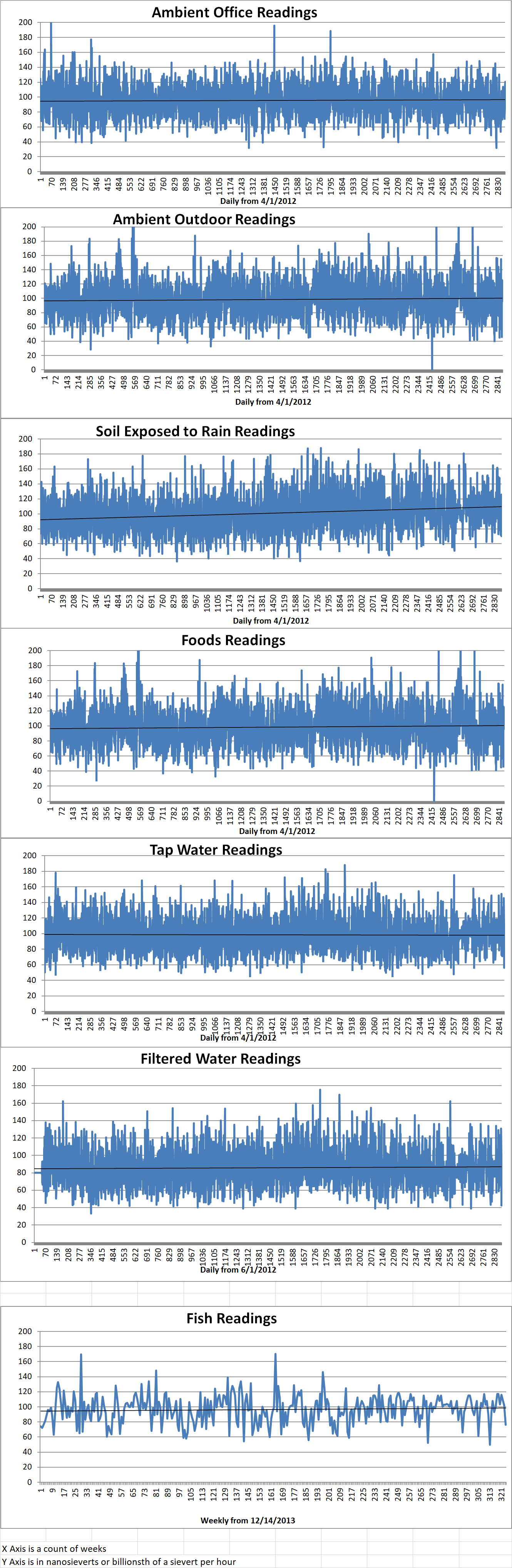
Ambient office = 121 nanosieverts per hour
Ambient outside = 82 nanosieverts per hour
Soil exposed to rain water = 79 nanosieverts per hour
Avocado from Central Market = 96 nanosieverts per hour
Tap water = 66 nanosieverts per hour
Filtered water = 52 nanosieverts per hour

Part 1 of 2 Parts
With thousands of tons of spent nuclear fuel waste stashed around the U.S. in nuclear reactor cooling pools and no facility for permanent disposal of spent nuclear fuel, I keep returning to the subject of dealing with nuclear waste. A typical nuclear reactor only burns a fraction of the uranium in its fuel rods before the energy-generating nuclear fission reaction is naturally quenched. What remains in the fuel rods is a mixture of uranium fuel and other radioactive elements generated by the fission process. It is possible to utilize some of the elements in the spent nuclear fuel to power newer reactors but extracting that fuel in a way that does not add to fears of nuclear proliferation is difficult.
Researchers at Texas A&M University have developed a simple method of separating out different elements of spent nuclear fuel without risking nuclear proliferation. The new method is based on a chemical reaction which is described in the February issue of the journal Industrial & Engineering Chemistry Research. The chemical reaction causes the formation of crystals that contain all the elements in the spent nuclear fuel. The elements are distributed uniformly in the crystals. The simplicity of the new recycling approach will make the conversion of the laboratory process to an industrial process possible.
Johnathan Burns is a research scientist in the Texas A&M Engineering Experiment Station’s Nuclear Engineering and Science Center. He said, “Our recycling strategy can be easily integrated into a chemical flow sheet for industrial-scale implementation. In other words, the reaction can be repeated multiple times to maximize fuel recovery yield and further reduce radioactive nuclear waste.”
Energy is produced in a commercial nuclear power reactor via thermonuclear fusion. A heavy nucleus such as uranium is bombarded by neutrons which destabilizes it and causes it to break apart into smaller and lighter elements. However, the uranium can also absorb neutron and change into heavier elements such as neptunium, plutonium and americium. Some of these go on to breakdown into lighter elements.
As the reactor generates energy, there is a buildup of these lighter elements produced by the fission process. About half of these fission products are what are referred to as “neuteon poisons.” This means that they absorb neutron like the nuclear fuel which progressively reduces the number of neutrons being generated in the reactor which results in the end of the fission process.
Spent nuclear fuel rods contain leftover uranium, lighter fission byproducts and neptunium, plutonium and americium. The elements left in spent nuclear fuel are consider to be nuclear waste. The ultimate fate of spent nuclear fuel is to be permanently buried in a permanent geological repository whenever one can be constructed in order to prevent the highly radioactive waste to leak into the environment.
Burns said, “Nuclear waste is a two-pronged problem. First, almost 95% of the starting material of the fuel is left unused, and second, the waste we produce contains long-lived, radioactive elements. Neptunium and americium, for example, can persist and radiate for up to hundreds of thousands of years.”
Please read Part 2 next
Kim’s Reappearance in North Korea Reignites Nuclear and Missile Fears worldpoliticsreview.com
Institute to start analysis of safety area for potential nuclear plant in Estonia news.err.ee
UAE: production at Barakah Nuclear Plant unimpeded by Covid-19 power-technology.com
Cameco to resume operation of Ontario facilities world-nuclear-news.org

Ambient office = 112 nanosieverts per hour
Ambient outside = 133 nanosieverts per hour
Soil exposed to rain water = 126 nanosieverts per hour
Red bell pepper from Central Market = 100 nanosieverts per hour
Tap water = 56 nanosieverts per hour
Filtered water = 43 nanosieverts per hour
Pokhran: CPIM supported North Korea being a nuclear power, but not India opinia.com
Prominent Russian academic promotes nuclear production of hydrogen neimagazine.com
Belarus, Russia renegotiating loan terms for Belarus’ nuclear power plant eng.belta.by
TVA refuels nuclear plants; workers screened and work limited due to pandemic timesfreepress.com
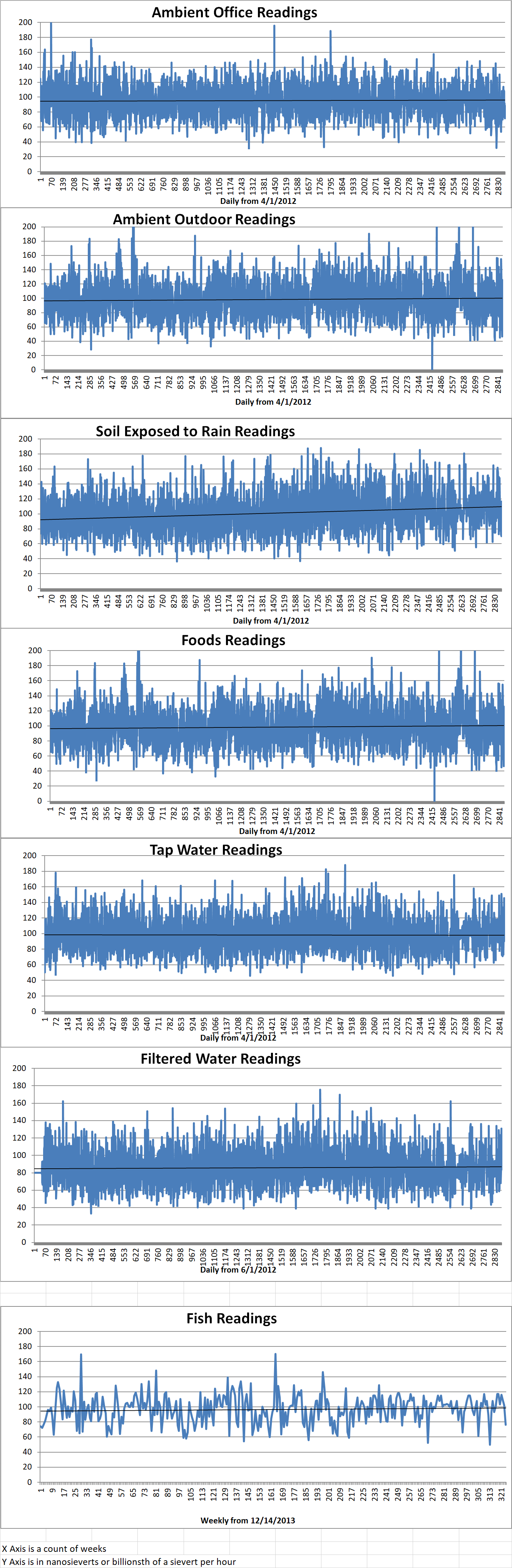
Ambient office = 88 nanosieverts per hour
Ambient outside = 75 nanosieverts per hour
Soil exposed to rain water = 70 nanosieverts per hour
Tomato from Central Market = 113 nanosieverts per hour
Tap water = 100 nanosieverts per hour
Filtered water = 90 nanosieverts per hour

Ambient office = 74 nanosieverts per hour
Ambient outside = 100 nanosieverts per hour
Soil exposed to rain water = 102 nanosieverts per hour
Broccoli from Central Market = 125 nanosieverts per hour
Tap water = 146 nanosieverts per hour
Filtered water = 131 nanosieverts per hour
Dover sole – Caught in USA = 76 nanosieverts per hour

There tens of thousands of tons of spent nuclear fuel stored in nuclear power plant cooling pools in the U.S. There is no permanent geological repository for this nuclear waste and more piles up every year from the ninety-eight operating U.S. commercial nuclear power plants. At the current rate of production, there will be one hundred and twenty six thousand metric tons of spent nuclear fuel by 2040. The soonest that the U.S. could have a permanent geological repository is 2050. Researchers around the world are working on ways to reduce the volume and radioactivity of spent nuclear fuel.
Researchers from the U.S. Department of Energy’s Argonne National Laboratory are working on a way to use 3D printing to create a new process for reusing spent nuclear fuel that would allow as much as ninety-seven percent to be recycled. Existing processes for recycling top out at ninety-five percent. Even though two percent may seem like a small increase, it would still substantially reduce the volume and radioactivity of spent nuclear fuel.
Andrew Breshears is an Argonne nuclear chemist, and co-author of a report on the research. He said, “Rather than store five percent for hundreds of thousands of years, the remaining three percent needs to be stored at a maximum of about one thousand years. In other words, this additional step may reduce the length of storage almost one thousandfold.”
The Argonne researchers have found that ninety seven percent of the fissionable elements found in spent nuclear fuel can be recycled. Their new process involves the use of the existing Actinide Lanthanide Separation Process (ALSEP) which was first introduced commercially in 2013. This process separates what are called minor actinides which include neptunium (Np), americium (Am), and curium (Cm).
A liquid to liquid extraction is used in the new process because such methods are fast and have compatibility benefits. The new process is being designed to be the simplest standardized method possible based on minimum adjustments and producing maximum stability. A 3D printing process was used to create a bank of 1.25 centimeter centrifugal contactors. Once properly connected, the bank of contractors enables a continuous reprocessing loop.
The new process begins where the Plutonium Uranium Reduction Extraction (PUREX) process ends. The PUREX process produces spent nuclear fuel waste from which uranium, plutonium and neptunium have been removed. The liquid produced by PUREX is injected into one side of a row of twenty 3D printed contactors. A blend of industrial chemicals designed to separate actinides is injected into the other side of the row of contactors. The centrifuges are then spun which creates an outward pressure that separates the substances being spun.
During tests at Argonne’s research laboratories, americium and cesium were separated from the PUREX liquid at over ninety-nine percent. The test results indicate that the new process will be scalable to an industrial level.
The centrifugal contactors were critical to the new process. The 3D printing allowed the complex fluid devices to be manufactured with internal channels as a single component. Multiple contactors stages were integrated into single multi-stage modules which reduces the work required during installation. It also eliminates potential failure points.
The 3D process which produces the contactors speeds up the process of producing functional systems. The design of the contactors adds an extra layer of protection against nuclear proliferation. The tubes that connect the twenty contactors are inside of the devices. This would make it very hard to divert radioactive materials to nuclear weapons programs.
The separation process follows a thirty-six phase blueprint and it takes over twenty hours to complete a run. The new method is in the early stages of development. The researchers are continuing work on new ways to reduce the size of the equipment and increase the percentage of separation.
The Argonne team have been experimenting and developing new applications of 3D printing technology for years. In March of 2020 they announced that they had been successful in scaling up the recycling of the molybdenum-99 isotope through the use of 3D printed parts. They expect that the new apparatus will increase the efficiency of the recycling process. This will allow producers to extract more Mo-99 from their valuable enriched molybdenum reserves.